消费电子

Search documents
新华视点|“护娃神器”儿童电话手表真能放心护娃吗?
Xin Hua She· 2026-01-13 06:32
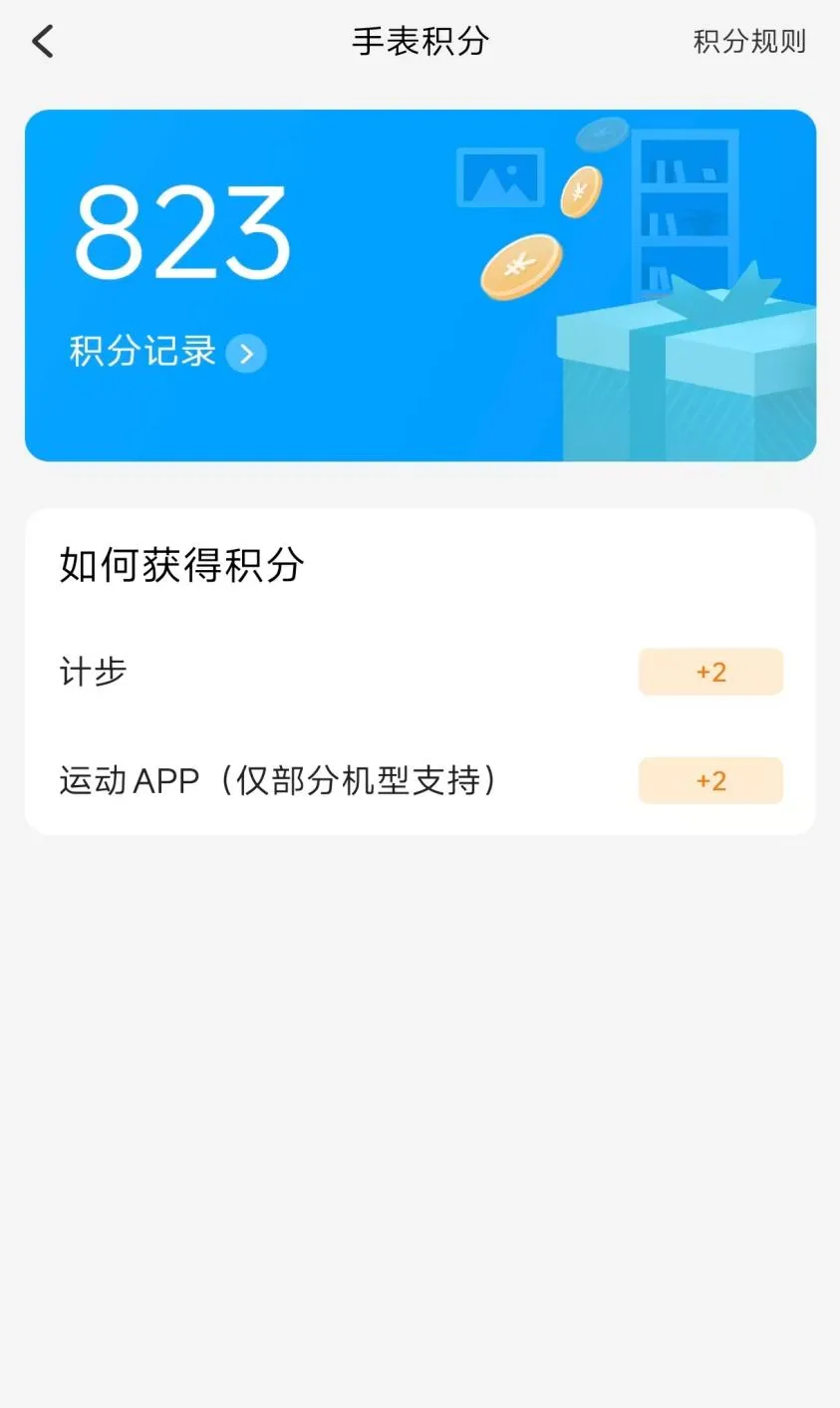
Core Viewpoint - The increasing functionality of children's smartwatches, originally designed for safety, has led to concerns about children's addiction to social features and inappropriate content, raising questions about the balance between safety and convenience [1][8]. Group 1: Social Dynamics and Behavioral Issues - Children are engaging in social comparisons through features like "likes" on their smartwatch profiles, which are seen as symbols of social status among peers [3][6]. - The design of these smartwatches encourages children to spend excessive time on them to earn points and rewards, leading to potential addiction and negative impacts on their social skills and emotional development [6][8]. - Parents report that their children are spending significant amounts of time, sometimes exceeding 10 hours a day, on these devices, focusing on accumulating points and social interactions [6]. Group 2: Safety and Security Concerns - The evolution of children's smartwatches has introduced risks related to information security, as some devices lack adequate safety features, making them vulnerable to data breaches [10]. - There are reports of children being exposed to inappropriate content through these devices, including explicit images and messages from unverified contacts [11]. - The presence of subscription services and in-app purchases has raised concerns about the potential for inducing children to spend money without parental consent [9]. Group 3: Regulatory and Parental Guidance - Experts emphasize the need for stricter regulations on children's electronic products, highlighting that companies should bear greater responsibility for the content provided to minors [19][20]. - Recent initiatives by regulatory bodies aim to address the issues surrounding children's use of smart devices, focusing on content safety and the prevention of addiction [19]. - Collaborative management between parents and schools is recommended to guide children in healthy social interactions and to establish effective rules for device usage [20].

爱建证券:蓝思科技发布前沿应用进展,维持“买入”评级
Xin Lang Cai Jing· 2026-01-13 06:28
Group 1 - The core theme of the report is "defining the physical boundaries of AI," showcasing Lens Technology's comprehensive AI hardware ecosystem at CES 2026 [1] - The company continues to innovate in traditional consumer electronics while increasing capacity in emerging fields such as robotics and server liquid cooling [1] - Lens Technology has established a leading technological position in the cutting-edge commercial aerospace sector [1] Group 2 - The company is expected to leverage its long-standing expertise in material processing and precision manufacturing to advance its business in consumer electronics, robotics, server components, and commercial aerospace [1] - Profit forecasts for the years 2025-2027 are projected at 5.42 billion, 6.71 billion, and 7.93 billion yuan, with corresponding price-to-earnings ratios of 31.1, 25.2, and 21.3 times [1] - The report maintains a "buy" rating and profit forecast for the company [1]

研报掘金丨爱建证券:蓝思科技发布前沿应用进展,维持“买入”评级
Ge Long Hui A P P· 2026-01-13 06:28
爱建证券研报指出,CES2026,蓝思科技以"定义AI的物理边界"为主题,首次系统呈现覆盖全栈式AI硬 件生态布局。认为公司首先在消费电子传统业务领域持续工艺创新,其次在机器人和服务器液冷等新兴 领域加大产能投放,同时公司在前沿的商业航天领域也有了领先的技术布局。持续看好公司立足于自身 在材料加工和精密制造领域的多年沉淀,向消费电子,机器人,服务器零部件和商业航天领域的业务推 进。预计公司25-27年,净利润54.2/67.1/79.3亿元,对应市盈率31.1/25.2/21.3倍。维持"买入"评级和盈利 预测。 ...
开源证券:AI终端开启2026年新周期 聚焦苹果华为及光学PCB等环节
Xin Lang Cai Jing· 2026-01-13 06:28
Core Viewpoint - The report from Kaiyuan Securities highlights that the AI terminal market is set to enter a new cycle in 2026, with a focus on key players like Apple and Huawei, as well as advancements in optical PCB technology [1][5]. Group 1: Industry Performance - The consumer electronics and components industry is expected to see significant performance improvements in 2025, with the PCB sector leading in growth [1][5]. - The overall electronic sector is projected to perform strongly, driven by rapid iterations and bulk shipments of AI products, alongside new product launches and government subsidies boosting demand in the consumer electronics sector [1][5]. - Traditional categories such as smartphones, PCs, and tablets are maintaining stable growth, while AI glasses and AI servers are experiencing rapid growth trends [1][5]. Group 2: AI Terminal Focus - Key investment lines for 2026 include Apple's ecosystem, Huawei's HarmonyOS, AI glasses, and OpenAI's hardware [2][6]. - Apple is positioned as a leader in the global consumer electronics supply chain, with plans to launch new products including the iPhone 17E, foldable iPhone, and AI glasses in 2026, entering a three-year innovation cycle [2][6]. - Huawei is expected to continue releasing new foldable devices in 2025, with its HarmonyOS 6 significantly enhancing user experience through AI capabilities, and increasing domestic component sourcing likely to boost sales [2][6]. - The AI glasses market is anticipated to grow significantly, with companies like Meta driving sales, positioning AI glasses as potential high-volume products [2][6]. - OpenAI's entry into terminal hardware is expected to create popular native AI hardware products from the perspective of AI model manufacturers [2][6]. Group 3: Component Upgrades - Focus areas for component upgrades include optical systems, batteries and fast charging, thermal management, and structural components [3][7]. - Enhanced optical hardware modules are crucial for AI terminals, with ongoing upgrades in mobile optical performance from both Apple and Android manufacturers [3][7]. - The demand for battery life is increasing due to enhanced AI terminal performance, leading to the adoption of new battery technologies such as steel shell batteries and solid-state batteries [3][7]. - Thermal management challenges are intensifying, with Apple expected to implement VC heat spreaders in more models, while Android manufacturers are exploring liquid cooling and micro-fan solutions [3][7]. - Upgrades in display technology are focusing on durability and lightweight designs, with advanced manufacturing techniques like 3D printing and liquid metal processes expected to penetrate more consumer electronics components [3][7]. Group 4: Resonance of AI Computing and Components - The synergy between AI computing and AI terminals is expected to drive an upward cycle for PCBs and passive components [4][8]. - As SoC performance improves and internal integration in smartphones increases, PCBs are evolving towards higher density and precision, with a greater use of flexible printed circuits in foldable devices [4][8]. - The iteration of AI chips is continuously raising the specifications and demand for PCBs, with corresponding upgrades in upstream materials [4][8]. - The increase in power consumption of AI servers is prompting a shift in data center power supply architectures towards high voltage direct current (HVDC) and solid-state transformer (SST) systems, leading to a rise in the use and specifications of various passive components [4][8].

2026年合肥高新区首批高质量项目签约 总投资超100亿元
Xin Lang Cai Jing· 2026-01-13 06:22
Core Insights - Hefei High-tech Zone has made significant progress in promoting the "Industrial Pioneer Zone" construction, with 16 high-quality projects signed and a total investment of 10.67 billion yuan, marking a strong start for the first quarter's investment attraction efforts [1][2] Group 1: Project Highlights - The projects align with national strategic directions and technological development trends, covering key industries such as semiconductor materials and new energy, as well as cutting-edge fields like quantum technology, commercial aerospace, and AI large models [1] - In the semiconductor sector, two major projects worth 1 billion yuan each have been launched, including a power module packaging and testing project expected to generate an annual output value of 1.5 billion yuan and tax revenue of 100 million yuan [1] - The semiconductor defect detection equipment industrial park project aims to overcome the domestic bottleneck in wafer defect detection equipment, promoting self-controllable industrial chains [1] Group 2: AI and Innovation - The Sila Science Computing Center and regional headquarters project will deploy high-performance computing resources focusing on AI foundational models and material simulations, promoting the integration of "artificial intelligence + scientific research" [1] - The Qingting Acoustic R&D production base project aims to produce 1 million directional sound module products annually, leveraging innovative directional sound technology to drive advancements in consumer electronics and smart automotive sectors [1] Group 3: Future Plans - Hefei High-tech Zone will continue to optimize the business environment and enhance project service capabilities, aiming to improve enterprise satisfaction and contribute significantly to the city's high-quality development [2]
Phancy正式推出1300万像素AI智能眼镜
Zheng Quan Shi Bao Wang· 2026-01-13 06:19
Core Viewpoint - Phancy, a consumer electronics brand under Fan Shi Intelligent, has launched AI smart glasses equipped with a 13-megapixel high-definition camera, making it one of the few AI glasses in the industry to achieve high pixel implementation [1] Group 1 - The new AI smart glasses feature a 13-megapixel camera, highlighting advancements in consumer electronics [1] - Phancy's product launch positions the company as a key player in the AI glasses market, which is still developing [1] - The introduction of high-resolution cameras in AI glasses may set a new standard for future products in the industry [1]
消费电子出海国别机会洞察
特易资讯· 2026-01-13 06:10
1. Report Industry Investment Rating No relevant content provided. 2. Core Viewpoints of the Report - The consumer electronics industry will undergo a comprehensive upgrade from products to ecosystems. Technological advancements will make devices smarter and more flexible, and environmental protection will become a key requirement. The global consumer electronics market is rapidly differentiating, with emerging markets presenting new opportunities [64]. - Chinese consumer electronics exports face new development opportunities in 2024, with emerging markets playing an increasingly important role. Green compliance and local production are crucial for companies to break through [4]. 3. Summary by Directory 3.1 China's Overall Consumer Electronics Export Situation - In 2024, China's consumer electronics exports had new opportunities. For example, the total export value of laptops was about $78.8 billion, a year - on - year increase of 4.1%. Chinese consumer electronics led globally with full - industrial - chain advantages and technological iteration capabilities [4]. - Emerging markets such as Southeast Asia, Latin America, and the Middle East had increasing contributions. Smartphones dominated in some emerging markets, while wireless headphones and power banks grew explosively in Africa and Southeast Asia through cross - border e - commerce. Green compliance and local production became key factors for companies [4]. 3.2 Export Statistics of Major Chinese Consumer Electronics from 2022 to June 2025 3.2.1 Smartphones - From 2022 to 2024, the total export value of smartphones decreased slightly from $137.31 billion to $133.08 billion. In the first half of 2025, the main export destinations were Hong Kong, China, the US, and Japan, accounting for 47.7% of the total export volume. Japan and the Netherlands had relatively large export increments [6]. 3.2.2 Tablets - From 2022 to 2024, the total export value of tablets decreased from $30.55 billion to $23.34 billion. In the first half of 2025, the main export destinations were Hong Kong, China, the US, and Japan, accounting for 58.5% of the total export volume. Singapore and Japan had relatively large export increments [9]. 3.2.3 Laptops - From 2022 to 2024, the total export value of laptops decreased and then remained stable, from $95.94 billion to $78.85 billion. In the first half of 2025, the main export destinations were the US, the Netherlands, and Japan, accounting for 43.2% of the total export volume. Japan and India had relatively large export increments [12][15]. 3.2.4 Wireless Headphones - From 2022 to 2024, the total export value of wireless headphones first decreased and then increased, from $10.1 billion to $9.85 billion. In the first half of the 2025, the main export destinations were the US, the Netherlands, and Hong Kong, China, accounting for 42.5% of the total export volume. Australia and Germany had relatively large export increments [18]. 3.2.5 Power Banks - From 2022 to 2024, the total export value of power banks decreased from $2.13 billion to $1.86 billion. In the first half of 2025, the main export destinations were the US, Germany, and the Netherlands, accounting for 22% of the total export volume. Mexico and Thailand had relatively large export increments [21][24]. 3.2.6 Multi - Speaker Speakers - From 2022 to 2024, the total export value of multi - speaker speakers remained stable, slowly decreasing from $4.36 billion to $4.04 billion. In the first half of 2025, the main export destinations were the US, the Netherlands, and Germany, accounting for 35.8% of the total export volume. The Netherlands and Poland had relatively large export increments [27]. 3.3 Analysis of Consumer Electronics Procurement and Supply in Emerging Markets from January to June 2025 3.3.1 Russia - From January to June 2025, there were 156 purchasers, 202 suppliers, 5,900 transactions, and the transaction amount was about $400 million. The average transaction amount per purchaser was $2,589,234, with an average of 37 transactions and an average transaction cycle of 142 days. The average transaction amount per of the top 800 suppliers was $1,971,085, with an average of 27 transactions and an average transaction cycle of 145 days [34]. 3.3.2 Mexico - From January to June 2025, there were 164 purchasers, 316 suppliers, 4,500 transactions, and the transaction amount was about $200 million. The average transaction amount per purchaser was $1,217,639, with an average of 28 transactions and an average transaction cycle of 121 days. The average transaction amount per supplier was $581,756, with an average of 12 transactions and an average transaction cycle of 142 days [37]. 3.3.3 Vietnam - From January to June 2025, there were 1,000 purchasers, 2,000 suppliers, 70,000 transactions, and the transaction amount was about $2.25 billion. The average transaction amount per purchaser was $2,244,470, with an average of 69 transactions and an average transaction cycle of 65 days. The average transaction amount per of the top 1000 suppliers was $2,244,746, with an average of 67 transactions and an average transaction cycle of 64 days [44]. 3.4 Briefing on Relevant Policies for Consumer Electronics Imports in Emerging Markets 3.4.1 Russia - It is the 11th largest economy globally, with a growing consumer electronics market but relying on imports. China is the main source of its consumer electronics imports. It has differential tariff policies, requires EAC certification, and restricts parallel imports. Importers are required to use rubles for settlement [52][58]. 3.4.2 Mexico - It is the second - largest consumer electronics market in Latin America. There is a significant "near - shore manufacturing" trend. It has zero - tariff policies for locally assembled products, and all products need NOM certification. There are also tax incentives for new - energy logistics and solar energy transformation in warehousing [55][56]. 3.4.3 Vietnam - It is the fastest - growing consumer electronics market in Southeast Asia. It has differential tariff policies, requires import model registration, and offers tax incentives for foreign technology companies [60]. 3.5 Future Development of the Global Consumer Electronics Industry - The industry will experience a comprehensive upgrade from products to ecosystems. Technology will make devices smarter, and environmental protection will be a hard requirement. The global market pattern is differentiating, and companies need to adopt different strategies in different markets [64]. 3.6 Appendices - Include the top 50 lists of consumer electronics purchasers in Russia, Mexico, and Vietnam [66][68][70].
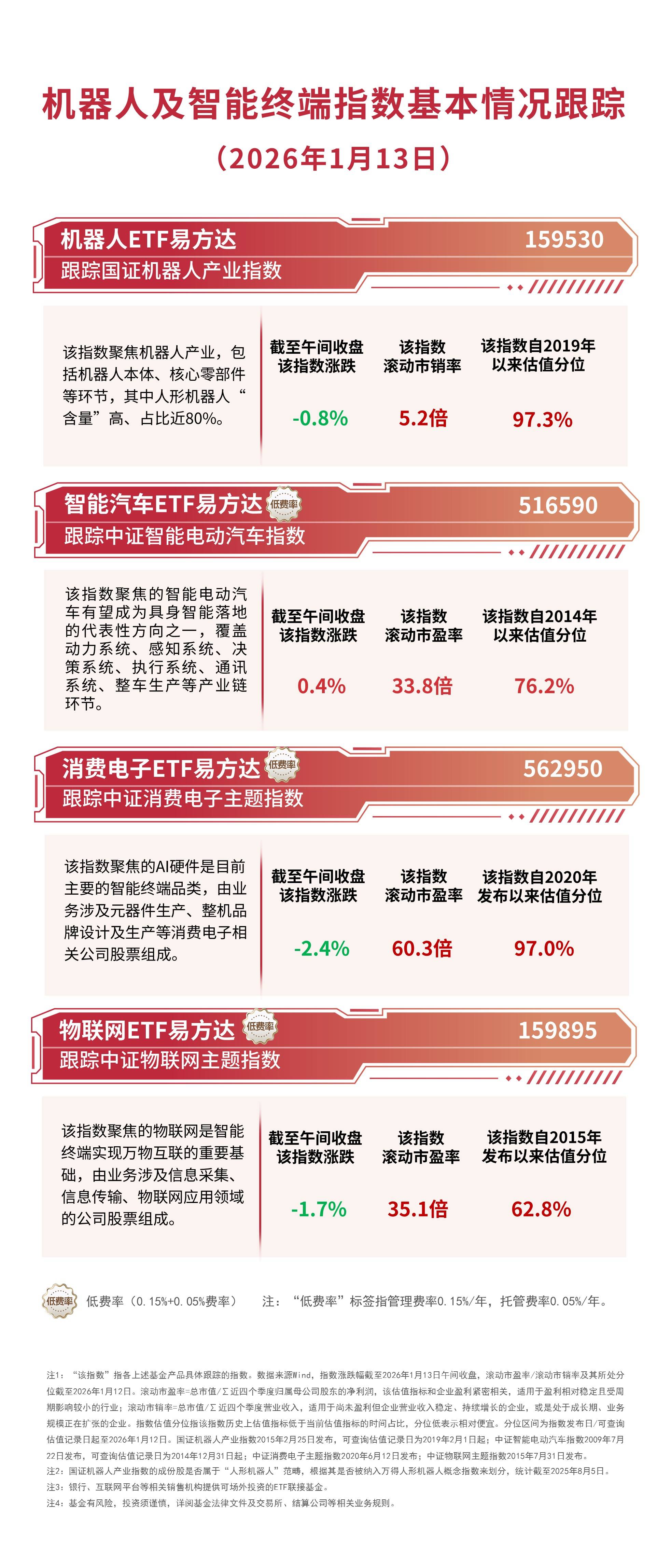
人形机器人板块早盘回调,资金逆势加仓,机器人ETF易方达(159530)半日净申购超3000万份
Sou Hu Cai Jing· 2026-01-13 05:11
Group 1 - The index focuses on smart electric vehicles, which are expected to become a representative direction for embodied intelligence, covering various segments of the industry chain including power systems, perception systems, decision systems, execution systems, communication systems, and vehicle production [2] Group 2 - The E Fund Consumption Electronics ETF tracks the CSI Consumption Electronics Theme Index, which focuses on AI hardware as a major category of smart terminal products, comprising stocks of companies involved in component production, complete machine brand design, and production [4] Group 3 - The E Fund IoT ETF tracks the CSI IoT Theme Index, which has shown a decline of 2.4% as of the midday close [6]

苹果公司服务业务2025年创多项纪录 生态扩张与技术创新驱动增长
Xin Lang Cai Jing· 2026-01-13 04:28
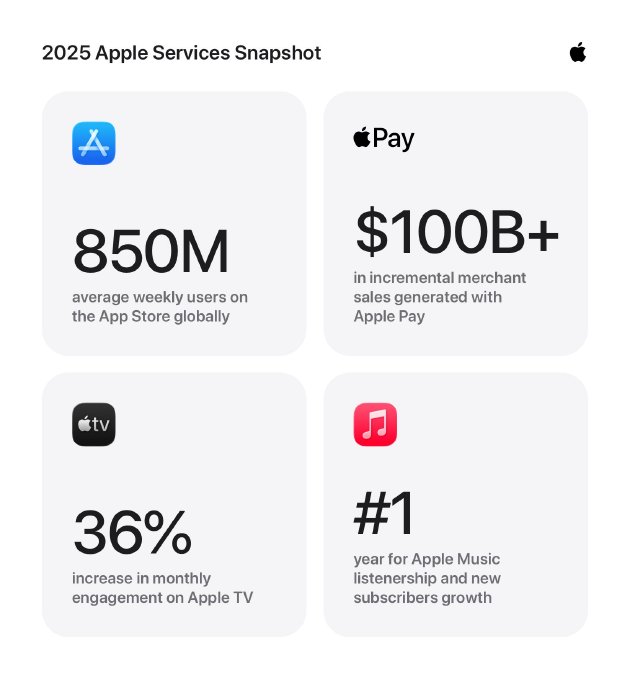
新酷产品第一时间免费试玩,还有众多优质达人分享独到生活经验,快来新浪众测,体验各领域最前 沿、最有趣、最好玩的产品吧~!下载客户端还能获得专享福利哦! 新浪数码讯 1月13日上午消息,苹果公司宣布,其服务业务在 2025 年实现创纪录增长,涵盖 App Store、Apple Music、Apple Pay 等核心服务在内的业务线均刷新关键数据,同时完成全球市场拓展与产 品功能革新的双重突破,这些,都显示了苹果软件生态系统的活力与商业价值。 作为 Apple 服务生态的核心支柱,App Store 在 2025 年展现出强劲的用户粘性与商业潜力。官方数据显 示,全球每周平均有 8.5 亿用户访问该平台,覆盖 175 个国家和地区,其中美国、日本、印度和中国市 场的访问量均创下历史新高。尤其在 2025 年圣诞节至元旦的节日季期间,App Store 的访客量与用户数 字商品消费支出双双打破纪录,效率类、照片视频类应用成为增长主力,Simply Draw: Learn to Draw 等教育类应用亦广受青睐。 开发者生态的繁荣页为 App Store 注入持续动力。自 2008 年上线以来,平台开发者累计收入已 ...
OpenAI的首款硬件:是AI耳机,今年销量要冲5000万
机器之心· 2026-01-13 04:08
Core Viewpoint - OpenAI is venturing into hardware development with a new audio product named "Sweetpea," aimed to compete directly with Apple's AirPods, indicating a significant shift in its business strategy [1][3]. Group 1: Product Details - The "Sweetpea" is designed to replace AirPods and is expected to have an initial production target of 40-50 million units in its first year, compared to Apple's AirPods annual sales of approximately 60-70 million units [3]. - The product features a unique industrial design resembling an eggstone, made from metal, and includes two capsule-like units for wearing behind the ear [3]. - It will utilize a smartphone-grade processor with a 2nm process, likely Samsung's Exynos, enabling local AI processing, and will include a custom chip for Siri control [3][4]. Group 2: Development and Strategy - OpenAI's hardware initiative is a bold attempt to enter the wearable AI market, following its acquisition of the hardware startup io, founded by former Apple chief designer Jony Ive, for $6.5 billion [7]. - The integration of io's team is expected to be completed by July 2025, with a focus on creating a new type of computing device that enhances AI interaction beyond traditional smartphone screens [7]. Group 3: Market Positioning and Expectations - Concerns have been raised regarding the high BOM (Bill of Materials) costs due to the premium materials and specifications, but the device is anticipated to offer superior functionality compared to existing products [4]. - The product's development has garnered excitement among consumers, with many expressing high expectations for its potential to revolutionize the audio device market [6].