
软件服务

Search documents
云学堂上涨8.78%,报0.825美元/股,总市值4956.23万美元
Jin Rong Jie· 2025-08-08 14:09
Core Viewpoint - Yunxuetang (YXT) experienced an 8.78% increase in stock price, reaching $0.825 per share, with a total market capitalization of $49.56 million as of August 8 [1] Financial Performance - For the fiscal year ending December 31, 2024, Yunxuetang reported total revenue of 331 million RMB, a year-on-year decrease of 21.89% [1] - The company recorded a net loss attributable to shareholders of 91.75 million RMB, which represents a year-on-year increase of 58.38% [1] Company Background - Yunxuetang Group Holdings Limited was established in January 2017 under Cayman Islands law and is an exempted limited liability company [1] - The company was renamed from Unicent Century Group Holding Limited in June 2021 [1] - The group operates through subsidiaries and variable interest entities (VIEs), focusing on a SaaS model that integrates software and content to assist clients in digital transformation for corporate learning [1] - The primary business and market of the group are located in the People's Republic of China [1]
智通港股解盘 | 结构问题引发调整 新藏铁路公司成立周期品再起
Zhi Tong Cai Jing· 2025-08-08 13:07
Market Overview - The Hong Kong stock market experienced a decline of 0.89%, attributed to internal structural issues despite positive market sentiment [1] - Concerns about "stagflation" in the US economy were highlighted, with initial jobless claims rising to 226,000, exceeding economists' expectations of 221,000 [1] - The US added 73,000 jobs in July, below the expected 100,000, while the personal consumption expenditure inflation rate rose to 2.6% year-on-year in June, higher than the anticipated 2.5% [1] Company Performance - Crocs projected a revenue decline of 9% to 11% for Q3, leading to a nearly 30% drop in its stock price, marking its lowest point in three years [1] - Semiconductor companies like SMIC and Hua Hong Semiconductor reported better-than-expected Q2 results, with SMIC's Q3 revenue guidance indicating a 5-7% increase and Hua Hong's a 11.3% increase [2] - AI application company Mingyuan Cloud turned a profit of 12.09 million to 15.41 million RMB, recovering from a loss of 115.37 million RMB last year, driven by product optimization and AI technology [3] Sector Insights - The pharmaceutical sector showed mixed results, with companies like Rongchang Bio and Junshi Biosciences seeing stock increases of over 6%, while Hutchison China MediTech's stock fell nearly 16% despite a significant profit increase due to asset sales [3] - The real estate sector in Hong Kong faced caution, with Wharf Holdings expressing a pessimistic outlook on retail rental prospects, resulting in an 8% stock drop [4] - Gold stocks remained strong, with companies like Zhaojin Mining and Shandong Gold benefiting from a weaker dollar [4] Infrastructure Developments - The establishment of the Xinjiang section of the New Tibet Railway, with a total investment of up to 350 billion RMB, is expected to boost related sectors, leading to stock increases in construction companies [4] - The MSCI announced the addition of 14 new stocks to its China index, including companies like 3SBio and Meituan, indicating potential investment opportunities [6] Emerging Technologies - The low Earth orbit satellite launch pace is accelerating, with multiple successful launches planned for the second half of the year, enhancing China's capabilities in satellite communications [7] - Companies like Interstellar Aerospace Technology are developing AI application satellites and aim to capture a significant market share in optical remote sensing satellites by 2028 [8] Individual Company Strategies - Smoore International is focusing on business transformation, with expectations of improved performance in HNB products following successful launches in Japan [9] - The company is diversifying into aerosol technology for beauty and medical applications, positioning 2025 as a critical year for growth [10]
大摩:Shopify(SHOP.US)二季报彰显增长潜力 上调目标价至165美元
Zhi Tong Cai Jing· 2025-08-08 08:46
(原标题:大摩:Shopify(SHOP.US)二季报彰显增长潜力 上调目标价至165美元) 大摩指出,Shopify 在 2025 年第二季度的业绩展示了通过构建多元化的解决方案组合以及扩大分销渠道 来加速营收增长的潜力,尽管存在消费者购买力不确定性、关税背景波动以及最低税额变化等因素的影 响。在本季度,大摩过去两年一直提及的核心增长驱动力推动了 GMV的31%增长,远远超出了投资者 预期的低两位数增长。 智通财经APP获悉,在Shopify(SHOP.US)公布第二季度业绩后,摩根士丹利将其目标价从112美元上调 至165美元,并重申"增持"评级。大摩指出,Q2营收同比增速加速至 31%,这凸显了平台在快速创新与 扩张方面的成果。凭借核心驱动因素,目前其市场份额正在稳步增长,而人工智能、代理商务和广告业 务也在逐步推进。尽管估值较高,但大摩仍看好该股的投资机会。 对于未来实现持久增长的要素,大摩认为,该公司估值偏高——随着今年以来股价涨幅超过 40%,且 当前股价市盈率为 23 倍,相较于大型软件公司的平均水平(15 倍);但大摩坚信,Shopify增长持久性以及 其股价持续上涨的潜力,源于该公司在创新方 ...

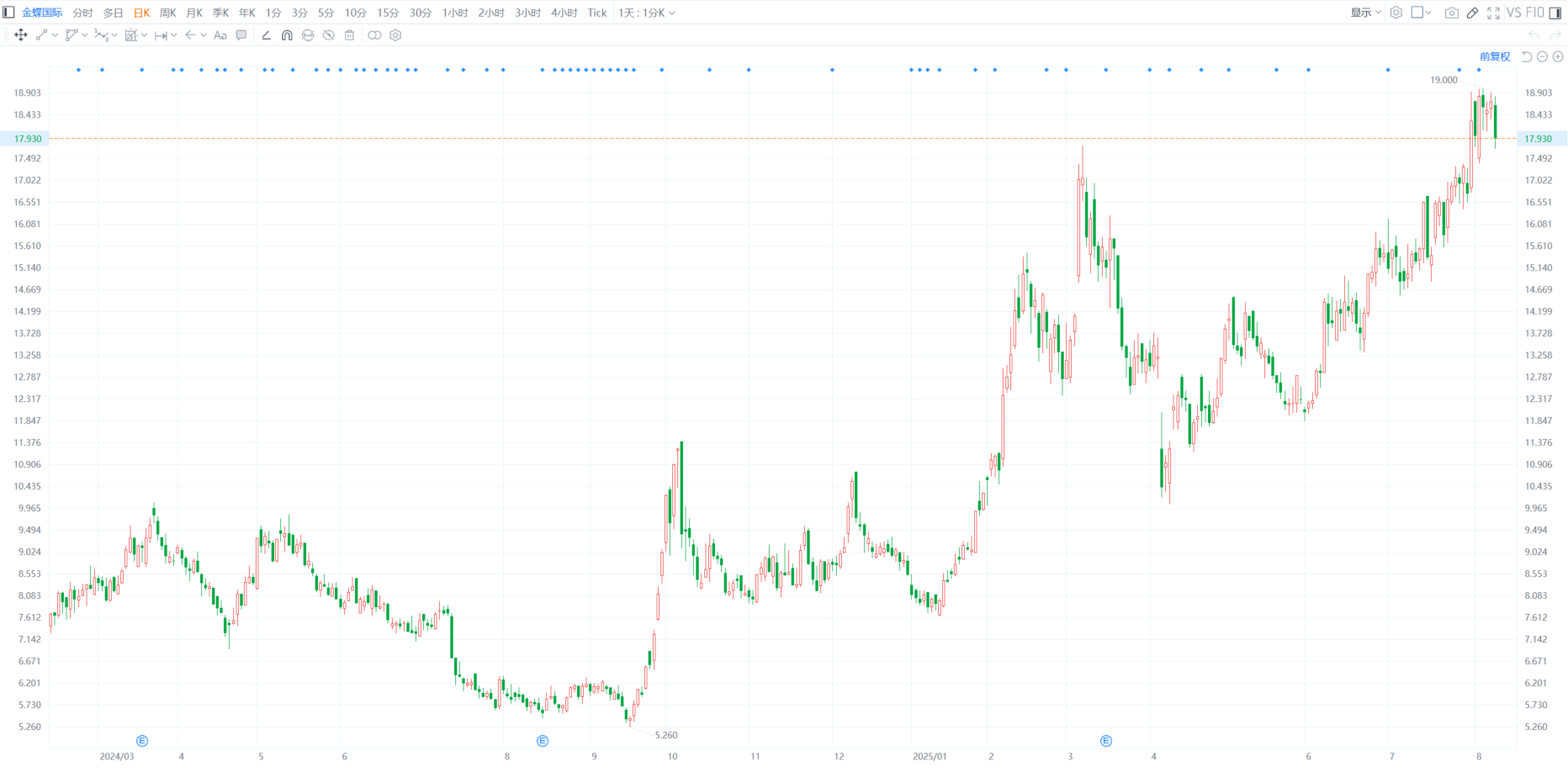
港股异动丨金蝶国际跌逾4% 遭贝莱德减持279.1万股
Ge Long Hui· 2025-08-08 08:03
| 表格序號 | 大股東/董事/最高行政人員名 作出披露的 買入 / 賣出或涉及的 每股的平均價 | | | | | 持有權益的股份數目 佔已發行的有關事件的日 相關法 | | | --- | --- | --- | --- | --- | --- | --- | --- | | | | | 股份數目 | | | (請參閱上述*註 | 有役票權股 期(日/月/ 權益 | | | | | | | | | 份自分比 年) | | | | | | | | | 9/2 | | CS20250807E00249 | BlackRock, Inc. | 1201(L) | | 2,791,000(L | HKD 18.4159 | 211,575,223(L) | 5.96(L)04/08/2025 | | | | | | | | 6,127,000(S) | 0.17(S) | 金蝶国际(0268.HK)现跌4.17%报17.93港元,暂成交6.55亿港元,最新市值636.42亿港元。联交所最新权益披露资料显示,金蝶国际于8月4日遭BlackRock, Inc.以每股均价18.4159港元减持好仓279.1万股,涉资约 ...

科创板收盘播报:科创50指数跌1.39% 医疗保健股表现活跃
Zhong Guo Jin Rong Xin Xi Wang· 2025-08-08 07:52
Market Performance - The Sci-Tech Innovation 50 Index opened lower on August 8 and experienced significant declines, closing at 1043.54 points with a drop of 1.39% and a trading range of 0.94% [1] - The overall Sci-Tech Composite Index fell by 1.04%, ending at 1346.97 points, with a total trading volume of 156.5 billion [1] Stock Performance - Excluding the suspended stock Jin Chengzi, among the remaining 588 stocks on the Sci-Tech board, the average decline was 0.68% with an average turnover rate of 3.46% [1] - High-priced stocks mostly declined, while low-priced stocks showed mixed performance; healthcare and specialized machinery stocks were active, while software services and semiconductor stocks had the largest declines [1] Individual Stock Highlights - Notable gainers included Sainuo Medical and Kewell, which hit the daily limit up; the largest decliner was Anhui Technology, which fell by 10.27% [2] - Semiconductor company SMIC had the highest trading volume at 5.1 billion, while ST Pava had the lowest at 707.2 million [3] Turnover Rate - The stock with the highest turnover rate was Mcland at 23.66%, while Tianneng Co. had the lowest turnover rate at 0.18% [4]
免费CRM的光环与暗坑,企业是否应该使用免费CRM?
Sou Hu Cai Jing· 2025-08-08 04:12
这种"用不久"的根源,在于功能上的"先天不足"。近六成企业抱怨缺少销售流程可视化工具,无法直观追踪客户转化状态;45%的零售企业表示,免费版缺 失自动化营销功能,导致节日促销时手忙脚乱。某电商初创公司甚至直言:"免费版就像一辆卸了轮子的自行车,看着能骑,其实根本跑不起来。" 在数字化转型的热潮中,免费CRM(客户关系管理)软件凭借"零成本"的优势,成了许多中小企业的首选工具。然而,这些"免费午餐"真的能撑起企业的长 远发展吗?2025年最新调研覆盖全国500家中小企业,真实数据揭开免费CRM的光环与暗坑——有些代价,可能比你想象中更贵。 免费CRM:开箱容易,用久艰难 调研数据显示,70%的企业对免费CRM的第一印象是"操作简单""界面友好",尤其适合缺乏技术团队的小微企业快速上手。但热度往往难敌现实:仅有35% 的企业坚持使用超过6个月。一家服装店老板的话很具代表性:"一开始觉得省了钱,但客户资料攒到500个就提示容量不足,发个促销短信还要单独买插 件,不知不觉就掉进坑里。" 免费版常通过客户数量上限、存储空间限制等设定,倒逼企业升级付费。一位用户比喻:"这就像健身房送7天体验卡,但想用储物柜得加钱,想约教 ...

明源云(00909.HK)料中期扭亏为盈 股东应占净利润1209万至1541万元
Jin Rong Jie· 2025-08-08 03:33
本文源自财华网 【财华社讯】明源云(00909.HK)公布,预期截至2025年6月30日止六个月将录得介乎于约人民币1209万 元至人民币1541万元之间的股东应占利润净额,相比2024年同期则录得股东应占亏损净额约人民币1.15 亿元。预期扭亏为盈主要原因为积极优化其现有产品线及客户结构,聚焦核心产品与重点客户,以此削 减对应的开发、销售、运营成本;通过AI技术赋能进一步提升经营效率,人均产出同比大幅提升;及 报告期內受美元兑港币升值影响导致的外汇收益增加。 ...
金蝶国际(00268)下跌5.02%,报17.77元/股
Jin Rong Jie· 2025-08-08 02:24
Core Viewpoint - Kingdee International (00268) experienced a 5.02% drop in stock price, trading at 17.77 HKD per share with a transaction volume of 2.35 billion HKD as of August 8 [1] Company Overview - Kingdee International Software Group Co., Ltd. is a globally recognized enterprise management cloud SaaS company, primarily providing cloud services for Enterprise Resource Planning (ERP) and AI management platforms [1] - According to IDC research data, Kingdee ranks first in the Chinese enterprise resource management cloud service market and has maintained the top position in the Chinese growth enterprise application software market for 19 consecutive years, serving over 7.4 million enterprises and government organizations worldwide [1] Financial Performance - As of the 2024 annual report, Kingdee International reported total revenue of 6.256 billion CNY and a net loss of 142 million CNY [2] Upcoming Events - Kingdee International is set to disclose its mid-year report for the fiscal year 2025 on August 11 [3]
【光大研究每日速递】20250808
光大证券研究· 2025-08-07 23:03
Group 1 - The core viewpoint of the article highlights the performance of various companies in the technology and consumer goods sectors, focusing on their revenue growth and profitability in the first half of 2025 [5][6][8] Group 2 - For萤石网络 (688475.SH), the company reported a revenue of 1.447 billion yuan in Q2 2025, representing a year-over-year increase of 7.48% and a quarter-over-quarter increase of 4.85%. The net profit attributable to shareholders was 164 million yuan, up 4.95% year-over-year and 19.07% quarter-over-quarter [5] - 海康威视 (002415.SZ) experienced a slight revenue decline of 0.5% year-over-year in Q2 2025, but the net profit increased by 14.9%. The overall gross margin for the first half of 2025 was 45.19%, reflecting a 0.35 percentage point increase year-over-year [5] - 亚信科技 (1675.HK) reported a revenue of 2.598 billion yuan for the first half of 2025, a decrease of 13.2% due to pressure on its ICT support business from reduced costs by operators. The company is restructuring its revenue reporting to focus on high-growth areas [6][7] - 海信家电 (000921.SZ) achieved a revenue of 49.34 billion yuan in the first half of 2025, a year-over-year increase of 1.4%. However, Q2 2025 revenue was 24.5 billion yuan, down 2.6% year-over-year, with a net profit of 950 million yuan, down 8.3% [8] - 上美股份 (2145.HK) exceeded expectations with a projected revenue of 4.09 to 4.11 billion yuan for the first half of 2025, representing a year-over-year growth of 16.8% to 17.3%. The net profit is expected to be between 540 million to 560 million yuan, reflecting a growth of 30.9% to 35.8% [8]




隔夜美股 | 三大指数涨跌不一 现货黄金一度突破3400美元关口
智通财经网· 2025-08-07 22:25
Market Overview - The U.S. stock market showed mixed results with the Dow Jones down by 224.48 points (0.51%) closing at 43968.64, while the Nasdaq rose by 73.27 points (0.35%) to 21242.7 [1] - European markets saw the DAX30 index increase by 287.71 points (1.20%) to 24192.24, while the FTSE 100 dropped by 63.14 points (0.69%) to 9101.17 [1] - The Nikkei 225 index in Asia rose by 0.6%, while the KOSPI index saw a slight increase and the Indonesian Composite index fell by 0.15% [2] Commodity Prices - Gold prices increased with spot gold rising by 0.86% to $3398.39 per ounce, while COMEX gold futures rose by 1.12% to $3471.70 per ounce [3] - Crude oil prices fell, with light crude oil futures for September down by $0.47 to $63.88 per barrel (0.73% decline) and Brent crude for October down by $0.46 to $66.43 per barrel (0.69% decline) [2] Cryptocurrency - Bitcoin rose over 2% to $117,263.8, while Ethereum increased by over 5% to $3,873.15 [4] Employment Data - The number of Americans continuing to claim unemployment benefits surged to 1.97 million, the highest level since November 2021, indicating a cooling labor market [5] - Initial claims for unemployment benefits also rose to 226,000, slightly above economists' expectations [5] Corporate News - Trump nominated Stephen Milan to serve on the Federal Reserve Board until January 2026, highlighting his economic expertise [6] - Microsoft announced the integration of OpenAI's GPT-5 into its product ecosystem, enhancing capabilities across various applications [10] - General Motors plans to import lithium iron phosphate (LFP) batteries from China's CATL for its second-generation Chevrolet Bolt EV, despite an 80% tariff imposed by Trump [11]



