
进出口贸易

Search documents
增速全国第一 今年前5个月青海进出口同比增长50.5%
news flash· 2025-06-18 11:48
Core Insights - Qinghai Province's total import and export value reached 2.98 billion yuan in the first five months of this year, marking a 50.5% increase compared to the same period last year, the highest growth rate in the country [1] - The number of private enterprises engaged in import and export activities in Qinghai reached 153, with a total import and export value of 2.59 billion yuan, reflecting an 86.3% year-on-year growth, highlighting the increasing role of private enterprises in the province's foreign trade [1] - Exports to countries involved in the Belt and Road Initiative amounted to 2.46 billion yuan, a year-on-year increase of 68.2%, accounting for 82.6% of Qinghai's total import and export value, indicating a deepening cooperation with these countries [1] Industry Performance - The export of new energy products from Qinghai experienced explosive growth, with a total export value of 1.22 billion yuan in the first five months, representing a year-on-year increase of 16.5 times [1] - Exports of lithium-ion batteries reached 1.15 billion yuan, showing a staggering year-on-year growth of 33.5 times, which has been a major driver of the significant increase in Qinghai's foreign trade [1] - The international competitiveness of Qinghai's agricultural products remains strong, with agricultural exports totaling 260 million yuan, a year-on-year increase of 44.9%, the highest growth rate in the country [1] - Exports of cool-season vegetables increased by 2.1 times year-on-year, while exports of frozen trout and related products grew by 1.3 times, indicating the accelerated release of highland "cold resources" [1]
港商灵活施策应对贸易障碍,香港今年出口增速仍有望达3%!
Nan Fang Du Shi Bao· 2025-06-18 10:38
Core Viewpoint - The Hong Kong Trade Development Council (HKTDC) maintains its forecast for a 3% growth in Hong Kong's exports for the year 2025 despite facing unprecedented global trade uncertainties due to changes in U.S. trade policies under a potential second term for President Trump [1][2]. Group 1: Export Performance and Strategies - Hong Kong exporters are opting to ship goods early in 2025 to avoid the impact of increased tariffs, which is expected to boost export figures at the beginning of the year [4]. - Hong Kong's reliance on the U.S. market is relatively low, with exports to the U.S. accounting for only 6.5% of total merchandise exports in 2024. This is offset by significant increases in exports to ASEAN and the Middle East, which rose by 38.5% and 58.1% respectively [5]. - The diversification of procurement locations by Hong Kong exporters has reduced the impact of U.S. trade policies. Nearly half of the products exported to the U.S. in 2024 were sourced from multiple countries, a significant increase from 15% in 2017 [7]. Group 2: Export Confidence and Industry Outlook - The HKTDC's export confidence index shows positive sentiment in three out of six major industries tracked, with the jewelry industry at 51.6, the watch industry at 52.1, and the production equipment/materials industry at 50.4 [9]. - The HKTDC anticipates that even with adverse trade conditions, Hong Kong's exports are likely to meet the initial forecast of 3% growth due to the factors mentioned above [7].

1至5月四川外贸进出口同比增长7.5%
Xin Hua Cai Jing· 2025-06-18 08:49
Group 1 - The total value of goods trade in Sichuan reached 430.52 billion yuan from January to May this year, maintaining the 8th position nationally, with a year-on-year growth of 7.5% [1] - Exports amounted to 263.17 billion yuan, showing a year-on-year increase of 8.7%, while imports were 167.35 billion yuan, with a growth of 5.8% [1] - In May, Sichuan's trade grew by 6.9% year-on-year, with exports increasing by 17.4% [1] Group 2 - Eight cities in Sichuan experienced double-digit growth in foreign trade, with Chengdu's trade reaching 351.53 billion yuan, a 10.4% increase, accounting for 81.7% of the province's total trade [1] - Mianyang and Yibin saw export growth rates of 27.9% and 14%, respectively, driven by their respective advantageous industries [1] - Five other cities, including Neijiang and Zigong, achieved over 20% growth in foreign trade [1] Group 3 - The number of enterprises engaged in import and export activities in Sichuan increased by 8.9% in the first five months, with over 9,000 foreign trade enterprises currently operating [1] - Private enterprises accounted for a total import and export value of 155.02 billion yuan, while state-owned enterprises had 25.69 billion yuan [1] - Foreign-invested enterprises experienced a year-on-year growth of 26.4% in their import and export activities [1] Group 4 - Sichuan's foreign trade has maintained steady growth this year, supported by various policy measures aimed at boosting economic recovery [2] - The provincial government introduced a new set of 21 measures to support foreign trade enterprises, focusing on export credit insurance and international market expansion [2] - Additional measures were launched in April to support leading enterprises in securing orders and expanding international markets, as well as promoting cross-border e-commerce [2]
新疆:前5个月对中亚五国进出口总值超千亿元
Xin Hua Wang· 2025-06-18 07:31
Core Insights - Xinjiang's trade with Central Asian countries has significantly increased, with a total import and export value exceeding 100 billion yuan in the first five months of the year, accounting for 39.4% of China's total trade with these nations [1][2] - The export of agricultural products from Xinjiang to Central Asia has diversified, with a notable 100.1% year-on-year increase in agricultural exports, reaching 4.47 billion yuan [1] - The region's ports have shown impressive growth in trade volume, with specific ports like Yilkihtan and Turgart reporting increases of 66% and 53.4% respectively in cargo volume [2] Trade and Economic Cooperation - The "Belt and Road" initiative has driven the growth of Xinjiang's agricultural imports and exports, with companies like Ivan Import and Export Trade Co. increasing their imports of sunflower seed oil and honey significantly [1] - The Urumqi Customs has been proactive in enhancing the quality and safety management of exported agricultural products, aiming to improve the efficiency of customs clearance [2] - The establishment of free trade zones and comprehensive bonded zones in Xinjiang is expected to further facilitate trade growth with Central Asian countries [2]
前5个月北京地区进出口约1.27万亿元
Zhong Guo Xin Wen Wang· 2025-06-17 16:14
Group 1 - The total import and export value of Beijing in the first five months reached 12,667 billion RMB, with exports amounting to 2,508.5 billion RMB, reflecting a year-on-year growth of 2.8% [1] - Private enterprises in Beijing contributed 1,711.4 billion RMB to the import and export total, marking a growth of 3.3% and accounting for 13.5% of the total, an increase of 2.8 percentage points compared to the same period last year [1] - Exports to countries involved in the Belt and Road Initiative accounted for over 60% of the total, with a value of 7,700.3 billion RMB, an increase of 2.5 percentage points year-on-year [1] Group 2 - The export value from Beijing's Free Trade Zone reached 375.9 billion RMB, growing by 7.1%, while the Beijing Economic and Technological Development Zone saw exports of 260 billion RMB, an 18.1% increase [2] - The import of consumer goods in Beijing showed steady growth, with a notable increase in the proportion of art imports and a significant rise in food imports [2]
5月经济运行的复合节奏
BOCOM International· 2025-06-17 13:45
Economic Overview - China's economic data for May 2025 shows structural differentiation, with consumer market recovery being the most significant highlight, as retail sales grew by 6.4% year-on-year, the highest this year, driven by policies like "trade-in for new" and holiday promotions [1][3] - Industrial production growth moderated to 5.8%, influenced by external factors, but high-tech manufacturing and equipment manufacturing maintained rapid growth around 9% [1][2] - Fixed investment growth slightly slowed, while foreign trade demonstrated resilience, with exports showing some differentiation in products and regions [1][7] Industrial Production - The industrial added value for May increased by 5.8% year-on-year, a decline of 0.3 percentage points from the previous month, primarily due to external factors affecting export delivery values and production-sales ratios [2] - Despite the overall slowdown, equipment manufacturing and high-tech manufacturing sectors grew by 9.0% and 8.6% respectively, indicating a continued trend towards high-end and intelligent manufacturing [2] Consumer Market - Retail sales in May saw a year-on-year increase of 6.4%, significantly exceeding market expectations, driven by the "trade-in for new" policy, concentrated consumption during the May Day holiday, and early promotions for the "618" shopping festival [3] - Categories such as home appliances, communication devices, and cultural office supplies experienced retail growth of 53.0%, 33.0%, and 30.5% respectively, showcasing the effectiveness of policy stimuli [3] Fixed Asset Investment - From January to May, fixed asset investment grew by 3.7% year-on-year, influenced by a moderate decline in manufacturing investment and real estate investment [5] - Manufacturing investment increased by 8.5%, reflecting a slowdown due to external uncertainties and declining capacity utilization rates, indicating potential for improved corporate investment sentiment [5] Real Estate Market - Real estate development investment in May decreased by 12% year-on-year, with new housing sales area and sales value declining by 3.3% and 5.9% respectively [6] - Recent government meetings have emphasized the need for stronger measures to stabilize the real estate market, with ongoing policy adjustments expected to support recovery [6] Foreign Trade - Exports in May grew by 4.8% year-on-year, a decrease from the previous month's 8.1%, affected by external demand fluctuations and high base effects [7] - High-tech products like machinery and electronics continued to show resilience, with exports of integrated circuits, automobiles, and ships growing by 35.4%, 13.8%, and 43.7% respectively [7][44] Financial Data - In May, the social financing scale increased by 2.29 trillion yuan, reflecting a year-on-year increase of 2.248 billion yuan, primarily driven by government bonds and direct financing [8] - The M2 money supply grew by 7.9% year-on-year, indicating marginal improvements in market liquidity, while new RMB loans totaled 620 billion yuan, with corporate loans accounting for nearly 530 billion yuan [8][39]
不再是美国,中国第一大贸易伙伴变了,是谁上位了?
Sou Hu Cai Jing· 2025-06-17 04:19
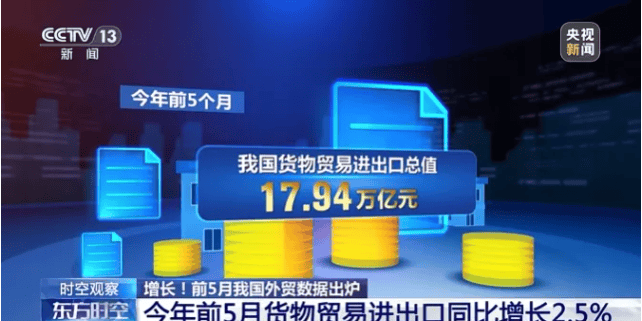
Core Insights - China's overall trade performance in the first five months of 2025 shows a steady recovery, with total import and export value reaching 17.94 trillion yuan, a year-on-year increase of 2.5% [1][3] - Exports amounted to 10.67 trillion yuan, growing by 7.2%, while imports were 7.27 trillion yuan, reflecting a decline of 3.8% [1] Trade Partners - ASEAN remains China's largest trading partner, with a trade value of 3.02 trillion yuan, marking a significant growth of 9.1% [1][6] - The EU ranks second with a trade value of 2.3 trillion yuan, up by 2.9%, while the US has fallen to third place with a trade value of 1.72 trillion yuan, down by 8.1% [1][5] Export and Import Dynamics - In the first five months, exports to ASEAN reached 1.9 trillion yuan, increasing by 13.5%, while imports from ASEAN were 1.12 trillion yuan, up by 2.3% [6] - Notable growth in exports was observed towards Germany (12.3% increase), India (15.1% increase), and Africa (18.9% increase) [5][6] Product Structure and Market Opportunities - The main products exported to ASEAN include electromechanical products, textiles, steel, and chemical products, indicating a diverse demand structure [6][7] - Vietnam, as the largest trading partner within ASEAN, saw a 20.2% increase in exports from China, driven by integrated circuits and lithium-ion batteries [7] Economic Context - The ASEAN region, with a population of 686 million and a projected GDP of 3.98 trillion USD in 2024, is positioned as the fifth-largest economy globally, enhancing its significance as a trading partner for China [6][7] - The implementation of the Regional Comprehensive Economic Partnership (RCEP) has facilitated trade by reducing barriers, further strengthening economic ties between China and ASEAN [6][7]
下半年出口展望:抢出口:前置了多少需求
Haitong Securities International· 2025-06-16 13:24
Group 1: Export Trends - The surge in exports since Q4 2024 is linked to preemptive shipping behavior in response to tariff expectations, particularly noted in November 2024 when exports to the U.S. significantly exceeded seasonal norms[7] - By April 2025, the export growth rate was expected to stabilize around 4.7%, despite the impact of preemptive shipping and tariffs[19] - The overall export growth rate is projected to decline slightly in the second half of 2025, with a central tendency around 2.7% due to potential economic downturns in the U.S.[25] Group 2: Impact of Tariffs - Tariff expectations have driven export behaviors, with significant preemptive shipping observed when tariffs were anticipated but not yet implemented[12] - The introduction of a 10% tariff on U.S. and transshipment goods could lead to a maximum decline of 2% in the export growth rate central tendency[25] - The central tendency for exports to the U.S. increased from 1.1% to 2.8%, while exports to transshipment areas rose from 8.5% to 12.7%[18] Group 3: Risks and Considerations - Risks include potential demand shrinkage in the U.S. and other countries due to tariffs, which could lead to an unexpected decline in export growth rates[26] - The report emphasizes that the actual contribution of genuine new orders is significant, with about half of the high export growth rate from November 2024 to April 2025 attributed to real demand rather than preemptive shipping[13]
4月香港商品整体出口货量及进口货量同比分别上升12.3%及13.4%
智通财经网· 2025-06-16 08:56
贸易价格比率指数是根据商品整体出口价格指数与商品进口价格指数的比率计算出来。与2024年同期比 较,这指数在2025年四月上升0.1%,而在2025年首四个月则大致维持不变。 智通财经APP获悉,6月16日,香港特区政府统计处发表4月份对外商品贸易货量及价格统计数字。2025 年四月与2024年四月比较,香港的商品整体出口货量及进口货量分别上升12.3%及13.4%。2025年首四 个月与2024年同期比较,香港的商品整体出口货量及进口货量分别上升9.6%及8.9%。 经季节性调整的数字显示,截至2025年四月为止的三个月与对上三个月比较,商品整体出口货量及进口 货量分别上升10.4%及10.3%。 2025年四月与2024年四月比较,商品整体出口价格及进口价格分别上升2.2%及2.1%。 2025年首四个月与2024年同期比较,商品整体出口价格及进口价格均上升2.0%。 与此同时,来自所有主要供应地的进口价格均上升:韩国(5.3%)、中国台湾省(5.2%)、新加坡(2.4%)、 越南(0.7%)及内地(0.6%)。 2025年四月与2024年四月比较,输往所有主要目的地的整体出口货量均录得升幅:越南(45. ...
中国外贸在复杂环境中稳健前行 前5月民企进出口增7%提升“含新量”
Chang Jiang Shang Bao· 2025-06-16 04:21
Core Viewpoint - China's foreign trade demonstrates strong resilience and vitality amid external pressures, with policies effectively supporting enterprises and achieving both quantity and quality growth in trade [1][2]. Group 1: Trade Performance - In the first five months of this year, China's total goods trade value reached 17.94 trillion yuan, a year-on-year increase of 2.5% [2][4]. - Private enterprises accounted for 10.25 trillion yuan of the total trade, growing by 7% and representing 57.1% of China's foreign trade value, an increase of 2.4 percentage points compared to the same period last year [1][6]. - In May alone, the total goods trade value was 3.81 trillion yuan, reflecting a growth of 2.7% [2]. Group 2: Market Diversification - China's trade with emerging markets has contributed significantly to growth, with imports and exports to Belt and Road countries increasing by 4.2%, ASEAN by 9.1%, and Africa by 12.4% [2][3]. - Trade with African countries reached a historical high, with imports and exports totaling 963.21 billion yuan, accounting for 5.4% of China's total trade [2][3]. Group 3: Product Quality and Innovation - The export of electromechanical products reached 6.4 trillion yuan, a year-on-year increase of 9.3%, making up 60% of total exports [4]. - High-tech and high-value-added products are becoming increasingly competitive, with integrated circuits growing by 18.9% and electric vehicles by 19% [4]. Group 4: Role of Private Enterprises - Private enterprises have become a crucial force in China's foreign trade, with their exports growing by 8% and accounting for 65.4% of total exports [6][7]. - The number of private enterprises engaged in foreign trade has surpassed 609,000, marking a significant increase in their participation [6][7]. Group 5: Government Support and Local Initiatives - The government emphasizes policies to stabilize foreign trade, including financial support and market expansion initiatives [7][8]. - Local governments are actively launching programs to enhance the capabilities of foreign trade enterprises, such as Sichuan's "Hundred Enterprises Navigation" initiative and Shandong's "Ten Thousand Enterprises Going Global" plan [8].