
自动数据处理设备及其零部件

Search documents
中国出口的“HALO”时刻(国金宏观孙永乐)
雪涛宏观笔记· 2026-03-12 06:42
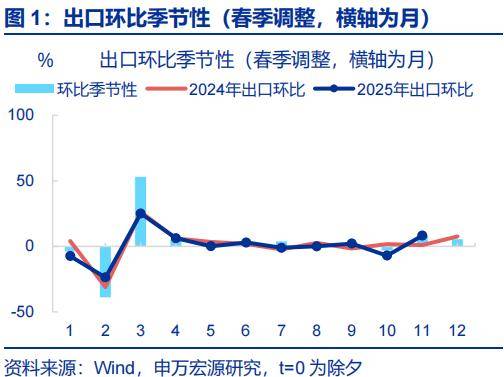
Core Viewpoint - China's AI product exports are experiencing significant growth, supported by the country's industrial chain advantages and the emerging "HALO" trading characteristics, influenced by geopolitical conflicts affecting supply chains [2][15]. Export Data Summary - In January and February, China's exports increased significantly by 21.8% year-on-year, while imports rose by 19.8%. The export growth rates for January and February were 10% and 39.6%, respectively, with the latter exceeding expectations [4]. - The late timing of the Spring Festival and a low base from the previous year contributed to the higher-than-expected export figures. The adjustment after the Spring Festival is estimated to bring February's export growth down to around 10% [4]. - The semiconductor sector led the growth with a 72.6% year-on-year increase in exports, while automatic data processing equipment and its components saw a 20.6% increase, contributing 4.5 percentage points to overall export growth [6]. Price Trends - The demand for AI-related products has led to significant price increases. In January and February, the export price of semiconductors rose by 55.7%, significantly outpacing the 13.7% increase in export volume [6]. - The export price index for electrical machinery and equipment rose from -4% in March 2025 to 5.3% in December 2025, indicating a recovery in pricing [6]. Regional Export Performance - Other East Asian regions also experienced high export growth, with Taiwan, South Korea, and Vietnam seeing increases of 44.5%, 31.3%, and 18.3%, respectively, driven by a high proportion of AI-related products [6][7]. - In contrast, regions with lower AI-related exports, such as India and Australia, reported much lower growth rates of 0.6% and -0.9% in January [7]. Product Category Performance - Various product categories showed significant improvement in export performance, with notable increases in agricultural products (12.1%), finished oil (9.9%), and machinery (27.1%) [8]. - The export of integrated circuits and automatic data processing equipment, both AI-related, saw substantial growth, with integrated circuits alone contributing significantly to Taiwan's and South Korea's export increases [7][8]. Conclusion - The ongoing global AI investment cycle is driving high growth in AI trade, with regions like Taiwan, South Korea, and mainland China benefiting from their high AI trade proportions. China's export growth in semiconductors, new energy, and electronic components reflects its industrial chain advantages and the emerging "HALO" trading characteristics [15].


双轮驱动 构建高质量外贸协同生态
Sou Hu Cai Jing· 2026-01-28 16:47
Core Viewpoint - China's foreign trade is a crucial stabilizer and driver of economic growth, with a total import and export volume reaching 45 trillion yuan in 2025, marking a 3.8% increase from the previous year, and a trade surplus exceeding 850 billion yuan (approximately 120 billion USD) [1][3] Group 1: Economic Impact - The trade surplus of 8.5 trillion yuan supports foreign exchange reserves above 3.4 trillion USD, providing a solid foundation for macroeconomic stability [3] - Foreign trade activities directly or indirectly support over 190 million jobs and maintain a GDP contribution rate of over 15% [3] Group 2: Industrial Upgrade - Foreign trade enterprises are driving the transition from "manufacturing" to "intelligent manufacturing," with new energy vehicle exports exceeding 1 trillion yuan [4] - The import of high-end technology equipment is increasing domestic R&D investments, with semiconductor manufacturing equipment imports reaching 302 billion yuan, a 7.1% increase [4] Group 3: Financial Services - The core foreign trade business, valued at 17.6 trillion yuan, generates significant demand for cross-border settlement, trade financing, and currency hedging [5] - By 2025, cross-border RMB payments under goods trade are expected to reach 7.2 trillion yuan, accounting for 30% of the total, marking a historical high [5] Group 4: Challenges in Financial Services - There is a notable gap in financial services coverage, innovation, and adaptability compared to the high-quality development of foreign trade, which restricts the potential of enterprises to expand internationally [6] - The market share of domestic banks in core foreign trade settlements is only 38%-42%, with foreign banks capturing the majority of high-value business [7] Group 5: Policy and Institutional Framework - The financial service and foreign trade development imbalance is influenced by multiple factors, including policy environment, institutional capabilities, and market conditions [10] - The domestic legal framework needs to align better with international standards, and the credit system for SMEs requires improvement [13] Group 6: Future Pathways - A collaborative ecosystem involving government, financial institutions, enterprises, and industry associations is essential to address the lag in financial services and enhance the synergy between finance and foreign trade [16] - The government should promote long-term policies and cross-departmental collaboration to support foreign trade, while financial institutions need to enhance service capabilities and product innovation [17][18]
双轮驱动,构建高质量外贸协同生态
Di Yi Cai Jing· 2026-01-28 13:10
Core Viewpoint - Financial services in China are lagging in coverage, adaptability, and innovation, which restricts the potential of foreign trade, a key pillar of the economy [1][6]. Group 1: Economic Impact of Foreign Trade - Foreign trade is a stabilizer and driver of China's economy, contributing significantly to GDP and employment, with a trade surplus projected to reach 8.5 trillion yuan (approximately 1.2 trillion USD) by 2025 [1][3]. - Foreign trade activities are expected to directly or indirectly support over 190 million jobs and maintain a GDP contribution rate of over 15% [3]. Group 2: Role of Foreign Trade Enterprises - Foreign trade enterprises are crucial for economic growth and industrial upgrading, demonstrating resilience and continuous innovation amid global changes [2]. - The export of new energy vehicles is projected to exceed 1 trillion yuan, becoming a significant driver in the global market [4]. Group 3: Financial Services Demand - The core foreign trade business, valued at 17.6 trillion yuan, generates substantial financial needs, including cross-border settlement and trade financing, with an estimated trade financing demand of about 4.4 trillion yuan [5]. - By 2025, cross-border RMB transactions are expected to reach 7.2 trillion yuan, accounting for 30% of total goods trade, marking a historical high [5]. Group 4: Challenges in Financial Services - There is a significant gap in financial service coverage, with domestic banks holding only 38%-42% of the core foreign trade settlement market, while foreign banks dominate [7][8]. - Financing support for large state-owned enterprises exceeds 80%, while small and medium-sized enterprises (SMEs) face a financing accessibility rate of less than 40% [9]. Group 5: Root Causes of Inefficiency - The imbalance between financial services and foreign trade development is influenced by policy environment, institutional capabilities, and market conditions [11]. - Domestic banks have limited international presence, particularly in key markets like Europe and the U.S., and lack innovative financial products tailored for foreign trade [12]. Group 6: Path Forward for Collaboration - A multi-faceted support system involving government, financial institutions, enterprises, and industry associations is essential to enhance the synergy between financial services and foreign trade [17]. - The government should promote long-term policies and improve legal frameworks to support foreign trade and financial innovation [18]. - Financial institutions need to optimize service networks and enhance product innovation to meet the diverse needs of foreign trade enterprises [19].
——12月进出口数据点评:再论出口强在中游:2026机电出口或延续景气
Huachuang Securities· 2026-01-15 08:43
Group 1: December Export Performance - In December, China's exports increased by 6.6% year-on-year, exceeding the expected 3% and the previous month's 5.9%[1] - The export growth rate in December was supported by four categories of electromechanical products: mobile phones, computers, vehicles, and integrated circuits[3] - Mobile phone exports in December saw a 10.5% increase in value, driven primarily by a low base effect from the previous year[15] Group 2: Key Product Insights - New energy vehicle exports reached 273,000 units in December, marking a 119.8% year-on-year increase, contributing significantly to overall vehicle export growth[20] - Integrated circuit exports surged by 48% year-on-year in December, benefiting from increased demand for technology imports driven by AI investments in developed markets[24] - Exports of computer parts showed strong performance, with a 36.6% year-on-year increase in November, while the overall equipment export remained weak[28] Group 3: Future Outlook for 2026 - The outlook for 2026 suggests continued strength in the midstream sector, supported by favorable product structures across electromechanical categories[49] - The overseas gross profit margin for midstream manufacturing has surpassed domestic margins, indicating improved competitiveness of Chinese products in international markets[59] - The share of intermediate goods in China's exports has risen from 41.8% in 2017 to 47.4% in 2025, while the share of consumer goods has declined from 36.6% to 28.8%[42]
前11月陕西外贸进出口总值超去年全年 同比增长13.7%
Shan Xi Ri Bao· 2025-12-22 08:15
Core Insights - Shaanxi's total import and export value from January to November reached 472.04 billion yuan, exceeding last year's total and showing a year-on-year growth of 13.7%, ranking sixth nationwide, and surpassing the national average growth rate of 10.1% [1] Group 1: Trade Performance - Exports amounted to 326.7 billion yuan, reflecting a year-on-year increase of 16.6% [1] - Imports totaled 145.34 billion yuan, with a year-on-year growth of 7.8% [1] - The trade surplus during this period was 181.36 billion yuan [1] Group 2: Trade by Type - Processing trade, general trade, and bonded logistics all showed growth, with processing trade at 224.34 billion yuan (up 12.7%), general trade at 174.45 billion yuan (up 11.4%), and bonded logistics at 55.67 billion yuan (up 8.8%) [1] Group 3: Regional Trade Partners - Significant growth in trade with Taiwan, with imports and exports reaching 65.03 billion yuan, a year-on-year increase of 71.4% [1] - Trade with ASEAN reached 75.06 billion yuan, with South Korea at 74.19 billion yuan, the EU at 56.3 billion yuan (up 39.1%), Hong Kong at 30.31 billion yuan, and the US at 26.06 billion yuan [1] Group 4: Belt and Road Initiative - Trade with countries involved in the Belt and Road Initiative totaled 254.72 billion yuan, showing a year-on-year growth of 4.4% [1] - Trade with other RCEP countries also grew by 4.4%, reaching 178.36 billion yuan [1] Group 5: Foreign Investment Impact - Foreign-invested enterprises had a notable performance with imports and exports totaling 274.56 billion yuan, a year-on-year increase of 21.6%, accounting for 58.2% of the province's total trade [2] - Private enterprises reported 164.43 billion yuan in trade (up 4%), while state-owned enterprises reached 31.79 billion yuan (up 6.4%) [2] Group 6: Product Categories - Mechanical and electrical products exports were strong at 281.24 billion yuan, up 17.6%, making up 86.1% of total exports [2] - Notable exports included integrated circuits at 127.61 billion yuan, automobiles at 46.37 billion yuan, and solar cells at 14.29 billion yuan [2] - Imports of mechanical and electrical products reached 100.37 billion yuan, with integrated circuits at 63.79 billion yuan and semiconductor manufacturing equipment seeing a dramatic increase of 176.4% to 7.51 billion yuan [2]
【西安】前11月西安进出口总值同比增长17.5%
Shan Xi Ri Bao· 2025-12-20 00:26
Group 1 - The total import and export value of Xi'an reached 442.36 billion yuan in the first 11 months, with a year-on-year growth of 17.5%, surpassing the national growth rate of 13.9% [1] - Exports amounted to 307.69 billion yuan, increasing by 21.3%, while imports were 134.68 billion yuan, up by 9.6%, resulting in a trade surplus of 173.01 billion yuan [1] - In November alone, the import and export value was 47.82 billion yuan, with exports at 33.04 billion yuan and imports at 14.78 billion yuan, reflecting a year-on-year growth of 30.9% [1] Group 2 - Xi'an's trade with South Korea reached 73.18 billion yuan, making it the largest trading partner, followed by ASEAN at 70.3 billion yuan, and the EU at 56.71 billion yuan, which saw a significant growth of 48.2% [2] - The total import and export value with countries along the "Belt and Road" was 236.49 billion yuan, accounting for 53.5% of Xi'an's total trade, with a year-on-year growth of 7.1% [2] - Foreign-invested enterprises contributed significantly to the trade, with a total of 271.43 billion yuan, growing by 23%, while private enterprises had 147.18 billion yuan, up by 6.5% [2] Group 3 - The export scale of Xi'an continues to expand, with electromechanical products accounting for 88.7% of total exports, valued at 273 billion yuan, growing by 20.5% [3] - Integrated circuits exports reached 127.58 billion yuan, increasing by 23.7%, while automotive exports were 45.82 billion yuan, up by 22.4% [3] - Steel exports saw a remarkable growth of 330.4%, totaling 4.34 billion yuan, indicating a strong demand in this sector [3]
前11月陕西外贸进出口总值超去年全年
Shan Xi Ri Bao· 2025-12-12 23:42
Group 1 - The total import and export value of Shaanxi reached 472.04 billion yuan from January to November, exceeding last year's total and showing a year-on-year growth of 13.7%, ranking sixth in the country, and surpassing the national growth rate of 10.1% [1] - Exports amounted to 326.7 billion yuan, with a year-on-year increase of 16.6%, while imports were 145.34 billion yuan, growing by 7.8%, resulting in a trade surplus of 181.36 billion yuan [1] - Processing trade, general trade, and bonded logistics all showed growth, with processing trade at 224.34 billion yuan (up 12.7%), general trade at 174.45 billion yuan (up 11.4%), and bonded logistics at 55.67 billion yuan (up 8.8%) [1] Group 2 - Foreign-invested enterprises saw a significant increase in import and export value, totaling 274.56 billion yuan, a year-on-year growth of 21.6%, accounting for 58.2% of the province's total [2] - Mechanical and electrical products exports grew rapidly, reaching 281.24 billion yuan, a 17.6% increase, making up 86.1% of the province's total exports [2] - Semiconductor manufacturing equipment imports surged, with a total of 7.51 billion yuan, reflecting a year-on-year growth of 176.4% [2]
出口韧性的“来源”?
Sou Hu Cai Jing· 2025-12-09 00:39
Core Viewpoint - The significant rebound in November exports is primarily attributed to the dissipation of short-term supply disruptions rather than an improvement in external demand [2][7][30] Export Analysis - November exports increased by 5.9% year-on-year (YoY) in USD terms, a notable recovery from a decline of 1.1% in October, driven by factors such as increased working days and the reduction of "production rush" effects [2][6][7] - The increase in working days in November (up by 2 days YoY) and the tapering off of the "production rush" phenomenon contributed significantly to the export rebound [2][7] - Exports to emerging economies showed a marked recovery in November, with exports to Africa and Latin America rising by 17.1 percentage points (pct) and 12.8 pct respectively, despite no significant improvement in demand from these regions [2][11] - The export of goods such as food, steel, and auto parts, which had seen significant declines in October, rebounded in November, with respective increases of 34 pct, 18.7 pct, and 13.6 pct [3][18] Import Analysis - Imports also showed a recovery in November, with a YoY increase of 1.9%, up by 0.9 pct from the previous month [3][25] - Processing trade imports surged by 9.2 pct to 13.9%, exceeding previous growth levels, indicating a rebound in supply conditions [3][25] - Major commodities like crude oil and electromechanical products saw improved import growth rates, with crude oil imports increasing by 8.4 pct to 8.1% [3][25][51] Future Outlook - The easing of supply disruptions, combined with ongoing improvements in external demand and China's competitive export advantages, is expected to support exports for the remainder of the year [4][30] - The potential for improved exports to the U.S. is bolstered by the easing of tariffs and the likelihood of inventory replenishment in the U.S. market [4][30] - Continued industrialization in emerging markets is anticipated to drive demand for imported production materials, further supporting China's export of intermediate and capital goods [4][30] Regular Tracking - In November, both exports and imports showed signs of recovery, with notable increases in consumer electronics and light industrial products [5][37] - Capital goods exports exhibited mixed results, with intermediate goods like auto parts and integrated circuits showing growth [5][40] - Exports to non-U.S. developed economies and emerging markets increased, while exports to the U.S. declined [5][47][48]
海关总署:前11个月集成电路出口1.29万亿元 汽车出口8969.1亿元
Cai Jing Wang· 2025-12-08 08:48
Core Viewpoint - The General Administration of Customs reported that in the first 11 months of this year, China's export of electromechanical products reached 14.89 trillion yuan, an increase of 8.8%, accounting for 60.9% of total exports [1] Summary by Category Electromechanical Products - Exports of electromechanical products totaled 14.89 trillion yuan, growing by 8.8% [1] - Automatic data processing equipment and its components accounted for 1.31 trillion yuan, showing a decline of 1.3% [1] - Integrated circuits reached 1.29 trillion yuan, with a significant increase of 25.6% [1] - Automobile exports were valued at 896.91 billion yuan, reflecting a growth of 17.6% [1] Labor-Intensive Products - Exports of labor-intensive products amounted to 3.7 trillion yuan, decreasing by 3.5%, which represents 15.1% of total exports [1] - Exports of clothing and accessories were 987.26 billion yuan, down by 3.7% [1] - Textile exports reached 931.33 billion yuan, with a slight increase of 1.7% [1] - Plastic products exports were valued at 677.6 billion yuan, showing a minor decline of 0.5% [1] Agricultural Products - Agricultural product exports totaled 670.21 billion yuan, marking a growth of 2% [1]
海关总署:前11个月集成电路出口1.29万亿元,增长25.6%
Mei Ri Jing Ji Xin Wen· 2025-12-08 03:12
Core Insights - The General Administration of Customs reported that in the first 11 months, China's export of electromechanical products reached 14.89 trillion yuan, an increase of 8.8%, accounting for 60.9% of total exports [1] Summary by Category Electromechanical Products - Exports of automatic data processing equipment and its components totaled 1.31 trillion yuan, a decrease of 1.3% [1] - Exports of integrated circuits reached 1.29 trillion yuan, an increase of 25.6% [1] - Exports of automobiles amounted to 896.91 billion yuan, an increase of 17.6% [1] Labor-Intensive Products - Exports of labor-intensive products were 3.7 trillion yuan, a decrease of 3.5%, accounting for 15.1% of total exports [1] - Exports of clothing and accessories reached 987.26 billion yuan, a decrease of 3.7% [1] - Exports of textiles totaled 931.33 billion yuan, an increase of 1.7% [1] - Exports of plastic products were 677.6 billion yuan, a decrease of 0.5% [1] Agricultural Products - Exports of agricultural products reached 670.21 billion yuan, an increase of 2% [1]