养殖业

Search documents
中金公司李求索:2026年国际秩序重构与中国产业创新两大因素共振将支持A股表现
Zheng Quan Shi Bao Wang· 2026-01-05 01:37
Group 1 - The core viewpoint is that the restructuring of the international order and China's industrial innovation will resonate in 2026, supporting the performance of A-shares [1] - The market is expected to show a pattern of rising initially and then stabilizing, with increased volatility and valuation uplift in the context of active capital [1] - Three main lines of focus are suggested: 1) Growth sectors such as AI, which is expected to enter the application realization phase, with opportunities in computing power, optical modules, and cloud computing infrastructure, leaning towards domestic directions; application areas include robotics, consumer electronics, intelligent driving, and software applications [1] 2) External demand breakout, focusing on sectors like home appliances, construction machinery, commercial buses, power grid equipment, gaming, and globally priced resources like non-ferrous metals, in line with the trend of going abroad and exposure to the US [1] 3) Cyclical reversal, with attention to sectors nearing improvement inflection points or supported by policies, such as chemicals, aquaculture, and new energy [1] Group 2 - There is an expectation for capital market policies to further promote a "long-term" and "steady" market [2] - The restructuring of the international monetary system and global capital reallocation could further drive the opening of capital markets, such as expanding the range of foreign investment and encouraging the internationalization of Chinese securities firms [2] - The focus is on supporting financing for innovative enterprises and enhancing market inclusivity while optimizing mechanisms for medium- and long-term capital entry, thereby increasing market stability and resilience [2]


两大因素共振 支持A股新年表现
Zheng Quan Shi Bao· 2026-01-04 17:30
Group 1 - The core viewpoint is that the restructuring of international order and China's industrial innovation will support A-share performance in 2026, with a market trend of initial growth followed by stability [1] - The market is expected to see increased volatility and valuation uplift, with a focus on sectors that align with fundamental performance [1] - Three main investment themes are identified: 1) Growth sectors such as AI, which is entering an application phase, with opportunities in computing power, optical modules, and cloud computing infrastructure, particularly in domestic markets; application areas include robotics, consumer electronics, intelligent driving, and software applications [1] 2) External demand breakout, focusing on sectors like home appliances, construction machinery, commercial buses, power grid equipment, gaming, and globally priced resources like non-ferrous metals [1] 3) Cyclical reversal, with attention to sectors nearing improvement in supply-demand dynamics or receiving policy support, such as chemicals, aquaculture, and new energy [1] Group 2 - There is an expectation for capital market policies to further promote a "long-term" and "steady" market environment, which could enhance capital market openness in the context of international monetary system restructuring and global capital reallocation [2] - The company aims to support financing for innovative enterprises and improve market inclusivity while optimizing mechanisms for long-term capital entry, thereby increasing market stability and resilience [2]

农产品月报:出栏节奏分歧,猪价先弱后强-20260104
Hua Tai Qi Huo· 2026-01-04 12:12
1. Report Industry Investment Ratings - The investment rating for the pig market is neutral [4]. - The investment rating for the egg market is cautiously bearish [6]. 2. Core Views of the Report - In the pig market, the price showed a trend of being weak first and then strong in December. The supply and demand situation in January is complex, with both supply and demand increasing in the middle and late January, and attention should be paid to the price game. The supply in the first quarter of this year is relatively sufficient [1][2][3]. - In the egg market, the spot price fluctuated in the first half - month, declined rapidly after the Winter Solstice, and rebounded slightly at the end of the month. The supply pressure remains high, and the demand support during festivals is less than expected. The current egg market is in a seasonal consumption off - season with over - capacity [4][5]. 3. Summary by Relevant Catalogs Pig Market Market News and Important Data - Futures: On December 31, 2025, the closing price of the live hog 2603 contract was 11,795 yuan/ton, up 545 yuan/ton from the previous month, a rise of 4.84% [1]. - Spot: The ex - ternary live hog prices in Henan, Jiangsu, and Sichuan were 11.67 yuan/kg, 11.90 yuan/kg, and 11.94 yuan/kg respectively. The prices in Henan and Jiangsu decreased slightly from the previous month, while that in Sichuan increased. The spot basis in different regions changed accordingly [1]. - Supply: In November, the inventory of breeding sows decreased by 0.37% month - on - month; the elimination volume increased. The inventory of commercial pigs in large - scale farms increased, while that in small and medium - sized farms decreased slightly. In December, the average slaughter weight of live hogs increased slightly [2]. - Demand: In December, the slaughter enterprise's operating rate was 39.44%, an increase of 5.32 percentage points from the previous month [2]. - Inventory: In December, the frozen product storage capacity rate of domestic key slaughter enterprises was 17.91%, a decrease of 0.39 percentage points [2]. Market Analysis - In December, the pig price was weak in the first half and strong in the second half. The supply rhythm of large - scale enterprises was different in the first and second half of the month. The consumption expectation during the Winter Solstice and curing season supported the price. The epidemic situation affected the slaughter structure, but the overall impact on price was controllable. The demand in December was in the seasonal peak, but the fresh sales rate was lower than last year, and the frozen product inventory digestion was not as expected [2][3]. - In January, the planned slaughter volume of large - scale enterprises is not large in the first half, and the tight supply of large hogs may be alleviated in the second half. The demand has pre - festival stocking support, but it is difficult to form a concentrated demand. The supply in the first quarter is relatively sufficient [3]. Strategy - The strategy for the pig market is neutral [4]. Egg Market Market News and Important Data - Futures: The closing price of the egg futures main 2603 contract last month was 2,951 yuan/500 kg, a decrease of 160 yuan from the previous month, a decline of 5.14% [4]. - Spot: The egg spot prices in Liaoning, Hebei, and Shandong increased from the previous month, and the spot basis also changed accordingly [4]. - Supply: In December, the inventory of laying hens decreased by 0.92% month - on - month, and the elimination volume of old hens increased. The average elimination age decreased [4]. - Demand: The arrival volume in Beijing and Guangdong markets increased. The production - link and circulation - link inventories decreased [4]. Market Analysis - The egg spot price fluctuated in the first half of the month, declined rapidly after the Winter Solstice, and rebounded slightly at the end of the month. The supply pressure decreased but was still at a high level. The demand support during festivals was less than expected, and the egg market was in a seasonal consumption off - season with over - capacity [5]. Strategy - The strategy for the egg market is cautiously bearish [6]. Table 1: Breeding Sector Basis - The current basis situation shows different changes in different regions for live hogs and eggs. The basis is expected to strengthen, and the basis strategy suggests that the breeding sector is in a situation of oversupply, and the seasonal consumption support has a stronger boosting effect on live hogs than on eggs. It is recommended to mainly adopt the reverse spread strategy [8].
建好新时代“陇东粮仓”——庆阳市“十四五”时期农业农村高质量发展综述
Xin Lang Cai Jing· 2026-01-04 01:28
Core Viewpoint - The article discusses the agricultural and rural development in Qingyang during the "14th Five-Year Plan" period, emphasizing the importance of food security, poverty alleviation, and the promotion of sustainable agricultural practices to support high-quality economic growth [5][14]. Summary by Sections Food Security Enhancement - The city has implemented the strategy of "storing grain in the ground and technology," leading to significant improvements in grain production capacity. A total of 3.2625 million acres of high-standard farmland have been established, and the comprehensive mechanization rate for major crops has reached 80.4% [6]. - In the first nine months of 2025, the grain sowing area reached 6.0111 million acres, exceeding the provincial target of 5.91 million acres, with a total grain production of 1.5 million tons [6]. Poverty Alleviation Achievements - Qingyang has successfully eradicated absolute poverty, with a poverty incidence rate dropping from 26.58% in 2013 to zero by 2020. The city has implemented various policies to prevent a return to poverty, with a total of 2.0802464 billion yuan allocated for poverty alleviation projects [7][8]. - The city has achieved a 100% insurance coverage rate for low-income and formerly impoverished populations, and significant improvements in rural infrastructure have been made [8]. Sustainable Agricultural Practices - The "three-dimensional dual-cycle" agricultural model promotes the recycling of waste between planting, breeding, and mushroom industries, enhancing resource support for agricultural development and reducing pollution [9][10]. - The livestock population has shown steady growth, with significant increases in the number of cattle, sheep, pigs, and chickens, alongside a remarkable 146% increase in edible mushroom production [10]. Expansion of Specialty Industries - The city is focusing on developing five major agricultural industry clusters, including beef, mutton, pork, chicken, and apples, with 389 agricultural industrialization leading enterprises established [11][12]. - The overall agricultural product processing rate has reached 63%, and the total output value of advantageous specialty industries has surpassed 50 billion yuan [12]. Rural Development Initiatives - The city has implemented various rural construction actions, achieving a sanitation toilet coverage rate of 94.24% and improving rural infrastructure significantly [13]. - The overall rural environment has improved, with increased public satisfaction and happiness among residents [13]. Future Outlook - Looking ahead to the "15th Five-Year Plan," Qingyang aims to further enhance agricultural strength, rural beauty, and farmer prosperity, revitalizing the "East Long Grain Warehouse" [15].

抱团发展走出生态致富路
Xin Lang Cai Jing· 2026-01-03 22:20
Core Insights - The article discusses the successful transformation of a previously impoverished village in Inner Mongolia into a self-sustaining community through innovative agricultural practices and cooperative economic models [1][2][3] Group 1: Economic Development Strategies - The village implemented a "hugging cycle" model for collective economic development, focusing on "one piece of land, one stalk, and a group of sheep" [1][2] - The land consolidation strategy involved leasing over 4,000 acres from 170 households, generating an average annual income of approximately 1.2 million yuan [1] - A feed processing plant was established to utilize agricultural straw, reducing environmental impact and providing job opportunities for villagers [2] Group 2: Cooperative Models - A cooperative sheep farming model was created by uniting 14 villages, leading to stable income for farmers and employment for over 140 individuals, with monthly earnings reaching over 4,000 yuan for many [2] - The cooperative structure allows for resource sharing and efficient utilization, creating a "wealth chain" that benefits both the community and the environment [2] Group 3: Skills Training and Employment - The village provided skills training for various practical jobs, helping residents transition from dependency to self-sufficiency [3] - A "guaranteed dividend" mechanism was introduced to support those without skills or labor, enhancing their income through land leasing [3] Group 4: Sustainable Practices - The village has expanded its circular industrial chain by introducing new crops and processing facilities, increasing product value [3] - The integration of ecological farming practices, such as raising free-range chickens and goats, has diversified income sources and improved community wealth [3]
当好“服务员” 为民办实事
Guang Xi Ri Bao· 2026-01-02 04:02
Core Viewpoint - The article highlights the achievements of the Fourth Secretariat Party Branch of the Autonomous Region Government Office in enhancing grassroots party building and improving government operations through focused efforts on major projects and community needs [1] Group 1: Government Initiatives - The Party Branch has concentrated on key responsibilities and major issues, leading to effective operations and new results in government work [1] - The branch has actively engaged in the Guangxi Water Resource Allocation Project, facilitating timely coordination to address construction progress and issues [1] Group 2: Social Welfare and Community Engagement - The branch identified discrepancies in the basic medical insurance subsidy for severely disabled individuals across urban and rural areas, leading to coordinated efforts to unify subsidy standards by 2026 [1] - Initiatives have been taken to involve universities and government agencies in the development of local agriculture and the promotion of intangible cultural heritage products, contributing to rural revitalization [1]
东西问丨穆罕默德·曼苏里:中国实践如何助力保障全球粮食安全?
Zhong Guo Xin Wen Wang· 2026-01-01 08:07
Core Insights - The global food security situation remains severe, with approximately 673 million people facing hunger and 2.3 billion in food insecurity, exacerbated by regional conflicts, extreme weather, and trade barriers [1] - China's practices in ensuring food security and promoting rural revitalization offer valuable insights for the world, particularly as the FAO approaches its 80th anniversary in 2025 [1] Group 1: Effective Practices in Rural Revitalization - The FAO's strategic pillars of "better production, better nutrition, better environment, and better life" align closely with China's rural practices observed during the visit [2] - China demonstrates effective production methods that balance productivity and sustainability, including diverse agricultural practices and livestock farming [2] - There is a strong emphasis on diversified food production, creating job opportunities, and enhancing quality of life through the development of fresh produce and health-related food products [2] - Environmental protection efforts include wetland conservation and the production of green and organic foods, showcasing a commitment to sustainable practices [2] Group 2: Key Characteristics of China's Rural Revitalization - Two notable characteristics of China's rural revitalization are the guiding role of local governments and the entrepreneurial spirit of rural residents [5] - Local governments provide public investment and ensure that development benefits cooperatives and farmers, while also maintaining fair pricing mechanisms [5] - The entrepreneurial drive among rural residents has led to successful local businesses that create jobs and contribute to poverty alleviation [5] Group 3: Investment in Human Capital - Investment in human capital is crucial for sustainable development, yet rural development has often focused more on physical infrastructure than on enhancing human capabilities [8] - Human capital investment includes education, training, and health, which are essential for empowering farmers and entrepreneurs [8] - The FAO has identified six key recommendations for human capital investment, emphasizing the importance of partnerships, inclusive policies, and continuous innovation [9] Group 4: China's Contributions to Global Food Security - China has made significant contributions to global food security, achieving the UN Millennium Development Goal of halving extreme poverty and hunger ahead of the 2030 target [11] - The country has ensured stable supplies of staple foods and maintained abundant availability of various agricultural products, improving national nutrition [11] - China's experience in poverty alleviation and food security serves as a model for other countries, particularly through South-South cooperation initiatives [12]

养殖业板块12月31日跌0.78%,晓鸣股份领跌,主力资金净流出4.17亿元
Zheng Xing Xing Ye Ri Bao· 2025-12-31 08:56
证券之星消息,12月31日养殖业板块较上一交易日下跌0.78%,晓鸣股份领跌。当日上证指数报收于 3968.84,上涨0.09%。深证成指报收于13525.02,下跌0.58%。养殖业板块个股涨跌见下表: | 代码 | 名称 | 收盘价 | 涨跌幅 | 成交量(手) | 成交额(元) | | | --- | --- | --- | --- | --- | --- | --- | | 000048 | 京墓智农 | 17.60 | 2.15% | 33.51万 | | 5.88亿 | | 603717 | 天域生物 | 7.84 | 0.90% | 6.74万 | | 5198.88万 | | 000735 | 罗牛山 | 9.04 | 0.44% | 95.16万 | | 8.57亿 | | 002299 | 圣农发展 | 16.54 | -0.12% | 1 7.39万 | | 1.22亿 | | 300761 | 立华股份 | 20.75 | -0.14% | 5.37万 | | 1.11亿 | | 301116 | 益客食品 | 10.93 | -0.27% | 4.19万 | | 4568.54万 | ...

一块地整好用好,产生多少价值(不掉队 赶上来)
Ren Min Ri Bao· 2025-12-31 00:37
Core Viewpoint - The article discusses the comprehensive land consolidation efforts in Guangxi's Hechi, focusing on transforming fragmented farmland into larger, more productive agricultural areas, which has led to increased income and improved living conditions for local villagers [1][4]. Group 1: Land Consolidation Efforts - The initiative aims to merge small plots of land into larger, more manageable units, improving agricultural productivity and efficiency [1][3]. - The local government has implemented a comprehensive plan to ensure legal compliance and transparency in land ownership and usage during the consolidation process [3]. Group 2: Economic Impact on Villagers - Villagers have expressed initial concerns about losing their land and income during the consolidation, but the government has provided compensation and support during the transition [2][3]. - The consolidation has resulted in a significant increase in rice planting area from 3.75 acres to 1283.25 acres, enhancing food production and economic opportunities [4]. Group 3: Community Engagement and Benefits - The local community has become actively involved in the consolidation process, with clearer rules and visible benefits encouraging participation [4][5]. - The establishment of a labor service company has provided job opportunities for villagers, with individuals earning approximately 3500 yuan per month through local agricultural initiatives [5]. Group 4: Future Prospects - The construction of a water dam has not only improved irrigation but also enhanced tourism potential, with an expected 100,000 visitors by 2025 [6].
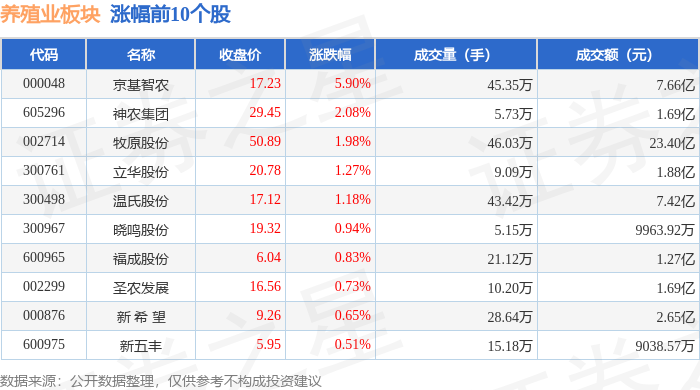
养殖业板块12月30日涨1.15%,京基智农领涨,主力资金净流出2195.12万元
Zheng Xing Xing Ye Ri Bao· 2025-12-30 08:56
Core Viewpoint - The aquaculture sector experienced a rise of 1.15% on December 30, with Jingji Zhino leading the gains, while the overall market showed mixed results with the Shanghai Composite Index closing at 3965.12, unchanged, and the Shenzhen Component Index at 13604.07, up by 0.49% [1]. Group 1: Stock Performance - Jingji Zhino (000048) closed at 17.23, up by 5.90%, with a trading volume of 453,500 shares and a transaction value of 766 million yuan [1]. - Other notable performers included: - Shennong Group (605296) at 29.45, up by 2.08% [1]. - Muyuan Foods (002714) at 50.89, up by 1.98% [1]. - Lihua Co. (300761) at 20.78, up by 1.27% [1]. - Wens Foodstuff Group (300498) at 17.12, up by 1.18% [1]. Group 2: Capital Flow - The aquaculture sector saw a net outflow of 21.95 million yuan from institutional investors, while retail investors contributed a net inflow of 153 million yuan [2]. - The capital flow for key stocks included: - Muyuan Foods (002714) had a net inflow of 1.29 billion yuan from institutional investors, but a net outflow of 104 million yuan from retail investors [3]. - Jingji Zhino (000048) experienced a net inflow of 32.34 million yuan from institutional investors and a net inflow of 43.92 million yuan from retail investors [3]. - New Hope (000876) had a net inflow of 11.87 million yuan from institutional investors [3].