跨境支付

Search documents
A股收评:三大指数涨跌不一,沪指续创10年新高,跨境支付、数字货币板块走高
Ge Long Hui· 2025-08-21 07:11
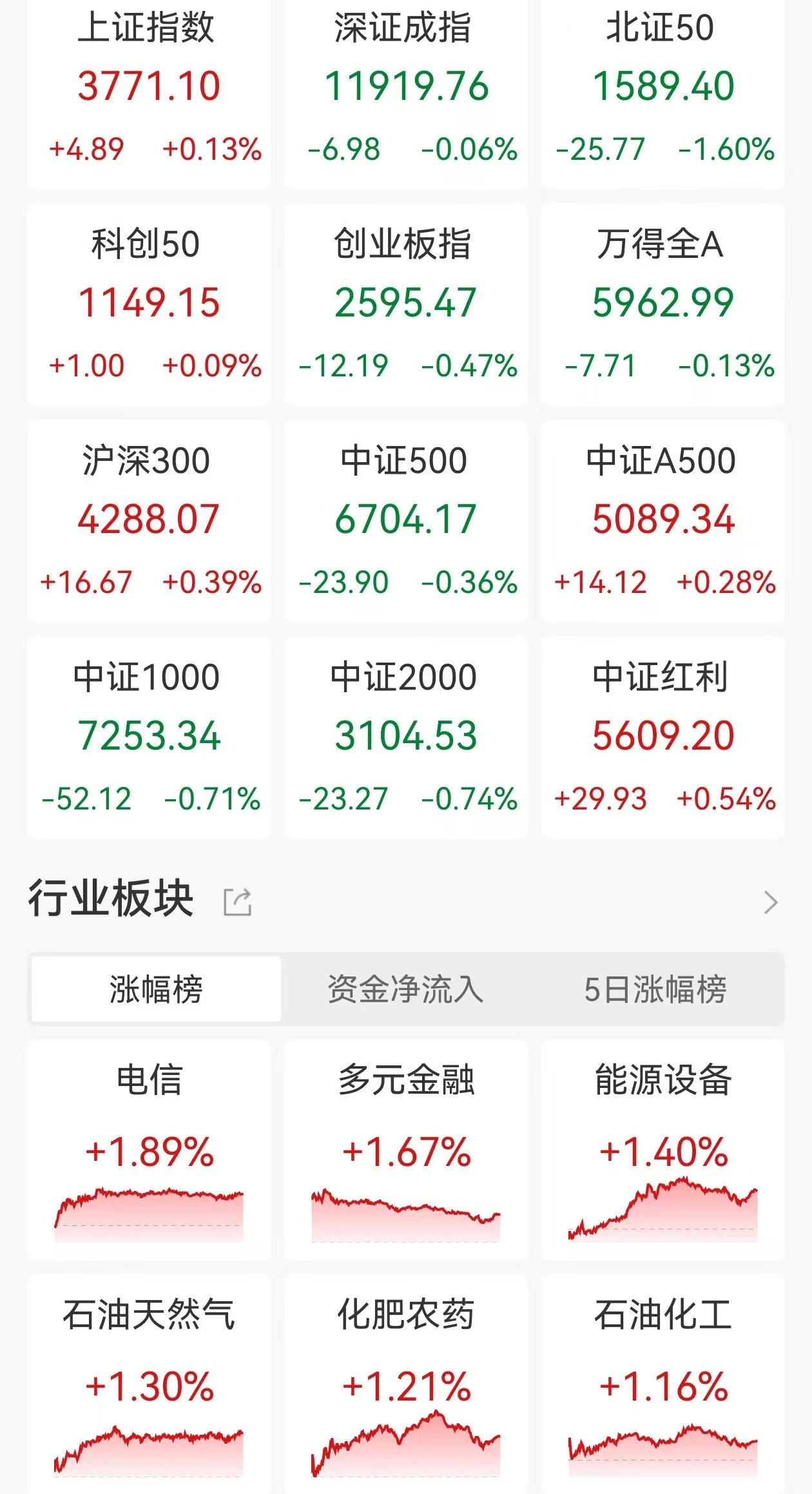
Market Overview - The A-share market showed mixed performance with the Shanghai Composite Index reaching a 10-year high, closing up 0.13% at 3771 points, while the Shenzhen Component Index fell 0.06% and the ChiNext Index dropped 0.47% [1] - The total trading volume for the day was 2.46 trillion yuan, an increase of 11.9 billion yuan compared to the previous trading day, with nearly 3100 stocks declining [1] Sector Performance - The cross-border payment sector experienced a surge, with stocks like Sanwei Xinan and Tianrongxin hitting the daily limit [1] - The combustible ice sector remained strong throughout the day, with ShenKai Co. also reaching the daily limit [1] - The digital currency sector saw gains, with Beixin Source rising by 20% to hit the daily limit [1] - Other sectors with notable gains included petrochemicals, titanium dioxide, electricity, and data security [1] - Conversely, the generator concept faced a downturn, with Weichai Heavy Industry hitting the daily limit down [1] - The liquid cooling concept saw significant declines, with stocks like Chuanrun Co., Feilong Co., and Jintian Co. all hitting the daily limit down [1] - The blade battery and Kirin battery sectors also fell, with Huaguang New Materials dropping over 10% [1] - Sectors with the largest declines included PEEK materials, PCB, and CPO concepts [1] Index Performance - Shanghai Composite Index: 3771.10 (+0.13%) [1] - Shenzhen Component Index: 11919.76 (-0.06%) [1] - ChiNext Index: 2595.47 (-0.47%) [1] - CSI 300 Index: 4288.07 (+0.39%) [1] - CSI 500 Index: 6704.17 (-0.36%) [1] - CSI 1000 Index: 7253.34 (-0.71%) [1] - CSI 2000 Index: 3104.53 (-0.74%) [1]

收评:沪指窄幅震荡收涨0.13% 跨境支付板块全线走强
Xin Lang Cai Jing· 2025-08-21 07:03
Market Overview - The three major A-share indices showed mixed performance, with the Shanghai Composite Index rising by 0.13%, while the Shenzhen Component Index and the ChiNext Index fell by 0.06% and 0.47% respectively [1] - The North China 50 Index experienced a decline of 1.60% [1] - Total trading volume across the Shanghai and Shenzhen markets reached 24,603 billion yuan, an increase of 119 billion yuan compared to the previous day [1] Sector Performance - Over 2,100 stocks in the market saw an increase in their prices [1] - The cross-border payment sector showed strong performance, with companies like Sanwei Xinan and New Morning Technology hitting the daily limit up [1] - The oil and gas exploration and service sector also performed well, with Huai Oil Co. reaching the daily limit up [1] - The combustible ice sector gained traction, with Shen Kai Co. hitting the daily limit up [1] - Conversely, the PCB concept sector weakened, with Chongda Technology hitting the daily limit down [1] - The liquid cooling server sector also faced declines, with Chuanrun Co., Feilong Co., Tenglong Co., and Jintian Co. all hitting the daily limit down [1]
沪指续创十年新高,A500ETF易方达(159361)、沪深300ETF易方达(510310)等助力布局核心资产
Sou Hu Cai Jing· 2025-08-21 05:38
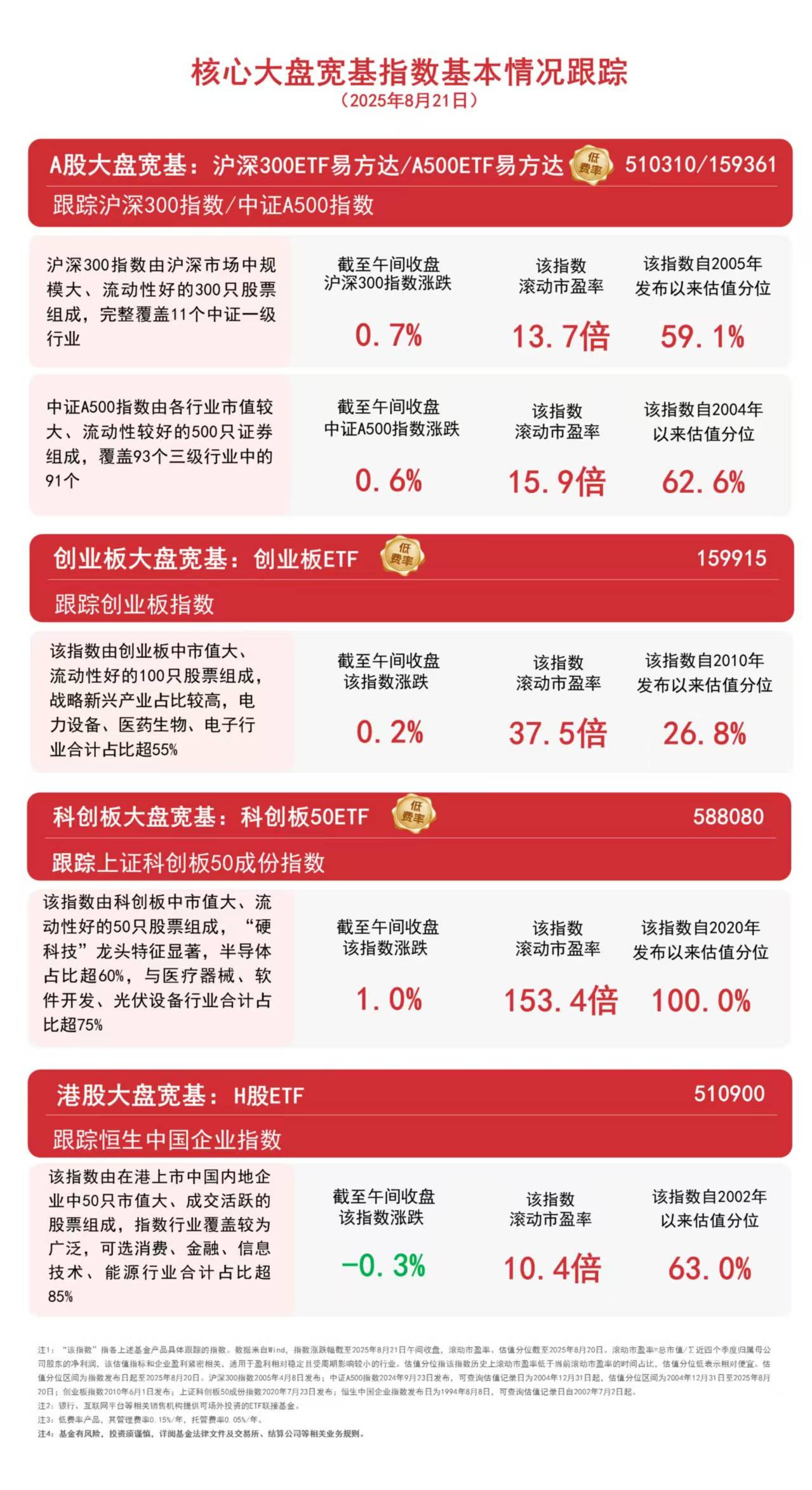
Market Overview - A-shares saw all three major indices rise in early trading, with the Shanghai Composite Index increasing by 0.35%, reaching a ten-year high [1] - The CSI A500 Index rose by 0.6%, the CSI 300 Index increased by 0.7%, the ChiNext Index gained 0.2%, and the STAR Market 50 Index climbed by 1.0% [1] - The Hang Seng Index showed mixed results, with energy and pharmaceutical sectors leading the gains, while the Hang Seng China Enterprises Index fell by 0.3% [1] Sector Performance - Sectors that performed well included cross-border payments, oil and gas extraction and services, and combustible ice [1] - The PCB concept and liquid cooling server sectors experienced adjustments [1]
午评:沪指窄幅震荡涨0.35%续创十年新高 跨境支付板块走强
Xin Lang Cai Jing· 2025-08-21 04:09
Market Overview - The three major indices collectively rose, with the Shanghai Composite Index up by 0.35%, the Shenzhen Component Index up by 0.45%, and the ChiNext Index up by 0.21%. However, the North China 50 Index fell by 0.96% [1] - The total trading volume in the Shanghai, Shenzhen, and Beijing markets reached 1.5912 trillion yuan, an increase of 56.2 billion yuan compared to the previous day. Over 2,500 stocks in the market experienced gains [1] Sector Performance - The cross-border payment, oil and gas exploration and services, and combustible ice sectors showed strong performance, while the PCB concept and liquid cooling server sectors experienced adjustments [2] - The cross-border payment sector was particularly strong, with companies such as Sanwei Xinan and New Morning Technology hitting the daily limit, along with Zhongyou Capital and Tianrongxin also reaching the daily limit [2] - The oil and gas exploration and services sector saw gains, with Huaiyou Co. hitting the daily limit [2] - The combustible ice sector performed well, with companies like Xinjing Power and Shenkai Co. rising over 8% [2] - Conversely, the PCB concept weakened, with Chongda Technology nearing the daily limit down [2] - The liquid cooling server sector also declined, with companies like Tenglong Co. and Jintian Co. hitting the daily limit down [2]


A股早评:沪指高开0.12%续创10年新高 跨境支付概念活跃
Ge Long Hui· 2025-08-21 01:35
Core Viewpoint - The A-share market opened with all three major indices rising, with the Shanghai Composite Index reaching a 10-year high, indicating positive market sentiment and investor confidence [1] Market Performance - The Shanghai Composite Index increased by 0.12% - The Shenzhen Component Index rose by 0.33% - The ChiNext Index gained 0.28% [1] Sector Highlights - The cross-border payment sector saw significant gains, with Tianrongxin hitting the daily limit, and Zhongyou Capital and Sifang Jingchuang both rising over 9% [1] - Brokerage stocks experienced a broad rally, with Zhongyin Securities up over 5%, and Haitou Securities and Dongxing Securities both increasing by over 3% [1] - The photovoltaic equipment sector faced adjustments, with Huamin Co. dropping over 4% and Yamaton falling over 3% [1] - The rare earth permanent magnet sector initially declined, with Jintian Co. down over 8% and Dongfang Zirconium down over 5% [1]
全球化中的「影子世界」
36氪· 2025-08-20 09:31
Core Insights - The article discusses the emergence of a "shadow world" in globalization, highlighting how various Chinese companies have built essential infrastructure that supports global commerce, including logistics, payment, and marketing services [4][5]. Logistics: Time and Space Compression - Companies like Zongteng and Wanyitong have established themselves as key players in cross-border logistics by investing in heavy assets such as overseas warehouses and dedicated transportation routes, which provide competitive advantages in cost and efficiency [9][11]. - Zongteng, founded in 2007, transitioned from e-commerce to logistics, focusing on overseas warehousing and specialized transportation, which allowed it to thrive during the e-commerce boom [8][10]. - Wanyitong has also adapted by investing in automated warehouses and self-built routes to enhance delivery efficiency, achieving a 95% order delivery rate within three days across the U.S. [11][12]. Payment: The Payment Revolution - The article outlines the rise of fintech companies like Airwallex and PingPong, which emerged to address the high costs and inefficiencies of traditional cross-border payment systems [20][21]. - These companies have introduced innovative pricing models and streamlined processes, significantly reducing transaction fees and improving service speed for small and medium enterprises [22][23]. - The competitive landscape in cross-border payments is evolving, with companies focusing on comprehensive financial ecosystems and compliance capabilities to differentiate themselves [25][30]. Marketing: Unlocking Overseas Traffic - The marketing sector is represented by companies like Taitong Technology, which has developed a data-driven approach to optimize advertising for Chinese businesses entering overseas markets [32][33]. - Taitong's platform integrates various media resources and advertising technologies, allowing clients to manage global campaigns efficiently [34][35]. - The article emphasizes the importance of marketing in driving sales for intangible products, where marketing costs can reach up to 50% of revenue [33]. Future Variables in the Shadow World - The article concludes that the "shadow world" of globalization is characterized by a growing number of specialized service companies that address specific pain points in cross-border trade, such as high payment fees and complex compliance issues [40][41]. - The competitive landscape is shifting towards integrated ecosystems, where logistics, payment, and marketing services are increasingly interconnected, enhancing the overall efficiency of global operations [42].

深圳中小企业借力PayPal 征战全球市场
Shen Zhen Shang Bao· 2025-08-19 16:40
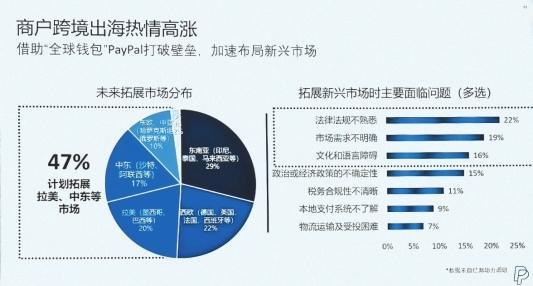
Core Insights - PayPal China released a report on small and medium-sized enterprises (SMEs) in cross-border e-commerce, indicating strong growth despite a complex international trade environment, with 67% of enterprises having annual revenues below $3 million, highlighting the dominance of SMEs in the sector [2] Group 1: Growth Opportunities - Shenzhen SMEs demonstrate remarkable innovation capabilities, with examples of businesses leveraging unique products to attract significant overseas interest [3] - Emerging business models, such as interest-based e-commerce, are showing substantial growth potential, with Shenzhen companies having a clear advantage in these new fields [4] - The report highlights a rapid increase in digital product transactions, alongside traditional sectors like consumer electronics and furniture [4] Group 2: Payment Localization Challenges - Localized payment requirements are critical for successful transactions, with specific needs varying by country, such as local tax invoices in Mexico and "buy now, pay later" options in Brazil [5] - PayPal offers a comprehensive payment solution that allows Chinese merchants to accept payments in over 200 countries, addressing local payment preferences and facilitating quick currency conversion [5][6] Group 3: Fast Settlement Solutions - PayPal's four-hour RMB withdrawal service is a leading cross-border settlement solution, enabling quick fund recovery for SMEs, which is crucial in the current trade environment [6] - The service supports multi-currency transactions and ensures rapid access to funds, enhancing cash flow for small businesses [6] Group 4: Diversification Strategies - In response to US-China trade tensions, successful companies exhibit traits such as multi-market presence, product differentiation, and digital empowerment [8] - Chinese enterprises are expanding into emerging markets in Europe and Latin America, with localized adaptations being essential for success [8] - A Shenzhen home goods company has successfully shifted focus from the US market to multiple European countries, increasing its European business share to 35% through PayPal's localized payment solutions [8] Group 5: Technology Empowerment - Shenzhen companies utilizing digital tools have an average order conversion rate 18 percentage points higher than traditional firms, with AI tools expected to reduce operational costs by 30% [8] - The digitalization of global trade necessitates inclusive global collaboration platforms, with PayPal's innovative payment solutions providing crucial support for SMEs venturing abroad [8]

全球化中的“影子世界”
暗涌Waves· 2025-08-19 04:33
Core Viewpoint - The article explores the emergence of "shadow companies" in China's globalization efforts, highlighting their roles in logistics, payment, and marketing as essential infrastructure supporting global trade [2]. Group 1: Logistics - The logistics sector has seen the rise of companies like Zongteng Group, which established overseas warehouses early on, differentiating itself from competitors by focusing on direct shipping and logistics infrastructure [5][6]. - Zongteng's strategic investments in heavy assets, such as cargo planes and automated warehouses, have created significant barriers to entry, allowing it to control costs and improve service efficiency [7][8]. - Other logistics companies, like Wanyitong and Fanding, have adapted their strategies to focus on automation and industry-specific solutions, reflecting a shift towards more integrated logistics services [9][10]. Group 2: Payment - The payment sector has been revolutionized by companies like Airwallex and PingPong, which address the high costs and inefficiencies of traditional cross-border payment systems [16][17]. - These companies have emerged in response to the pain points faced by small and medium enterprises in cross-border transactions, offering lower fees and faster processing times [18]. - The competitive landscape in cross-border payments is evolving, with firms focusing on comprehensive financial ecosystems and compliance capabilities to differentiate themselves [20][21]. Group 3: Marketing - The marketing landscape for overseas expansion is characterized by companies like Taitong Technology, which leverage data-driven strategies to optimize advertising and improve ROI for clients [25][26]. - Taitong's innovative platform integrates various marketing services, allowing clients to manage global campaigns efficiently [27][28]. - The marketing sector is witnessing a shift towards AI-driven solutions, enhancing the effectiveness of campaigns and enabling better targeting of audiences [31]. Group 4: Future Variables in the Shadow World - The "shadow world" of globalization is driven by specific pain points, such as high payment fees and inefficient logistics, leading to the emergence of specialized service providers [34][35]. - The competitive dynamics are changing, with geopolitical factors and technological advancements introducing new variables that will shape the future of these industries [35][36]. - The integration of services across logistics, payment, and marketing is creating a more complex ecosystem, where companies must adapt to survive in a rapidly evolving global landscape [35].

东南亚电商大爆发,中企纷纷落子布局
凤凰网财经· 2025-08-16 14:32
Core Viewpoint - The Southeast Asian e-commerce market is experiencing explosive growth, with annual sales projected to increase from $4 billion in 2012 to $184 billion by 2024, attracting significant attention from Chinese companies [2][4]. Group 1: Market Growth and Opportunities - The e-commerce platforms in Southeast Asia, such as Lazada, are evolving through substantial investments from Alibaba and leveraging the entire Alibaba ecosystem for digital transformation [4]. - Chinese companies are increasingly entering the Southeast Asian market, shifting from merely selling products to offering services, thereby reshaping the e-commerce landscape [5]. - Southeast Asia, with nearly 700 million people and a high percentage of young consumers, presents a significant opportunity for e-commerce growth, as internet penetration rates exceed 70% in most countries [5][6]. Group 2: Consumer Preferences and Trends - The most notable e-commerce growth is observed in Indonesia, Thailand, and Vietnam, where consumers prefer visually appealing, low-decision, and high-repeat purchase products [6]. - Chinese sellers have a competitive advantage in understanding local demands and product selection, becoming a dominant seller group on Southeast Asian e-commerce platforms [6][10]. - The rise of content-driven e-commerce, particularly through platforms like TikTok Shop, is changing consumer purchasing behavior, with 75% of consumers more willing to buy products recommended by influencers [8][9]. Group 3: Technological Advancements - E-commerce platforms in Southeast Asia are benefiting from technological upgrades, with Lazada being a pioneer in applying AI for personalized recommendations and operational efficiency [7]. - The integration of AI has led to a 46% increase in user interaction with the platform during peak shopping events [7]. Group 4: Infrastructure Development - The logistics and payment infrastructure in Southeast Asia is improving, with significant investments from Chinese logistics companies to enhance delivery efficiency [12][13]. - The electronic payment adoption rate has surpassed 50%, with mobile payments in Thailand projected to account for 55% of e-commerce transactions by 2024 [13][14]. - Despite the growth in electronic payments, cash transactions remain prevalent due to cultural preferences and the limited issuance of debit and credit cards [13][14]. Group 5: Cross-Border Payment Solutions - Chinese payment service providers are capitalizing on the opportunity to address payment challenges in Southeast Asia, offering localized services and cross-border payment solutions [14]. - Successful collaborations, such as UnionPay's partnership with Laos' national payment network, highlight the potential for Chinese payment services to enhance local payment ecosystems [14].


东南亚电商大爆发,中企纷纷落子布局
21世纪经济报道· 2025-08-16 03:56
Core Viewpoint - The Southeast Asian e-commerce market is experiencing explosive growth, with annual sales projected to increase from $4 billion in 2012 to $184 billion by 2024, attracting significant attention from Chinese companies [1][3]. Group 1: Market Growth and Opportunities - The e-commerce platforms in Southeast Asia, such as Lazada, are evolving with the support of Chinese companies like Alibaba, which provides funding and ecosystem integration [3]. - The demand for Chinese products in Southeast Asia is rising, driven by a young population and increasing internet penetration, with over 70% in most countries except Laos, Myanmar, and East Timor [6][7]. - Indonesia, Thailand, and Vietnam are noted for their significant e-commerce consumption growth, with a preference for visually appealing and high-repurchase products [6][7]. Group 2: E-commerce Strategies and Innovations - The rise of live streaming and short videos as new consumer entry points is reshaping shopping habits, with 75% of Southeast Asian consumers preferring products recommended by influencers [9][10]. - TikTok Shop is leveraging a dual model of "content + shelf," where personalized recommendations and real-time interactions drive sales [10][11]. - Chinese sellers, experienced in domestic e-commerce, are successfully applying their strategies in Southeast Asia, enhancing the content ecosystem on platforms like TikTok Shop [11]. Group 3: Infrastructure Development - The logistics and payment infrastructure in Southeast Asia is improving, with significant investments from Chinese logistics companies like Cainiao and SF Express [12][14]. - The electronic payment adoption rate has surpassed 50%, with mobile payments in Thailand projected to account for 55% of e-commerce transactions by 2024 [14][15]. - Despite advancements, challenges remain in payment adoption due to low credit card issuance and a preference for cash transactions among local consumers [15]. Group 4: Cross-Border Payment Solutions - Chinese payment service providers are capitalizing on the payment challenges in Southeast Asia, offering solutions that facilitate cross-border transactions and reduce costs [15]. - Successful collaborations, such as UnionPay's partnership with Laos' national payment network, highlight the potential for Chinese companies to enhance local payment ecosystems [15].