
服装

Search documents
赢家时尚:受托人根据股份奖励计划购买110.85万股公司股份
Zhi Tong Cai Jing· 2025-11-11 10:54
Core Viewpoint - Winner Fashion (03709) announced the purchase of a total of 1,108,500 shares from the market by the trustee of the share award plan on November 7 and 10, 2025, which will be held in trust for the benefit of selected participants [1] Group 1 - The share award plan's trustee has acquired shares on behalf of selected participants [1] - A total of 1,108,500 shares were purchased from the market [1] - The acquisition took place on two specific dates: November 7 and November 10, 2025 [1]
赢家时尚(03709):受托人根据股份奖励计划购买110.85万股公司股份
智通财经网· 2025-11-11 10:52
Core Viewpoint - Winner Fashion (03709) has announced the purchase of a total of 1,108,500 shares from the market by the trustee of its share award plan, which will be held in trust for the benefit of selected participants [1] Group 1 - The shares were purchased on November 7 and 10, 2025 [1]
七匹狼:公司始终聚焦服装主营业务
Zheng Quan Ri Bao Wang· 2025-11-11 09:47
Core Viewpoint - The company, Seven Wolves (002029), is focused on its core apparel business while optimizing product structure, advancing brand upgrades, and enhancing operational efficiency to solidify its business fundamentals [1] Group 1: Business Strategy - The company emphasizes continuous optimization of its product structure to improve overall performance [1] - Brand upgrades are a key focus area for the company to enhance market competitiveness [1] - Operational efficiency is being improved as part of the strategy to strengthen the business foundation [1] Group 2: Financial Management - The company is utilizing part of its idle self-owned funds for securities investment, ensuring that this does not affect its normal production and operational needs [1] - The company is committed to maintaining sufficient funds for daily operational needs while effectively controlling risks associated with investments [1] - Investors are encouraged to monitor the company's periodic reports for specific investment situations and returns [1]

乔治白:截至11月10日股东总户数为15911户
Zheng Quan Ri Bao Wang· 2025-11-11 09:43
Core Viewpoint - As of November 10, 2025, the total number of shareholders for George White (002687) is projected to be 15,911 [1] Company Summary - George White has engaged with investors through an interactive platform, providing insights into shareholder numbers [1] - The company is actively communicating with its investors, indicating a focus on transparency and engagement [1]

锦泓集团(603518.SH):第一期锦泓领航员工持股计划完成股票购买
Ge Long Hui A P P· 2025-11-11 08:28
Group 1 - The company Jin Hong Group (603518.SH) announced that as of November 11, 2025, its first employee stock ownership plan has successfully purchased a total of 256,900 shares through secondary market trading, accounting for 0.07% of the company's total share capital [1] - The average transaction price for the shares purchased was approximately 9.36 yuan per share, with a total transaction amount of 2.4058 million yuan (excluding transaction fees) [1] - The shares acquired under the employee stock ownership plan will be locked for a period of 24 months from the date of this announcement, with a one-time unlocking of the shares after the lock-up period expires [1]

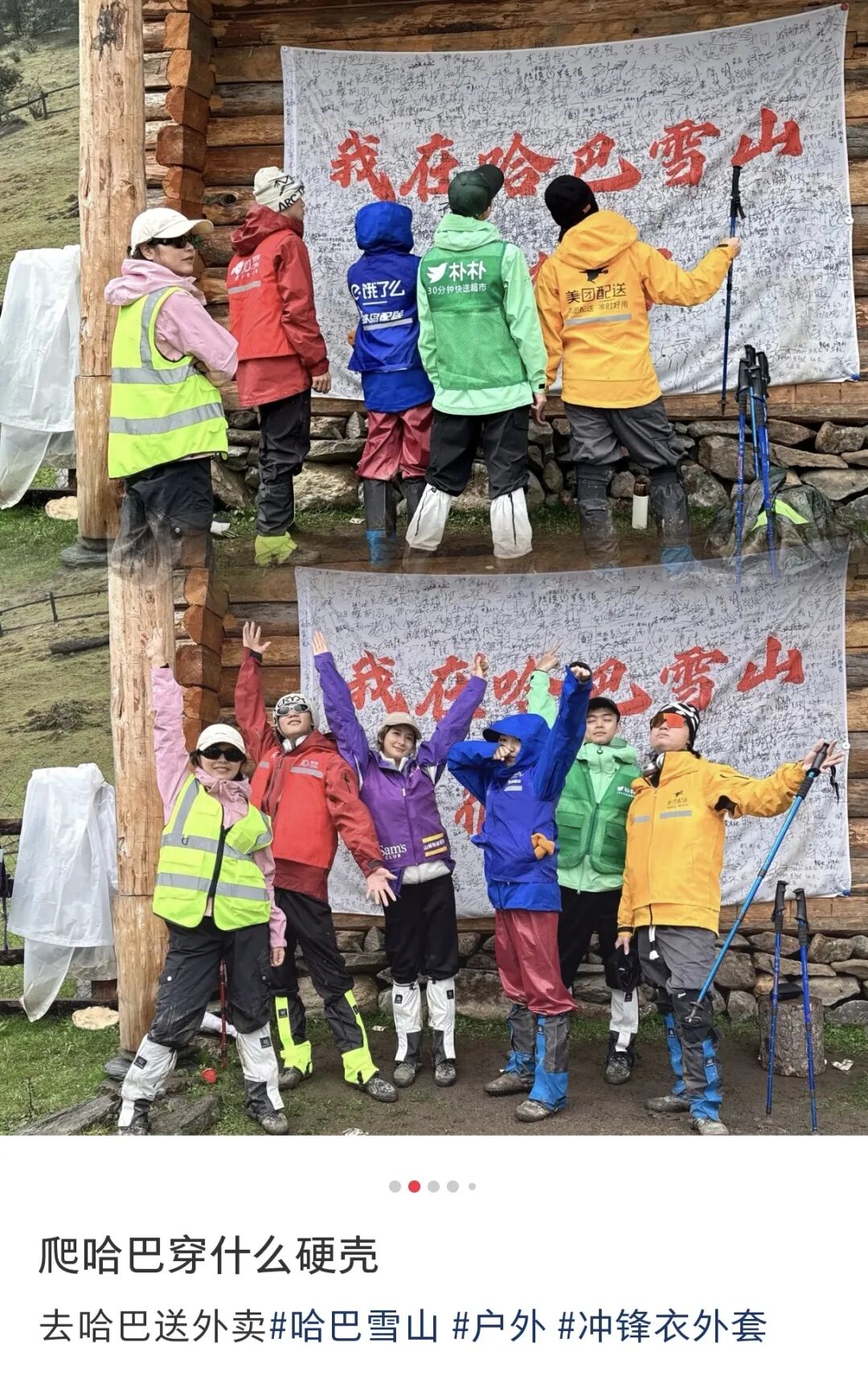
50元的外卖工服,把中产三宝的体面戳破了
3 6 Ke· 2025-11-11 07:52
Core Viewpoint - The rise of delivery worker uniforms is challenging the dominance of outdoor jackets, particularly among young consumers who are increasingly favoring the practicality and affordability of these uniforms over traditional outdoor brands [1][11][40]. Group 1: Market Dynamics - Delivery worker uniforms are becoming a fashionable alternative to outdoor jackets, with various colors and designs from different platforms overshadowing traditional brands [3][12]. - The affordability of delivery uniforms, often priced at tens of dollars compared to hundreds or thousands for outdoor jackets, is a significant factor in their popularity [25][28]. - The trend of wearing delivery uniforms in outdoor activities, such as skiing and hiking, is growing, with these uniforms being seen as stylish and practical [9][22]. Group 2: Consumer Behavior - Young consumers are shifting from seeking "socially popular" brands to "practically popular" items, valuing functionality over brand prestige [43][47]. - The practicality of delivery uniforms, such as their spacious pockets designed for delivery tasks, appeals to outdoor enthusiasts who find them useful for various activities [45][40]. - The perception of delivery uniforms as a form of social currency is rising, allowing wearers to blend into both outdoor and fashion circles [22][24]. Group 3: Brand Competition - Major delivery platforms are investing in high-quality materials and designs for their uniforms, competing directly with established outdoor brands [35][37]. - The use of advanced materials in delivery uniforms, comparable to those used by high-end outdoor brands, enhances their appeal and performance [35][39]. - The collaboration with well-known brands, such as Nike for delivery uniforms, further elevates their status in the fashion and outdoor markets [20][14].

海澜之家携手京东,做中国服装产业的革新者
Shen Zhen Shang Bao· 2025-11-11 05:38
Core Insights - The article highlights the transformation of the apparel industry towards "digital intelligence," exemplified by the smart factory of Hailan Home in Jiangyin, Jiangsu, where every garment is tracked through a digital system from fabric development to delivery [1][2][5] Group 1: Digital Transformation - Hailan Home has partnered with JD.com to enhance supply chain efficiency and product innovation, launching over a hundred exclusive products annually and utilizing JD's VMI cloud warehouse network for efficient distribution [1][9] - The focus has shifted from short-term sales spikes to long-term operational efficiency, with the "Double 11" shopping festival serving as a comprehensive supply chain exercise rather than just a traffic-driven event [2][11] - The brand is redefining its identity from "men's wardrobe" to "family lifestyle," expanding into women's and children's clothing, thus tapping into new growth areas and diversifying its consumer base [3][4] Group 2: Supply Chain and Production Efficiency - The smart factory has transitioned from "mass production" to "customized production," allowing for single-piece orders and rapid delivery within seven days, showcasing a flexible and efficient manufacturing model [5][6] - The integration of data-driven production processes enables real-time adjustments based on sales data, enhancing responsiveness to market fluctuations [4][6] - Hailan Home's collaboration with JD.com has established a "smart brain" for supply chain management, allowing for predictive capabilities and improved consumer experience through localized fulfillment [9][10] Group 3: Consumer Engagement and Product Development - The rise of "parameter consumption" has led to a focus on fabric quality and functionality, with JD.com introducing a quality certification system for apparel, ensuring consumers receive reliable products [10][11] - Hailan Home and JD.com co-create numerous exclusive products based on consumer insights, enhancing the brand's ability to meet market demands effectively [10][11] - The brand's marketing strategies are increasingly tailored to younger consumers, utilizing social media and events to engage with this demographic [3][4]


“双11”记者探访深圳带货新业态——档口直播 别看店面不大 生意覆盖全国
Shen Zhen Shang Bao· 2025-11-11 00:42
Core Insights - The rise of live streaming hosts in traditional wholesale markets is transforming the retail landscape ahead of the "Double 11" shopping festival [1] Group 1: Gold and Jewelry Market - In the Shui Bei gold market, live streamers are showcasing various gold products, with a focus on gold foil crafts and creative products that contain minimal gold, making them suitable for impulse purchases [2] - The increasing international gold prices have made gold-related products a highlight for this year's "Double 11" online shopping event [2] Group 2: Electronics Market - The Huaqiangbei electronics market is experiencing a surge in live streaming, particularly for entertainment electronics like karaoke equipment and gaming peripherals, allowing consumers nationwide to access affordable products [3] - Foreign buyers, including those from India, are attracted to Huaqiangbei due to its significant price advantages [3] Group 3: Fashion and Apparel Market - The Nanyou clothing market has developed a comprehensive live streaming ecosystem, where clothing is designed, produced, and sold within the same building, significantly reducing the distance from factory to consumer [4] - The transformation of old factories into live streaming hubs is being replicated in various locations, enhancing the efficiency of the retail process [5] Group 4: Industry Growth Factors - The robust development of the live streaming e-commerce industry in Shenzhen is attributed to its strong manufacturing base, complete supply chain, and an innovative entrepreneurial environment [5] - Events like "Double 11" are driving the growth of live streaming sales, injecting new vitality into traditional commerce [5]
太平鸟(603877):业绩短期承压,期待后续渠道调整效果
Changjiang Securities· 2025-11-10 15:22
Investment Rating - The report maintains a "Buy" rating for the company [7][11]. Core Insights - Short-term performance is under pressure, but profit growth is expected to recover due to channel adjustments, retail improvements, and franchise gross margin recovery. Long-term, structural adjustments are anticipated to enhance operational quality and profit elasticity, shifting from retail-driven profit elasticity to a more sustainable and robust internal focus [2][11]. - The company reported revenues of 4.22 billion yuan and a net profit attributable to shareholders of 30 million yuan for the first three quarters of 2025, reflecting a year-on-year decline of 7.2% and a 73.8% drop in net profit [5][11]. Financial Performance Summary - For Q3 2025, the company achieved revenues of 1.32 billion yuan, with a net loss attributable to shareholders of 50 million yuan, marking a year-on-year revenue decline of 5.5% and a reduction in losses of 14 million yuan [5][11]. - The company’s gross margin improved by 1.6 percentage points year-on-year in Q3 2025, despite a challenging retail environment and ongoing franchise store closures [11]. - The projected net profits for 2025, 2026, and 2027 are estimated at 170 million yuan, 210 million yuan, and 230 million yuan, respectively, with corresponding price-to-earnings ratios of 41, 33, and 30 [2][11].

望远镜系列25之adidasFY2025Q3经营跟踪:收入符合预期,上调全年指引
Changjiang Securities· 2025-11-10 15:20
Investment Rating - The investment rating for the industry is "Positive" and is maintained [6]. Core Insights - In FY2025Q3 (July 1, 2025 - September 30, 2025), the company achieved revenue of €6.63 billion, representing an 8% year-over-year increase at constant exchange rates. The revenue performance was in line with expectations, with the Adidas brand revenue increasing by 12% [2][4]. - The gross profit margin improved by 0.5 percentage points to 51.8%, driven by lower product and transportation costs, improved business mix, and strong sales [2][4]. - Operating profit margin increased by 1.8 percentage points to 11.1%, while the net profit margin rose by 0.1 percentage points to 7.0% [2][4]. Revenue Breakdown - By region, the Adidas brand saw revenue growth across all markets: Europe (+9%), North America (+1%), Emerging Markets (+11%), Japan/Korea (+6%), and Greater China (+6%). The Adidas brand revenue in these regions grew by 12%, 8%, 13%, 11%, and 10% respectively [5]. - By channel, all channels for the Adidas brand experienced double-digit growth: wholesale (+10%), DTC (+14%), self-operated stores (+13%), and e-commerce (+15%) [5]. - By product category, both footwear and apparel for the Adidas brand achieved double-digit growth, with footwear up by 11% and apparel by 16%. Accessories saw a modest increase of 1% [5]. Inventory and Guidance - As of FY2025Q3, the company's inventory increased by 21% year-over-year to $5.47 billion, attributed to a low base last year and pre-purchases for the World Cup, which is expected to support revenue growth [11]. - The company raised its full-year guidance, projecting a 9% year-over-year revenue increase for FY2025 at constant exchange rates, with the Adidas brand expected to achieve double-digit growth. Operating profit is forecasted to be €2 billion, up from a previous estimate of €1.7 to €1.8 billion [11].
