Funds

Search documents
EIC: Adding This 11.7%-Yielding CLO Fund On The Drop
Seeking Alpha· 2025-06-11 07:49
Group 1 - The article reviews Eagle Point Income Co (NYSE: EIC), a fund primarily investing in CLO Debt with a minor allocation in CLO Equity [1] - The fund has experienced a decline due to a recent cut in its distribution [1]



ETF主力榜 | 港股通创新药ETF(159570)获主力资金加速买入,国债ETF获主力关注-20250610
Sou Hu Cai Jing· 2025-06-11 01:29
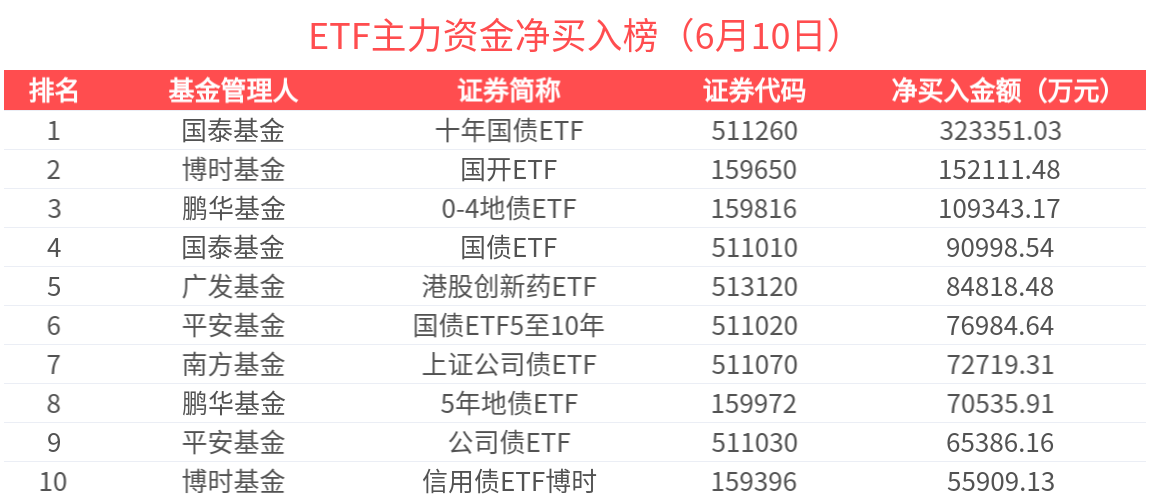
Core Insights - In June 2025, a total of 245 ETF funds experienced net buying from major funds, while 298 ETF funds faced net selling. Notably, 86 ETF funds had net purchases exceeding 10 million yuan, with the Ten-Year Treasury ETF (511260) leading with a net inflow of 3.234 billion yuan [1][3][5]. Group 1: Major Net Buyers - The top five ETFs with the highest net buying amounts include: 1. Ten-Year Treasury ETF (511260) with 3.233 billion yuan 2. National Development ETF (159650) with 1.521 billion yuan 3. 0-4 Year Local Debt ETF (159816) with 1.093 billion yuan 4. Treasury ETF (511010) with 909.9 million yuan 5. Hong Kong Innovative Drug ETF (513120) with 848.5 million yuan [1][3][5]. Group 2: Major Net Sellers - A total of 104 ETFs experienced net selling exceeding 10 million yuan, with the top five being: 1. Credit Bond ETF Guangfa (159397) with 522 million yuan 2. Credit Bond ETF (511190) with 480 million yuan 3. A500 Index ETF (159351) with 419 million yuan 4. Hang Seng Technology Index ETF (513180) with 334 million yuan 5. Shanghai 50 ETF (510050) with 306 million yuan [5][7][9]. Group 3: Continuous Net Buying - Over the recent period, 168 ETFs have seen continuous net buying, with the leading ones being: 1. Entrepreneur Large Cap ETF (16 days) with 144 million yuan 2. Ten-Year Local Debt ETF (12 days) with 4.342 billion yuan 3. CSI 2000 ETF (12 days) with 341 million yuan 4. National Development ETF (11 days) with 1.689 billion yuan 5. Biotechnology ETF (11 days) with 23.4 million yuan [11][13]. Group 4: Continuous Net Selling - A total of 101 ETFs have experienced continuous net selling, with the top five being: 1. Transaction Currency ETF (13 days) with 32.37 million yuan 2. Bank ETF Preferred (9 days) with 20.5 million yuan 3. Dividend Low Volatility ETF (8 days) with 46.67 million yuan 4. CSI A500 ETF Morgan (7 days) with 123 million yuan 5. Data ETF (7 days) with 17.04 million yuan [15][16]. Group 5: Recent Trends - In the last five days, 62 ETFs have seen net buying exceeding 100 million yuan, with the top five being: 1. Credit Bond ETF Guangfa (159396) with 5.728 billion yuan 2. Credit Bond ETF (511190) with 5.450 billion yuan 3. Ten-Year Treasury ETF (511260) with 4.624 billion yuan 4. National Development ETF (159650) with 4.336 billion yuan 5. 5-Year Local Debt ETF (159972) with 4.034 billion yuan [18][20]. - Conversely, 19 ETFs have seen net selling exceeding 100 million yuan, with the top five being: 1. Yin Hua Daily ETF (511880) with 5.750 billion yuan 2. Hua Bao Tian Yi ETF (511990) with 3.822 billion yuan 3. Credit Bond ETF Tian Hong (159398) with 2.705 billion yuan 4. A500 ETF Fund (512050) with 825 million yuan 5. Shanghai Company Bond ETF (511070) with 823 million yuan [22][24].
北交所主题基金年内最高已上涨超70%;自由现金流基金年内募资151亿元丨天赐良基早参
Mei Ri Jing Ji Xin Wen· 2025-06-11 00:46
Group 1 - A new floating rate fund, the交银施罗德瑞安混合, is being launched with a proprietary investment of 20 million yuan by交银施罗德, reflecting confidence in the long-term stability of China's capital markets [1] - Since the launch of the first batch of floating rate products on May 27, multiple public funds have announced self-purchases, with total subscriptions exceeding 100 million yuan as of June 9 [1] Group 2 - 15 fund companies have terminated their sales cooperation with民商基金销售公司 as of June 9, with 中欧基金 and 华泰保兴基金 being among the latest to announce this decision [2][3] - Additionally, 上银基金 has also announced the termination of its sales cooperation with海银基金销售有限公司 [4] Group 3 - As of June 9, the total scale of ETFs has reached 4.16 trillion yuan, with an increase of nearly 440 billion yuan this year, and the number of shares has risen to 2.74 trillion [5] - 14 ETFs have seen an increase in scale of over 10 billion yuan this year, with the highest individual increase exceeding 30 billion yuan [5] Group 4 - 26 new free cash flow strategy funds have been established this year, raising a total of 15.143 billion yuan, with several funds exceeding 1 billion yuan in issuance [6] - New products in this category are actively being reported, indicating ongoing interest and expansion in the free cash flow strategy fund segment [6] Group 5 - The 北证50成份指数 has shown strong performance, with all 20 available北交所主题基金 achieving positive returns this year, the highest increase being 72.29% [7][8] - Several北证50成份指数基金 have implemented purchase limits to protect the interests of fund holders [7] Group 6 - 兴证全球基金's manager, 陈聪, emphasizes four key investment directions: internet leading companies, innovative pharmaceuticals, new consumer trends, and technology hardware, particularly in the context of AI applications [9] - The innovative pharmaceutical sector is expected to continue its momentum into the second half of the year, with A-shares showing potential in niche markets like pet products and beauty [9] Group 7 - On June 10, the market experienced a decline, with the Shanghai Composite Index falling by 0.44% and the Shenzhen Component Index by 0.86% [10] - The trading volume reached 1.42 trillion yuan, indicating increased market activity compared to the previous trading day [10]
3100亿元!创新制度引债券ETF规模爆发
2 1 Shi Ji Jing Ji Bao Dao· 2025-06-10 14:00
Core Viewpoint - The bond ETF market is experiencing significant growth driven by product innovation, with a total scale reaching 310.67 billion yuan as of June 9, 2025, representing a 78% increase compared to the end of 2024 [1] Group 1: Market Expansion - The total scale of bond ETFs has increased significantly, surpassing the growth rate of the entire year of 2024 [1] - Eight benchmark credit bond ETFs launched in January 2025 contributed approximately 77 billion yuan to the market, with a combined scale nearing 77 billion yuan [1][3] - The nine credit bond ETFs have attracted over 80 billion yuan in new funds, accounting for about 60% of the total new scale in bond ETFs [4] Group 2: Trading and Liquidity - The introduction of general pledge-style repurchase business for the nine credit bond ETFs has enhanced trading volumes, with a 65% increase in transaction amounts on the first day of implementation [6][7] - On June 9, the transaction amount for these ETFs approached 67 billion yuan, indicating strong market activity [1][7] - Credit bond ETFs are expected to improve liquidity in the market, providing a buffer against potential liquidity issues during downturns [5][8] Group 3: Investment Appeal - Credit bond ETFs offer multiple advantages, including higher liquidity due to the selection of high-quality bonds and clear investment targets [4] - The ability to conduct T+0 trading allows for flexible asset switching, making these ETFs attractive to investors [4] - The inclusion of credit bond ETFs in the pledge-style repurchase market is seen as a significant innovation in China's bond market, potentially attracting a broader range of investors [8]
国开债券ETF(159651)冲击4连涨,公司债ETF(511030)最新规模超175亿元再创新高,资金面维持偏松
Sou Hu Cai Jing· 2025-06-10 02:54
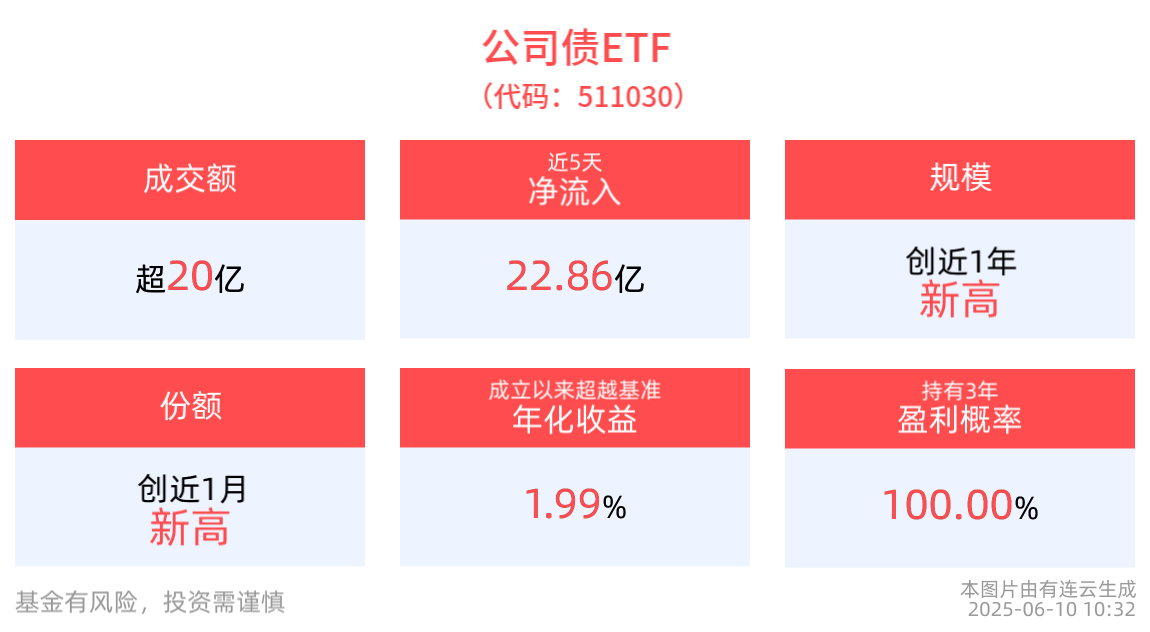
Core Viewpoint - The bond market is experiencing active trading and significant inflows into various ETFs, indicating investor confidence and strategic positioning in the current economic environment [6]. Group 1: Company Bond ETF (511030) - As of June 10, 2025, the Company Bond ETF has increased by 0.02%, with a latest price of 105.91 yuan. Over the past year, it has accumulated a rise of 2.06% [1]. - The liquidity of the Company Bond ETF is robust, with an intraday turnover of 11.8% and a transaction volume of 2.069 billion yuan. The average daily transaction volume over the past week is 1.985 billion yuan [1]. - The latest scale of the Company Bond ETF has reached 17.524 billion yuan, marking a new high since its inception [1]. - The latest share count for the Company Bond ETF is 166 million shares, also a recent high for the past month [1]. - The net inflow of funds into the Company Bond ETF is 449 million yuan, with a total of 2.286 billion yuan net inflow over the past five trading days, averaging 457 million yuan per day [1]. - Leveraged funds are actively positioning in the Company Bond ETF, with net purchases for three consecutive days, peaking at a net buy of 911,300 yuan in a single day, and the latest financing balance is 2.7589 million yuan [1]. Group 2: National Debt ETF (511020) - As of June 10, 2025, the National Debt ETF (5 to 10 years) is in a state of market indecision, with a latest price of 117.46 yuan. It has seen a cumulative increase of 0.31% over the past week [3]. - The liquidity for the National Debt ETF (5 to 10 years) shows a turnover of 5.95% and a transaction volume of 85.1123 million yuan. The average daily transaction volume over the past week is 1.096 billion yuan [3]. - The latest scale of the National Debt ETF (5 to 10 years) is 1.431 billion yuan [3]. Group 3: National Development Bond ETF (159651) - As of June 10, 2025, the National Development Bond ETF has increased by 0.02%, achieving a four-day consecutive rise, with a latest price of 106.14 yuan. It has accumulated a rise of 1.97% over the past year [5]. - The liquidity of the National Development Bond ETF shows a turnover of 0.46% and a transaction volume of 5.2335 million yuan. The average daily transaction volume over the past year is 5.51 billion yuan [5]. - The scale of the National Development Bond ETF has grown by 68.8514 million yuan over the past six months, ranking it in the top half among comparable funds [5]. Group 4: Market Insights - Recent trading data indicates that large banks have sold 28.6 billion yuan while bond funds have net bought 73.6 billion yuan, suggesting a shift in market dynamics with banks selling long-term bonds and bond funds increasing leverage [6]. - The current monetary policy is supportive, with expectations of low volatility in funding rates, and a focus on credit bonds with yields above 2% as potential opportunities [6]. - The bond market is expected to remain cautious, with no significant trends anticipated in government bonds for 2025, while opportunities in 5-year credit bonds are highlighted [6].
信用债ETF天弘(159398)近三日获资金净流入超9亿,质押式回购交易折扣系数0.6
2 1 Shi Ji Jing Ji Bao Dao· 2025-06-10 02:49
Group 1 - The core viewpoint of the news highlights the strong performance and growing popularity of the Tianhong Credit Bond ETF (159398), which has seen significant capital inflow and expansion in scale due to favorable market conditions [1][2] - As of June 10, the Tianhong Credit Bond ETF recorded a trading volume exceeding 30 million yuan within the first half hour of trading, indicating robust market interest [1] - The latest circulation scale of the Tianhong Credit Bond ETF reached 6.698 billion yuan, setting a new historical high [2] Group 2 - The Tianhong Credit Bond ETF tracks the Shenzhen benchmark market-making credit bond index, reflecting the operational characteristics of the deep market credit bond sector [2] - According to Huaxi Securities, the credit bond ETF has demonstrated a solid long-term return capability, with yields ranging from 0.34% to 0.83% this year, outperforming other bond ETFs in terms of risk-adjusted returns [2] - The limited number of credit bond ETFs in the current market, combined with policy support for general pledge repo transactions, positions the Tianhong Credit Bond ETF as a reliable investment choice moving forward [2]
ETF资金榜 | 豆粕ETF(159985)资金加速流入,上证50ETF(510050)单日“吸金”近15亿元-20250609
Sou Hu Cai Jing· 2025-06-10 01:59
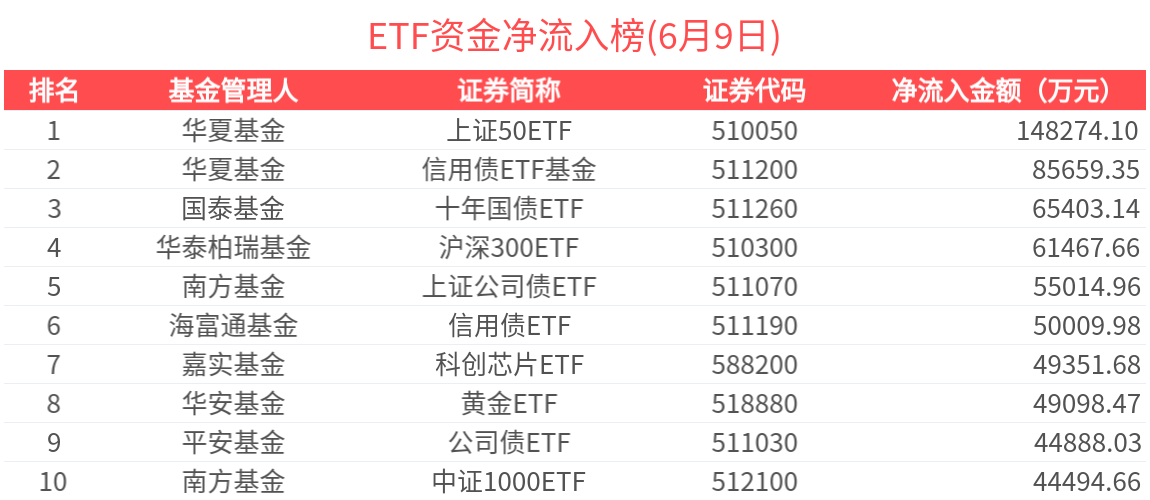
Core Insights - On June 9, 2025, a total of 212 ETF funds experienced net inflows, while 390 funds saw net outflows, indicating a significant disparity in investor sentiment towards different ETFs [1] - The top five ETFs with net inflows exceeding 100 million yuan included the SSE 50 ETF, Credit Bond ETF, Ten-Year Treasury ETF, CSI 300 ETF, and SSE Corporate Bond ETF, with inflows of 1.48 billion yuan, 856.5 million yuan, 654 million yuan, 615 million yuan, and 550 million yuan respectively [1][3] - Conversely, 17 ETFs had net outflows exceeding 100 million yuan, with the ChiNext ETF, Hang Seng Internet ETF, Short-term Bond ETF, Military Industry ETF, and Pharmaceutical ETF leading the outflows, totaling 359 million yuan, 331 million yuan, 287 million yuan, 285 million yuan, and 214 million yuan respectively [1][5] Inflow and Outflow Analysis - A total of 110 ETFs have seen consecutive net inflows, with the top performers being the Hong Kong Stock Connect Dividend ETF (29 days), Soybean Meal ETF (27 days), High Dividend ETF (26 days), SSE 180 Index Fund (23 days), and Credit Bond ETF Dachen (23 days), accumulating inflows of 445 million yuan, 61.69 million yuan, 171.34 million yuan, 140 million yuan, and 3.16 billion yuan respectively [1][7] - In contrast, 202 ETFs have experienced consecutive net outflows, with the leading ones being the Biopharmaceutical ETF (32 days), Innovative Drug ETF (27 days), Dividend Value ETF (26 days), Hang Seng Consumer ETF (24 days), and Traditional Chinese Medicine ETF (23 days), resulting in outflows of 556 million yuan, 3.29 billion yuan, 213 million yuan, 303 million yuan, and 262 million yuan respectively [1][8] Recent Trends - Over the past five days, 66 ETFs have recorded cumulative net inflows exceeding 100 million yuan, with the Short-term Bond ETF, Ten-Year Treasury ETF, Credit Bond ETF, Corporate Bond ETF, and SSE Corporate Bond ETF leading with inflows of 3.42 billion yuan, 3.37 billion yuan, 2.48 billion yuan, 2.29 billion yuan, and 2.19 billion yuan respectively [1][8] - Conversely, 86 ETFs have seen cumulative net outflows exceeding 100 million yuan, with the ChiNext ETF, Hang Seng Internet ETF, Hang Seng Medical ETF, Hong Kong Innovative Drug ETF, and East Financial Treasury ETF leading the outflows, totaling 1.82 billion yuan, 971 million yuan, 825 million yuan, 763 million yuan, and 583 million yuan respectively [1][8]
每日钉一下(A股现在是分红市还是融资市呢?)
银行螺丝钉· 2025-06-09 13:56
Group 1 - The core concept of fund advisory is to serve as an investment consultant for funds [1] - Fund advisory emerged to address the issue where "funds make money, but investors do not" [4] - Fund advisory has advantages in helping investors achieve better returns through its dual role of "advising" and "investing" [5] Group 2 - Various industries utilize consultants, especially those with high specialization [2] - The article suggests that just as one needs a doctor for medical issues or a lawyer for legal problems, fund advisory serves a similar purpose in the investment realm [7]

【财经分析】站上3000亿元大关 债券ETF规模如何实现跨越式突破?
Xin Hua Cai Jing· 2025-06-09 13:49
Core Insights - The total scale of bond ETFs in China has surpassed 300 billion yuan for the first time, marking a significant milestone since the market first crossed the 200 billion yuan mark in February 2024 [1] - The bond ETF market has seen rapid growth, with the total scale increasing from 200 billion yuan to 300 billion yuan in just four months, highlighting a robust development trajectory since the inception of the first bond ETF in 2013 [1] Market Performance - Bond ETFs have become a crucial asset allocation tool for investors due to their advantages such as good liquidity and diversified risk [2] - In the past year, certain bond ETFs have shown remarkable performance, with the Bosera SSE 30-Year Treasury ETF and Pengyang Zhongzhai 30-Year Treasury ETF rising by 14.52% and 14.40% respectively [2] Product Classification - Credit bond ETFs, long-duration interest rate bond ETFs, and convertible bond ETFs are currently the most popular types in the bond ETF market, with credit bond ETFs accounting for over half of the total scale [3] - As of June 6, the total scale of credit bond ETFs reached 156.5 billion yuan, representing 51.45% of the total bond ETF market [3] Industry Trends - The bond ETF market is experiencing a "Matthew Effect," with eight bond ETF products managing over 10 billion yuan, indicating a growing head effect [4] - The total management scale of bond ETFs increased by over 40 billion yuan in May 2025 alone, reflecting strong market dynamics [4] Company Landscape - Sixteen fund companies are currently involved in the bond ETF sector, with Haifutong Fund leading with a management scale of 86.5 billion yuan [5] - The bond ETF market has seen a significant increase in scale, with a growth of 101.4 billion yuan in 2025 compared to 2024, indicating a positive outlook for future development [5]
我国公募基金管理总规模首次突破33万亿元;中央汇金旗下券商已达8家|每周金融评论(2025.6.2-2025.6.8)
清华金融评论· 2025-06-09 11:13
Focus on Key Events - The National Development and Reform Commission and other departments are launching the 2025 New Energy Vehicle Rural Promotion Campaign to enhance the adoption of electric vehicles in rural areas, including measures like tax reductions and improved service networks [3][4]. - The European Central Bank's Isabel Schnabel stated that now is an opportune time to enhance the global status of the euro, driven by increased investor interest in Europe and a relative decline in the dollar's dominance [5][6]. - The State-owned Assets Supervision and Administration Commission issued a new management method for the development planning of central enterprises, emphasizing the concentration of state capital in key industries and strategic emerging sectors [6][7]. - China's public fund management scale has surpassed 33 trillion yuan for the first time, reflecting a significant growth trend in the wealth management sector [8]. - Central Huijin has increased its control over eight securities firms, potentially leading to a new wave of mergers and acquisitions in the securities industry [9]. Policy Developments - The 2025 New Energy Vehicle Rural Promotion Campaign aims to improve the green development level in rural areas by promoting electric vehicle usage and enhancing service support [3][4]. - The new management method for central enterprises establishes a three-tier planning system to guide the optimization of state-owned capital allocation [6][7]. Market Trends - The public fund industry is experiencing growth due to policy benefits and product innovation, indicating a robust future potential driven by increasing wealth management needs [8]. - The consolidation of securities firms under Central Huijin is expected to enhance industry concentration and drive professionalization and internationalization [9]. Economic Indicators - As of the end of May, China's foreign exchange reserves increased to $32,853 billion, supported by a recovering economy and improved trade relations [10][11].