
生物医药

Search documents
渤海证券研究所晨会纪要-20260306
BOHAI SECURITIES· 2026-03-06 01:44
Macro and Strategy Research - The economic growth target for 2026 is set at 4.5%-5%, reflecting a pragmatic adjustment in response to market expectations, with nearly 60% of provinces lowering their GDP growth targets [2] - Fiscal policy maintains a deficit rate target of around 4%, consistent with the previous year, indicating a commitment to sustaining expenditure levels while optimizing the use of fiscal funds [3] - Monetary policy is expected to remain moderately accommodative, with a focus on the reasonable recovery of prices, aiming for a CPI increase of 2% [4] - Expanding domestic demand remains a top priority, with policy adjustments focusing on sustainable growth and high-quality development, including a slight increase in central budget investment to 755 billion [5] - The emphasis on cultivating new driving forces in various fields highlights the importance of technological self-reliance and innovation, with significant support for key core technology enterprises [6][7] - The report indicates a deepening of "anti-involution" governance, with a focus on antitrust and fair competition, alongside reforms in the capital market to enhance the investment and financing ecosystem [8] Industry Research - The Tianjin biopharmaceutical industry is positioned as a key part of the "1+3+4" modern industrial system, with a reported output value exceeding 90 billion yuan in 2025, reflecting a year-on-year growth of 11.6% [13] - The industry benefits from strong policy support and a rich innovation resource base, including multiple laboratories and specialized universities, fostering advancements in synthetic biology and gene therapy [14] - Traditional sectors like chemical drugs and modern Chinese medicine are consolidating their advantages, while emerging sectors such as biomanufacturing and nucleic acid drugs are rapidly developing [15] - The biopharmaceutical industry is expected to reach a production value of over 100 billion yuan by 2025, with significant growth in medical device production [16] Computer Industry Research - The report highlights that China's AI models surpassed those of the US in global usage in February 2026, indicating a strong competitive position in the AI sector [17] - The software industry in China reported a business revenue of 15.48 trillion yuan in 2025, with a year-on-year growth of 13.2%, showcasing robust industry performance [18] - The investment strategy emphasizes the sustained high demand for AI computing power, with major cloud computing firms expected to maintain rapid capital expenditure growth [19]
专访全国人大代表、北京证监局原局长贾文勤:完善制度供给 引导资金流向科创领域
证券时报· 2026-03-06 01:41
Core Viewpoint - The article emphasizes the importance of enhancing financial services for technological innovation throughout its lifecycle, as proposed in the government work report, and discusses the need for capital market reforms to better support innovation and regulatory measures to ensure market stability [1][3]. Group 1: Capital Market Support for Innovation - The capital market has unique advantages in sharing innovation risks and promoting the formation of innovative capital, with the China Securities Regulatory Commission (CSRC) implementing reforms to support innovation-driven development [3][4]. - The multi-tiered market system is being expanded to cover technological innovation, with reforms in the Sci-Tech Innovation Board, Growth Enterprise Market, and the establishment of the Beijing Stock Exchange [4]. - The efficiency of mergers and acquisitions (M&A) has significantly improved, with over 2,000 asset restructuring projects in the A-share market in 2025, totaling over 1.5 trillion yuan, a 30% increase year-on-year [4]. Group 2: Private Equity and Venture Capital - There is a growing market ecosystem guiding private equity and venture capital funds to invest early, in smaller amounts, and for the long term in hard technology sectors, with significant investments in strategic emerging industries like semiconductors and renewable energy [4][5]. - The cumulative issuance of Sci-Tech bonds has exceeded 2 trillion yuan, primarily funding sectors such as semiconductors, artificial intelligence, and high-end manufacturing [5]. Group 3: Regulatory Measures for Market Stability - The CSRC maintains a strict regulatory environment to ensure fair market order, focusing on combating fraud, financial misconduct, and insider trading, with over 2,500 administrative penalties issued during the 14th Five-Year Plan period [7]. - In 2025, the CSRC handled 701 securities and futures law violation cases, imposing fines totaling 15.47 billion yuan, reinforcing the foundation for stable and sustainable market development [7]. Group 4: Enhancing Quality of Listed Companies - The CSRC has implemented measures to improve the operational standards of listed companies, including enhancing governance and encouraging value growth through M&A activities [9][10]. - Specific recommendations include promoting market value management, facilitating M&A for upgrading to new productive forces, and ensuring a coordinated development of investment and financing [10].


首批!“调出”科创板成长层,涉寒武纪、百济神州等
券商中国· 2026-03-06 01:12
Core Viewpoint - Several companies in the Sci-Tech Innovation Board's growth tier have reported turning losses into profits for the fiscal year 2025, indicating a positive trend in their financial performance and potential for exiting the growth tier [1][3]. Group 1: Company Performance - Cambrian Technology reported a revenue of 6.497 billion yuan for 2025, a year-on-year increase of 453.21%, and a net profit of 2.059 billion yuan, marking a turnaround from losses [3]. - BeiGene announced total revenue of 38.205 billion yuan for 2025, a 40.4% increase year-on-year, with a net profit of 1.422 billion yuan, also indicating a shift to profitability [3]. - North Chip Life achieved a revenue of 542 million yuan, a 71.23% increase from the previous year, and a net profit of 80.6219 million yuan, turning from losses to profits [3]. - Jingjin Electric reported a revenue of 2.726 billion yuan, a 108.93% increase year-on-year, with a net profit of 162 million yuan, recovering from a loss of 436 million yuan in the previous year [3]. - Obsidian Light announced total revenue of 941 million yuan, a 66.66% increase from the previous year, and a net profit of 127 million yuan, achieving profitability [3]. Group 2: Regulatory Framework - The China Securities Regulatory Commission (CSRC) has set clear criteria for companies to exit the Sci-Tech Innovation Board's growth tier, including achieving positive net profits for two consecutive years with a cumulative profit of at least 50 million yuan, or a positive net profit with revenue exceeding 100 million yuan in the most recent year [4]. - Among the five companies that turned profitable, North Chip Life, which was newly listed in February 2026, meets the criteria for exiting the growth tier [4]. - The other four companies that achieved profitability will also likely exit the growth tier following the formal disclosure of their annual reports [4]. Group 3: Industry Overview - The Sci-Tech Innovation Board's growth tier currently includes 39 companies, with over 90% concentrated in the new generation information technology and biomedicine sectors [5]. - These 39 companies are projected to see a revenue growth of 36.7% in 2025, while their net profits are expected to reduce losses by 56.9% [5].





政府工作报告里的微妙转折
吴晓波频道· 2026-03-06 00:29
Economic Growth Target - The economic growth target for 2026 is set at a range of 4.5% to 5%, marking a shift from fixed values to a more flexible approach [5][19][20] - This range reflects the challenges posed by a high base from previous years and aligns with the long-term average growth target of approximately 4.6% during the 14th Five-Year Plan [19][20] - The emphasis on quality over quantity in growth reflects a broader strategic shift towards high-quality development, moving away from a strict focus on GDP growth [9][21] Investment in Human Capital - The term "investment in people" has gained prominence, indicating a focus on enhancing public welfare and social security, which includes increasing coverage and levels of social security [12][13] - This shift suggests a prioritization of human capital investment over traditional infrastructure projects, aiming to create a healthier and more educated population as a core asset for the future [34] New Industry Focus - The report introduces "emerging pillar industries," including integrated circuits, aerospace, biomedicine, and low-altitude economy, indicating a strategic pivot towards sectors that can drive future growth [13][63] - The concept of "intelligent economy" is highlighted, emphasizing the integration of data, computing power, and industry, which is expected to revolutionize production and business models [15][60] Fiscal and Monetary Policy - The fiscal deficit for 2026 is projected to reach 5.89 trillion, with a deficit rate maintained at 4%, reflecting a significant increase in public spending, particularly in social welfare and innovation [29][34] - Monetary policy is expected to focus on structural tools rather than traditional methods, with potential for limited interest rate cuts and reserve requirement reductions to address external shocks [32][36] Real Estate and Capital Markets - The report emphasizes the importance of real estate in stabilizing growth and managing risks, with a focus on high-quality development and improving living conditions [39][41] - Capital markets are encouraged to shift towards direct financing, with an emphasis on institutional reforms rather than short-term market stabilization [39] Consumer and Social Policies - Policies aimed at increasing consumer spending include enhancing income for low-income groups and optimizing consumption structures, with a focus on both goods and services [48][51] - The introduction of support for initial marriage and childbearing families reflects a response to demographic challenges, aiming to improve housing security for these groups [54][57]

太平洋医药日报(20260304):FDA授予Brepocitinib优先审评
Tai Ping Yang Zheng Quan· 2026-03-06 00:20
Investment Rating - The overall industry rating is neutral, indicating that the expected return over the next six months will be between -5% and 5% relative to the CSI 300 index [6][7]. Core Insights - The pharmaceutical sector experienced a decline of 1.12% on March 4, 2025, outperforming the CSI 300 index by 0.02 percentage points, ranking 26th among 31 sub-industries in the Shenwan classification [3]. - Notable performers in the sector included Yahui Pharmaceutical (+20.02%), Ailis (+11.17%), and Rundou Co. (+6.99%), while the worst performers were Kanghui Co. (-6.26%), Changshan Pharmaceutical (-5.89%), and Hualan Biological (-4.75%) [3]. - Priovant announced that the FDA has accepted its new drug application for Brepocitinib, granting it priority review status based on positive results from the Phase 3 VALOR study, which showed significant clinical improvement in myositis total improvement score (TIS) for the 30mg dose group [4]. Summary by Sections Market Performance - On March 4, 2025, the pharmaceutical sector's performance was -1.12%, with various sub-industries showing mixed results, including in vitro diagnostics (-0.62%) and hospitals (-0.72%) performing better than blood products (-2.16%) and offline pharmacies (-2.10%) [3]. Industry News - The FDA has accepted Priovant's application for Brepocitinib, a selective TYK2 and JAK1 dual inhibitor, which could become the first targeted therapy approved for dermatomyositis if successful [4]. - Sanyou Medical announced that its SWINGO-3D Lumbar Cage System received FDA 510(K) certification [4]. Company News - Cap Bio's subsidiary received a medical device registration certificate for its chromosome multi-STR genotyping kit [5]. - Jiukang Bio announced the approval of its blood type identification and irregular antibody screening quality control product by the National Medical Products Administration [5]. - Dongya Pharmaceutical received approval for its fumaric acid valproate tablets from the National Medical Products Administration [5].




政府工作报告中的医疗提法变了,透露三大重要信号
21世纪经济报道· 2026-03-05 13:42
Group 1 - The core message of the article highlights the significant changes in China's healthcare policy as outlined in the government work report, emphasizing the importance of healthcare as a strategic pillar for economic development and public welfare [1][9]. Group 2 - Signal 1: The increase in the per capita financial subsidy for resident medical insurance by 24 yuan indicates a commitment to reducing the financial burden on residents, with total subsidies rising from 10 yuan in 2003 to 724 yuan in 2026, reflecting a stable policy environment [3][4]. - Signal 2: The elevation of the biopharmaceutical industry from an "emerging" to a "pillar" industry signifies a fundamental shift in national policy, with increased support expected for biopharmaceuticals, which are now seen as a strategic asset in addressing aging populations and ensuring public health [4][5]. - Signal 3: The focus on strengthening primary healthcare services through a tiered medical system aims to enhance the capabilities of grassroots healthcare institutions, ensuring better access to medications and services for the public [8][9].

【中国银河宏观】立足实际,打牢基础——2026年政府工作报告解读
Xin Lang Cai Jing· 2026-03-05 13:21
Group 1 - The GDP growth target for 2026 is set in the range of 4.5% to 5%, reflecting a pragmatic approach and a focus on quality improvement rather than merely speed [1][13][19] - The CPI target remains around 2%, consistent with the previous year, indicating a cautious stance on inflation management [1][14] - The urban unemployment rate target is maintained at approximately 5.5%, emphasizing the importance of employment stability in macroeconomic policy [1][14] Group 2 - The overall fiscal expenditure for 2026 is projected to increase, with a deficit rate of 4% and a new deficit scale of 5.89 trillion yuan [2][19] - The general public budget expenditure is expected to reach 30 trillion yuan for the first time, with a growth rate of 4.4% [2][19] - The issuance of special bonds is planned to support infrastructure and new projects, with a total of 11.89 trillion yuan in budgetary deficits, slightly up from the previous year [2][19] Group 3 - The monetary policy will maintain a moderately loose stance, with an emphasis on flexible and efficient use of tools such as interest rate cuts and reserve requirement ratio adjustments [3][29] - Structural monetary policy tools will be prioritized to enhance the effectiveness of monetary policy, particularly in supporting key sectors like technology and small enterprises [3][33] - The central bank is expected to maintain liquidity and coordinate with fiscal policies to support economic stability [3][34] Group 4 - Expanding domestic demand is identified as a top priority, with measures to boost consumption and stabilize investment [4][25] - A combination of policies will be implemented to enhance consumer income and optimize supply, including fiscal support for consumption initiatives [4][25] - Investment strategies will focus on central leadership, leveraging social capital, and prioritizing human investment [4][25] Group 5 - The government aims to accelerate the construction of a modern industrial system, emphasizing the development of new productive forces and enhancing service quality [5][11] - Key actions include promoting high-quality development of traditional industries and fostering emerging industries through innovation initiatives [5][11] - The focus will also be on integrating advanced manufacturing with modern services to create a more complete and high-value industrial system [5][11] Group 6 - The report emphasizes the need to deepen reforms and expand openness, particularly in establishing a unified national market [6][11] - Reforms will focus on enhancing the role of both state-owned and private enterprises, ensuring they work in tandem to drive economic growth [6][11] - The fiscal system will be improved to increase local financial autonomy, with a focus on consumption tax reforms and merging local additional taxes [6][11] Group 7 - Regional policies will be implemented with a focus on human-centered development and regional collaboration [8][11] - The government will promote urbanization and enhance infrastructure and public services to support high-quality development in rural areas [8][11] - Efforts will be made to strengthen the economic capabilities of major urban clusters and improve overall regional economic integration [8][11] Group 8 - The report highlights the importance of ensuring people's livelihoods and enhancing social security systems [9][11] - Employment stability will be prioritized through various measures, including increasing investment in public services and expanding social insurance coverage [9][11] - The government will also focus on promoting green transformation and achieving carbon peak and neutrality goals [9][11] Group 9 - The report outlines strategies for risk mitigation in key sectors, particularly in stabilizing the real estate market [10][11] - Policies will be tailored to local conditions to manage inventory and supply in the real estate sector [10][11] - There will be increased support for resolving risks in small financial institutions and addressing non-performing assets [10][11] Group 10 - The "15th Five-Year Plan" sets clear goals and a determined approach towards achieving modernization by 2035, focusing on quality and structural optimization [11][12] - The plan emphasizes the importance of developing new productive forces and building a modern industrial system to drive high-quality growth [11][12] - Key tasks include enhancing domestic circulation, improving social welfare, and ensuring food and energy security [11][12]

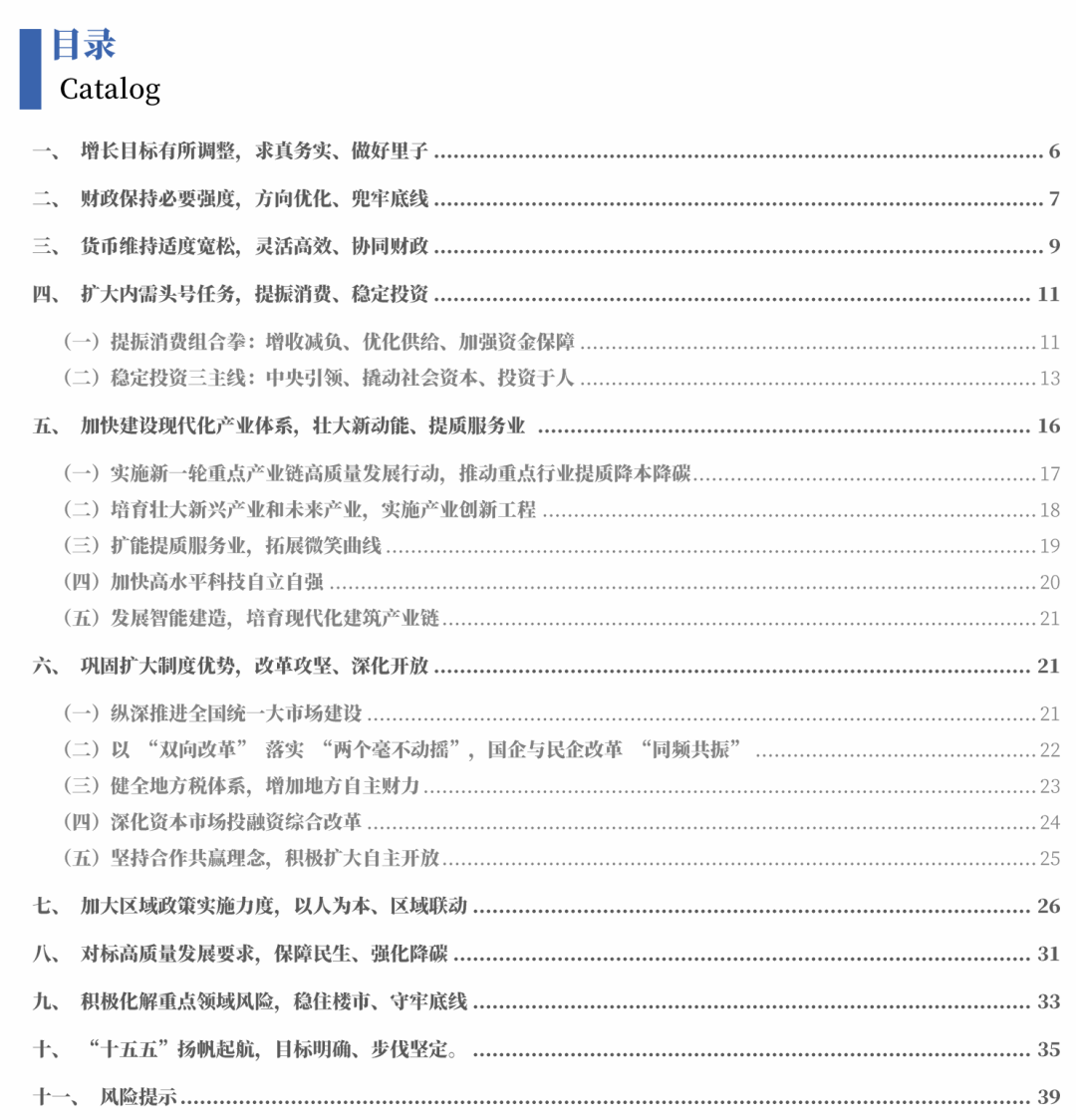
2026年政府工作报告学习体会:财政发力,扩大内需,科技创新,绿色转型
Ping An Securities· 2026-03-05 11:31
Core Insights - The report outlines the Chinese government's economic growth target for 2026 at 4.5%-5%, with a focus on reducing carbon emissions per unit of GDP by approximately 3.8% [2] - The fiscal policy is set to be more proactive, with a deficit rate of 4% and a budget expenditure reaching 30 trillion yuan, marking a significant increase from the previous year [2] - Monetary policy will remain moderately loose, aiming to support consumption and technological innovation, with new financial tools introduced to enhance investment [2] Fiscal and Real Estate Policy - The government plans to implement a more aggressive fiscal policy, maintaining a deficit of 5.89 trillion yuan, which is an increase of 230 billion yuan from the previous year [2] - Special government bonds will be issued to support long-term projects, with 1.6 trillion yuan allocated for various initiatives, including capital supplementation for state-owned banks [2] - The focus on stabilizing the real estate market will shift towards promoting quality housing and new development models [2] Monetary and Financial Policy - The monetary policy will continue to be moderately loose, utilizing various tools such as interest rate cuts to support key sectors like consumption and technology [2] - A new 100 billion yuan fund will be established to promote domestic demand through financial collaboration [2] - The report emphasizes the importance of enhancing financial services for technological innovation and supporting small and medium enterprises [2] Industrial Policy - The report highlights the need to build a strong domestic market and foster new growth drivers, with a focus on emerging industries such as integrated circuits and aerospace [3][4] - Investment in consumer goods and infrastructure will be prioritized, with 755 billion yuan allocated for central government investments [3] - The government aims to eliminate unreasonable restrictions in the consumption sector to boost spending in areas like tourism and healthcare [3] Green Transition - The report emphasizes the acceleration of green transformation, with the establishment of a national low-carbon transition fund to support new energy sources [5] - There will be a strong focus on controlling high-energy consumption projects and promoting the application of green technologies [5] - The construction of a new power system and smart grid will be prioritized to facilitate the transition to a low-carbon economy [5] Social Welfare - The report outlines measures to improve healthcare services and develop commercial health insurance, alongside initiatives to support the aging population [6] - There is a commitment to enhancing cultural and recreational services to meet the spiritual and cultural needs of the population [6] Market Impact - The combination of expansive fiscal measures and industrial reforms is expected to create positive market conditions, particularly in sectors supported by government policies [6] - The report suggests that technology-driven sectors and green energy industries will present significant investment opportunities [6] - Traditional industries are anticipated to improve due to the government's efforts to address "involution" and promote green and intelligent upgrades [6]
全国两会释放重要产业政策信号:重实体、夯根基、谋创新、强担当
Western Securities· 2026-03-05 10:52
Policy Highlights - The government emphasizes the importance of the real economy, stating that the focus should be on developing the real economy and modern industrial systems[1] - Traditional industry policies are prioritized over emerging and future industries, with a commitment of 200 billion yuan in special bonds for equipment upgrades[1] - New industries such as "future energy" and "brain-machine interfaces" are highlighted for the first time in the government report, indicating a shift towards innovative sectors[2] Innovation and Investment - State-owned enterprises are encouraged to lead in opening application scenarios and establishing investment growth mechanisms for future industries[2] - The report emphasizes the importance of an innovation ecosystem, promoting venture capital and angel investment to support startups[2] - The concept of "smart economy" is introduced, focusing on the commercialization of AI and the development of new infrastructure like satellite internet and 5G[2] Service Sector Development - The report calls for deeper integration of advanced manufacturing and modern service industries, with a specific mention of the financial sector's role[3] - The government aims to enhance the value of software services and expand the technology service market[3] Risk Considerations - There are warnings about the long policy implementation cycles and potential market risks exceeding expectations[5]
策略快评报告:政府工作报告部署年度重点工作
Wanlian Securities· 2026-03-05 10:29
Group 1 - The government work report sets a GDP growth target of 4.5%-5% for 2026, slightly down from 2025, emphasizing a pragmatic and quality-focused approach to economic development [3][4] - The report prioritizes building a strong domestic market, with measures to boost consumption and investment, including a special bond issuance of 250 billion yuan to support consumer goods replacement and a 100 billion yuan fund to stimulate domestic demand [3][4] - The report outlines plans for effective investment, with a central budget investment of 755 billion yuan and 800 billion yuan in special bonds for key projects, aiming to enhance private investment in high-tech and modern service sectors [3][4] Group 2 - The government aims to foster new pillar industries, focusing on emerging sectors such as integrated circuits, aerospace, and biomedicine, while also establishing mechanisms for future industries like quantum technology and 6G [3][4] - Continued reforms in the capital market are highlighted, with an emphasis on enhancing the role of long-term funds and improving investor protection, which is expected to support the financing needs of technology-driven companies [4] - Investment recommendations suggest focusing on high-growth companies in the technology sector and leading firms in the service consumption area, as policies to stimulate domestic demand are expected to gain momentum [4]