肉制品

Search documents
金字火腿: 公司章程(2025年6月)
Zheng Quan Zhi Xing· 2025-06-30 16:24
Core Points - The company Jinzi Ham Co., Ltd. was established as a joint-stock company in accordance with the Company Law and Securities Law of the People's Republic of China [1][2] - The company was approved by the China Securities Regulatory Commission to issue 18.5 million shares of common stock to the public and was listed on the Shenzhen Stock Exchange on December 3, 2010 [2] - The registered capital of the company is RMB 1,210,614,164 [2] Chapter Summaries General Principles - The articles of association aim to protect the rights and interests of the company, shareholders, employees, and creditors, and to regulate the company's organization and behavior [1] - The company is a permanent joint-stock company established under relevant laws [2] Business Objectives and Scope - The company's business objectives include adhering to the principle of "integrity-based, stable operation," focusing on ham, meat products, and food as core businesses, and striving for sustainable development [4] - The business scope includes food production and sales, internet sales, import and export of goods, and investment management among others [4] Shares - The company's shares are issued in the form of stocks, and the issuance follows principles of openness, fairness, and justice [5] - The total number of shares issued at the company's establishment was 50 million, with a par value of RMB 1 per share [5][6] - The company has issued a total of 1,210,614,164 shares, all of which are common shares [7] Shareholder and Shareholder Meeting - Shareholders have rights to dividends, request meetings, supervise the company's operations, and transfer their shares [13][14] - The company must hold an annual general meeting within six months after the end of the previous fiscal year [48] - The company can hold temporary shareholder meetings under specific circumstances, such as when the number of directors is insufficient [49] Board of Directors and Management - The board of directors is responsible for the company's operations and must act in the best interests of the company and its shareholders [3] - The company must appoint a legal representative from among the directors [3] Financial Accounting and Auditing - The company must establish a financial accounting system and conduct internal audits [7] - The appointment of accounting firms must be approved by the shareholders' meeting [7] Amendments to Articles - The articles of association can be amended following the procedures outlined in the Company Law and the company's regulations [9] Miscellaneous Provisions - The company must comply with laws and regulations regarding the transfer of shares and the rights of shareholders [11][12] - The company is required to disclose information in accordance with legal obligations and ensure transparency in its operations [15]

金字火腿: 董事、高级管理人员离职管理制度
Zheng Quan Zhi Xing· 2025-06-30 16:24
General Provisions - The company establishes a system to regulate the management of resignations of directors and senior management, ensuring governance stability and protecting shareholders' rights [1] - This system applies to all directors (including independent directors) and senior management personnel regarding resignation, term expiration, and dismissal [1] Resignation Conditions and Effectiveness - Directors can resign before their term expires by submitting a written resignation report, effective upon receipt by the board, with disclosure required within two trading days [2] - Directors automatically resign if not re-elected upon term expiration, and shareholders can dismiss directors with immediate effect [2] - Senior management can also resign before their term expires, with specific procedures outlined in their labor contracts [2] Transfer Procedures and Unresolved Matters - Resigning directors and senior management must transfer all company-related documents and assets within three working days after resignation [3] - If the resigning personnel are involved in significant investments or financial decisions, an audit committee may initiate a departure audit [3] - The company can require resigning personnel to fulfill any outstanding public commitments, with the right to seek compensation for any losses incurred [3] Obligations of Resigning Directors and Senior Management - The loyalty obligations of directors and senior management remain effective for two years after their term ends [4] - There are restrictions on the transfer of shares during and after their tenure, with a limit of 25% of total shares held per year during their term and a six-month restriction post-resignation [4] - Resigning personnel must cooperate with the company in follow-up investigations regarding significant matters during their tenure [4] Accountability Mechanism - The board will review specific accountability plans for resigning personnel who fail to fulfill commitments or violate loyalty obligations [5] - Resigning personnel can appeal the accountability decisions within 15 days, but this does not affect the company's ability to take protective measures [5] Supplementary Provisions - Any matters not covered by this system will be governed by relevant national laws, regulations, and the company's articles of association [6] - The board is responsible for interpreting this system, which takes effect upon approval by the board [6]
金字火腿: 对外担保管理制度
Zheng Quan Zhi Xing· 2025-06-30 16:24
Core Viewpoint - The company establishes a comprehensive system for external guarantees to protect investor interests and mitigate risks associated with external guarantees [1][2]. Group 1: General Principles - The company aims to maintain investor interests and regulate external guarantee behaviors to prevent risks and ensure asset safety [1]. - External guarantees are defined as guarantees provided by the company and its subsidiaries for others, including guarantees for subsidiaries [1]. - External guarantees must be uniformly managed, requiring board or shareholder approval for any contracts or agreements [1][2]. Group 2: Principles and Review of Guarantee Objects - External guarantees should adhere to principles of legality, prudence, mutual benefit, and safety, with strict risk control [2]. - The company cannot provide guarantees for controlling shareholders or their affiliates without shareholder approval, and such guarantees must be backed by counter-guarantees [2][3]. - Guarantees are primarily provided for subsidiaries, with strict procedures for guarantees outside this scope [2][3]. Group 3: Approval Process and Authority - The highest decision-making body for external guarantees is the shareholders' meeting, with the board exercising decision-making authority based on company regulations [6]. - Guarantees exceeding 10% of the latest audited net assets or 50% of total assets require shareholder approval [6][7]. - The board must analyze the credit status of the debtor and the associated risks before approving guarantees [3][5]. Group 4: Management and Responsibilities - The finance department is responsible for conducting credit investigations and managing guarantee procedures [36]. - Legal advisors assist in handling legal matters related to guarantees and ensure compliance with regulations [37]. - The company must take necessary measures to control risks if the debtor shows signs of losing repayment ability [16]. Group 5: Information Disclosure - The company is obligated to disclose information regarding external guarantees in accordance with relevant regulations [47]. - If a debtor fails to fulfill repayment obligations within fifteen trading days, the company must disclose this information [49]. - The company must ensure confidentiality of guarantee information until it is legally disclosed [52].
金字火腿: 股东会议事规则
Zheng Quan Zhi Xing· 2025-06-30 16:24
General Provisions - The company establishes rules to regulate its behavior and ensure shareholders can exercise their rights according to relevant laws and regulations [1][2] - The board of directors is responsible for organizing shareholder meetings in a diligent and timely manner [1][2] Shareholder Meeting Convening - The board must convene the annual shareholder meeting within six months after the end of the previous fiscal year and can hold temporary meetings as needed [1][3] - Independent directors can propose temporary meetings, and the board must respond within ten days [3][4] - Shareholders holding more than 10% of shares can request a temporary meeting, and the board must respond within ten days [4][5] Proposals and Notifications - Proposals must fall within the scope of the shareholder meeting's authority and be clearly defined [6][13] - Shareholders holding more than 1% of shares can submit temporary proposals, which must be disclosed in the meeting notice [6][15] - The notice for the annual meeting must be sent at least 20 days in advance, while temporary meetings require a 15-day notice [15][16] Meeting Procedures - The shareholder meeting can be held in person or via electronic means, and the location must be convenient for shareholders [27][28] - Shareholders can attend in person or appoint proxies to vote on their behalf [30][32] - Voting rights are based on the number of shares held, with each share granting one vote [30][45] Voting and Resolutions - Resolutions require a majority or two-thirds majority depending on the type of resolution [47][48] - The results of the voting must be announced immediately after the meeting [47][48] - Meeting records must be maintained for ten years, detailing the proceedings and outcomes [50][51] Legal Compliance - Any resolutions that violate laws or regulations are deemed invalid [55] - Shareholders can request the court to annul resolutions if there are procedural violations [55][56]
金字火腿: 会计师事务所选聘制度
Zheng Quan Zhi Xing· 2025-06-30 16:24
Core Points - The document outlines the regulations for the selection and management of accounting firms by Jinzi Ham Co., Ltd. to ensure the hiring of qualified firms and improve financial information quality [1][2] - The selection process requires approval from the audit committee, board of directors, and shareholders, ensuring independence and transparency [1][3][4] Chapter 1: General Provisions - The company aims to comply with relevant laws and regulations while maintaining shareholder interests through proper selection of accounting firms [1] - The selection of accounting firms must be approved by the audit committee before any engagement [1][2] Chapter 2: Quality Requirements for Accounting Firms - Selected accounting firms must have independent legal status, good quality records, and meet specific qualifications set by regulatory authorities [2] - Firms must have a solid organizational structure and be familiar with financial laws and regulations [2] Chapter 3: Selection Procedures - The audit committee is responsible for the selection process, including policy formulation and evaluation of candidates [3][4] - The selection must be conducted through competitive negotiations or public bidding to ensure fairness [3][4] Chapter 4: Reappointment of Accounting Firms - The audit committee must evaluate the performance of the accounting firm before reappointment, ensuring quality and compliance with the service agreement [6][7] - The company must disclose information about the accounting firm, including service duration and fees, in its annual report [7] Chapter 5: Supervision and Evaluation - The audit committee must monitor the performance of the selected accounting firm and ensure compliance with legal and regulatory standards [21][22] - The committee should be cautious of any significant changes in the accounting firm's performance or fees [21][22] Chapter 6: Supplementary Provisions - The document will be effective upon approval by the board of directors and will be modified as necessary [23][24] - The board is responsible for the interpretation and amendment of the regulations [25]
华统股份: 关于使用部分暂时闲置募集资金用于现金管理的进展公告
Zheng Quan Zhi Xing· 2025-06-20 10:00
Core Viewpoint - Zhejiang Huatong Meat Products Co., Ltd. has approved the use of idle fundraising funds for cash management, allowing up to RMB 400 million to be invested in high-security, liquid financial products for a period not exceeding 12 months [1][2]. Group 1: Cash Management Details - The company has decided to use part of the idle fundraising funds for cash management, with a maximum amount of RMB 400 million [1][2]. - The cash management products will be purchased within the approved limits and will not affect the company's normal operations [3][4]. - The investment products will have a maximum duration of 12 months and can be rolled over within the approved limits [2][3]. Group 2: Approval Process - The decision was made during the 21st meeting of the 5th Board of Directors and the 17th meeting of the 5th Supervisory Board on May 30, 2025 [1][2]. - The independent directors and the sponsor institution have expressed their agreement with the decision [2]. Group 3: Impact on the Company - The use of idle funds for cash management is expected to enhance the efficiency of fund utilization and generate additional returns for the company and its shareholders [4]. - The company has not engaged in cash management with idle funds in the past twelve months, except for the current instance [4].
双汇构建绿色产业链 激活禽产业消费市场
Huan Qiu Wang· 2025-06-11 05:55
Core Viewpoint - The company is leveraging a full industry chain layout and digital upgrades to address raw material supply challenges in the meat processing industry, promoting high-quality development in the poultry sector [1][5]. Group 1: Industry Challenges and Solutions - The Chinese meat processing industry has long faced issues such as fragmented upstream breeding and significant fluctuations in raw material prices [1]. - In 2019, the company established a poultry division, investing 5.898 billion yuan to build three modern poultry bases, creating a complete industry chain from feed processing to slaughtering [1]. - The company's annual output capacity for market chickens has reached 300 million, ranking among the top three in self-breeding and self-raising, thereby reducing reliance on external raw material procurement [1]. Group 2: Digital Transformation - The company is advancing the deep application of digital technology in the breeding process, transforming traditional farms into "digital factories" by integrating IoT, big data, and AI technologies [1]. - Real-time data on temperature, humidity, and feed consumption from over 90 sites is synchronized to a dispatch center, allowing for automated control of environmental parameters [1]. Group 3: Product Diversification - The company is continuously developing diversified products to stimulate consumer demand, with its "Five Advantages" fresh chicken brand becoming a key product alongside meat products and chilled meat [4]. - New products such as Orleans chicken wings and pan-fried chicken fillets are popular among consumers due to their low fat, low calorie, high protein, and easy cooking characteristics [4]. - The company targets Generation Z with small packaging and convenience strategies for the C-end market, while collaborating with leading restaurant enterprises to develop customized ingredients for the B-end market [4]. Group 4: Future Development - The integrated green industry chain, driven by industrialization and diversification, enhances the company's control over raw materials, competitive efficiency, and market adaptability, paving the way for a more resilient future in the poultry industry [5].


金字火腿再度易主:主力产品火腿毛利率下滑,频繁跨界收效甚微
Bei Ke Cai Jing· 2025-06-04 13:40
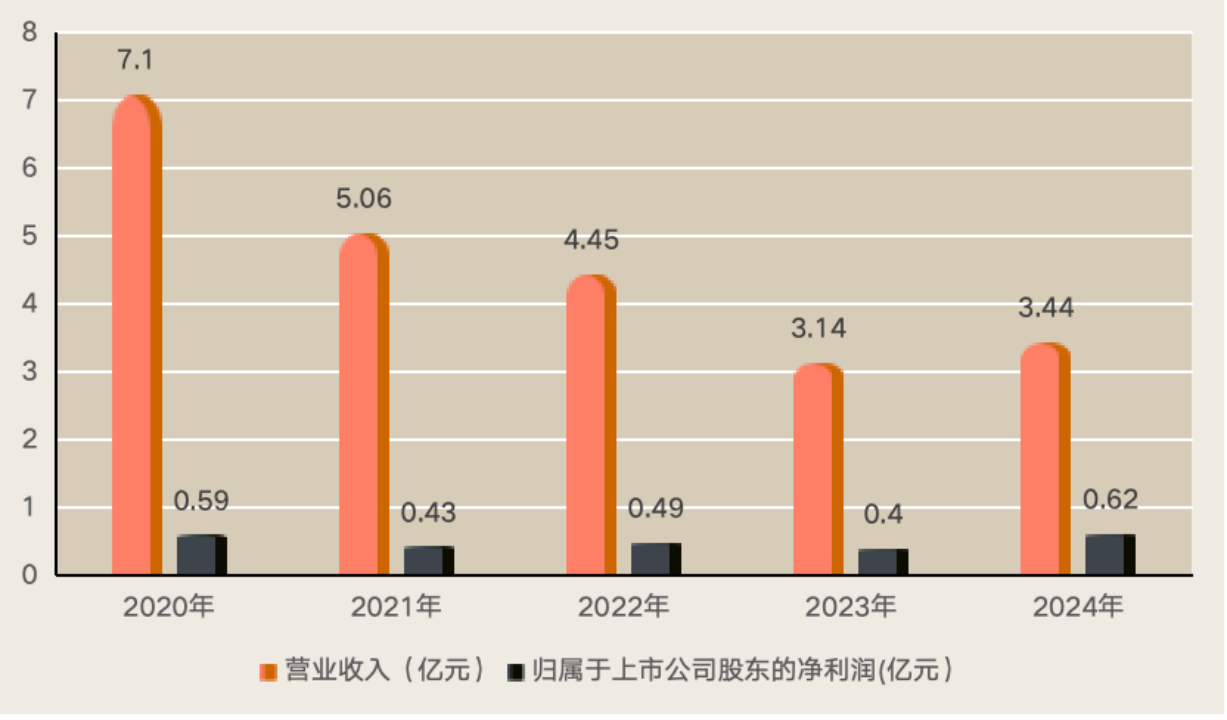
Core Viewpoint - The transfer of shares from Ren Guilong to Zheng Qingsheng has been completed, making Zheng the controlling shareholder of Jinzi Ham, which may lead to new strategic directions for the company [1][4][6]. Share Transfer Details - Ren Guilong transferred 145 million shares to Zheng Qingsheng, who now holds 11.98% of the company's shares and 18.83% of the voting rights, becoming the largest shareholder [1][5]. - The share transfer was valued at 870 million yuan [4][7]. Financial Performance - Since Ren Guilong took control in 2021, Jinzi Ham's revenue has been on a downward trend, although 2024 showed a year-on-year increase in revenue and net profit [2][12]. - In 2024, Jinzi Ham achieved approximately 344 million yuan in revenue, a 9.62% increase, and a net profit of about 62.17 million yuan, a 55.19% increase [13]. - Despite revenue growth, the gross margin for ham products decreased by 1.51% to 26.14% in 2024, indicating challenges in maintaining profitability [14][15]. Strategic Challenges - Jinzi Ham has been diversifying into various sectors since 2013, including mining, banking, e-commerce, and new energy vehicles, but these ventures have not significantly supported its performance [3][19]. - The company's total market value has halved from its peak, reflecting the impact of its strategic decisions [18][23]. Future Outlook - Zheng Qingsheng's background in real estate and automotive sectors raises questions about his ability to navigate the food industry, which may present both opportunities and risks for Jinzi Ham [7][9]. - The company plans to focus on cost reduction, sales expansion, and structural adjustments in 2025, with an emphasis on developing ham-related products [16][17].
老字号“皇上皇”腊味传奇,在抖音电商续写新篇
Guang Zhou Ri Bao· 2025-06-03 19:14
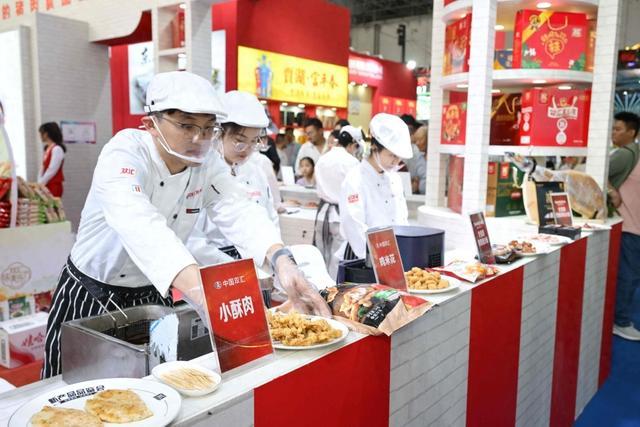
Core Viewpoint - The article highlights the transformation of the traditional brand "Huang Shang Huang" in Guangzhou, showcasing its adaptation to the digital age through e-commerce and live streaming, while maintaining its heritage and quality in producing Cantonese cured meats [1][2][4]. Group 1: Company Background - "Huang Shang Huang" was established in 1940 and has evolved from a small shop to a leading brand in Cantonese cured meats, recognized as a "hometown flavor" by many locals [2]. - The brand emphasizes the quality of its products, using a specific blend of pork cuts and traditional seasoning methods, which have been preserved over decades [2][3]. - The production process includes 13 traditional steps, ensuring the craftsmanship is maintained while integrating modern technology for efficiency [2][3]. Group 2: Technological Integration - The company has modernized its production with smart temperature and humidity control, increasing production efficiency by nearly 50% and reducing energy consumption by over 70% compared to traditional methods [3]. - A research and development base has been established to combine traditional techniques with digital control technologies, ensuring both flavor preservation and standardized production [3]. Group 3: E-commerce Strategy - In 2021, the brand recognized the shift in consumer demographics on platforms like Douyin (TikTok), targeting younger audiences by adjusting product sizes and packaging [4][5]. - The e-commerce team has grown from 3 to 13 members, with a focus on training and expertise in short video content creation [4][5]. - During a recent promotional event, the brand achieved a transaction volume of 22 million yuan, with a 90% increase in daily sales during the campaign [4][5]. Group 4: Market Expansion - The brand's consumer base on Douyin now sees 50% of sales coming from users aged 25 to 35, with 80% of customers located outside Guangdong province, indicating a successful national expansion [5][6]. - Multiple Douyin accounts have been established to cater to different demographics, successfully bridging the gap between traditional and modern consumer bases [6]. Group 5: Cultural Integration - The brand has effectively integrated its traditional craftsmanship into modern marketing strategies, using live streaming to showcase its heritage and engage younger consumers [5][6]. - The approach has transformed the perception of traditional brands, making them relevant in contemporary consumer culture while preserving their historical significance [6].
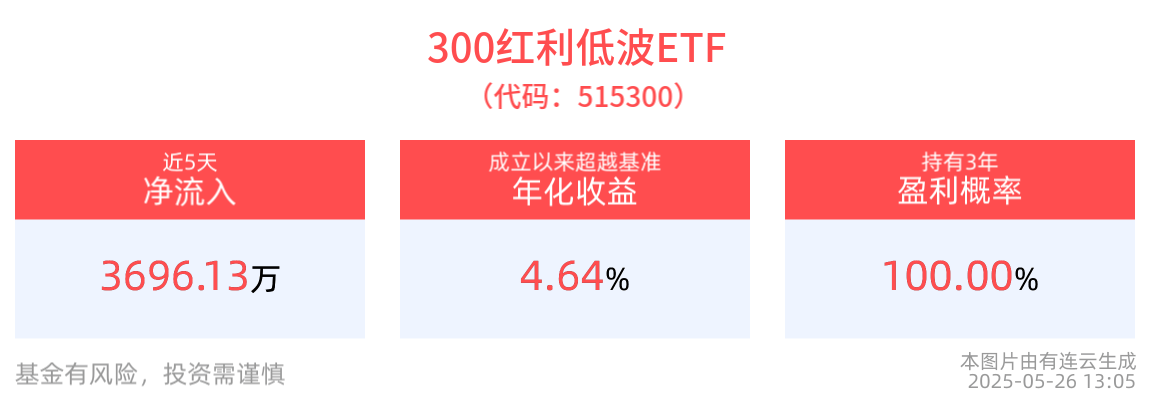
高股息资产投资价值有望延续,300红利低波ETF(515300)最新资金净流入超3000万元
Sou Hu Cai Jing· 2025-05-26 05:33
Group 1 - The CSI 300 Dividend Low Volatility Index decreased by 0.52% as of May 26, 2025, with mixed performance among constituent stocks [1] - Minsheng Bank led the gains with an increase of 0.72%, followed by Ninghu Expressway at 0.63% and China Unicom at 0.56%, while Shanghai Bank, Conch Cement, and Huayu Automotive experienced declines [1] - The CSI 300 Dividend Low Volatility ETF (515300) underwent a rebalancing adjustment [1] Group 2 - The CSI 300 Dividend Low Volatility ETF recorded a trading volume of 54.8688 million yuan during the session, with an average daily trading volume of 110 million yuan over the past week [3] - The latest scale of the CSI 300 Dividend Low Volatility ETF reached 5.643 billion yuan, with a net inflow of 30.3007 million yuan recently [3] - Over the past five trading days, there were three days of net inflows totaling 36.9613 million yuan [3] Group 3 - As of April 30, 2025, the top ten weighted stocks in the CSI 300 Dividend Low Volatility Index accounted for 37.43% of the index, including China Shenhua, Gree Electric, and Daqin Railway [3] - Dongfang Wealth Strategy suggests that the relative return probability of dividends remains high, with a potential marginal increase in stable dividend style profitability from Q2 to Q3 [3] - The micro liquidity environment is expected to limit the valuation elasticity of high sensitivity styles, supporting the relative return probability of stable dividend styles in the near future [3] Group 4 - According to estimates from Founder Securities, long-term holding of dividend assets shows a higher success rate compared to broad indices like the CSI 300, aligning with the long-term performance assessment direction of the "Action Plan for Promoting the High-Quality Development of Public Funds" [4] - Institutions indicate that dividend assets are a valuable investment direction for long-term investors, especially in the context of ongoing policy encouragement for long-term capital market entry [4] - Investors without stock accounts can access investment opportunities through the corresponding CSI 300 Dividend Low Volatility ETF linked fund (007606) [4]