Semiconductor

Search documents
云天励飞三季报:营收近翻倍、亏损收窄,推理芯片加速落地
Nan Fang Du Shi Bao· 2025-10-30 13:51
Core Viewpoint - Yuntian Lifei (688343.SH) continues to show strong operational performance, with significant revenue growth and improved cash flow, indicating a positive outlook for future strategic investments [1][3][4] Financial Performance - For the first three quarters of 2025, Yuntian Lifei reported a revenue of 0.951 billion yuan, representing a year-on-year increase of 97% [1] - The net profit after deducting non-recurring items showed a reduced loss of 1.59 billion yuan, narrowing the loss by 32% compared to the same period last year [1] - The net operating cash flow reached 0.195 billion yuan, continuing to improve after turning positive in the second quarter [1] Business Strategy and Development - Yuntian Lifei is focusing on the "AI inference chip + application ecosystem" strategy, enhancing its commercial capabilities and product system [4][5] - The company has developed a complete R&D system around the concept of "algorithm chipification," leading to the launch of various inference chips and models [4][5] - The business structure is organized around a "1+N" model, with a unified inference chip platform and multiple business directions, creating a synergistic value chain [5] Market Trends and Opportunities - The AI inference chip market is experiencing rapid growth, with the market size projected to increase from 11.3 billion yuan in 2020 to 162.6 billion yuan by 2024, reflecting a compound annual growth rate (CAGR) of 94.9% [5][6] - The NPU-driven market is also expected to grow significantly, from 0.5 billion yuan in 2020 to 26 billion yuan by 2024, with a CAGR of 72.3% [5][6] - The inference chip market is seen as a "blue ocean market," providing ample growth opportunities for domestic AI chip manufacturers [6] Competitive Advantages - Yuntian Lifei's long-term industry experience in instruction set design, domestic process adaptation, and Chiplet architecture positions it favorably in the inference chip competition [6] - The company's focus on continuous product iteration in real application scenarios helps refine its chip instruction sets and software systems, creating a sustainable competitive advantage [5][6] - Future plans include increasing R&D investment and strengthening ecosystem development to enhance the computing power system from edge to center [6]



How the job market could get ugly
Business Insider· 2025-10-30 13:46
Company Insights - Amazon announced layoffs of 14,000 employees, which, while significant, represent a small fraction of its total workforce of approximately 1.6 million [4][5] - The layoffs at Amazon have raised concerns about potential ripple effects across the white-collar job market, with fears that similar layoffs could occur at other companies [5][6] - The current job market is experiencing a "Great Freeze," where companies are hesitant to hire or fire, which could lead to cracks in the job market if layoffs continue without replacements [7] Industry Trends - The tech industry is seeing increased scrutiny regarding job losses attributed to artificial intelligence, with some experts suggesting that overhiring during the pandemic may be a more significant factor [8][9] - Nvidia reached a milestone as the first company to achieve a $5 trillion market capitalization, driven by substantial investments in data centers [15] - Major tech companies, including Google, Meta, and Microsoft, are ramping up spending on AI infrastructure, indicating a strong commitment to AI despite concerns about a potential bubble [17] Market Overview - Amazon's stock performance has lagged behind its peers, with a 43% increase over the past five years compared to Nvidia's 1,521% gain [13] - The Federal Reserve cut interest rates for the second time this year, which may provide relief to borrowers, although future cuts remain uncertain [14] - November is historically a strong month for the stock market, with positive expectations for this year as well [14]


学习笔记|推动科技自立自强,提升产业链安全性和竞争力
2 1 Shi Ji Jing Ji Bao Dao· 2025-10-30 13:29
Core Insights - The "15th Five-Year Plan" emphasizes the importance of technological self-reliance and innovation as key goals for economic and social development in China [2][3][6] - The plan aims to enhance the overall effectiveness of the national innovation system and promote deep integration of technological and industrial innovation [2][3] Group 1: Technological Innovation - The plan highlights the need for breakthroughs in key core technologies, including integrated circuits, advanced materials, and biomanufacturing [3][6] - It calls for a new type of national system to support technological advancements and strategic national needs [3][4] - The focus is on strengthening the role of enterprises in technological innovation and encouraging them to lead national research initiatives [3][4] Group 2: Talent Development - The "15th Five-Year Plan" aims to integrate education, technology, and talent development to foster a robust innovation ecosystem [4] - It emphasizes the need for a coordinated mechanism to enhance the interaction between technological innovation and talent cultivation [4] - The plan seeks to cultivate a diverse range of high-level talents, including strategic scientists and skilled engineers, to support innovation [4] Group 3: Emerging Industries - The plan identifies the cultivation of emerging and future industries as a critical focus area, including sectors like renewable energy and aerospace [5][6] - It advocates for the implementation of industry innovation projects to accelerate the development of strategic emerging industry clusters [5] - The plan also stresses the importance of exploring new technologies and business models to drive economic growth [6] Group 4: Risk Management and Investment - The plan suggests establishing mechanisms for risk-sharing and investment growth in future industries to support innovation [6] - It highlights the role of venture capital in fostering innovation and addressing the challenges of technological iteration [6] - The emphasis on self-reliance in technology is seen as a necessary response to rising international trade protectionism [6]
ChipMOS Technologies: Is In The Process Of Breaking Free Of Its Shackles
Seeking Alpha· 2025-10-30 12:39
Core Viewpoint - ChipMOS Technologies (IMOS) has faced significant challenges over the past year, with a gradual decline in earnings culminating in a difficult financial situation [1]. Company Summary - ChipMOS Technologies is a provider of outsourced semiconductor assembly and test (OSAT) services to the semiconductor industry [1]. - The company has experienced a downturn in earnings over the last 12 months, indicating potential operational or market challenges [1].


SemiAnalysis--X射线光刻能否颠覆ASML+TSMC芯片制造格局?
傅里叶的猫· 2025-10-30 12:33
Core Viewpoint - The article discusses the potential disruption in the semiconductor industry brought by Substrate, a startup aiming to innovate chip manufacturing through its new X-ray lithography (XRL) technology, which promises significant cost reductions and performance improvements compared to existing methods [5][10][30]. Group 1: Industry Context - The semiconductor manufacturing industry has been dominated by inertia, with leading companies hesitant to deviate from established technologies despite rising costs and slowing scaling speeds [5][7]. - Current lithography tools, such as EUV, are highly profitable, making companies reluctant to abandon existing systems, which creates opportunities for innovative newcomers like Substrate [7][10]. Group 2: Substrate's Technology - Substrate aims to provide technological support for next-generation wafer fabs, focusing on significantly lowering the production costs of advanced logic wafers through its proprietary XRL tools [8][10]. - The XRL technology claims to overcome historical challenges associated with X-ray lithography, such as optical system and light source issues, and has demonstrated impressive performance metrics, including a resolution comparable to High-NA EUV [10][12]. Group 3: Performance Metrics - Substrate's XRL tool reportedly achieves single-exposure capabilities for 2nm and 1nm nodes, with a patterning accuracy of 1.6nm and a critical dimension uniformity (CDU) of 0.25nm [10][12]. - The company asserts that its technology can reduce production costs by 50% compared to current methods, although this claim requires further validation [10][13]. Group 4: Market Implications - If successful, Substrate's XRL technology could reshape the lithography landscape, providing a cost-effective alternative to existing high-cost tools, thus enhancing design flexibility and potentially increasing transistor density [16][18]. - The global lithography equipment market is projected to reach approximately $50 billion by 2030, and Substrate's technology could capture significant market share if it achieves mass production [18][30]. Group 5: Strategic Goals - Substrate's long-term vision includes establishing its own wafer fabrication facility, integrating XRL technology into a complete end-to-end chip manufacturing process [14][24]. - The company aims to contribute to the localization of chip manufacturing in the U.S., addressing concerns over reliance on foreign production, particularly from Taiwan [23][24]. Group 6: Challenges Ahead - Despite the promising technology, Substrate faces significant hurdles, including the need for larger exposure field sizes, equipment stability, and full-process validation to ensure compatibility across multiple layers [28][29]. - The transition from laboratory technology to commercial production is complex and may take several years, with industry experts noting that achieving mass production could take until around 2030 [29][30].


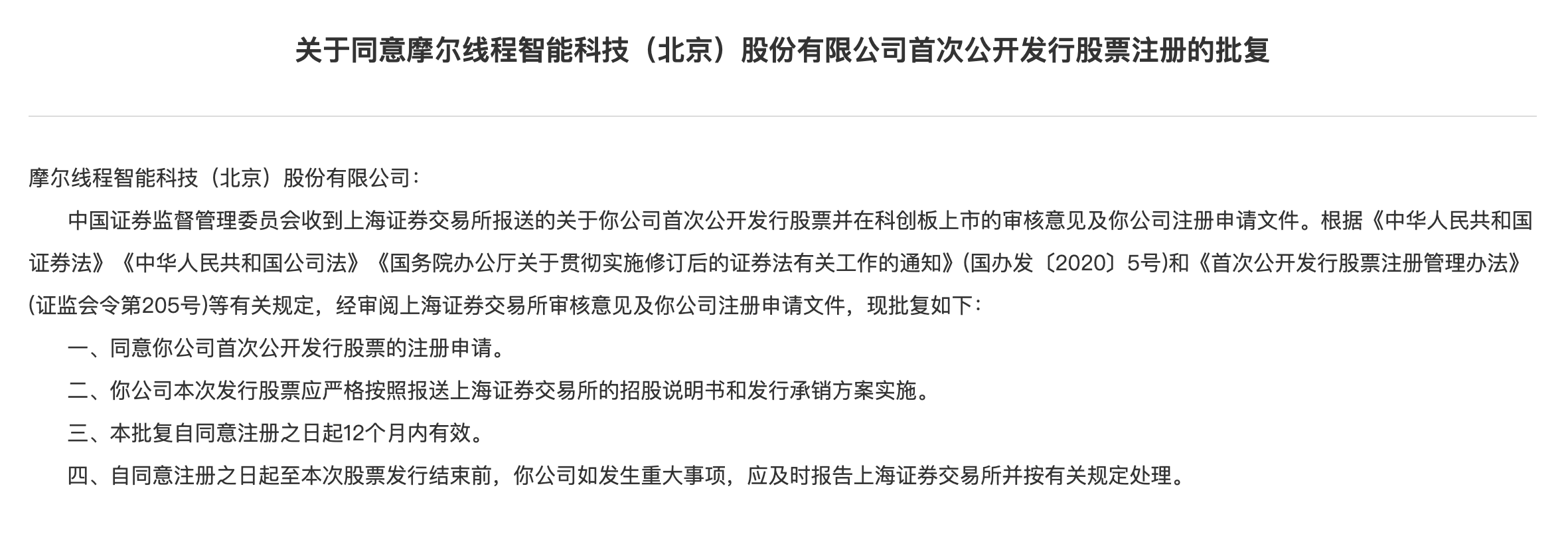
摩尔线程科创板IPO获得注册
Sou Hu Cai Jing· 2025-10-30 12:24
Core Viewpoint - Moore Threads is a representative enterprise of domestic AI chips, achieving technological breakthroughs in a single chip architecture that supports AI computing acceleration, graphics rendering, physical simulation, scientific computing, and ultra-high-definition video encoding and decoding based on its self-developed MUSA architecture [2] Group 1 - Moore Threads' IPO progress is rapid, with the listing application accepted on June 30, 2025 [2] - After two rounds of inquiries, the company's IPO was approved on September 26, and the registration was submitted on the same day [2]
广立微今年前三季度净利润同比增长380.14%
Zheng Quan Ri Bao Zhi Sheng· 2025-10-30 11:38
Group 1 - The core viewpoint of the article highlights that Hangzhou Guangli Microelectronics Co., Ltd. reported significant growth in revenue and net profit for the first three quarters of 2025, with a revenue of 428 million yuan, representing a year-on-year increase of 48.86%, and a net profit of 37.0172 million yuan, up 380.14% [1] - In the third quarter alone, the company achieved a revenue of 182 million yuan, marking a year-on-year growth of 57.31%, and a net profit of 21.333 million yuan, which is a substantial increase of 321.35% [1] - Guangli Micro is recognized as a leading supplier of integrated circuit EDA software and wafer-level electrical testing equipment, focusing on improving chip yield and rapid monitoring technology, and has become a key partner for many large integrated circuit manufacturing and design companies both domestically and internationally [1] Group 2 - To enhance its industrial layout, Guangli Micro acquired 100% of the shares of LUCEDA through its wholly-owned subsidiary SMTX TECHNOLOGIES SINGAPORE PTE. LTD., aiming to strategically position itself in silicon photonics technology [1] - LUCEDA is a global leader in the field of automated software for silicon photonic chip design, and it will serve as a core anchor for Guangli Micro's future layout in the silicon photonics industry, facilitating the company's expansion from traditional EDA to PDA [2] - The company plans to integrate the technological advantages of both parties in the integrated circuit and photonic chip sectors to gradually build a comprehensive solution covering all aspects of silicon photonic chip design, manufacturing, testing, and yield improvement [2]
ETF Areas to Buy on Fed Cuts and Trade Truce Optimism
ZACKS· 2025-10-30 11:25
Monetary Policy Impact - The Federal Reserve cut interest rates by a quarter percentage point for the second consecutive meeting, bringing the benchmark rate down to a range of 3.75%–4.00% [1] - The Fed will halt the reduction of its asset purchases effective December 1, ending the balance sheet runoff that began earlier this year [2] - Fed Chair Powell raised doubts about a further rate cut at the next meeting in December [2] Market Sentiment and Trade Relations - Hopes of easing U.S.–China trade tensions have lifted investor sentiment, with an understanding reached to pause new trade tensions and resume U.S. agricultural imports [3] - These developments are setting the stage for a likely rebound in risk assets and high-growth sectors [4] Sector-Specific Opportunities - **Technology**: Lower borrowing costs and reduced tariff tensions could boost the technology sector, particularly semiconductor and AI-driven companies, with ETFs like VanEck Semiconductor ETF (SMH) and Strive U.S. Semiconductor ETF (SHOC) expected to perform well [5] - **Growth Stocks**: Growth stocks typically outperform in a falling-rate environment, with ETFs like Invesco QQQ Trust (QQQ) and Vanguard Growth ETF (VUG) likely to surge amid an extended equity rally [6] - **Emerging Markets**: An improving U.S.–China relationship and a Fed rate cut are positive for emerging markets, with iShares MSCI Emerging Markets ETF (EEM) positioned favorably [7] - **Small Caps**: Smaller U.S. companies are expected to benefit from lower rates and increased consumer confidence, with iShares Russell 2000 Growth ETF (IWO) as a potential performer [8] - **High-Dividend**: High-dividend ETFs like Vanguard High Dividend Yield ETF (VYM) may provide steady income and become more attractive if bond yields fall [9] Future Outlook - A growing number of Fed officials favor holding off another rate cut, with traders reducing the probability of a December rate cut to 67% [11] - The ongoing AI-fueled market momentum is expected to continue, especially with the increased chance of a U.S.-China trade resolution [11]

Trump's Former Trade Chief Calls for 'Substantial' China Tariffs, Tech Curbs
Youtube· 2025-10-30 08:11
Economic Context - A successful trade deal must address both economic and national security contexts, with technology being a critical factor in both [1][3] - Maintaining substantial tariffs is essential to correct the unbalanced trade relationship with China, which has resulted in significant wealth transfer to China [2][15] National Security Concerns - The U.S. must avoid making concessions that could harm national security, particularly regarding technology transfers to China [3][5] - Export controls will remain a vital part of U.S. policy, ensuring that sensitive technology is not shared with China [7][18] Choke Points and Fentanyl - Addressing choke point issues is crucial to prevent economic disruptions for both the U.S. and China [4][9] - Fentanyl trafficking from China is a significant concern, with approximately 100,000 deaths annually in the U.S. attributed to it, and China has the capability to halt this flow if desired [10][11] Agricultural Trade - Soybeans are a key component of U.S. agricultural exports, making it important for China to purchase them, although this is less critical than tariffs and national security issues [12][14] Trade Imbalance - The U.S. should aim for balanced trade with China, avoiding large trade surpluses that have historically favored China [15][16] - The nature of Chinese investments in the U.S. should be carefully controlled, particularly in technology sectors, to protect national interests [17][19] Strategic Decoupling - A strategic decoupling between the U.S. and China is anticipated, focusing on maintaining a balanced relationship that prioritizes security and technology independence [24][25]

Small Cap Stocks Worth Watching – October 28th
Defense World· 2025-10-30 08:06
Group 1: Small Cap Stocks Overview - Seven small-cap stocks to watch include Beyond Meat, Spring Valley Acquisition, Strive, SEALSQ, VSee Health, Inflection Point Acquisition Corp. II, and Churchill Capital Corp X [2] - Small-cap stocks are defined as publicly traded companies with market capitalizations generally between $300 million and $2 billion [2] - These stocks are perceived to have higher growth potential but also come with increased volatility, lower liquidity, and greater business risk compared to mid- and large-cap stocks [2] Group 2: Beyond Meat Overview - Beyond Meat, Inc. specializes in developing, manufacturing, marketing, and selling plant-based meat products both in the United States and internationally [3] - The company offers a variety of plant-based meat products across beef, pork, and poultry categories [3] - Products are distributed through various channels including grocery stores, mass merchandisers, club stores, natural retailers, restaurants, foodservice outlets, and schools [3] Group 3: Other Companies Overview - Spring Valley Acquisition is a blank check company formed for the purpose of effecting a merger or similar business combination [7] - Strive (ASST) provides social media marketing and content delivery services across platforms like Discord and TikTok, focusing on community server management and investment education [4] - SEALSQ Corp designs and markets semiconductor chips globally, offering products such as secure elements and identity provisioning services [5]