
农产品加工

Search documents
事关中美经贸谈判,商务部最新回应
21世纪经济报道· 2025-08-28 10:20
Group 1: China-Africa Economic Cooperation - In the first seven months of this year, China's imports from the least developed African countries reached $39.66 billion, a year-on-year increase of 10.2% [2] - China supports the least developed African countries by providing 100% zero-tariff treatment on certain products, enhancing trade relations and facilitating the entry of African specialty products into the Chinese market [1][2] - Chinese enterprises are investing in Africa through overseas economic cooperation zones, focusing on sectors such as agricultural processing, home appliances, logistics, and new energy, thereby improving industrialization levels in Africa [2] Group 2: Green Development and Digital Economy - Chinese financial institutions are establishing special funds for green industrial chains, and numerous clean energy projects are being implemented in Africa to support its green development [3] - Initiatives such as the "Cloud Classroom" for e-commerce are being launched to cultivate digital talent in Africa, promoting deeper cooperation in the digital economy [3] Group 3: Future Directions - The Ministry of Commerce will continue to promote the "Ten Major Partnership Actions" to enhance economic integration and development collaboration between China and Africa [3]


小象超市在金华成立新公司 注册资本1000万
Xin Lang Cai Jing· 2025-08-28 09:18
天眼查工商信息显示,近日,金华象鲜科技有限公司成立,法定代表人为谢益军,注册资本1000万人民 币,经营范围包括餐饮管理、外卖递送服务、食用农产品初加工等。股东信息显示,该公司由小象超市 关联公司北京象鲜科技有限公司全资持股。 ...
商务部:前7个月中国自非洲最不发达国家进口额同比增长10.2%
Zhong Guo Xin Wen Wang· 2025-08-28 09:13
Group 1 - The core viewpoint of the article highlights the significant growth in trade between China and the least developed countries in Africa, with imports from these nations increasing by 10.2% year-on-year in the first seven months of the year, reaching $39.66 billion [1] - China actively supports the least developed African countries by providing zero-tariff treatment on 100% of product categories, facilitating the entry of unique African products into the Chinese market, which enriches consumer choices in China [1] - Notable products imported include avocados from Kenya, Arabica coffee beans from Ethiopia, and cocoa beans from Cameroon, which have contributed to the development of related industries in Africa [1] Group 2 - The article discusses how industrial chain cooperation is enhancing the quality and efficiency of investments in Africa, with Chinese enterprises establishing economic cooperation zones that foster industrial clusters and deepen investment in sectors like agricultural processing, home appliances, logistics, and renewable energy [2] - Chinese investments have increased the local processing rate in Africa from 15% to 45%, significantly contributing to the continent's industrialization and integration into global supply chains [2] - The International Monetary Fund's report indicates that trade between China and Africa contributes 1-2 percentage points to Africa's economic growth annually, underscoring the importance of this partnership [2] Group 3 - The article emphasizes the role of green development in fostering cooperation in emerging fields, with Chinese electric vehicles and photovoltaic products gaining popularity in African nations [2] - Chinese financial institutions are establishing special funds for green industrial chains, supporting numerous clean energy projects in Africa, which aligns with the continent's green development goals [2] - Initiatives such as the "Cloud Classroom" for e-commerce and the establishment of a digital verification platform for trade are aimed at enhancing digital talent in Africa and deepening digital economic cooperation between China and Africa [2]
宏辉果蔬(603336) - 2025年第二季度主要经营数据公告
2025-08-28 08:46
宏辉果蔬股份有限公司 二、报告期内主要产品销量及同比增减情况 产品单位:吨 | 证券代码:603336 | 证券简称:宏辉果蔬 | 公告编号:2025-053 | | --- | --- | --- | | 转债代码:113565 | 转债简称:宏辉转债 | | 2025 年第二季度主要经营数据公告 本公司董事会及全体董事保证本公告内容不存在任何虚假记载、误导性陈述 或者重大遗漏,并对其内容的真实性、准确性和完整性承担个别及连带责任。 宏辉果蔬股份有限公司(以下简称"公司")根据《上市公司行业信息披露指 引第一号——一般规定》,现将公司 2025 年第二季度主要经营数据(未经审计) 公告如下: 一、报告期内主要产品产量及同比增减情况 注:肉类贸易的产量为该业务采购量。 以上生产经营数据来自公司内部统计,仅供投资者及时了解本公司生产经营 概况,该数据未经审计,敬请投资者审慎使用。 特此公告。 宏辉果蔬股份有限公司董事会 2025 年 8 月 29 日 2 三、报告期末主要产品库存量及同比增减情况 四、其他说明 | 品种 | 2025 | 年 | 2024 | 年 | 同期增减 | 2025 | 年 | 2024 ...

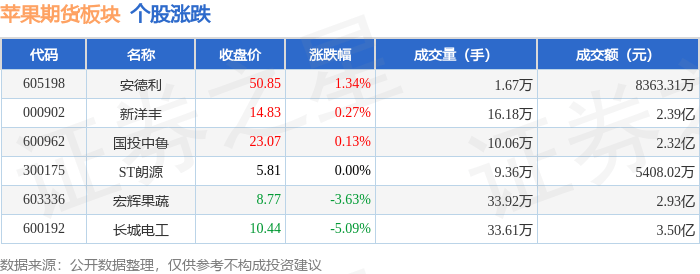
苹果期货板块8月28日跌0.41%,长城电工领跌,主力资金净流出1.24亿元
Sou Hu Cai Jing· 2025-08-28 08:45
Core Viewpoint - The apple futures sector experienced a decline of 0.41% on August 28, with Changcheng Electric leading the drop, while the Shanghai Composite Index rose by 1.14% and the Shenzhen Component Index increased by 2.25% [1] Group 1: Market Performance - The closing price for the apple futures sector stocks showed mixed results, with notable declines in Changcheng Electric by 5.09% and Honghui Fruits and Vegetables by 3.63% [1] - The trading volume for the apple futures sector was significant, with An Deli recording a volume of 16,700 and a transaction value of 83.63 million yuan [1] Group 2: Capital Flow - The apple futures sector saw a net outflow of 124 million yuan from main funds, while retail investors contributed a net inflow of 128 million yuan [1] - Detailed capital flow data indicated that ST Langyuan had a main fund net outflow of 7.92 million yuan, while retail investors contributed a net inflow of 4.97 million yuan [2]


农产品加工板块8月28日涨0%,*ST中基领涨,主力资金净流出2.86亿元
Zheng Xing Xing Ye Ri Bao· 2025-08-28 08:43
Group 1 - The core viewpoint indicates that the agricultural processing sector experienced a slight increase of 0.0% on August 28, with *ST Zhongji leading the gains [1] - The Shanghai Composite Index closed at 3843.6, up by 1.14%, while the Shenzhen Component Index closed at 12571.37, up by 2.25% [1] Group 2 - In terms of capital flow, the agricultural processing sector saw a net outflow of 286 million yuan from main funds, while retail funds had a net inflow of 221 million yuan [2] - Speculative funds recorded a net inflow of approximately 64.59 million yuan [2]


商务部:今年上半年离境退税销售额同比增长95%
智通财经网· 2025-08-28 08:21
Group 1: Inbound Consumption and Economic Cooperation - The Ministry of Commerce is actively expanding inbound consumption, optimizing tax refund policies, and enhancing payment channels, leading to over 19 million inbound foreign visitors in the first half of the year, a 30% increase year-on-year [1][7] - The number of tax refund stores has increased significantly, with tax refund sales rising by 95% year-on-year [1][7] - China is enhancing cooperation with African countries through investment in various sectors, including agriculture, logistics, and renewable energy, contributing to local industrialization and increasing resource product value [1][5] Group 2: Trade and Investment Highlights - China supports the least developed African countries with zero-tariff treatment on 100% of product categories, resulting in a 10.2% year-on-year increase in imports from these countries, totaling $39.66 billion from January to July [5] - Chinese investments have improved Africa's local processing rate from 15% to 45%, contributing 1-2 percentage points to Africa's economic growth annually [1][5] Group 3: Green Development and Digital Economy - Chinese companies are implementing numerous clean energy projects in Africa, and there is a focus on developing digital economy cooperation through training and platforms [6] - The Ministry of Commerce aims to continue promoting the "Ten Partnership Actions" to enhance economic integration and development between China and Africa [6]
市场购销较清淡 油菜籽期货盘中低位震荡运行为主
Jin Tou Wang· 2025-08-28 07:09
8月27日,加拿大菜籽(10月船期)C&F价格542美元/吨,与上个交易日相比下调3美元/吨;加拿大菜籽 (12月船期)C&F价格532美元/吨,与上个交易日相比下调3美元/吨。 8月28日,国内期市油脂油料板块全线飘绿。其中,油菜籽期货盘中低位震荡运行。截止发稿,油菜籽 主力合约报4731.00元/吨,大幅走低2.33%。 市场资讯: 加拿大油籽加工商协会(COPA):2025年7月,加拿大油菜籽压榨量为968515.0吨,环比升13.13%。 农村农业部:7月国内外食用植物油价格普遍上涨。国内市场油菜籽上市量和花生库存量均继续减少, 市场购销清淡,价格以稳为主。 监测数据显示,截至2025年第34周末,国内进口油菜籽库存总量为19.2万吨,较上周的23.7万吨减少4.5 万吨。去年同期库存为47.7万吨,五周平均库存为18.7万吨。 分析师预计,加拿大在2025/26年度的油菜籽产量将达到580万吨至720万吨,远高于10年平均水平480万 吨和去年的610万吨。 ...
2025山东名优特精农产品发布暨“齐鲁农超”建设推进会举行
Qi Lu Wan Bao Wang· 2025-08-28 06:49
Core Viewpoint - The event held on August 28 in Jinan, Shandong, aimed to promote agricultural consumption and showcase high-quality agricultural products from Shandong, enhancing the influence of the "Qilu Agricultural Supermarket" brand and demonstrating achievements in rural revitalization strategies [1][3]. Group 1: Event Overview - The event was guided by the Shandong Provincial Department of Agriculture and Rural Affairs, organized by Dazhong Media Group and Lushang Group, and hosted by Shandong Qilu Agricultural Supermarket Technology Co., Ltd. [3]. - Nearly 200 participants attended, including representatives from 16 cities in Shandong, well-known agricultural product distribution companies, major supermarket buyers, e-commerce platform representatives, and outstanding enterprises [1][3]. Group 2: Industry Development - Shandong has over 11,000 large-scale agricultural processing enterprises with a revenue of 2.3 trillion yuan, accounting for one-tenth of the national total, and 151 national key leading enterprises [5]. - The province has developed ten industrial clusters, including Yantai apples and Yellow River beef, and established 19 modern agricultural industrial parks and 122 strong agricultural towns [5]. Group 3: Future Plans - Shandong aims to create a higher-level "Qilu Granary" and accelerate the formation of a new rural industrial development pattern that is safe, complete, green, low-carbon, and beneficial to farmers [7]. - The "Qilu Agricultural Supermarket" platform, launched in August 2023, has gathered nearly 5,600 quality agricultural enterprises and integrated over 100 high-quality products from 16 cities [9]. Group 4: Marketing Initiatives - The event introduced various marketing activities both online and offline, including digital currency promotions and a "flowing exhibition + on-site experience" model for showcasing Shandong products [9]. - The "Qilu Agricultural Supermarket" will focus on five areas for future development: integration of primary, secondary, and tertiary industries, supply chain optimization, digital upgrades, brand matrix deepening, and market expansion [9].

国富期货早间看点-20250828
Guo Fu Qi Huo· 2025-08-28 06:41
Report Industry Investment Rating - Not mentioned in the provided content Core Viewpoints of the Report - The export volume of Malaysian palm oil products from August 1 - 25, 2025, increased by 36.41% compared to the same period last month. The cool weather in the US Midwest will continue until next week, with several precipitation events expected, but dry conditions in some areas may lead to a decline in crop yields. The futures market had a net capital inflow of 12.44 billion yuan on August 27, 2025, with a net outflow in commodity futures and an inflow in stock index futures [1][5][7][23] Summary by Relevant Catalogs 01 Overnight Market Quotes - The closing prices and percentage changes of various commodities such as Malaysian palm oil, Brent crude oil, and US soybeans are presented. The exchange rates of the US dollar index and multiple currencies are also provided [1] 02 Spot Market Quotes - Spot prices, basis, and basis changes of DCE palm oil, DCE soybean oil, and DCE soybean meal are given. CNF quotes and CNF premium changes for imported soybeans are also included [2] 03 Important Fundamental Information - Production Area Weather - The future weather outlook for US soybean - producing states from September 1 - 5 shows generally low temperatures and above - median precipitation. The cool weather in the US Midwest will continue until next week, with precipitation expected, but dry conditions in the south and east may cause a decline in crop yields [3][5] - International Supply and Demand - Malaysian palm oil exports from August 1 - 25, 2025, increased by 36.41% compared to the same period last month. The Malaysian palm oil industry calls for the government to reinvest windfall profit tax revenue and adjust the tax threshold. Ghana plans to narrow the gap between palm oil production and consumption. Analysts predict US soybean, soybean meal, and soybean oil export sales. Brazilian farmers are preparing for the 2025/26 planting season, and the soybean harvest in Goiás state in 2024/25 reached a record high. Low soybean meal prices have affected South American crushing margins. Canadian rapeseed crushing data for July 2025 are provided, and Australia's rapeseed production forecast is given. The Baltic Dry Index rose for the third consecutive day [7][9][10][11][12] - Domestic Supply and Demand - On August 27, 2025, the total trading volume of soybean oil and palm oil increased by 6% compared to the previous trading day. The trading volume of soybean meal decreased, and the operating rate of oil mills declined. The "Agricultural Product Wholesale Price 200 Index" and the "Vegetable Basket Product Wholesale Price Index" increased, while the average pork price decreased [15] 04 Macroeconomic News - International News - The probability of the Fed keeping interest rates unchanged in September is 11.3%, and the probability of a 25 - basis - point rate cut is 88.7%. US mortgage application and oil reserve data are provided. The EU plans to accelerate the legislative process to fully cancel tariffs on US industrial products [18] - Domestic News - On August 27, 2025, the US dollar/renminbi exchange rate was lowered. The central bank conducted 379.9 billion yuan of 7 - day reverse repurchase operations, resulting in a net withdrawal of 236.1 billion yuan. In July, the operating income of large - scale industrial enterprises increased year - on - year, and the profit decline narrowed [20] 05 Capital Flows - On August 27, 2025, the futures market had a net capital inflow of 12.44 billion yuan, with a net outflow of 3.107 billion yuan in commodity futures and a net inflow of 15.546 billion yuan in stock index futures [23] 06 Arbitrage Tracking - Not mentioned in the provided content