
酒店餐饮

Search documents
餐饮行业动态点评:从瑞幸和百胜中国看外卖补贴大战的得与失
Guoxin Securities· 2025-11-19 07:56
Investment Rating - The report maintains an "Outperform" rating for the industry [2][6][21] Core Insights - The external competition environment differs significantly between Luckin Coffee and Yum China, impacting their profit margins amid the delivery subsidy war [5][15][16] - Yum China's revenue and profit have improved through leveraging delivery services, while Luckin Coffee has seen high revenue growth but profit pressure due to rising delivery costs [4][6][21] - The report emphasizes that online delivery and offline dining can coexist, suggesting that a balanced approach is ideal for maximizing revenue and customer experience [6][21] Summary by Sections Company Performance - Luckin Coffee reported a revenue of 15.29 billion yuan, a year-on-year increase of 50.2%, with an operating profit of 1.78 billion yuan, up 12.9%. However, net profit decreased by 2.7% to 1.28 billion yuan due to increased delivery costs, which rose by 211.4% to 2.89 billion yuan, accounting for 18.9% of total revenue [4][7][11] - Yum China achieved a revenue of 3.206 billion USD, a 4.4% increase, with an operating profit of 400 million USD, up 7.8%. Net profit fell by 5.1% to 282 million USD, primarily due to investment losses rather than operational issues. Delivery sales increased by 32%, making up 51% of restaurant revenue [4][11][21] Competitive Strategies - The report highlights that Yum China's membership sales, which account for about 60% of its revenue, help mitigate the impact of third-party delivery commissions. In contrast, Luckin Coffee is enhancing its own app capabilities to retain customer traffic and reduce reliance on third-party platforms [5][15][16] - The report suggests that both companies' strategies in the delivery market provide valuable lessons for other dining enterprises, with Yum China's approach being particularly effective in maintaining profit margins [6][21] Recommendations - The report recommends focusing on companies like Xiaocaiyuan, Guoquan, Guming, Mixue Group, Haidilao, and Yum China, while suggesting to pay attention to Green Tea Group, Dashishi, Tongqinglou, Guangzhou Restaurant, Jiumaojiu, Chabaidao, and Hushang Ayi [6][21][22]


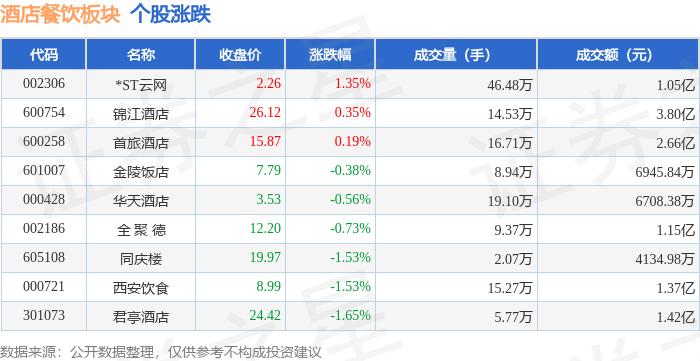
酒店餐饮板块11月18日跌0.21%,君亭酒店领跌,主力资金净流出1984.57万元
Zheng Xing Xing Ye Ri Bao· 2025-11-18 08:11
Market Overview - The hotel and catering sector experienced a decline of 0.21% on November 18, with Junting Hotel leading the drop [1] - The Shanghai Composite Index closed at 3939.81, down 0.81%, while the Shenzhen Component Index closed at 13080.49, down 0.92% [1] Stock Performance - Notable stock performances include: - *ST Yunwang: Closed at 2.26, up 1.35% with a trading volume of 464,800 shares and a turnover of 105 million yuan - Jinjiang Hotel: Closed at 26.12, up 0.35% with a trading volume of 145,300 shares and a turnover of 380 million yuan - Shoulv Hotel: Closed at 15.87, up 0.19% with a trading volume of 167,100 shares and a turnover of 266 million yuan - Junting Hotel: Closed at 24.42, down 1.65% with a trading volume of 57,700 shares and a turnover of 142 million yuan [1] Capital Flow - The hotel and catering sector saw a net outflow of 19.84 million yuan from institutional investors, while retail investors had a net inflow of 21.59 million yuan [1] - Detailed capital flow for key stocks includes: - Jinjiang Hotel: Net inflow of 22.57 million yuan from institutional investors, but a net outflow of 25.98 million yuan from retail investors [2] - Shoulv Hotel: Net outflow of 3.74 million yuan from institutional investors, with a net inflow of 4.68 million yuan from retail investors [2] - Junting Hotel: Net outflow of 1.01 million yuan from institutional investors, with a net inflow of 3.92 million yuan from retail investors [2]


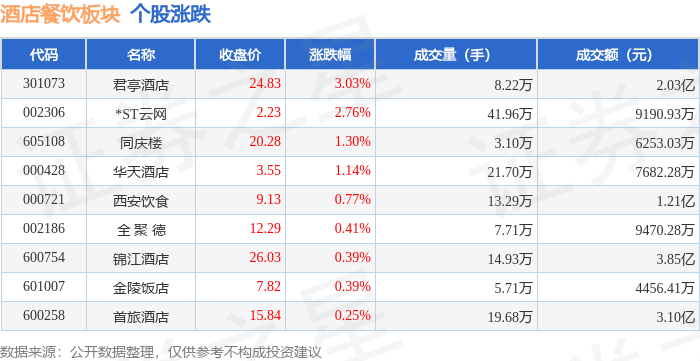
酒店餐饮板块11月17日涨0.72%,君亭酒店领涨,主力资金净流出2527.52万元
Zheng Xing Xing Ye Ri Bao· 2025-11-17 08:49
Market Overview - The hotel and catering sector increased by 0.72% on November 17, with Junting Hotel leading the gains [1] - The Shanghai Composite Index closed at 3972.03, down 0.46%, while the Shenzhen Component Index closed at 13202.0, down 0.11% [1] Stock Performance - Junting Hotel (301073) closed at 24.83, up 3.03% with a trading volume of 82,200 lots and a transaction value of 203 million [1] - Other notable performers included *ST Yunwang (002306) with a 2.76% increase, and Tongqinglou (605108) with a 1.30% increase [1] - The overall trading data for the hotel and catering sector is summarized in a table, highlighting various stocks' closing prices, percentage changes, trading volumes, and transaction values [1] Capital Flow - The hotel and catering sector experienced a net outflow of 25.28 million from institutional investors and 14.91 million from retail investors, while individual investors saw a net inflow of 40.19 million [1] - Detailed capital flow data for individual stocks indicates varying levels of net inflow and outflow among different companies, with Junting Hotel showing a net inflow of 8.03 million from institutional investors [2] - Notably, Qianjude (002186) had a significant net outflow of 9.79 million from institutional investors, while Shoulu Hotel (600258) saw a net inflow of 22.35 million from retail investors [2]


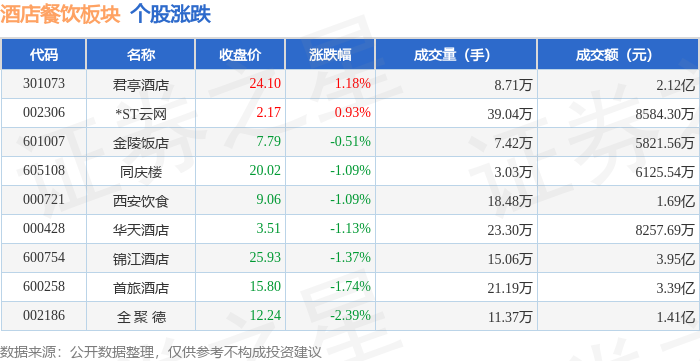
酒店餐饮板块11月14日跌1.22%,全聚德领跌,主力资金净流出3346.64万元
Zheng Xing Xing Ye Ri Bao· 2025-11-14 08:58
Market Overview - The hotel and catering sector experienced a decline of 1.22% on November 14, with Quanjude leading the drop [1] - The Shanghai Composite Index closed at 3990.49, down 0.97%, while the Shenzhen Component Index closed at 13216.03, down 1.93% [1] Stock Performance - Key stocks in the hotel and catering sector showed varied performance, with Junting Hotel increasing by 1.18% to a closing price of 24.10, while Quanjude fell by 2.39% to 112.24 [1] - The trading volume and turnover for Junting Hotel were 87,100 shares and 212 million yuan, respectively [1] Capital Flow - The hotel and catering sector saw a net outflow of 33.47 million yuan from institutional investors and 24.86 million yuan from retail investors, while retail investors had a net inflow of 58.33 million yuan [1] - Specific stock capital flows indicated that Quanjude had a significant net outflow of 16.11 million yuan from institutional investors, while retail investors contributed a net inflow of 30.62 million yuan [2]
酒店餐饮板块11月13日涨0.36%,华天酒店领涨,主力资金净流出1.18亿元
Zheng Xing Xing Ye Ri Bao· 2025-11-13 08:45
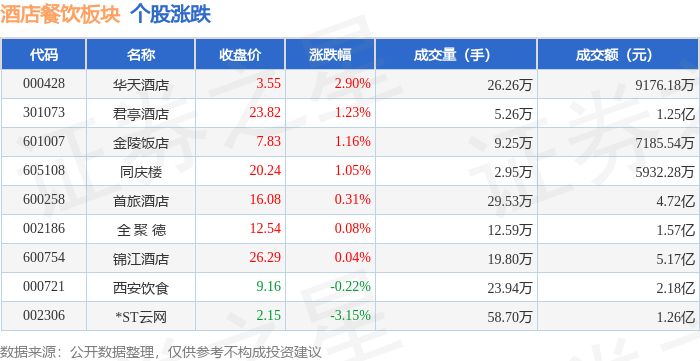
Market Overview - The hotel and catering sector increased by 0.36% on November 13, with Huatian Hotel leading the gains [1] - The Shanghai Composite Index closed at 4029.5, up 0.73%, while the Shenzhen Component Index closed at 13476.52, up 1.78% [1] Individual Stock Performance - Huatian Hotel (000428) closed at 3.55, up 2.90% with a trading volume of 262,600 shares and a turnover of 91.76 million yuan [1] - Junting Hotel (301073) closed at 23.82, up 1.23% with a trading volume of 52,600 shares and a turnover of 125 million yuan [1] - Jinling Hotel (601007) closed at 7.83, up 1.16% with a trading volume of 92,500 shares and a turnover of 71.85 million yuan [1] - Tongqinglou (605108) closed at 20.24, up 1.05% with a trading volume of 29,500 shares and a turnover of 59.32 million yuan [1] - Shoulv Hotel (600258) closed at 16.08, up 0.31% with a trading volume of 295,300 shares and a turnover of 472 million yuan [1] - Quanjude (002186) closed at 12.54, up 0.08% with a trading volume of 125,900 shares and a turnover of 157 million yuan [1] - Jinjiang Hotel (600754) closed at 26.29, up 0.04% with a trading volume of 198,000 shares and a turnover of 517 million yuan [1] - Xianyin Food (000721) closed at 9.16, down 0.22% with a trading volume of 239,400 shares and a turnover of 21.8 million yuan [1] - ST Yunwang (002306) closed at 2.15, down 3.15% with a trading volume of 587,000 shares and a turnover of 126 million yuan [1] Capital Flow Analysis - The hotel and catering sector experienced a net outflow of 118 million yuan from institutional investors, while retail investors saw a net inflow of 188 million yuan [1] - The detailed capital flow for individual stocks shows that Huatian Hotel had a net inflow of 10.37 million yuan from institutional investors, while it faced a net outflow from retail investors of 7.87 million yuan [2] - Quanjude experienced a significant net outflow of 20.51 million yuan from institutional investors, but a net inflow of 34.91 million yuan from retail investors [2] - Jinjiang Hotel had a net outflow of 43.72 million yuan from institutional investors, with a net inflow of 52.48 million yuan from retail investors [2]
华天酒店涨2.32%,成交额5559.43万元,主力资金净流入370.39万元
Xin Lang Cai Jing· 2025-11-13 06:28
Core Viewpoint - Huatian Hotel's stock has shown a positive trend with a year-to-date increase of 10.31%, despite a decline in revenue and net profit for the first nine months of 2025 [1][2]. Financial Performance - As of September 30, 2025, Huatian Hotel reported a revenue of 398 million yuan, a year-on-year decrease of 12.52%, and a net profit of -156 million yuan, a decline of 39.99% [2]. - The company has not distributed any dividends in the past three years, with a total payout of 328 million yuan since its A-share listing [3]. Stock Market Activity - On November 13, Huatian Hotel's stock price rose by 2.32% to 3.53 yuan per share, with a trading volume of 55.59 million yuan and a turnover rate of 1.57% [1]. - The stock has appeared on the "Dragon and Tiger List" three times this year, with the most recent appearance on September 23, where it recorded a net buy of 321,900 yuan [1]. Shareholder Information - As of September 30, 2025, the number of shareholders increased to 46,100, with an average of 22,114 shares per shareholder, a decrease of 1.91% from the previous period [2]. - The top three circulating shareholders include the Fortune China Securities Tourism Theme ETF, holding 10.44 million shares, and Jinyuan Shun'an Yuanqi Flexible Allocation Mixed Fund, holding 4.14 million shares [3]. Business Composition - Huatian Hotel's main business revenue breakdown is as follows: 34.69% from dining, 32.85% from guest rooms, 30.87% from other services, and 1.59% from entertainment [1]. Industry Classification - Huatian Hotel is classified under the Shenwan industry as part of the social services sector, specifically in hotel and catering services [2]. The company is associated with concepts such as online tourism, tourism hotels, and pre-prepared dishes [2].
餐饮行业专题报告:餐饮外卖业务,蜜糖还是砒霜?
Guoxin Securities· 2025-11-13 05:13
Investment Rating - The report maintains an "Outperform" rating for the restaurant industry [4]. Core Insights - The restaurant industry is transitioning from extensive expansion to a new phase of steady growth, with a 3.3% year-on-year increase in cumulative revenue from January to September 2025, which is lower than the growth rate of social retail sales [14][15]. - The importance of online channels, particularly food delivery, is increasingly recognized as traditional shopping district advantages diminish and foot traffic conversion rates decline [20][26]. - Different restaurant formats exhibit varying degrees of adaptability to food delivery, with beverage and fast food categories showing the highest compatibility, while hot pot restaurants have the lowest [33][39]. Summary by Sections New Changes - The online channel's significance is becoming more pronounced, with a 22.8% share of the national restaurant revenue attributed to the food delivery market, which is projected to reach approximately 1.3 trillion yuan in 2024 [20][21]. - The number of new shopping centers opened in 2024 fell to a ten-year low, indicating a retreat of traditional shopping district advantages [15]. Adaptability of Different Formats - The adaptability of various restaurant formats to food delivery is ranked as follows: beverage and fast food > casual dining > hot pot, with delivery revenue proportions reaching 60-70% for fast food and beverages, while casual dining ranges from 15-40% [33][39]. - The compatibility of restaurant formats with food delivery is influenced by the type of consumer demand, frequency of consumption, and the complexity of supply and delivery [36][39]. Balancing Delivery and Dine-in - A healthy balance between delivery and dine-in is crucial for restaurant brands, with optimal delivery revenue proportions estimated at 30-40% for casual dining and up to 60-70% for fast food and beverages [2][3]. - Brands that overly rely on delivery may risk losing brand recognition and profitability, emphasizing the need for a strategic approach to manage both channels effectively [2][3]. Investment Recommendations - The report recommends focusing on companies that can effectively balance online and offline strategies, highlighting brands like Xiaocaiyuan, Gu Ming, and Meituan-W as key players in the industry [4][8].
酒店餐饮板块11月12日跌0.49%,全聚德领跌,主力资金净流出2.29亿元
Zheng Xing Xing Ye Ri Bao· 2025-11-12 08:44
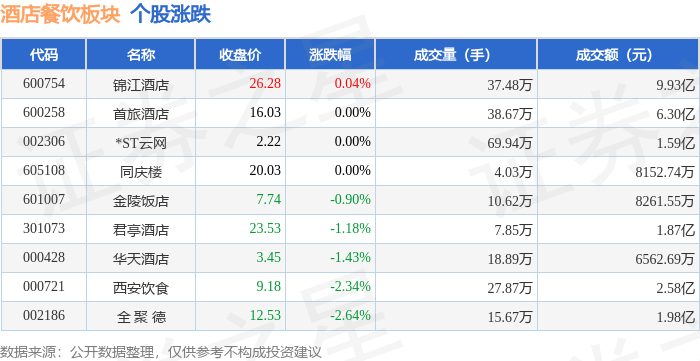
Core Insights - The hotel and catering sector experienced a decline of 0.49% on November 12, with Quan Juding leading the drop [1] - The Shanghai Composite Index closed at 4000.14, down 0.07%, while the Shenzhen Component Index closed at 13240.62, down 0.36% [1] Sector Performance - The hotel and catering sector's individual stock performance showed varied results, with Quan Juding down 2.64% to 12.53, and Jinling Hotel down 0.90% to 7.74 [1] - The trading volume for Jinjiang Hotels was 374,800 shares, with a closing price of 26.28, reflecting a slight increase of 0.04% [1] Capital Flow Analysis - The hotel and catering sector saw a net outflow of 229 million yuan from institutional investors and 111 million yuan from retail investors, while retail investors had a net inflow of 340 million yuan [1] - Specific stocks like Quan Juding and Huatian Hotels experienced significant net outflows from institutional and speculative funds, indicating a shift in investor sentiment [2]
颜廷利教授解读:五星级酒店40元剩菜盲盒背后的消费逻辑与时代隐喻
Sou Hu Cai Jing· 2025-11-11 16:40
Core Insights - The emergence of blind box dining experiences, such as the 40 yuan dinner box at Hangzhou Guoshou Junlan Hotel, reflects a deeper transformation in contemporary Chinese consumer society, representing a marketing breakthrough and a social experiment in "value reconstruction" [1][2] Group 1: Blind Box Economy - The traditional blind box economy, centered around "unknown surprises," has evolved into a paradigm shift from entertainment consumption to survival wisdom, as evidenced by the 40 yuan blind box containing high-end food items like hairy crabs and roasted ducks [2][5] - The data indicates that over 200 blind boxes were sold in the first week of the promotion, with 65% of buyers being young white-collar workers aged 25-35, who are forming a unique subculture of "smart consumers" on social media [2][4] Group 2: Surplus Value and Environmental Ethics - The concept of "surplus" has transformed from an economic term to a practice of environmental ethics, with the hotel converting an 18% food waste rate into sellable products, reducing carbon emissions by 2.57 kg per box, equivalent to saving 250 disposable chopsticks [5][6] - The Hilton Hotel in Shenzhen exemplifies this with a 79 yuan blind box containing a 200 yuan buffet, utilizing a strict time window for collection to ensure freshness and create scarcity, merging environmental actions with consumer enjoyment [5][6] Group 3: Spatial Politics - The introduction of blind boxes is reshaping the spatial politics of high-end hotels, compressing traditional hierarchical consumption into a more accessible format, as seen in the 28 yuan lunch box at Shanghai Hongqiao Accor Hotel, allowing consumers to mix and match dishes [5][6] - The Zhengzhou Yonghe Earl International Hotel's 19.9 yuan lunch box allows consumers to maximize food within limited space, representing a micro-practice of spatial justice that is more persuasive than political declarations [6] Group 4: Consumer Revolution - The blind box phenomenon is part of an ongoing consumer revolution in China, challenging traditional consumption values and prompting a re-examination of the essence of value in a materially abundant society [6]
商社美护行业周报:10月CPI表现超预期,离岛免税新政落地海南免税消费市场升温-20251111
Guoyuan Securities· 2025-11-11 14:43
Investment Rating - The report maintains an "Overweight" rating for the industry, with a focus on new consumption sectors such as beauty care, IP derivatives, and gold jewelry [6][29]. Core Insights - The October CPI performance exceeded expectations, with a year-on-year increase of 0.2%, higher than the consensus forecast of -0.04%. The core CPI, excluding food and energy, rose by 1.2%, marking the highest increase since March 2024 [4][24]. - The implementation of the new duty-free policy in Hainan has led to a surge in tourism consumption, with duty-free shopping amounting to 506 million yuan from November 1 to 7, representing a year-on-year growth of 34.86% [5][27]. - Key events in the beauty care sector include Kimberly-Clark's acquisition of Kenvue, expected to complete in the second half of 2026, and Amorepacific's Q3 operating profit increasing by 41% [4][24]. Summary by Sections Market Performance - For the week of November 3 to November 7, the retail trade, social services, and beauty care sectors saw changes of +0.31%, +0.11%, and -3.10% respectively, ranking 17th, 19th, and 31st among 31 primary industries [15][17]. Key Industry Data and News - The beauty care sector is highlighted by Kimberly-Clark's acquisition of Kenvue and Amorepacific's significant profit increase. Additionally, new medical devices have received regulatory approval [4][24]. - In the travel sector, the number of domestic flights increased by 4.9% compared to 2019, with a total of approximately 101,000 flights executed in the week [5][24]. - The IP derivatives market is seeing growth, with significant sales expected from the film "Wang Wang Mountain" and new store openings in the toy sector [5][28]. Investment Recommendations - The report recommends focusing on companies such as Shangmei Co., Juzhibio, Marubi, Runben, Proya, Chaohongji, and Furuida within the beauty care and new consumption sectors [6][29].