运输

Search documents
中国神华披露公司章程,明确公司治理与运营规范
Xin Lang Cai Jing· 2025-08-29 17:33
Core Viewpoint - China Shenhua Energy Co., Ltd. has released its latest company charter, which was approved by the first extraordinary general meeting of shareholders in 2025, marking the most recent revision since its initial approval in 2005 [1] Company Overview and Operations - China Shenhua was established on November 8, 2004, with a registered capital of RMB 19,868,519,955. The company aims to implement new development concepts, focusing on energy as its leading industry, and strives to build a comprehensive energy company with world-class value creation and sustainable development capabilities [2] Share Issuance and Structure - The company has issued a total of 19,868,519,955 ordinary shares, with A-share shareholders holding 16,491,037,955 shares (approximately 83% of total capital) and H-share shareholders holding 3,377,482,000 shares (approximately 17% of total capital). The founding shareholder, China Energy Investment Corporation, holds 13,812,709,196 A-shares, accounting for about 69.52% of total capital [3] Shareholder Rights and Meetings - Shareholders enjoy rights and obligations based on their share categories. The general meeting of shareholders is the company's authority, consisting of annual and extraordinary meetings. Annual meetings are held once a year, while extraordinary meetings are convened within two months under specific circumstances. Resolutions require a simple majority for ordinary resolutions and a two-thirds majority for special resolutions [4] Corporate Governance Structure - The company has established a party committee to provide leadership, with a board of directors consisting of nine members responsible for convening shareholder meetings and making key operational decisions. The board has several specialized committees, including the audit and risk committee, nomination committee, and compensation and assessment committee [5] Financial and Profit Distribution - The company adheres to legal regulations in its financial accounting system and discloses financial reports timely. After tax profits are allocated in a specific order, prioritizing cash dividends, which must be at least 35% of the net profit attributable to shareholders. The recent charter publication supports the company's standardized operations and sustainable development, providing important reference for investors regarding governance and operations [6]

中国神华: 中国神华2025年半年度报告
Zheng Quan Zhi Xing· 2025-08-29 12:18
Core Viewpoint - China Shenhua Energy Company Limited reported a stable operational performance in the first half of 2025, despite challenges in the coal and electricity markets, with a focus on enhancing production efficiency and maintaining energy supply stability [7][10]. Company Overview and Financial Indicators - The company reported a total revenue of RMB 138,109 million for the first half of 2025, a decrease of 18.3% compared to the previous year [6]. - The total profit amounted to RMB 37,602 million, reflecting an 8.6% decline year-on-year [6]. - The net profit attributable to shareholders was RMB 24,641 million, down 12.0% from the previous year [6]. - The company proposed an interim dividend of RMB 0.98 per share, pending shareholder approval, which would total RMB 19,471 million based on the total share capital as of June 30, 2025 [4]. Operational Performance - The company maintained high coal production levels and efficient energy transportation, achieving a significant contract fulfillment rate for coal supply [7]. - The company completed the acquisition of 100% equity in Hanjin Energy, enhancing its operational capabilities [9]. - The company’s market capitalization reached RMB 762.3 billion by the end of June 2025, with stock performance exceeding major industry indices [7]. Industry Context - The domestic coal market showed signs of weakness, with the average price of coal declining by approximately 22.2% year-on-year [13]. - National coal production reached 2.4 billion tons in the first half of 2025, with a year-on-year growth of 5.4% [14]. - The overall electricity consumption in China increased by 3.7% year-on-year, with coal-fired power generation accounting for 64.8% of total generation [16]. Strategic Initiatives - The company is focusing on green development and the efficient use of coal, aligning with national carbon reduction goals [11]. - Investments in renewable energy projects increased, with an additional 215 MW of renewable energy capacity added [8]. - The company is enhancing its technological capabilities, having secured 244 patents in the first half of 2025, including 58 invention patents [8]. Future Outlook - The company anticipates a stable coal market in the second half of 2025, with a slight recovery in coal consumption expected [19]. - The electricity market is projected to see increased demand, with a forecasted growth in total electricity consumption of 5%-6% for the year [19]. - The company aims to strengthen its operational efficiency and risk management to navigate the evolving market landscape [12].
激发服务贸易与消费新活力(锐财经)
Ren Min Ri Bao Hai Wai Ban· 2025-08-28 22:55
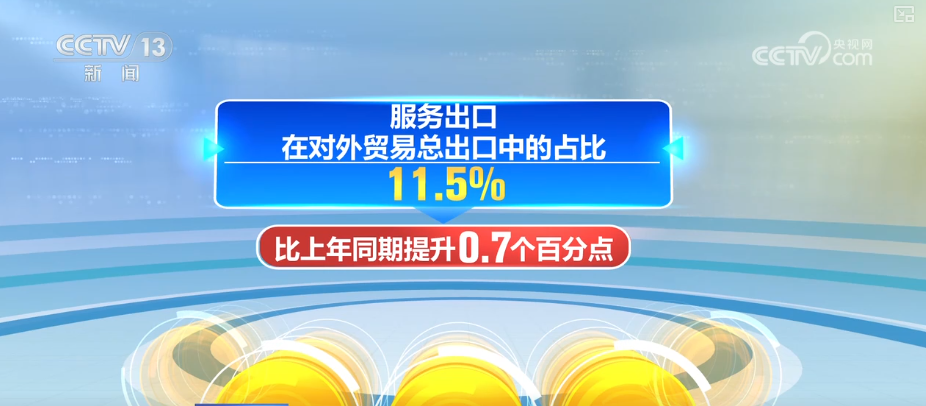
Core Viewpoint - The 2025 China International Service Trade Fair will be held from September 10 to 14 in Beijing, focusing on the theme "Digital Intelligence Leading, Service Trade Renewed," highlighting the characteristics of service trade [2] Group 1: Service Trade Growth - In the first half of the year, China's service import and export total reached 3.9 trillion yuan, a year-on-year increase of 8%, marking a historical high for the same period [2] - Service exports accounted for 11.5% of total foreign trade exports, an increase of 0.7 percentage points compared to the same period last year [2] - Transportation service exports reached 418.5 billion yuan, growing by 23.9%, while travel service exports reached 174.87 billion yuan, growing by 68.7%, making travel the fastest-growing sector [3] Group 2: Policy Support - The development of service trade is expected to benefit from global growth, with the WTO projecting a 4.0% increase in global service exports by 2025 [4] - The Chinese government plans to introduce new policies to support service exports, including financial and regulatory measures [5] - The Ministry of Commerce is focusing on enhancing the role of service trade in the economy, with significant investments in key areas [5] Group 3: Consumer Potential - From January to July, national service retail sales increased by 5.2%, indicating a rising share of service consumption [6] - The upcoming service trade fair will feature over 40 supporting activities, integrating service consumption, trade, and investment [6] - The Ministry of Commerce aims to stimulate service consumption by implementing policies that enhance service quality and expand service offerings [6][7]


多方紧密部署 服务贸易系列政策加快“落子
Shang Hai Zheng Quan Bao· 2025-08-28 12:16
Core Viewpoint - The Chinese government is accelerating the implementation of policies to support service trade, indicating a positive growth trend in this sector [1][2]. Group 1: Policy Initiatives - The State Council's recent study emphasizes the need to enhance the international competitiveness of service exports, focusing on areas such as research, consulting, e-commerce, and digital service trade [2]. - The Ministry of Commerce plans to introduce a series of measures to promote service exports, including optimizing zero tax rate declaration procedures and increasing export credit insurance support [2][5]. - The government aims to leverage the effects of visa-free policies to attract more foreign tourists, thereby boosting travel service exports [2][3]. Group 2: Service Trade Growth - The global service export is projected to grow by 4% by 2025, with major economies showing robust growth in service trade during the first half of the year [1]. - In the first half of the year, transportation service exports reached 418.5 billion yuan, growing by 23.9%, while travel service exports surged to 174.87 billion yuan, marking a 68.7% increase [2][5]. Group 3: Digital Service Trade - The development of digital service trade is prioritized, with a focus on cross-border e-commerce and the digital transformation of trade processes [3]. - The Ministry of Commerce is set to promote and regulate cross-border data flow, which is crucial for many multinational companies [3]. Group 4: Negative List Management - The reduction of the negative list for cross-border service trade is a key strategy for expanding service imports [3][4]. - The government is actively monitoring the implementation of the negative list and addressing any challenges that arise [4]. Group 5: Future Outlook - The next phase is expected to see increased support from fiscal, tax, financial, and regulatory measures for service trade, particularly service exports [5]. - Overall, service trade is anticipated to maintain growth throughout the year, with an ongoing optimization of trade structure [5].
乐氏国际控股(01529)发布中期业绩,股东应占亏损231.2万元 同比减少78.16%
智通财经网· 2025-08-28 11:42
Core Viewpoint - Le Shi International Holdings (01529) reported a significant increase in revenue for the six months ending June 30, 2025, with earnings reaching 186 million, a year-on-year increase of 96.04% [1] - The company reported a loss attributable to shareholders of 2.312 million, which is a reduction of 78.16% compared to the previous year [1] - The increase in revenue is primarily attributed to the growth in transportation service earnings [1] Financial Performance - Revenue for the period was 186 million, reflecting a 96.04% year-on-year increase [1] - Loss attributable to shareholders was 2.312 million, a decrease of 78.16% year-on-year [1] - Earnings per share were reported at a loss of 0.5445 cents [1] Business Operations - The increase in revenue is mainly due to the rise in earnings from transportation services [1]
2025年1-6月蒙古运输收入同比下降15.1%
Shang Wu Bu Wang Zhan· 2025-08-28 06:26
Group 1 - The total freight volume in Mongolia for the first half of 2025 reached 62.4 million tons, a decrease of 2.6 million tons or 4% year-on-year [1] - Road and rail freight volumes declined by 4.1% and 3.9% respectively during the same period [1] - Passenger transport volume totaled 79.5 million trips, an increase of 3.5 million trips or 4.6% year-on-year [1] Group 2 - Transportation revenue for January to June amounted to 4.8 trillion tugriks (approximately 13.36 billion USD), a decrease of 857.8 billion tugriks (approximately 2.38 billion USD) or 15.1% year-on-year [1] - Road transport revenue fell by 1 trillion tugriks (approximately 2.78 million USD), while postal and express delivery revenue decreased by 800 million tugriks (approximately 22,250 USD) [1] - Compared to the previous quarter, transportation revenue increased by 249 billion tugriks (approximately 0.69 billion USD) [1]
以“人工智能+”赋能服务贸易高质量发展正当其时
Zheng Quan Ri Bao· 2025-08-27 16:12
Group 1 - The total import and export volume of services in China reached 3.9 trillion yuan in the first half of the year, marking an 8% year-on-year growth and setting a historical record for the same period [1] - The development of service trade in China is supported by favorable conditions and opportunities, with significant potential for expansion [1] - Accelerating the cultivation and development of digital service trade and "AI + service trade" is identified as a key focus area for future growth [1] Group 2 - Government departments are encouraged to implement measures that promote the integration of "AI + service trade," enhancing international competitiveness through the use of digital technologies and AI [2] - Various local governments have introduced initiatives to optimize digital service trade, leveraging advanced technologies like AI and big data across multiple industries [2] - The successful implementation of policies requires collaboration among all stakeholders to ensure effective execution from formulation to implementation [2] Group 3 - Service trade entities are urged to leverage "AI +" to enhance the competitiveness of their products and services [3] - The government has released opinions on implementing "AI +" actions, promoting the evolution of service industries towards intelligent and innovative service models [3] - Service trade entities should focus on technology research and development, talent acquisition, and expanding application scenarios to strengthen their competitive edge [3] Group 4 - The integration of "AI +" presents unprecedented opportunities for the high-quality development of service trade, driving it towards greater efficiency, intelligence, and quality [4]
3.9万亿元、4185亿元、8650.4亿元……多视角“数”览服务贸易强劲活力
Yang Shi Wang· 2025-08-27 08:51
Group 1 - The 2025 Service Trade Fair will be held in Beijing from September 10 to 14, with preparations nearly complete [1] - The Ministry of Commerce plans to introduce a series of policies to promote service exports, focusing on fiscal, financial, and facilitation measures [1][11] - In the first half of the year, China's total service trade reached 3.9 trillion yuan, a year-on-year increase of 8% [3] Group 2 - Service exports amounted to 1.7 trillion yuan, growing by 15%, and accounted for 11.5% of total exports, up 0.7 percentage points from the previous year [3] - The growth in service exports is primarily driven by traditional sectors such as transportation and travel, with transportation services exporting 418.5 billion yuan (up 23.9%) and travel services exporting 174.87 billion yuan (up 68.7%) [7] - Knowledge-intensive service exports reached 865.04 billion yuan, growing by 7.8%, with significant contributions from other business services and telecommunications, which saw exports of 416.33 billion yuan and 377.16 billion yuan, growing at 6.9% and 14.6% respectively [10]
系列促进服务出口、扩大服务消费政策将出!商务部最新发声
Sou Hu Cai Jing· 2025-08-27 07:54
Core Viewpoint - The Chinese government is set to introduce a series of policies aimed at promoting service exports and expanding service consumption, highlighting the significant growth potential in these areas for domestic demand and international trade [1][5]. Service Trade Growth - In the first half of the year, China's total service trade reached 3.9 trillion yuan, marking an 8% year-on-year increase, which is 5.1 percentage points faster than the growth rate of goods trade [3]. - Service exports amounted to 1.7 trillion yuan, growing by 15%, with service exports accounting for 11.5% of total exports, an increase of 0.7 percentage points from the previous year [3]. - The rapid growth in service exports is primarily driven by traditional sectors such as transportation and travel, with transportation services exporting 418.5 billion yuan (up 23.9%) and travel services exporting 174.87 billion yuan (up 68.7%) [3]. Policy Measures - The Ministry of Commerce plans to introduce new policies covering fiscal, financial, and regulatory aspects to further support service exports [5][7]. - Specific measures include enhancing support for key service export sectors, improving tax refund processes, and facilitating international market expansion for enterprises [10][11]. Service Consumption Expansion - Service consumption is recognized as a crucial component for expanding international trade and boosting domestic demand [9]. - The Ministry of Commerce aims to enhance service supply by focusing on high-quality services and expanding areas such as health, elderly care, and domestic services [12]. Upcoming Events - The China International Fair for Trade in Services (CIFTIS) is scheduled for September 10-14, featuring nearly 2,000 exhibitors, including around 500 Fortune 500 companies [14]. - The event will showcase over 190 new products and innovations, emphasizing high-quality service supply and promoting commercial value [14][15].
多项政策将出!商务部,最新发声!
券商中国· 2025-08-27 07:53
Core Viewpoint - The article emphasizes the significant growth potential of service consumption in expanding domestic demand and international trade, highlighting upcoming policies to promote service exports and consumption [1][2]. Summary by Sections Service Export Growth - In the first half of the year, China's total service trade reached 3.9 trillion yuan, a year-on-year increase of 8%, outpacing the growth rate of goods trade by 5.1 percentage points [3]. - Service exports amounted to 1.7 trillion yuan, growing by 15%, with their share in total exports rising to 11.5%, an increase of 0.7 percentage points from the previous year [3]. - The rapid growth in service exports is primarily driven by traditional sectors such as transportation and travel, with transportation services exporting 418.5 billion yuan (up 23.9%) and travel services exporting 174.87 billion yuan (up 68.7%) [3]. Global Service Trade Outlook - The WTO projects a 4.0% growth in global service exports by 2025, with significant growth expected in travel and other key sectors [4]. - China's travel service trade exceeded 1 trillion yuan in the first half of the year, with a growth rate of 12.3%, and is expected to maintain rapid growth throughout the year [4]. Policy Support for Service Exports - The Ministry of Commerce plans to introduce a series of policies to enhance service exports, focusing on fiscal, financial, and regulatory support [5][6]. - Specific measures include optimizing tax refund processes, increasing export credit insurance support, and facilitating international market expansion for service trade [6]. Expansion of Service Consumption - Service consumption is identified as a crucial area for boosting domestic demand and consumption [7]. - From January to July, retail sales of consumer goods reached 28.4238 trillion yuan, with service retail sales growing by 5.2% [8]. - The Ministry of Commerce aims to enhance service supply and stimulate consumption through various policy initiatives, including targeted support for sectors like elderly tourism and health services [8][9]. Upcoming Events and Innovations - The China International Fair for Trade in Services (CIFTIS) is set to showcase over 190 new products and innovations, with participation from nearly 2000 enterprises, including 500 Fortune Global 500 companies [10]. - The event will feature numerous forums and discussions on cutting-edge topics, promoting high-quality service brands and innovative solutions [11].