
再生铝

Search documents
实探|多层次风险管理护航实体企业!五矿期货与再生铝企业样本
券商中国· 2025-11-07 23:45
Core Viewpoint - The article discusses the significant fluctuations in non-ferrous metal prices this year, particularly affecting the profitability of processing companies in the supply chain, highlighting the importance of financial tools for cost smoothing and profit locking [1]. Group 1: Market Dynamics - Non-ferrous metal prices, including copper and aluminum, have shown increased volatility, creating operational pressures for upstream and downstream companies [1]. - The processing companies, positioned in the middle of the supply chain, face further compression of profit margins due to these price fluctuations [1]. Group 2: Role of Futures Market - Futures companies play a crucial role in stabilizing the operations of real economy enterprises while enhancing their own professional capabilities and service boundaries [3]. - The average daily equity scale of industrial clients at Wukuang Futures Chengdu branch has increased over tenfold since 2021, with a compound annual growth rate of over 200% in client accounts [3]. - The client structure includes approximately 60% from the new energy industry, 30% from the metal industry, and 10% from agricultural products [3]. Group 3: Risk Management Strategies - Wukuang Futures Chengdu branch has developed tiered and differentiated risk management solutions based on the different risk characteristics of upstream and downstream enterprises [3]. - Upstream companies utilize futures to lock in sales prices while employing options for additional value, with some state-owned enterprises preferring controlled risk options for hedging [3]. - Midstream traders engage in full-process hedging by buying futures or call options to lock in raw material costs and selling futures or buying put options to secure sales prices [4]. Group 4: Case Study - Recycled Aluminum - Sichuan Shenglin New Materials Technology Co., Ltd. produces 100,000 tons of recycled aluminum alloy ingots annually and employs futures market operations to mitigate risks from price volatility [6]. - The company emphasizes a principle of hedging without speculation, ensuring that futures trading aligns with production operations [6]. - The introduction of casting aluminum alloy futures has enhanced the pricing power of recycled aluminum companies, providing valuable price signals [7]. Group 5: Futures Market Functionality - The Shanghai Futures Exchange has improved its delivery system, with its delivery volume and amount leading among domestic exchanges, accounting for approximately 60% of the market's delivery value and 30% of the delivery volume in 2024 [8]. - The core value of the futures market lies in risk management and price discovery, with ongoing training and innovation aimed at helping more enterprises effectively utilize futures tools [8].

上证早知道|摩尔线程,IPO获准注册;免税店政策“升级”,五部门最新发布;超百亿元资金,涌入半导体
Shang Hai Zheng Quan Bao· 2025-10-30 22:55
Group 1 - The China Securities Regulatory Commission approved the initial public offering registration of Moore Threads Technology, aiming to raise 8 billion yuan for its IPO on the Sci-Tech Innovation Board [2][11] - Moore Threads has developed four generations of GPU architecture and offers solutions for intelligent computing across various markets, including government and enterprise sectors [11] - The company is positioned to benefit from the domestic shift towards advanced process technology and the increasing demand for AI chips, indicating a significant market opportunity [11] Group 2 - The Ministry of Finance and other departments announced improvements to the duty-free shop policy, effective from November 1, 2025, to boost consumption and attract foreign visitors [7] - China Duty Free Group, primarily engaged in duty-free retail, is expected to benefit from the expanded product range and increased sales of domestic products in duty-free shops [7] - The recent adjustments to the duty-free shopping policy in Hainan are anticipated to enhance consumer experience and drive growth for domestic brands [7] Group 3 - The semiconductor-themed ETF saw a net subscription of 13.106 billion yuan in October, indicating strong investor interest in the sector [2][23] - Institutional research on the semiconductor industry has surged, with over 1,000 investigations conducted recently, reflecting optimism about advancements in equipment and AI computing power [23] - The domestic semiconductor manufacturing chain is expected to accelerate its self-sufficiency, with a rising domestic production rate anticipated [23] Group 4 - The prices of certain rare earth products have increased, driven by structural demand growth in sectors like electric vehicles and wind power [10] - The demand for neodymium-iron-boron magnets is particularly strong, as they are essential for high-performance electric motors [10] - Companies like Baotou Steel Rare Earth and Northern Rare Earth are positioned to benefit from the integrated development of the rare earth industry [10]
四川连续6个季度实现出口正增长 顶压前行,外贸增量从何来?
Si Chuan Ri Bao· 2025-10-29 00:32
Core Insights - Sichuan's foreign trade has shown resilience with a total import and export value of 776.79 billion yuan in the first three quarters, ranking 8th nationally and achieving a year-on-year growth of 3.6% [3][8] - The province has experienced six consecutive quarters of positive export growth, with exports reaching 461.01 billion yuan, a year-on-year increase of 5.8% [3][8] - The growth in exports is driven by the advantages of industries such as electronic information, equipment manufacturing, and pharmaceutical health [3][10] Foreign Trade Overview - In September, Sichuan's import and export value was 93.79 billion yuan, marking a year-on-year increase of 13.4%, outpacing the national growth rate by 5.4 percentage points [3][8] - The number of enterprises engaged in import and export activities has increased by 9.5% year-on-year, indicating a growing international market presence [3][8] Trade Opportunities and Events - The 138th China Import and Export Fair (Canton Fair) saw Sichuan's participation with 511 enterprises and 1,017 booths, setting a record for the province [5][6] - Sichuan's enterprises have reported significant international interest, with numerous new clients and contracts signed during the fair [5][6] Government Support and Initiatives - The Sichuan government is providing substantial subsidies to support enterprises at the Canton Fair, facilitating their international market expansion [6][7] - A "Sichuan Pharmaceutical Going Global" delegation is set to attend a major pharmaceutical exhibition in Germany, showcasing the province's commitment to international trade [6][7] Innovative Trade Models - Sichuan is adopting new models such as "cross-border e-commerce + industrial belts" to enhance production efficiency and meet precise market demands [9][10] - The province is focusing on integrating trade and industry to boost export capabilities and adapt to market needs [10] Import Growth and Strategic Centers - Sichuan is establishing import centers for products like salmon and durian, which are expected to drive import growth and support overall foreign trade [12] - The province's imports have increased by 0.6% year-on-year, surpassing the national average by 0.8 percentage points [12] Sector-Specific Developments - The second-hand car export base in Chengdu has seen significant growth, with an export value exceeding 2 billion yuan [13] - Innovations in the import of recycled aluminum are improving efficiency and reducing costs for businesses in the region [13]

中国中车推动氢能列车产业链布局,央企创新驱动ETF(515900)回调蓄势
Xin Lang Cai Jing· 2025-10-17 06:15
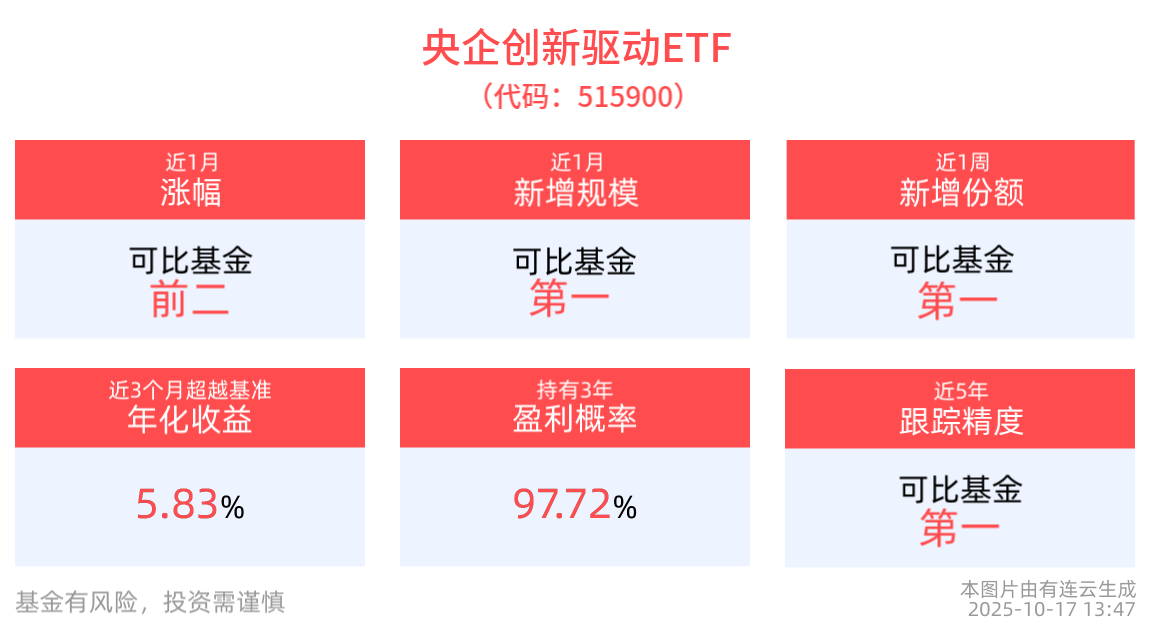
Core Insights - The China Central State-Owned Enterprises Innovation-Driven Index has decreased by 1.72% as of October 17, 2025, with mixed performance among constituent stocks [3] - The China Central State-Owned Enterprises Innovation-Driven ETF (515900) has seen a decline of 1.44%, currently priced at 1.57 yuan, but has increased by 2.05% over the past two weeks [3][4] - The conference on the integrated development of the hydrogen energy industry chain was held in Changchun, focusing on rail transit equipment, clean energy equipment, and hydrogen energy [3] Market Performance - The top-performing stocks include China Telecom, which rose by 1.02%, and Yangnong Chemical, which increased by 0.44%, while XJ Electric fell by 6.86% [3] - The trading volume for the China Central State-Owned Enterprises Innovation-Driven ETF was 6.1667 million yuan, with a turnover rate of 0.17% [3] - Over the past year, the ETF has maintained an average daily trading volume of 20.4625 million yuan, ranking first among comparable funds [3] Industry Trends - The recycled aluminum industry is experiencing rapid growth, with an expected production of approximately 10.5 million tons in 2024, accounting for nearly 19% of total aluminum supply [4] - The Ministry of Industry and Information Technology has set a target for recycled aluminum production to exceed 15 million tons by 2027, indicating a compound annual growth rate of 13% [4] - The carbon emissions from recycled aluminum are only 2.1% of those from electrolytic aluminum, which is expected to enhance its green premium due to the launch of the national carbon market and the upcoming EU CBAM [4] ETF Performance - The China Central State-Owned Enterprises Innovation-Driven ETF has seen a significant increase in scale, growing by 61.0039 million yuan over the past month, ranking 1/4 among comparable funds [4] - The ETF's share count increased by 6 million shares in the past week, also ranking 1/4 among comparable funds [4] - The index tracks 100 representative listed companies under the State-owned Assets Supervision and Administration Commission, reflecting the overall performance of innovative and profitable central state-owned enterprises [4][5]

申万宏源:资源保供+双碳目标推动 再生铝迎来发展机遇
智通财经网· 2025-10-17 03:07
Core Viewpoint - The domestic recycled aluminum industry is currently fragmented with low recycling utilization levels, but policies are expected to strengthen, promoting the improvement of the recycling system and transitioning from a "small and scattered" model to "scale," thereby unlocking the potential of urban mining [1] Group 1: Industry Growth and Potential - The recycled aluminum industry chain is short with high recovery value, becoming an important growth driver for China's aluminum supply [1] - The production of recycled aluminum in China is projected to reach approximately 10.5 million tons in 2024, accounting for about 19% of total aluminum supply, with a CAGR of 13% expected from 2024 to 2027 [1] Group 2: Resource Security and Domestic Supply Chain - The demand for resource security is increasing, and recycled aluminum is key to addressing the high dependence on imported bauxite, with over 77.6% reliance on imports from January to August 2025 [2] - The main source of raw materials for recycled aluminum is domestic waste aluminum, which is expected to account for over 80% of the recycling volume in 2024 [2] Group 3: Environmental Impact and Market Dynamics - The carbon emissions from producing one ton of electrolytic aluminum are approximately 11.2 tons, while recycled aluminum only emits 0.23 tons, representing 2.1% of the emissions from electrolytic aluminum production [3] - The inclusion of the aluminum smelting industry in the national carbon market by 2025 is expected to tighten quotas and increase carbon prices, enhancing the green premium for recycled aluminum products [3] Group 4: Recycling System Development - The potential of urban mining is significant, and the construction of the recycling system is accelerating, supported by policies and initiatives from state-owned enterprises and key companies [4] - The introduction of tax policies and the establishment of a national recycling platform are expected to alleviate raw material bottlenecks, especially as vehicle scrappage is anticipated to peak around 2026 [4]

顺博合金两位董事拟合计减持不超1372.9万股
Zhi Tong Cai Jing· 2025-10-16 14:01
Core Viewpoint - The company announced that certain controlling shareholders and concerted actors, including directors Wang Zhenjian and Wang Zengchao, plan to reduce their holdings in the company by a total of up to 13.72899 million shares, which represents 2.05% of the total share capital [1] Summary by Categories - **Shareholding Reduction Plan** - The reduction will occur through centralized bidding transactions within three months after the announcement date [1] - The shares to be reduced account for 2.08% of the total share capital after excluding shares held in the company's repurchase special securities account [1]
再生铝行业深度报告:资源保供+双碳目标推动,再生铝迎来发展机遇
Shenwan Hongyuan Securities· 2025-10-16 11:15
Investment Rating - The report maintains a positive outlook on the aluminum recycling industry, driven by resource supply security and dual carbon goals, indicating a favorable investment environment for recycled aluminum [1]. Core Insights - The recycled aluminum industry is becoming a significant growth area in China's aluminum supply, with an expected production of approximately 10.5 million tons in 2024, accounting for about 19% of total aluminum supply. The target is to exceed 15 million tons by 2027, reflecting a CAGR of 13% from 2024 to 2027 [2][11]. - The demand for resource supply security is increasing, with recycled aluminum seen as a key solution to reduce reliance on imported bauxite, which had a dependency rate of over 77.6% in the first eight months of 2025. The domestic supply of recycled aluminum is primarily sourced from social waste aluminum, which is expected to exceed 80% in 2024 [2][4]. - The dual carbon constraints and the establishment of a carbon market are accelerating the visibility of the green premium associated with recycled aluminum. The carbon emissions from producing one ton of electrolytic aluminum are approximately 11.2 tons, while recycled aluminum only emits 0.23 tons, making it a significantly lower carbon option [2][4]. - The potential of urban mining is substantial, with accelerated development of recycling systems. Policies are being implemented to support small recycling enterprises, and a national recycling platform is being established to enhance the recycling infrastructure [2][5]. Summary by Sections 1. Recycled Aluminum as a Key Supply Source - Recycled aluminum, derived from waste aluminum through melting and refining, is a crucial component of the aluminum supply chain, with a short industrial chain and high recovery value [2][11]. - The industry is expected to grow significantly, with a target of 15 million tons by 2027, supported by government policies promoting high-quality development in the aluminum sector [2][11]. 2. Resource Supply Security and Dual Carbon Goals - The increasing demand for resource supply security positions recycled aluminum as a critical strategy to mitigate reliance on foreign bauxite, especially as domestic bauxite reserves are limited [2][4]. - The green value of recycled aluminum is becoming more apparent, with the anticipated tightening of carbon quotas in the national carbon market expected to drive up carbon prices and enhance the green premium for recycled products [2][4]. 3. Urban Mining Potential and Recycling System Development - The recycling system is being rapidly developed, with policies favoring small recycling enterprises and the establishment of a national recycling platform to improve the efficiency of aluminum recovery [2][5]. - The peak of automobile scrappage is expected to occur around 2026, which will significantly increase the supply of waste aluminum, alleviating raw material bottlenecks [2][5]. 4. Investment Recommendations - The report suggests focusing on companies with high raw material security, advanced recycling technologies, and the ability to produce high-premium products, such as Ming Tai Aluminum, Shunbo Alloy, Yiqiu Resources, Lizhong Group, and Yongmaotai [2][3].


“铸铝”前行:铸造铝合金期货上市系列报告(八):ADC12:成本逻辑驱动下的平衡之道
Guo Tai Jun An Qi Huo· 2025-10-09 14:06
Report Summary 1. Report Industry Investment Rating No industry investment rating is provided in the report. 2. Core Viewpoints of the Report - The price of cast aluminum alloy futures has been oscillating strongly since listing, with a rising center of gravity, but the trading volume and open interest indicate low activity. As the first batch of warehouse receipts are successfully registered and the contracts enter continuous delivery, market activity is expected to gradually increase [3][9][29]. - It is not advisable to be overly bearish on the futures price of cast aluminum alloy. With the year - end production rush in the automotive industry, the seasonal performance of cast aluminum alloy in the fourth quarter may be stronger. The cancellation of tax - refund policies and the persistent tight supply of scrap aluminum will support prices. The price of cast aluminum alloy generally follows the price of aluminum and has some upward price elasticity [3][29]. - Although there are potential short - selling logics in the market, most of them are long - term variables, and some have been fully priced in by the market, having a relatively small impact on the current price. In the short term, considering the cost logic and bullish drivers, the downside space is limited, and short - term long positions on dips can be considered, with an expected price range of 20,000 - 21,000 yuan/ton [4][30]. 3. Section - by - Section Summaries 3.1 AD Market Review Since Listing - The price of cast aluminum alloy futures has been oscillating strongly with a rising center of gravity, but the activity is low. As of September 30, 2025, the weighted contract open interest was about 20,000 lots, and the trading volume dropped from nearly 58,000 lots at the beginning to 3,000 lots. The main reason is that the initial main contract AD2511 had a long time to delivery, leading to strong market wait - and - see sentiment [9]. 3.2 Core Bullish Logic 3.2.1 Persistent Tight Supply of Scrap Aluminum - **Domestic**: The growth of domestic scrap aluminum supply is limited, with a significant gap between production and demand. In 2025, the supply growth rate of new and old scrap aluminum is in the 3 - 4% range, while the production capacity growth rate of cast aluminum alloy is about 10%, and that of processed aluminum products is in the 5 - 10% range. The scrap aluminum market is a seller's market, and when aluminum prices fall, suppliers are reluctant to sell, tightening supply [12][13]. - **Overseas**: The US has increased import tariffs on aluminum products, attracting a large amount of scrap aluminum from the EU and other regions, intensifying the global imbalance between supply and demand. The EU is evaluating the possibility of imposing export tariffs on scrap aluminum, which may affect Asian countries' imports. Southeast Asian countries are tightening scrap aluminum regulations, and Thailand's suspension of issuing recycling factory licenses may reduce scrap aluminum exports to China [15][16][18]. 3.2.2 Impact of Tax - Refund Policy Cancellation - The cancellation of local tax - refund policies will increase the tax burden of recycled aluminum enterprises by about 3%, raising production costs by 300 - 500 yuan/ton. Some enterprises may face losses, and the cost is difficult to pass on in the short term [20][24]. - Scrap recycling will become more difficult, and smelting may face production cuts. Enterprises in concentrated areas like Anhui and Jiangxi rely on external scrap sources. After the policy cancellation, they may need to raise purchase prices, further increasing costs [24]. - The demand structure for scrap aluminum will change, with an increased demand for invoiced scrap. Market supervision is tightening, and enterprises' demand for invoiced scrap will increase, making scrap procurement more difficult [24]. - The industry consolidation will accelerate, promoting healthy competition. Small and medium - sized enterprises with insufficient funds may be cleared, and industry concentration will increase. Enterprises may also transfer production capacity to areas with concentrated scrap aluminum supply to reduce costs [25]. 3.2.3 Seasonal Improvement in Demand - About 70% of cast aluminum alloy is used in the automotive industry, especially traditional fuel vehicles. As the automotive industry enters the year - end production rush in the fourth quarter, a positive feedback loop of price - cost - price increase may occur. The increase in special treasury bond funds for consumer goods replacement will also boost automotive consumption [26][27]. 3.3 Summary and Strategy Outlook - The short - term strategy is to consider long positions on dips, with an expected price range of 20,000 - 21,000 yuan/ton, as the cost logic is valid, and there are short - term bullish drivers [30].
铸造铝合金产业链周报-20250921
Guo Tai Jun An Qi Huo· 2025-09-21 08:42
1. Report Industry Investment Rating - The strength - weakness analysis of the casting aluminum alloy industry is neutral [2] 2. Core Viewpoints of the Report - This week, the price of casting aluminum alloy showed a volatile and weak trend with a phased decline. With the callback of aluminum prices, the willingness of scrap aluminum traders to ship increased, and the market circulation improved marginally. The operating rate of the recycled aluminum industry continued to rise month - on - month, but there was obvious internal differentiation. The demand continued a mild recovery, and the pre - holiday inventory - building demand of downstream enterprises provided some support for the orders of recycled aluminum plants. It is expected that the price of casting aluminum alloy will maintain a high - level volatile trend [6]. - As of September 19, the inventory of aluminum alloy ingot factories and social inventory increased by 0.09 million tons to 13.22 million tons compared with the previous week, and the inventory pressure remained high. The supply shortage of raw materials persisted, and the domestic automobile sales in the second week of September decreased year - on - year. However, the "trade - in" policy had a prominent effect, and the fourth batch of funds would be issued in October as planned, which was conducive to stabilizing consumer confidence and boosting automobile consumption. With the arrival of "Golden September and Silver October", the automobile sales were expected to improve month - on - month [6]. 3. Summary According to Relevant Catalogs 3.1 Transaction End - Quantity and Price - The report presents the price differences (AD00 - 01, AD01 - 02, AD02 - 03), capital precipitation, trading volume, and open interest of casting aluminum alloy [9]. 3.2 Transaction End - Arbitrage 3.2.1 Inter - period Positive Spread Cost Calculation - The report calculates the cost of inter - period positive spread for casting aluminum alloy, including fixed costs (such as delivery and transaction fees) and floating costs (such as storage fees and capital costs). The total cost is 77 yuan/ton [12]. 3.2.2 Spot - Futures Arbitrage Cost Calculation - The market actual spot quotation fluctuates around the Baotai price. The calculated total cost of spot - futures arbitrage is 20,614.5 yuan/ton, including costs such as storage fees, capital costs, and registration costs [13][14]. 3.3 Supply End - Scrap Aluminum - The production of scrap aluminum is at a high level, and the social inventory is at a medium - high level in history. The import of scrap aluminum is also at a high level, with a relatively fast year - on - year growth rate. The refined - scrap price difference shows a trend of decline [16][21][26]. 3.4 Supply End - Recycled Aluminum - The price of Baotai ADC12 has been raised, and the price difference between recycled and primary aluminum has converged significantly. The regional price difference of casting aluminum alloy has strengthened and shows certain seasonal laws. The weekly operating rate of casting aluminum alloy has increased, while the monthly operating rate has decreased slightly. The monthly production of recycled aluminum alloy and its proportion in different regions are also presented. The cost of ADC12 is mainly composed of scrap aluminum, and it is currently above the break - even line. The factory inventory of casting aluminum alloy has decreased, while the social inventory is at a historical high. The import window of casting aluminum alloy is temporarily closed [33][38][43]. - The production and inventory of recycled aluminum rods are also analyzed. The production and its proportion in different regions are provided, as well as the factory inventory and its proportion [62][63][64]. 3.5 Demand End - Terminal Consumption - The production of fuel - powered vehicles is at a low level, which has an impact on die - casting consumption. The report also presents the production data of new energy vehicles, motorcycles, and household appliances, as well as the year - on - year change of PPI for auto parts and the monthly value of the automobile inventory warning index [69][70].
“山东制造”迈向高端:绿色转型中的产业突围
Qi Lu Wan Bao Wang· 2025-09-18 08:49
Group 1 - The core viewpoint is that Shandong Innovation Group is transforming the perception of "Shandong manufacturing" from traditional heavy industry to a focus on green and high-end manufacturing through innovative recycling technology [1][2]. - Shandong Innovation Group has developed a groundbreaking "full-process waste aluminum preservation and recycling technology," achieving aluminum purity of 99.8%, which meets the stringent requirements of 3C products and new energy vehicles [1]. - This technology not only resolves the long-standing issue of "downgrade recycling" in the recycled aluminum industry but also provides 100,000 tons of high-quality aluminum alloy profiles annually for the 3C sector, demonstrating a win-win in economic and environmental benefits [1]. Group 2 - The innovation aligns with the national "dual carbon" strategy, significantly reducing energy consumption and carbon emissions in the aluminum industry, with recycled aluminum production energy consumption being only about 5% of that of primary aluminum [1][2]. - Shandong's manufacturing sector is undergoing a transformation towards high-end, intelligent, and green development, as evidenced by various successful projects across different industries, indicating a shift away from the traditional heavy industry label [2]. - The success of Shandong Innovation Group illustrates that traditional industries can achieve economic and ecological benefits through technological innovation, providing a reference for the transformation of other old industrial bases in the country [2]. Group 3 - Looking ahead, "Shandong manufacturing" should continue to drive technological innovation and focus on green and low-carbon development while consolidating traditional industries and fostering emerging sectors [3]. - The practices of Shandong Innovation Group indicate that with the right direction and continuous innovation, "Shandong manufacturing" can occupy a more significant position in the global industrial chain, transitioning from a manufacturing province to a manufacturing powerhouse [3].