
汽车流通

Search documents
中国汽车流通协会:2026年汽车以旧换新政策有望持续激发消费活力
Zheng Quan Shi Bao Wang· 2025-12-31 03:27
Core Viewpoint - The 2026 automobile trade-in policy aims to enhance the efficiency of subsidy distribution, ensuring that limited funds benefit more consumers, particularly those with urgent needs [1] Group 1: Policy Implementation - The policy emphasizes a coordinated approach to streamline the subsidy process, making it more accessible and efficient for consumers [1] - There is a clear focus on encouraging the elimination of old vehicles and promoting the purchase of energy-efficient and new energy vehicles [1] - The implementation will leverage market mechanisms to align subsidies more closely with actual consumer demand [1] Group 2: Consumer Impact - The range of beneficiaries is expected to expand, allowing more consumers to take advantage of the trade-in subsidies [1] - The policy aims to stimulate consumer spending, thereby contributing to the transformation and high-quality development of the automotive industry [1] Group 3: Administrative Improvements - The procedures for applying for subsidies will be simplified, making it easier for consumers to participate [1] - Enhanced supervision and management mechanisms will be established to ensure the effective implementation of the policy [1]
海南封关启新程 力盛体育海南赛车场项目蓄势待发
Zhong Jin Zai Xian· 2025-12-29 09:11
Group 1 - The launch of the zero-tariff policy in Hainan marks a significant milestone for the Hainan Free Trade Port, expanding the range of zero-tariff goods from 1,900 to approximately 6,600 tax items, and implementing a "double 15%" tax incentive for eligible enterprises and core talents [1] - The Hainan International Circuit project, a core layout of Lisheng Sports in Hainan, is progressing well and aims to become a world-class platform for international motorsport events, leveraging its advantageous geographical location and strong customer base [1][2] - The integration of Hainan's developed cultural tourism industry with the Hainan International Circuit project is expected to create a "sports + tourism" ecosystem, attracting international motorsport enthusiasts and professional teams, thereby enhancing the local automotive industry [2] Group 2 - The recent approval of Lisheng Sports' stock issuance application will provide solid financial support for the construction and operation of the Hainan International Circuit, aligning with the strategic goals of the Hainan Free Trade Port [3] - Lisheng Sports is focusing on market trends and policy opportunities, aiming to expand its business boundaries while solidifying its existing operations, with a strategic emphasis on "IP-led, digital-driven" development [3]
未来我想做船长!
Mei Ri Shang Bao· 2025-12-26 22:18
Group 1 - The recruitment event held by Hangzhou Automotive Senior Technician School is the largest in its history, attracting nearly 80 companies across five sectors, including new energy vehicles, traditional fuel vehicles, smart manufacturing, drones, and shipping, offering around 700 job positions for over 400 students [1] - The school has established a "five common" order-based training model and has signed cooperation agreements with companies like Xianglong Aviation and Coolfly Aircraft, focusing on training talents for roles such as sales, drone pilots, and maintenance technicians [1] - 30 new energy vehicle companies participated in the recruitment, accounting for 40% of the total, with students from the CATL (300750) order class receiving hands-on training in battery disassembly and maintenance, as well as free certification through the CATL CIEP project [1] Group 2 - The recruitment event featured well-known automotive groups and companies in shipping and power sectors, including Zhejiang Yuantong, Deao, and Hangzhou New Century Power Equipment, covering multiple professional directions [2] - The school has long-term partnerships with companies like Hangzhou Water Public Sightseeing Bus Co., providing students with practical positions in engine maintenance and ship electronic log recording, with companies covering certification costs for various maritime qualifications [2] - Several graduates have obtained professional qualifications and secured positions in state-owned enterprises, showcasing the effectiveness of the school's training programs [2]

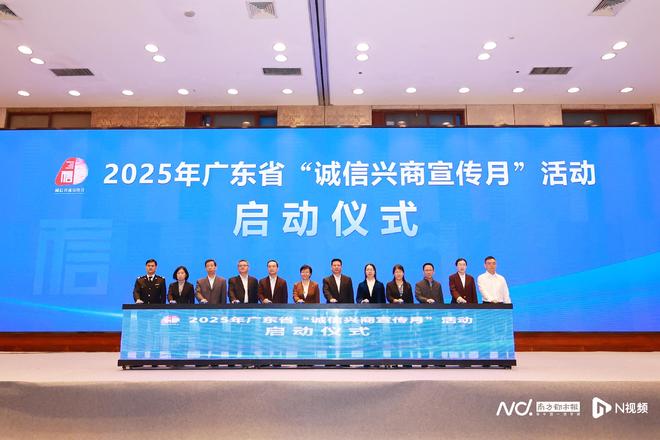
广东诚信兴商宣传月在穗启动,企业信用修复惠及560万商户
Nan Fang Du Shi Bao· 2025-12-19 10:32
Core Viewpoint - The "Integrity and Business Promotion Month" in Guangdong aims to enhance the social credit system to stimulate consumption and support high-quality economic development [1] Group 1: Economic Impact - From January to October 2025, Guangdong's total retail sales of consumer goods increased by 2.7% year-on-year, with online retail sales growing by 15.7%, indicating that the credit system is a crucial support for consumption potential [2] - The "Credit Guangdong" platform has issued 130,000 credit reports, saving time for businesses, while the "Credit Easy Loan" platform facilitated loans exceeding 1.9 trillion yuan [2] Group 2: Focus Areas of the Initiative - The initiative will focus on three key areas: using credit to invigorate trade circulation, enhancing consumer confidence through credit, and promoting a culture of integrity in business [4] Group 3: Industry Collaboration - Fourteen provincial business associations, along with over 80 leading enterprises, launched a joint initiative to establish industry integrity agreements, focusing on food safety, transparency in vehicle conditions, and strict checks on false violations [5] Group 4: Credit Repair Mechanism - Guangdong's innovative "one-stop acceptance" mechanism for credit repair has successfully restored credit for 5.604 million business entities, aiding in financing of 1.67 billion yuan [6] - The province plans to conduct extensive promotional activities to integrate credit reports into government procurement and investment attraction, positioning integrity as a core competitive advantage in building a unified national market [6]

中国汽车流通协会:11月中国汽车经销商库存预警指数为55.6%
Zhi Tong Cai Jing· 2025-12-03 08:49
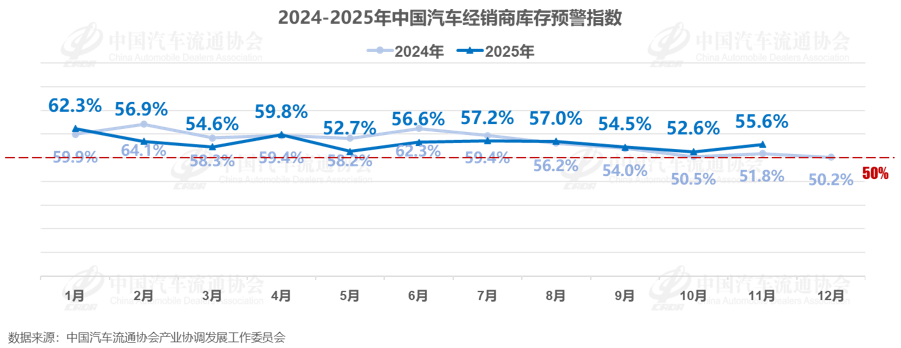
Core Viewpoint - The latest Vehicle Inventory Alert Index (VIA) from the China Automobile Dealers Association indicates a rising inventory alert index of 55.6% in November 2025, reflecting a year-on-year increase of 3.8 percentage points and a month-on-month increase of 3.0 percentage points, suggesting a decline in the automotive circulation industry's prosperity [1]. Group 1: Market Performance - The overall automotive market in November showed a "front low and back high" trend, with a relatively flat performance in the first half of the month due to the consumption pull-forward effect from previous months [3]. - 80% of dealers expressed pessimism about the November market, believing the overall performance did not meet expectations [3]. - The second half of November saw significant market improvement driven by promotional activities like "Double 11," the Guangzhou International Auto Show, and the release of new electric vehicle models [3]. Group 2: Inventory and Demand - The survey revealed a decline in sub-indices for inventory, market demand, average daily sales, employment, and operational conditions in November [4]. - The national index stood at 55.6%, with regional indices showing variations: North at 57.1%, East at 56.8%, West at 55.2%, and South at 52.0% [6]. Group 3: Brand Performance - The index for luxury and imported brands, as well as joint venture brands, increased month-on-month, while the index for domestic brands decreased [8]. Group 4: Future Outlook - December is expected to be a peak sales month, with dealers and manufacturers intensifying efforts to meet sales targets through increased promotions and accelerated sales [10]. - Looking ahead to 2026, dealers anticipate a slight growth trend in passenger car sales, with 25.4% expecting a year-on-year increase of up to 5%, while 20.8% foresee a decrease within the same range [10]. - The China Automobile Dealers Association advises dealers to realistically assess market demand and enhance promotion of "trade-in and scrapping policies" to boost consumer confidence [10].
机构调查:仅8%的汽车经销商看好12月经营情况
第一财经· 2025-12-03 02:23
Core Viewpoint - The latest "China Automobile Dealer Inventory Warning Index Survey" indicates a decline in the optimism of automobile dealers regarding their business conditions for December, with only 8.2% expecting a good performance, down 1.7 percentage points from the previous month [3][4]. Group 1: Dealer Expectations - The proportion of dealers expecting poor market conditions in December has increased from 17.7% to 20.3%, a rise of 2.6 percentage points [3][4]. - Only 8.2% of dealers anticipate a good business situation for December, marking the second-lowest level of the year, slightly better than the 8.1% recorded in July [4]. - 32.3% of dealers believe that market demand will decrease in December, which is an increase of 7.5 percentage points from the previous month [4]. Group 2: Inventory and Market Conditions - The inventory warning index for November was reported at 55.6%, which is an increase of 3.8 percentage points year-on-year and 3.0 percentage points month-on-month, indicating a decline in the automotive circulation industry's prosperity [4][6]. - A significant 80% of dealers held a pessimistic view of the November market, believing that overall performance did not meet expectations [6]. - Dealers are facing challenges such as reduced customer traffic, increased market hesitation, and narrowing profit margins on new car sales [7]. Group 3: Future Outlook and Recommendations - The tightening of trade-in policies and the expiration of tax exemptions for new energy vehicles are contributing factors to the current market situation [6]. - There is a market perspective suggesting that the upcoming reduction in vehicle purchase tax starting in 2026 may spur consumer purchasing enthusiasm in December [7]. - The China Automobile Circulation Association recommends that dealers rationally estimate actual market demand and enhance the promotion of trade-in and scrapping policies to boost consumer confidence [7].

2025年11月中国汽车经销商库存预警指数为55.6%
Zheng Quan Shi Bao Wang· 2025-11-30 02:44
Core Insights - The latest "Vehicle Inventory Alert Index" (VIA) released by the China Automobile Dealers Association indicates that the inventory warning index for Chinese automobile dealers is at 55.6% as of November 30, 2025, reflecting a year-on-year increase of 3.8 percentage points and a month-on-month increase of 3.0 percentage points [1] Industry Summary - The inventory warning index is above the threshold line, suggesting a decline in the overall prosperity of the automobile circulation industry [1]
扩消费、惠民生、稳增长 多部门详解如何增强消费品供需适配性
Shang Hai Zheng Quan Bao· 2025-11-28 00:44
Core Viewpoint - The implementation plan aims to enhance the adaptability of supply and demand for consumer goods, contributing to consumption expansion, improving people's livelihoods, and stabilizing economic growth [1] Group 1: Promotion of AI in Consumer Goods - The plan emphasizes accelerating the application of artificial intelligence (AI) technology in the consumer goods sector, positioning AI as a catalyst for consumption [2] - The Ministry of Industry and Information Technology (MIIT) will drive product innovation and scenario expansion to integrate AI and consumer goods, creating a digital ecosystem that connects user demand, intelligent design, flexible production, and precise services [2] - As of mid-2023, the user base for generative AI products in China reached 515 million, indicating strong market demand for AI consumer products [3] Group 2: Automotive Consumption Reform - The plan includes promoting reforms in automotive circulation, expanding the second-hand car market, and enhancing the automotive aftermarket, focusing on green and intelligent directions [4] - The Ministry of Culture and Tourism will develop cultural and tourism products that resonate with consumers, including promoting cultural creative products and non-material cultural heritage [4][5] Group 3: Quality and Safety Governance - The plan calls for establishing a comprehensive governance framework for consumer goods quality and safety, enhancing regulatory measures for online sales [6] - The State Administration for Market Regulation will implement actions to combat counterfeit and substandard products, ensuring consumer safety and confidence [7] - A new standard system for consumer goods will be developed, focusing on high-quality product supply and addressing safety concerns for specific categories like children's toys and gas appliances [7]
刚刚,五部门联合发声!这些大事与你有关→
Jin Rong Shi Bao· 2025-11-27 07:25
Core Viewpoint - The implementation plan aims to enhance the adaptability of supply and demand for consumer goods, promoting consumption through various measures and innovations in product development and market expansion [1]. Group 1: Consumer Goods Development - The plan emphasizes the integration of traditional toys and stationery with smart technology, focusing on safety and practicality in product design [2][3]. - There will be a push for the development of products catering to the elderly, such as service robots, adaptive clothing, and easy-to-swallow foods, alongside the establishment of a standard system for elderly products [3]. - The initiative supports the creation of culturally rich and fashionable products, including national trend clothing and designer collaborations, to meet the diverse needs of younger consumers [3]. Group 2: Market Performance and Trends - In the first ten months of the year, the trade-in program for consumer goods generated over 2.4 trillion yuan in sales, benefiting more than 360 million people [4]. - Retail sales of household appliances, furniture, and communication devices saw a year-on-year growth of approximately 20%, while retail sales of passenger vehicles increased by 7.9% [4]. - The plan anticipates the emergence of new consumption markets worth trillions of yuan by 2027, driven by supply-side structural reforms and the introduction of innovative products and services [5]. Group 3: Technological and Infrastructure Innovations - The plan includes the implementation of "Artificial Intelligence+" initiatives to promote intelligent development across industries, enhancing traditional industries and fostering smart product ecosystems [6]. - There is a focus on expanding parking facilities and electric vehicle charging infrastructure, with over 18.6 million charging points established nationwide, marking a 54% increase year-on-year [6]. - The initiative aims to support the development of high-quality outdoor sports destinations and enhance standards for outdoor sports products and services [7]. Group 4: Quality and Safety Regulations - The plan emphasizes the importance of consumer goods quality and safety, with ongoing actions to ensure the safety of children's and elderly products through comprehensive inspections and regulations [8][9]. - The market supervision authority has conducted extensive checks on various consumer goods, addressing quality issues in clothing, household appliances, and children's products [8]. - New national standards for energy consumption and safety for daily consumer goods are being established to promote green consumption and enhance consumer confidence [9].
全链条扩大汽车消费,商务部将推进汽车流通消费改革试点
Xin Lang Cai Jing· 2025-11-27 03:35
Core Viewpoint - The Chinese government is implementing measures to enhance the adaptability of supply and demand in consumer goods, particularly focusing on the automotive sector to stimulate consumption and improve market efficiency [1][2]. Group 1: Automotive Market Overview - In 2024, China's new car sales are projected to reach 31.436 million units, representing a year-on-year growth of 4.5%, while the used car transaction volume is expected to hit 19.6142 million units, with a growth of 6.52% [2]. - The number of scrapped vehicles is anticipated to be 7.872 million, showing a significant increase of 70.7% year-on-year [2]. Group 2: Policy Initiatives - The Ministry of Commerce, along with eight other departments, has launched a notice to encourage localities to deepen reforms in new, used, and scrapped vehicle markets, aiming to create a unified, efficient, and green automotive consumption market [2]. - The "Special Action Plan to Boost Consumption" emphasizes extending the automotive consumption chain, including reforms in the automotive circulation and expansion of the automotive aftermarket [2][3]. Group 3: Market Potential and Innovations - The current vehicle ownership in China stands at 360 million, providing substantial growth potential for the used car market [3]. - Major used car dealers are evolving from mere resellers to offering enhanced after-sales services, including extended warranty periods, which help alleviate consumer concerns regarding used car quality [3]. - The implementation of automotive circulation reforms is expected to promote market prosperity, innovate the automotive circulation system, and meet diverse consumer needs [3].