药店零售

Search documents
大爆发,这一板块集体拉升
Zheng Quan Shi Bao· 2025-12-02 05:20
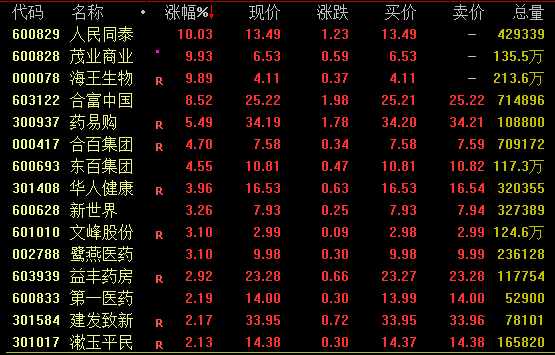
Market Overview - A-shares experienced a decline with major indices falling, as the Shanghai Composite Index dropped by 0.55% to fall below 3900 points, the ChiNext Index fell by 0.88%, and the STAR Market Index decreased by over 1% [1] - Nearly 4000 stocks were in the red, with sectors such as non-ferrous metals, pharmaceuticals, brokerages, and semiconductors declining, while insurance and coal sectors saw gains [1] Retail Pharmacy Sector - Retail pharmacy stocks surged, with notable performances from companies like Renmin Tongtai and Haiwang Biological, both hitting the daily limit, and Hezhi China rising over 8% [3][4] - The increase in flu-like cases is expected to benefit the retail pharmacy sector, driving demand for antiviral medications and symptomatic treatments [3][4] Fujian Local Stocks - Fujian local stocks saw a collective surge, with companies like Jiarong Technology and Haiyin Food hitting the daily limit [6][7] - The rise is attributed to the issuance of measures to promote the development of computing power infrastructure in Fujian, which includes plans for enhancing network transmission efficiency and expanding international connectivity [6][7] Strong Performing Stocks - Jinfu Technology achieved a 7-day consecutive limit-up, reaching a historical high, while Tongyu Communication has seen four consecutive limit-ups [9] - Jinfu Technology is in the process of planning an acquisition of at least 51% of Guangdong Lanyuan Technology, which is still in the due diligence phase, indicating potential risks associated with the transaction [9][10]

大爆发!这一板块 集体拉升!
Zheng Quan Shi Bao· 2025-12-02 05:02
Market Overview - A-shares experienced a decline with major indices falling, as the Shanghai Composite Index dropped by 0.55% to fall below 3900 points, and the ChiNext Index fell by 0.88% [1] - Nearly 4000 stocks were in the red, with sectors such as non-ferrous metals, pharmaceuticals, brokerages, and semiconductors declining, while insurance and coal sectors saw gains [1] Retail Pharmacy Sector - Retail pharmacy stocks surged, with notable gains including People's Tongtai and Haiwang Biological reaching their daily limit, and Hezhi China rising over 8% [3][4] - The increase in flu-like cases is expected to benefit the retail pharmacy sector, driving demand for antiviral medications and symptomatic treatments [3][4] Fujian Local Stocks - Fujian local stocks saw significant increases, with companies like Jiarong Technology and Pingtan Development hitting their daily limit [6][7] - The rise is attributed to the issuance of measures to promote the development of computing power infrastructure in Fujian, which includes plans for enhancing network transmission efficiency [6][7] Strong Performing Stocks - Jinfu Technology achieved a 7-day consecutive limit up, with its stock price reaching a historical high [9] - The company is in the process of planning an acquisition of at least 51% of Guangdong Lanyuan Technology, which is still in the due diligence phase [9] - Tongyu Communication has seen a 4-day consecutive limit up, focusing on expanding its satellite communication business and holding over 700 patents in the RF communication field [10]
大爆发!这一板块,集体拉升!
证券时报· 2025-12-02 04:58
Market Overview - A-shares experienced a decline with major indices falling, while Hong Kong stocks initially rose before retreating, leading to a drop in the Hang Seng Tech Index [1][2] - The Shanghai Composite Index fell by 0.55%, closing below 3900 points, while the ChiNext Index dropped by 0.88% and the Sci-Tech 50 Index fell by over 1% [2] Sector Performance - Nearly 4000 stocks declined, with sectors such as non-ferrous metals, pharmaceuticals, brokerage, and semiconductors showing weakness. Conversely, insurance and coal sectors performed well [2] - Retail pharmacy stocks surged, with companies like Renmin Tongtai and Haiwang Biological reaching their daily limit up [4][6] Retail Pharmacy Sector - The retail pharmacy sector is expected to benefit from a rapid increase in flu-like cases, leading to heightened demand for antiviral medications and symptomatic treatments [6] - Key stocks in this sector include: - Renmin Tongtai: up 10.03% to 13.49 [5] - Haiwang Biological: up 9.89% to 4.11 [5] - Hezhong China: up over 8% [4] Fujian Local Stocks - Fujian local stocks saw significant gains, with companies like Jiarong Technology and Haixin Food reaching their daily limit up [7][9] - The Fujian government has initiated measures to enhance computing power infrastructure, which may positively impact local companies involved in technology and telecommunications [9] Strong Performing Stocks - Jinfu Technology achieved a 7-day consecutive limit up, indicating strong market interest despite warnings of potential irrational trading risks [11] - Tongyu Communication has also seen a 4-day consecutive limit up, focusing on expanding its satellite communication business [12]

药店零售股拉升,人民同泰涨停,海王生物斩获5连板
Zheng Quan Shi Bao Wang· 2025-12-02 03:21
Core Viewpoint - The retail pharmacy sector has seen a significant surge in stock prices, driven by an increase in flu-like cases and heightened demand for related medications [1] Group 1: Stock Performance - Retail pharmacy stocks collectively rose on the 2nd, with notable gains including a limit-up for Renmin Tongtai and Haiwang Biological, approximately 8% increase for Hefuchina, and over 6% for Yaoyigou [1] - Haiwang Biological has achieved a consecutive five-day limit-up in trading [1] Group 2: Market Drivers - The rapid increase in flu-like cases is expected to benefit the retail pharmacy sector, leading to a surge in demand for antiviral medications such as Oseltamivir [1] - There is a significant rise in the need for symptomatic medications, including antipyretics and cough suppressants, due to the self-medication trend among mild symptom patients [1] - Increased public awareness regarding health protection has led to higher repurchase rates of masks, disinfectants, and hand sanitizers [1]


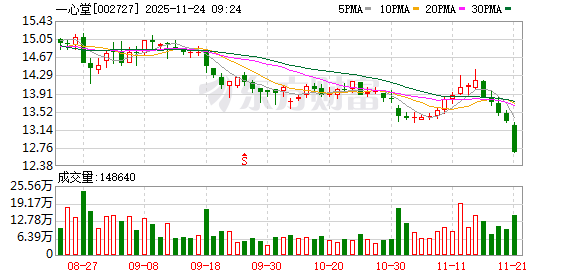
一心堂(002727.SZ):在部分门店新增美妆、个护、盲盒、卡牌等品类
Ge Long Hui· 2025-11-24 01:38
Core Viewpoint - Yixin Tang (002727.SZ) has introduced new product categories such as beauty, personal care, blind boxes, and trading cards in some of its stores to enhance operational performance [1] Group 1 - The company is expanding its product offerings in select stores [1] - The new categories aim to improve the operational situation of these stores [1]

一心堂:在部分门店新增美妆、个护、盲盒、卡牌等品类,可改善这部分门店的经营状况
Mei Ri Jing Ji Xin Wen· 2025-11-24 01:23
Group 1 - The core viewpoint of the article is that Yaozhong (002727.SZ) is enhancing its store offerings by adding new product categories such as cosmetics, personal care, blind boxes, and trading cards to improve the operational performance of certain stores [2][3] Group 2 - The company has received inquiries from investors regarding the effectiveness of the new product categories introduced in its stores [2] - The addition of beauty, personal care, and other products is aimed at improving the business conditions of specific stores [2]
大参林(603233):头部连锁药房,立足华南翼展全国
Guoxin Securities· 2025-11-18 13:58
Investment Rating - The report assigns an "Outperform" rating for the company [6] Core Views - The company has shown impressive profit growth in the first three quarters of 2025, with revenue reaching 20.068 billion yuan, a year-on-year increase of 1.7%, and net profit attributable to shareholders of 1.081 billion yuan, up 26.0% [1][9] - The company is expanding its market presence across China, leveraging a combination of self-built stores, franchises, and acquisitions, establishing a leading position in the industry [3][78] - The company is expected to achieve revenue of 27.205 billion yuan in 2025, with a projected growth rate of 2.7% [3][101] Financial Performance - In the first three quarters of 2025, the company's sales expense ratio decreased to 21.8%, while the net profit margin improved to 5.8% [2][17] - The gross profit margin for the retail business was 37.7%, reflecting a 0.4 percentage point increase [2][17] - The company anticipates a steady increase in revenue and profit over the next few years, with net profit expected to reach 1.208 billion yuan in 2025, a growth of 32.0% [3][101] Business Model and Strategy - The company operates a diversified business model that includes direct retail, franchise operations, and distribution, focusing on high-margin products [41][90] - The company has developed a robust supply chain and logistics system to enhance operational efficiency and customer service [41][88] - The franchise model is becoming a significant growth driver, with the number of franchise stores increasing substantially [82][86] Market Position and Expansion - The company has established a strong presence in South China and is expanding into other regions, including the Yangtze River Delta and Northeast China [3][78] - As of the end of Q3 2025, the company had a total of 17,385 stores, with a significant proportion being franchise stores [28][80] - The company is well-positioned to capitalize on the ongoing transformation in the pharmacy industry, which is shifting from rapid expansion to deeper integration [3][44] Future Outlook - The company is expected to benefit from structural growth opportunities in the pharmacy sector, driven by trends such as prescription drug outflow and the professionalization of retail endpoints [3][60] - The projected revenue for 2026 and 2027 is 30.071 billion yuan and 33.363 billion yuan, respectively, indicating a positive growth trajectory [3][101]

CVS Posts Strong Q3 Earnings, but Shares Show Little Movement
247Wallst· 2025-10-29 14:04
Core Insights - CVS reported Q3 financials showing it beat on earnings and revenue, which resulted in strong forward guidance [1] Financial Performance - The company exceeded expectations in both earnings and revenue for the third quarter [1] - Strong financial results have led to positive forward guidance for the upcoming periods [1]


医保改革后,个人账户划入减少?药店也都快撑不住
Sou Hu Cai Jing· 2025-10-27 05:52
Core Insights - The domestic pharmacy industry is facing a significant downturn, with a sharp increase in store closures, totaling 6,778 in Q1 2024 and rising to 8,792 in Q2 2024 [1][4] Group 1: Market Conditions - The oversaturation of pharmacies is a critical factor contributing to the industry's struggles, as the stable demand for pharmaceuticals is divided among an excessive number of stores, leading to reduced profit margins [4] - As of Q2 2023, the total number of pharmacies in China reached 701,000, which translates to an average of about 2,000 people served per pharmacy, significantly lower than the 6,000-7,000 range in developed countries [8] Group 2: Impact of Healthcare Policy - The reform of the medical insurance system, particularly the changes to personal accounts since 2021, has severely impacted consumer spending at pharmacies, as funds from personal accounts have decreased, leading to a decline in pharmacy revenues [6][9] - In 2023, the expenditure from personal accounts for purchasing medications dropped by 9% year-on-year, and this trend is expected to continue into 2024, further straining pharmacy revenues [8] Group 3: Consumer Behavior - Consumers are increasingly opting to visit hospitals for medication due to insufficient balances in their medical insurance accounts, which allows them to benefit from broader reimbursement options [8] - The reduction in personal account contributions has made consumers more price-sensitive, prompting them to seek lower-priced medications and compare prices more rigorously [8]
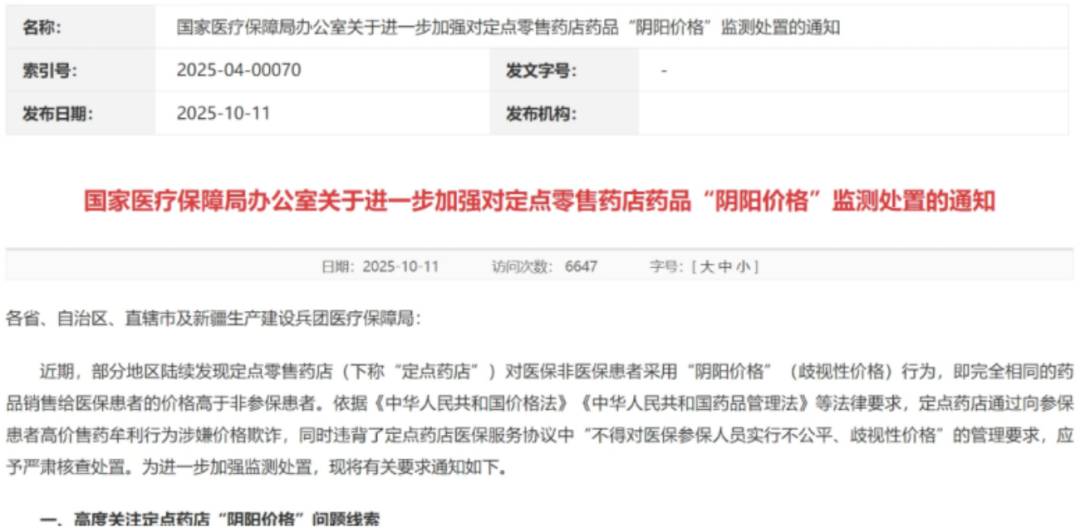
医保买药竟比自费贵?国家医保局整治定点药店“阴阳价”套路,高价售药牟利涉嫌价格欺诈
Hua Xia Shi Bao· 2025-10-17 00:40
Core Viewpoint - The article highlights the issue of "dual pricing" in retail pharmacies, where the same medication is sold at a higher price to patients using health insurance compared to those paying in cash, leading to distrust in the health insurance system [1][5]. Group 1: Regulatory Response - The National Healthcare Security Administration issued a notification to strengthen monitoring and handling of "dual pricing" practices in retail pharmacies, emphasizing that such discriminatory pricing violates service agreements [1][8]. - The notification proposes a multi-faceted approach involving technical monitoring, law enforcement, and public supervision to address the issue effectively [1][5]. Group 2: Pricing Practices - Common practices include "same drug dual pricing," where the insurance price is higher than the cash price, and "specification splitting," where purchasing individual units costs more than buying a full box [3][4]. - Some pharmacies require patients to join membership programs or purchase specific products to access the same pricing as cash customers, further complicating the pricing structure [3][4]. Group 3: Impact on Patients and Pharmacies - The "dual pricing" phenomenon particularly affects patients with chronic diseases, increasing their medication costs and leading to hidden losses in health insurance funds [5][10]. - Pharmacies face financial pressures due to delayed reimbursements from health insurance, which can take one to two months, leading them to adopt these pricing strategies to maintain cash flow [3][9]. Group 4: Monitoring and Enforcement - The notification mandates pharmacies to conduct self-inspections and encourages public reporting of violations, with a focus on increasing the cost of non-compliance through a tiered penalty system [8][9]. - A pilot program in Chengdu showed a 42% decrease in "dual pricing" incidents after reducing the reimbursement cycle from 45 days to 20 days, indicating the effectiveness of timely payments [9].