
军工制造

Search documents
【环球财经】记者观察:德国加码发展军工 打造经济复苏引擎
Xin Hua She· 2025-09-25 14:05
Core Viewpoint - Germany, as the economic "locomotive" of Europe, has been in recession for two consecutive years, prompting the government to significantly increase investment in the defense industry to stimulate the weak economy [1][3]. Economic Context - Germany's economy, heavily reliant on exports, has faced multiple challenges including energy price shocks and slow industrial transformation, leading to a clear downward trend [3]. - The Federal Statistical Office reported a 2.9% month-on-month decline in new industrial orders in July, marking the third consecutive month of decline [3]. - Major automotive manufacturers like BMW, Mercedes-Benz, and Volkswagen have reported significant profit declines for the first half of 2025 due to slow electrification and external pressures such as high tariffs from the U.S. [3]. - The German government has approved a total budget of €520.5 billion for the fiscal year 2026, with a defense budget of €82.7 billion, a 32% increase from the previous fiscal year [3]. Defense Industry Investment - The German defense ministry plans to submit over 60 orders by the end of 2025, including a new generation "European fighter jet" project with a budget of €3 to €5 billion and the "Puma" infantry fighting vehicle project costing around €10 billion [5]. - The defense industry is seen as a crucial component of Germany's economic resilience and is expected to play a significant role in economic recovery [5]. Industry Challenges - The German defense industry has been in a state of contraction since the end of the Cold War, with military spending as a percentage of GDP dropping from 2.5% in 1990 to 1.4% in 2020, leading to reduced production capacity and a loss of technical personnel [5]. - Germany remains competitive in traditional sectors like tank and submarine manufacturing but lags in emerging fields such as stealth fighters and drones due to lower R&D investment compared to other military powers [5]. Market Dynamics - Germany's military spending has increased for three consecutive years, making it the fourth-largest military spender globally in 2024 [8]. - Rheinmetall, a major defense manufacturer, has seen its stock price rise nearly 2000% over the past five years, with 80% of its revenue now coming from defense [8]. - Demand for products from ThyssenKrupp Marine Systems, including submarines and frigates, has surged, with projected sales of approximately €2.1 billion for the 2023-2024 fiscal year, a 16.7% increase from the previous year [9]. Employment and Economic Impact - The German Employment Research Institute predicts that the upward trend in the defense industry will continue for years, potentially creating up to 200,000 jobs [13]. - However, some economists express caution regarding the potential of defense spending to significantly boost the economy, citing the need for government borrowing rather than tax increases to fund military expansion [15]. - The economic multiplier effect of military spending is relatively low, with estimates suggesting that every €1 spent on defense only generates about €0.50 in economic activity, compared to higher multipliers for infrastructure and education investments [16].


商务部公告!中方对6家美国公司采取措施
券商中国· 2025-09-25 09:32
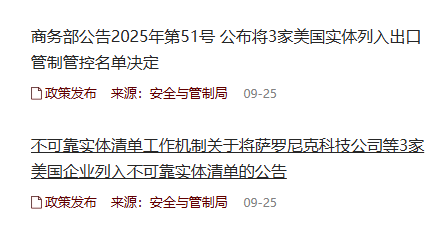
Core Points - The Ministry of Commerce of China announced on September 25, 2025, the inclusion of three U.S. entities in the export control list and three U.S. companies in the unreliable entity list to safeguard national security and interests [1][2][6][8] Export Control List - Three U.S. entities, namely Huntington Ingalls Industries, Planate Management Group, and Global Dimensions LLC, have been added to the export control list, prohibiting the export of dual-use items to them [1][6] - Ongoing export activities related to these entities must be halted immediately, and any necessary exports require an application to the Ministry of Commerce [1][6] Unreliable Entity List - Three companies, Saronic Technologies, Aerkomm Inc., and Oceaneering International, have been placed on the unreliable entity list due to their military technology cooperation with Taiwan, which is seen as a threat to China's national sovereignty and security [2][8] - These companies are prohibited from engaging in import and export activities related to China and from making new investments within China [2][8] Implementation - The measures outlined in the announcements will take effect from the date of publication, September 25, 2025 [4]


刚刚,中方宣布制裁
Zhong Guo Ji Jin Bao· 2025-09-25 09:25
Group 1 - The Chinese Ministry of Commerce announced the inclusion of three US companies in the unreliable entity list due to their military technology cooperation with Taiwan, which is seen as a threat to China's national sovereignty and security [3][4]. - The companies listed are Saronic Technologies, Aerkomm, and Oceaneering International, which will face restrictions on engaging in trade and investment activities related to China [4]. - The announcement is part of China's legal framework, referencing laws such as the Foreign Trade Law and the National Security Law, indicating a legal basis for the actions taken against these companies [3][4]. Group 2 - Additionally, three US entities have been placed on an export control list, prohibiting the export of dual-use items to them, as part of China's efforts to safeguard national security and fulfill international obligations [5][6]. - The companies included in the export control list are Huntington Ingalls Industries, Planate Management Group, and Global Dimensions LLC, with immediate effect on the export of relevant items [6]. - Exporters are required to seek approval from the Ministry of Commerce for any necessary exports under special circumstances [6].
商务部:将3家美国实体列入出口管制管控名单
中国能源报· 2025-09-25 08:55
Core Viewpoint - The Chinese Ministry of Commerce has added three U.S. entities to the export control list to safeguard national security and fulfill international obligations regarding non-proliferation [2]. Group 1: Export Control Measures - The three U.S. entities listed for export control are Huntington Ingalls Industries, Planate Management Group, and Global Dimensions LLC [3]. - Export of dual-use items to these entities is prohibited, and any ongoing export activities must be halted immediately [2]. - In special circumstances where export is necessary, exporters must apply to the Ministry of Commerce for approval [2].

商务部出手!将亨廷顿·英格尔斯工业公司等3家美国实体列入出口管制管控名单;将萨罗尼克科技公司等3家美国企业列入不可靠实体清单
Mei Ri Jing Ji Xin Wen· 2025-09-25 08:38
Core Points - The Ministry of Commerce of China has announced the inclusion of three U.S. entities in the export control list to safeguard national security and interests [2][4] - Additionally, three other U.S. companies have been added to the unreliable entity list due to their military technology cooperation with Taiwan, which China views as a threat to its sovereignty [5][8] Export Control List - Three U.S. entities, namely Huntington Ingalls Industries, Planate Management Group, and Global Dimensions LLC, have been prohibited from receiving dual-use items [2][5] - All ongoing export activities related to these entities must be halted immediately [2][3] Unreliable Entity List - The companies Saronic Technologies, Aerkomm Inc., and Oceaneering International, Inc. have been added to the unreliable entity list, prohibiting them from engaging in import and export activities related to China and from making new investments in the country [5][8] - The decision is based on their military technology cooperation with Taiwan, which China strongly opposes [8][9]
突发!俄罗斯,遭袭!
券商中国· 2025-09-24 23:38
Core Viewpoint - The article discusses the escalating tensions between Russia and Ukraine, highlighting recent military actions and political statements that indicate a deteriorating relationship between the two nations and their interactions with the United States [1][2][12]. Group 1: Military Actions - Ukrainian forces conducted a drone attack on the Russian port city of Novorossiysk, resulting in 2 deaths and multiple injuries, with damage to residential buildings and a hotel [4][6]. - The Russian military retaliated against Ukrainian training units, using two Iskander missiles, which led to casualties among Ukrainian personnel [8]. - Russia's defense ministry reported strikes against Ukrainian special forces and military facilities in response to attacks on Crimea, including drone storage sites and military enterprises [10][9]. Group 2: Political Statements - Russian presidential spokesperson Peskov stated that attempts to normalize U.S.-Russia relations have yielded minimal results, with significant issues remaining unresolved [12]. - U.S. President Trump expressed a belief that Ukraine could regain its territory with EU and NATO support, while also indicating continued U.S. military assistance to NATO allies [12]. - Ukrainian President Zelensky expressed willingness to meet with President Putin in various locations, excluding Moscow, which he views as a tactic to delay discussions [13]. Group 3: Economic Implications - The European Union is considering raising import tariffs on Russian oil, although no specific timeline has been provided [16][17]. - Hungary and Slovakia continue to import significant amounts of Russian oil, despite pressure from the U.S. to halt such purchases [18]. - The EU is also planning to provide compensation loans to Ukraine, potentially amounting to €130 billion [19].
猛涨超30%!宏昌科技火了 多家机构调研
Zhong Guo Ji Jin Bao· 2025-09-21 21:21
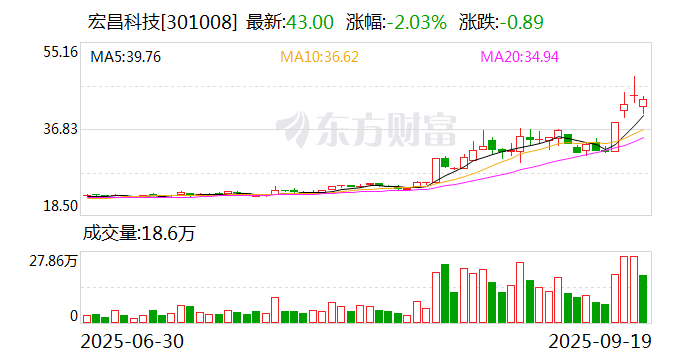
Group 1: Company Performance - Hongchang Technology (301008) experienced a nearly 34% increase in stock price last week, driven by institutional interest in its humanoid robot business [1][7] - The company invested 30 million yuan in Liangzhi Joint Technology Co., holding a 30% stake, with applications in collaborative robots, humanoid robots, robotic dogs, and wolves [3] - Other companies like Meilixin also saw significant stock price increases, with a rise of over 22%, indicating a broader interest in the humanoid robot sector [3] Group 2: Market Trends - The humanoid robot index rose over 2% last week, reflecting growing institutional enthusiasm for the sector [1] - Nearly 40% of companies that participated in institutional research achieved positive returns, with several companies, including Hongchang Technology, seeing stock price increases of over 30% [4] - The storage chip market is experiencing a price surge, with SanDisk announcing over a 10% price increase and Micron pausing product pricing, driven by supply-demand dynamics and increased capital expenditures in AI [5] Group 3: Industry Insights - Companies like Demingli are focusing on domestic storage product development to meet the growing demand from data centers and cloud computing, with expectations of continued price increases in the storage market [5] - Aviation and automotive sectors are also under scrutiny, with companies like AVIC Chengfei discussing military trade product interest and BYD emphasizing collaboration across the supply chain [6] - The introduction of eSIM technology by companies like Unisoc highlights advancements in telecommunications, particularly in AI and 5G applications [6]
三年前欧盟曾制裁新疆棉,如今军工囤中国棉短绒,俄购棉稳火力
Sou Hu Cai Jing· 2025-09-19 18:41
Core Viewpoint - The article highlights the dramatic shift in the European military industry's reliance on Chinese nitrocellulose, revealing the consequences of previous sanctions against Xinjiang cotton and the current urgent need for high-quality raw materials [1][5][6]. Group 1: European Military Industry Challenges - European military giants, once vocal against Xinjiang cotton, are now scrambling to secure Chinese cotton short fibers, which have been nearly depleted [1][3]. - The EU's defense meeting revealed that only 70% of the planned 1 million artillery shells for Ukraine were delivered, primarily due to a shortage of high-quality nitrocellulose [5][6]. - The reliance on Chinese nitrocellulose has become critical, as over 90% of the supply comes from China, leading to production constraints for European defense contractors [6][21]. Group 2: Shift in Trade Dynamics - Russia's import of nitrocellulose from China surged from virtually zero to 1,365 tons in 2023, indicating a significant shift in trade dynamics [3][8]. - The transportation of nitrocellulose to Russia is facilitated through intermediaries in Central Asia and Turkey, highlighting a complex supply chain [8][10]. - China's production of nitrocellulose, which accounts for nearly half of the global output, is supported by a robust supply of Xinjiang cotton, ensuring a stable production process [16][19]. Group 3: Global Supply Chain Implications - The article emphasizes the strategic importance of raw materials like nitrocellulose in modern warfare, as they directly affect artillery output frequency [24][26]. - European countries are struggling to establish a comparable supply chain to China's, despite efforts to revive local production [21][22]. - The ongoing competition for nitrocellulose illustrates a broader trend in geopolitical dynamics, where supply chain stability becomes a critical factor in military readiness [23][26].

调研速递|广东宏大接受线上众多投资者调研 矿服订单与军工业务成关注焦点
Xin Lang Cai Jing· 2025-09-19 10:57
Core Viewpoint - Guangdong Hongda Holding Group Co., Ltd. held an online performance briefing on September 19, discussing its mining service business, order status, military industry transformation, acquisition progress, and business synergy [1]. Group 1: Mining Service Business - The mining service segment has seen a steady increase in new orders, with over 35 billion yuan in hand orders as of the first half of the year, maintaining a stable service mineral structure [1]. - The company focuses on key regional markets and accelerates international expansion, emphasizing a "big clients, big projects" strategy, with major clients including Zijin Mining, China Energy Group, and Ansteel Mining [1]. - New mining service orders exceeded 10 billion yuan this year [1]. Group 2: Military Industry Transformation - The company is committed to transforming towards the military industry, investing heavily in high-end intelligent weapon systems and related supply chain layouts [1]. - The defense equipment product layout includes high-end defense equipment and core supporting products [1]. Group 3: Acquisition Progress - The acquisition of Changzhilin was priced considering multiple factors and aligns with the company's military transformation strategy, enhancing the industrial chain layout [1]. - The company is actively promoting the subsequent equity transfer related to the acquisition [1]. - The acquisition of Xuefeng Technology was also priced based on various factors, facilitating industrial chain synergy and seizing opportunities in Xinjiang's mineral resource development [1]. Group 4: Other Business Developments - The company expressed readiness to participate in the Yaxia Hydropower Station and Xinjiang Railway blasting business, although participation remains uncertain [2]. - The Hongda Satellite Wuxi project currently operates 10 satellites successfully, with future collaboration planned with the defense equipment business [2]. - The company held an investor open day on September 17 in Beijing, aiming to continuously optimize investor relations management [2].

德媒称,欧洲拒绝了特朗普,要求联合对中国征收100%关税的建议
Sou Hu Cai Jing· 2025-09-17 04:20
Group 1 - The core message of Trump's statement emphasizes the need for NATO allies to collectively stop importing oil from Russia as a condition for the U.S. to impose sanctions on Russia [1] - Trump criticizes NATO members for not meeting their commitments and highlights the contradiction of some countries still purchasing Russian oil, which undermines their negotiating power with Russia [1] - Trump suggests imposing a 50% tariff on Chinese goods, claiming it would lead to a swift end to the war, while also blaming China for the ongoing conflict [1] Group 2 - Trump's recent calls for European allies to impose 100% tariffs on China and India are framed as a strategy to cut off Russian energy revenue, but the underlying motives appear more complex [3] - Facing pressure from the EU to facilitate peace talks between Russia and Ukraine, Trump deflects by insisting that the EU must first halt energy imports from Russia, which some countries like Hungary have rejected [5] - The proposal for high tariffs on China could lead to a trade war between China and the EU, increasing the EU's reliance on the U.S., although this strategy has not succeeded as the G7 finance ministers collectively rejected the proposal [5] Group 3 - The U.S. has already imposed a 15% tariff on EU steel and aluminum products and demands that the EU cover $135 billion in military expenses, straining transatlantic relations [6] - Historical evidence from the U.S.-China trade war suggests that high tariffs can lead to mutual harm, making the EU hesitant to repeat such a strategy [6] - The unpredictability of U.S. policies under Trump's administration has led to a lack of trust from the EU, which is also concerned about the potential for a global economic crisis if a full-scale trade war erupts among the three major economies [6] - Experts note that a 100% tariff would violate WTO rules, and the EU prefers targeted measures rather than broad tariffs, reflecting internal divisions within the Western alliance and the shifting international landscape due to China's rising power [6]
