
生物制造

Search documents
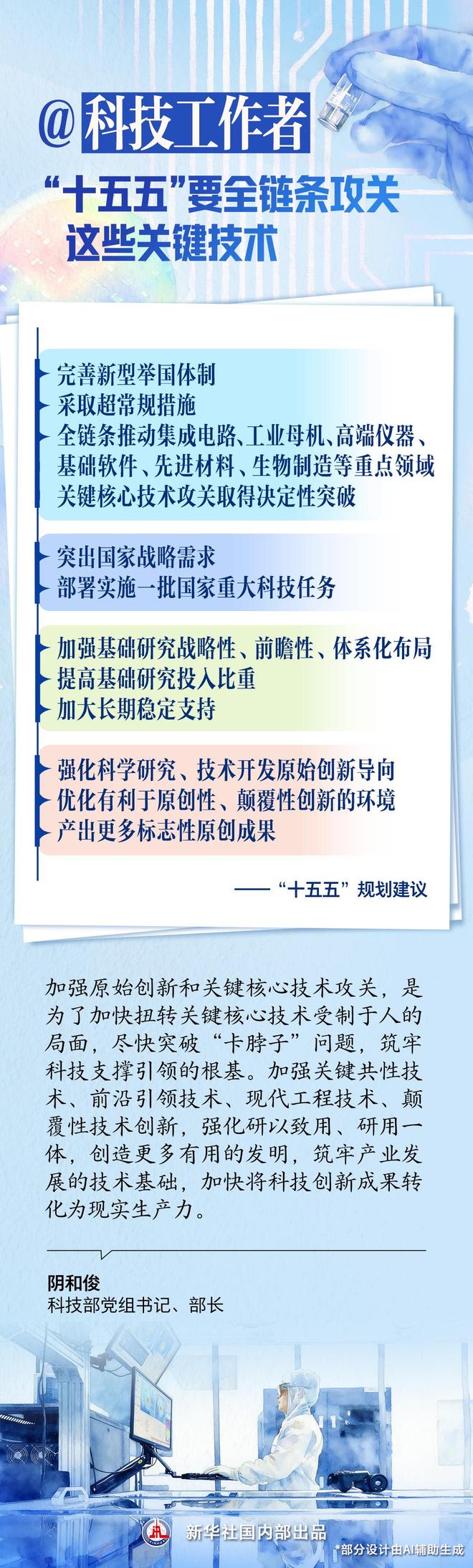
@科技工作者,“十五五”要全链条攻关这些关键技术
Xin Hua She· 2025-12-24 09:48
Group 1 - The article emphasizes the importance of strengthening original innovation and key core technology breakthroughs to address the issue of dependency on external technologies and to overcome critical bottlenecks in various sectors [2][1] - It highlights the need for a comprehensive approach to promote integrated circuits, industrial mother machines, high-end instruments, foundational software, advanced materials, and biomanufacturing as key focus areas for technological advancement [1] - The article outlines the strategic deployment of national major scientific tasks to enhance foundational research and increase investment in this area, aiming for a more systematic and forward-looking layout [1][2] Group 2 - The "14th Five-Year Plan" suggests optimizing the environment for original and disruptive innovation to produce more landmark original achievements [2] - It stresses the importance of transforming scientific and technological innovations into practical productivity, thereby solidifying the technological foundation for industrial development [2] - The article calls for a long-term and stable support system for foundational research to ensure sustained progress in key technological areas [1][2]

沃森生物在昆明成立生物制造公司,含生物基材料制造业务
Qi Cha Cha· 2025-12-24 09:36
Core Viewpoint - Watson Bio has established a new biomanufacturing company in Kunming, focusing on biobased materials and related technologies [1] Group 1: Company Overview - Watson Bio Manufacturing (Kunming) Co., Ltd. has been registered with a capital of 40 million yuan [1] - The legal representative of the new company is Li Yunchun [1] Group 2: Business Scope - The company's business scope includes research and application of cell technology, development of biobased materials technology, manufacturing of biobased materials, research on biological feed, and development of biopesticide technology [1] - The company is wholly owned by Watson Bio (300142) through indirect holdings [1]

本市新增115家博士后设站单位
Xin Lang Cai Jing· 2025-12-23 17:03
Group 1 - The core viewpoint of the article highlights the expansion of postdoctoral stations in Beijing, with 115 new stations set to be established by 2025, primarily focusing on technology-driven enterprises in strategic emerging industries such as new energy, new materials, aerospace, artificial intelligence, and biomanufacturing, which account for over 60% of the new stations [1][2] - The Beijing Municipal Human Resources and Social Security Bureau is organizing specialized training to enhance the operational level of postdoctoral stations, addressing concerns related to system construction, talent introduction, and training, providing precise guidance for newly established stations [1] - The training includes sharing experiences from leaders in postdoctoral work at institutions like Zhongguancun Science Park and Beijing Academy of Agriculture and Forestry Sciences, focusing on collective operation and talent cultivation, which serves as a reference for optimizing training models [1][2] Group 2 - The article mentions that the training also features insights from Professor Chen Shujun, a newly elected Beijing Scholar and Vice President of Beijing University of Technology, who shares experiences on postdoctoral growth and thoughts on talent cultivation in the new era, providing valuable references for high-quality postdoctoral work in the city [2] - Universities such as Peking University, Beijing Jiaotong University, and Beijing University of Science and Technology are actively promoting postdoctoral training policies and collaboration intentions, aiming to build bridges for collaborative education between academia and industry [2] - The Beijing Municipal Human Resources and Social Security Bureau plans to continue optimizing the service guarantee system for postdoctoral work, enhancing policy empowerment and resource integration to stimulate innovation and creativity among postdoctoral talents, thereby promoting deep integration of industry, academia, and research [2]
晶采观察丨盘点2025!这些细节里藏着中国经济底气
Yang Guang Wang· 2025-12-23 12:41
Group 1 - The core economic temperature of China is reflected in daily life changes, such as the rise of new retail experiences and increased tourism among the elderly, indicating a solid foundation for economic growth [1] - The Central Economic Work Conference emphasizes achieving greater breakthroughs in quality and effectiveness, providing important guidance for the start of the 14th Five-Year Plan [1] - Technological advancements, including intelligent robots and breakthroughs in quantum communication and biomanufacturing, are creating new growth points and reinforcing the foundation for high-quality economic development [1] Group 2 - The resilience of the industrial chain has contributed to stability, with new energy vehicle sales reaching 14.78 million units in the first 11 months, a year-on-year increase of 31.2%, supported by collaboration among numerous component manufacturers [2] - The logistics sector has shown robust performance, with express delivery volumes exceeding 18 billion packages in the first 11 months, reflecting the vibrant consumer market [2] - Policy support has strengthened development, with the Hainan Free Trade Port officially starting operations, offering over 6,600 tax-free items to enhance consumer benefits and create broader opportunities for employment and entrepreneurship [2] Group 3 - Looking ahead, the Central Economic Work Conference has set the tone for the next year, focusing on stability and quality improvement, with investments in people's livelihoods as a priority [3] - The emphasis on enhancing medical services, stabilizing employment, and improving elderly care aims to ensure economic stability and progress [3]
“十四五”我国生物制造产业总规模达1.1万亿元
Xin Lang Cai Jing· 2025-12-22 20:23
Core Insights - During the "14th Five-Year Plan" period, China's biomanufacturing industry has experienced significant growth in scale, technology, and cluster development, with a total scale reaching 1.1 trillion yuan [1][1][1] Industry Growth - The biomanufacturing industry in China has steadily expanded, with the production of biopharmaceutical products accounting for over 70% of the global output [1][1] - The annual output value of sub-sectors such as food additives and biopharmaceuticals exceeds 400 billion yuan, establishing biomanufacturing as a new economic growth point [1][1] Technological Innovation - China's biomanufacturing sector holds over 20% of the global patent application share, indicating significant innovation capabilities [1][1] - A number of national key laboratories and industrial innovation platforms have been established, leading to the industrial application of new instruments such as domestic high-throughput gene sequencers and large-scale fermentation tanks [1][1] Industry Clusters - Regions like Beijing and Tianjin have emerged as innovation hubs for biomanufacturing, while Shandong, Heilongjiang, and Henan have developed into major manufacturing bases for bulk biopharmaceutical products [1][1] - Cities such as Chongqing and Guangdong are continuously producing original achievements in the field [1][1] - The industry has nurtured several backbone enterprises with annual revenues exceeding 10 billion yuan, along with dozens of national-level manufacturing champions and specialized "little giant" enterprises [1][1]
新思想引领新征程丨粤港澳大湾区深入推进国际科技创新中心建设 奋力打造全球科技创新高地
Yang Guang Wang· 2025-12-22 08:06
Group 1 - The Guangdong-Hong Kong-Macao Greater Bay Area aims to establish itself as a global technology innovation hub, focusing on the development of emerging industries and leveraging the complementary advantages of the three regions [1][2] - The establishment of the Higher Education Regional Technology Transfer Center in the Greater Bay Area aims to facilitate the transformation of high-level projects from 27 renowned universities, including Hong Kong University of Science and Technology and University of Macau [1] - The region is home to over 400 invention patents authorized daily, showcasing its strong innovation aggregation effect [1] Group 2 - A high-energy direct geometry non-elastic neutron scattering time-of-flight spectrometer was recently accepted and delivered in Dongguan, marking a significant advancement in China's research capabilities [2] - The Greater Bay Area is witnessing a surge in technology innovation, with over 70,000 national high-tech enterprises and major scientific infrastructure projects under construction [2][3] - The region's innovation cluster, particularly the "Shenzhen-Hong Kong-Guangzhou" area, has ranked first globally in innovation index, while the "Macau-Zhuhai" cluster has been recognized among the top 100 globally for two consecutive years [3] Group 3 - The Guangdong Provincial Government emphasizes collaboration with Hong Kong and Macau in fields such as artificial intelligence, low-altitude economy, and biomanufacturing to build a comprehensive innovation community [3][4] - The ongoing development of infrastructure connectivity and regulatory mechanisms is enhancing the efficient flow of various elements within the Greater Bay Area, supporting industrial collaboration and innovation [3] - The "14th Five-Year Plan" period is critical for the Greater Bay Area to become a globally influential international technology innovation center, focusing on frontier emerging fields and cross-border industrial technology integration [4]
申万宏源晨会报告-20251222
Shenwan Hongyuan Securities· 2025-12-22 02:46
Group 1: Market Overview - The Shanghai Composite Index closed at 3890, with a slight increase of 0.36% [1] - The Shenzhen Composite Index also saw a rise of 0.98%, indicating a positive market sentiment [1] - Large-cap indices showed a modest increase of 0.3% yesterday, while mid-cap and small-cap indices performed better with increases of 0.91% and 0.8% respectively over the same period [1] Group 2: Industry Performance - The home decoration industry led the gains with a 3.33% increase yesterday, reflecting strong demand [1] - The energy sector also performed well, with a 3.26% increase, although it has seen a decline of 3.9% over the past month [1] - Conversely, the electronic components sector faced significant declines, with a drop of 3.46% yesterday and a 69.42% decrease over the past six months [1] Group 3: Future Industry Trends - The report highlights key future industries including quantum technology, bio-manufacturing, hydrogen energy, and brain-computer interfaces, emphasizing recent breakthroughs and commercialization efforts [10][8] - In quantum technology, a significant academic breakthrough was reported with the development of an 11-qubit silicon-based processor, marking progress in semiconductor quantum computing [10][8] - The bio-manufacturing sector is seeing advancements with AI applications in pharmaceuticals, as a unicorn company plans to raise 2.277 billion HKD for drug development [10][8] Group 4: Strategic Recommendations - The report suggests focusing on the hydrogen energy sector, particularly with the launch of the world's largest green hydrogen project, which is expected to drive growth in this area [10][8] - The brain-computer interface technology is advancing with successful clinical trials, indicating a promising future for this field [10][8] - The automotive industry is witnessing the approval of L3 autonomous driving models, which is expected to enhance the market for intelligent vehicles [21][22]
我国生物制造产业稳步壮大
Jing Ji Ri Bao· 2025-12-22 01:07
Core Insights - The biomanufacturing industry in China has grown significantly, with a total scale reaching 1.1 trillion yuan, and bioproducts accounting for over 70% of global production [1] - The industry is expected to be a core driver of the Fourth Industrial Revolution, emphasizing the importance of biomanufacturing in fostering new productive forces and advancing new industrialization [1] - The "14th Five-Year Plan" period is projected to see continued growth in biobased materials and chemicals, with bioproduct output increasing by approximately 20% compared to the end of the "13th Five-Year Plan" [1] Industry Growth and Innovation - Significant breakthroughs in technology and product innovation have been achieved, including high-throughput gene sequencers and AI protein design platforms, leading to the commercialization of various biomanufactured products [2] - The emergence of biomanufacturing clusters, such as in Shenzhen and Hainan, showcases localized development and the establishment of major technological infrastructures [2] - The Ministry of Industry and Information Technology has announced key lists related to high-performance bioreactor innovation and pilot capabilities, which are crucial for industry advancement [3] Policy and Strategic Development - The Ministry of Industry and Information Technology aims to create a complete industrial ecosystem that supports innovation, transformation, and high-quality development in biomanufacturing [3] - The upcoming "15th Five-Year Plan" will focus on establishing a framework for biomanufacturing, including the identification of flagship products and AI applications [3] - Emphasis will be placed on enhancing scientific research and innovation to address fundamental scientific issues and engineering bottlenecks in the biomanufacturing sector [3] Recommendations for High-Quality Development - The establishment of an innovation system, modern industrial system, and management service system is recommended to accelerate high-quality development in biomanufacturing [4] - Support for diverse development routes and the cultivation of flagship products is essential for the innovation ecosystem [4] - The integration of advanced biomanufacturing technologies with various industries is crucial for optimizing and upgrading industrial structures [5]
三地同心 共绘新篇——推动京津冀协同发展持续走深走实
Xin Lang Cai Jing· 2025-12-22 00:52
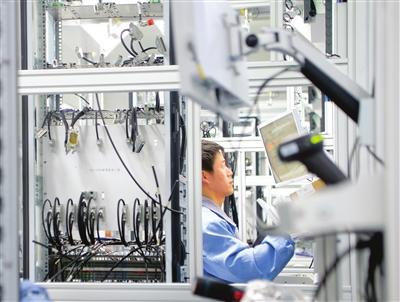
转自:北京日报客户端 在位于武清京津产业新城的交控技术装备有 限公司,工作人员正在加班加点赶制订单。 记者 钱进 摄 编者按 2025年是"十四五"规划收官之年,是进一步全面深化改革、奋力谱写中国式现代化天津篇章的重要一 年。 回望这一年,从蓝图擘画到施工落地,从夯基垒台到积厚成势,天津始终牢记习近平总书记的殷殷嘱 托,以推进京津冀协同发展为战略牵引,全面实施高质量发展"十项行动",深化科技创新、产业焕新、 城市更新,有效盘活存量、做优增量、提升质量,进一步全面深化改革,扩大高水平对外开放,加快建 设现代化产业体系,推动经济实现质的有效提升和量的合理增长,交出了一份扎实的天津答卷。 即日起,本报推出"牢记嘱托 善作善成——年终专稿",记者深入"十项行动"的一线现场,对话拼搏实 干的奋斗者,记录基层一线的生动实践,剖析攻坚克难的典型案例,展望充满机遇的未来图景。我们希 望通过这组报道,不仅呈现一份实事求是的"成绩单",更提炼一种面向未来的"方法论",为新征程上的 奋楫笃行、向"新"而进积蓄坚实力量。 "十四五"收官在即,冬日的津沽大地,协同发展的热潮比暖阳更激荡人心——京津城际列车风驰电掣, 将时空距离压缩成" ...
申万宏源证券晨会报告-20251222
Shenwan Hongyuan Securities· 2025-12-22 00:41
Group 1: Market Overview - The Shanghai Composite Index closed at 3890 points, with a daily increase of 0.36% and a monthly change of 0.03% [1] - The Shenzhen Composite Index closed at 2465 points, with a daily increase of 0.98% and a monthly change of -0.34% [1] - Large-cap indices showed a slight increase of 0.3% yesterday, while mid-cap and small-cap indices increased by 0.91% and 0.8% respectively [1] Group 2: Industry Performance - The decoration and renovation industry saw a daily increase of 3.33%, but a decline of 7.79% over the past month, while it increased by 30.51% over the past six months [1] - The energy metals sector increased by 3.26% yesterday, with an impressive 85.77% increase over the past six months [1] - The general retail sector increased by 3.22% yesterday, with an 8.93% increase over the past month and an 18.79% increase over the past six months [1] Group 3: Notable Declines - The components sector experienced a decline of 0.74% yesterday, with a 3.46% increase over the past month and a significant 69.42% increase over the past six months [1] - The other electronics sector declined by 0.68% yesterday, with a 42.32% increase over the past six months [1] - State-owned large banks saw a decline of 0.67% yesterday, with a 7.66% increase over the past six months [1]

