
茶饮

Search documents
古茗在杭州拿地 新茶饮品牌“热衷”拿地盖楼?
Zheng Quan Shi Bao Wang· 2026-01-13 13:32
证券时报记者吴家明 价格大战、密集上市......新茶饮企业的热点似乎都在价格和资本市场。不过,一个"特别"的现象正悄然 上演:头部茶饮品牌似乎也在关注重资产,开始拿地盖楼。 近日,位于杭州钱江世纪城核心区一宗商业用地挂牌出让。古茗技术(浙江)有限公司以4.55亿元总价竞 得该地块,成交楼面价约合每平方米6100元。浙江省自然资源网上交易中心的资料显示,该地块土地用 途为商务金融用地,用地面积约1.24万平方米。 根据《建设用地规划条件》和《地块出让合同》,该地块整体自持比例不低于80%,自持年限为40年, 自持期间不得分割转让、不得分割登记。该地块被明确定位为总部经济类用地,竞得者须与杭州市萧山 钱江世纪城管理委员会签订《杭州市萧山钱江世纪城核心单元XS010203-04地块投资开发协议》。 根据市场公开消息,目前古茗实行杭州、台州双总部战略。其中,台州总部坐落于温岭市大溪镇,杭州 总部则位于萧山区,新地块的用途尚在规划中。公司财报显示,2025年上半年公司营业收入约56.6亿 元,同比增加41.2%。与餐饮零售消费行业争抢一、二线城市不同,古茗81%的门店布局在二线及以下 城市。 有分析人士表示,自有物业 ...
霸王茶姬联合新加坡旅游局、亚洲文明博物馆,将推沉浸式茶文化展览
Feng Huang Wang Cai Jing· 2026-01-13 10:36
霸王茶姬联合亚洲文明博物馆(Asian Civilisations Museum,简称为ACM)与新加坡旅游局(Singapore Tourism Board,简称为STB)宣布,将于2026年1月28日至6月7日共同推出沉浸式多感官茶文化展览《茶 苑梦》(Garden of Senses:A Tea Reverie)。这是ACM首次与国际品牌展开深度策展合作。 新加坡不仅是霸王茶姬的亚太总部所在地,也是其品牌国际化的重要节点。霸王茶姬自2024年8月在新 加坡正式开设首家直营店以来,发展迅速,目前已拥有33家门店。 据悉,霸王茶姬已在新加坡开设各类特色门店。例如1月9日,在滨海城(Suntec City)正式开设了首家家 庭友好型概念店,适合到店的儿童玩耍;位于牛车水宝塔街的Pagoda House,则是其在新加坡首家带有 专属文创精品区的门店;2025年6月,霸王茶姬还在新加坡国立大学开设了东南亚首家"无声门店",其 中大部分店员为听障人士。 "此次联合策展,是亚洲文明博物馆首次与国际品牌展开合作,"亚洲文明博物馆及土生文化馆馆长温俊 玉先生表示:"透过与霸王茶姬及新加坡旅游局的共同策展,我们得以结合馆藏 ...
古茗4.55亿杭州拿地,一年股价涨超150%
Jin Rong Jie· 2026-01-13 06:07
Core Viewpoint - The new tea beverage brand, Gu Ming (01364.HK), has acquired a commercial land plot in Hangzhou for 455 million yuan, marking its entry into the local real estate market and plans to establish its headquarters there [1][2]. Group 1: Land Acquisition Details - Gu Ming Technology (Zhejiang) Co., Ltd. won the land plot located in the core area of Qianjiang Century City, Hangzhou, with a floor price of 6,100 yuan per square meter [1]. - The land covers approximately 12,400 square meters with a buildable area of about 75,000 square meters and a height limit of 190 meters [1]. - The land is designated for headquarters economy use, requiring the company to meet specific operational targets, including an annual revenue of no less than 1 billion yuan [2]. Group 2: Company Growth and Financial Performance - Gu Ming has not yet established its own headquarters in Hangzhou, currently operating from a location in Xiaoshan District [2]. - The company previously acquired land in May 2022 in Wenling City for a total investment of about 500 million yuan to build its headquarters [3]. - As of mid-2025, Gu Ming reported a revenue of 5.663 billion yuan, a year-on-year increase of 41.2%, and a net profit of 1.625 billion yuan, up 121.5% [4]. Group 3: Expansion Plans and Market Position - Gu Ming aims to expand its store network to 30,000-40,000 locations, targeting untapped markets in lower-tier cities and towns [6]. - The company has a total of 11,179 stores across over 200 cities, reflecting a year-on-year growth of 17.5% [5]. - In 2025, Gu Ming distributed significant dividends totaling approximately 4.1 billion Hong Kong dollars, with the founder holding 72.77% of the shares [6]. Group 4: Market Valuation and Stock Performance - As of January 12, Gu Ming's stock closed at 25.38 HKD per share, representing a more than 150% increase from its IPO price of 9.94 HKD [7]. - The company's market capitalization is approximately 60.36 billion HKD, with a peak valuation exceeding 70 billion HKD in mid-2025 [7].
古茗耗资4.5549亿元在杭州拿地
Cai Jing Wang· 2026-01-13 03:10
近日,浙江省自然资源网上交易中心官网显示,杭州市萧山区的世纪城核心单元XS010203-04地块,出让面积12445平方米(18.668亩),主用图商务金融用 地,被古茗技术(浙江)有限公司竞得。据悉,该地块最高有效报价为4.5549亿元,竞买保证金为9110万元。位置东至广孚中心,南至秋韵街,西至规划经 二路,北至鸿宁路。出让年限40年。 图片来源:浙江省自然资源网上交易中心官网截图 ...

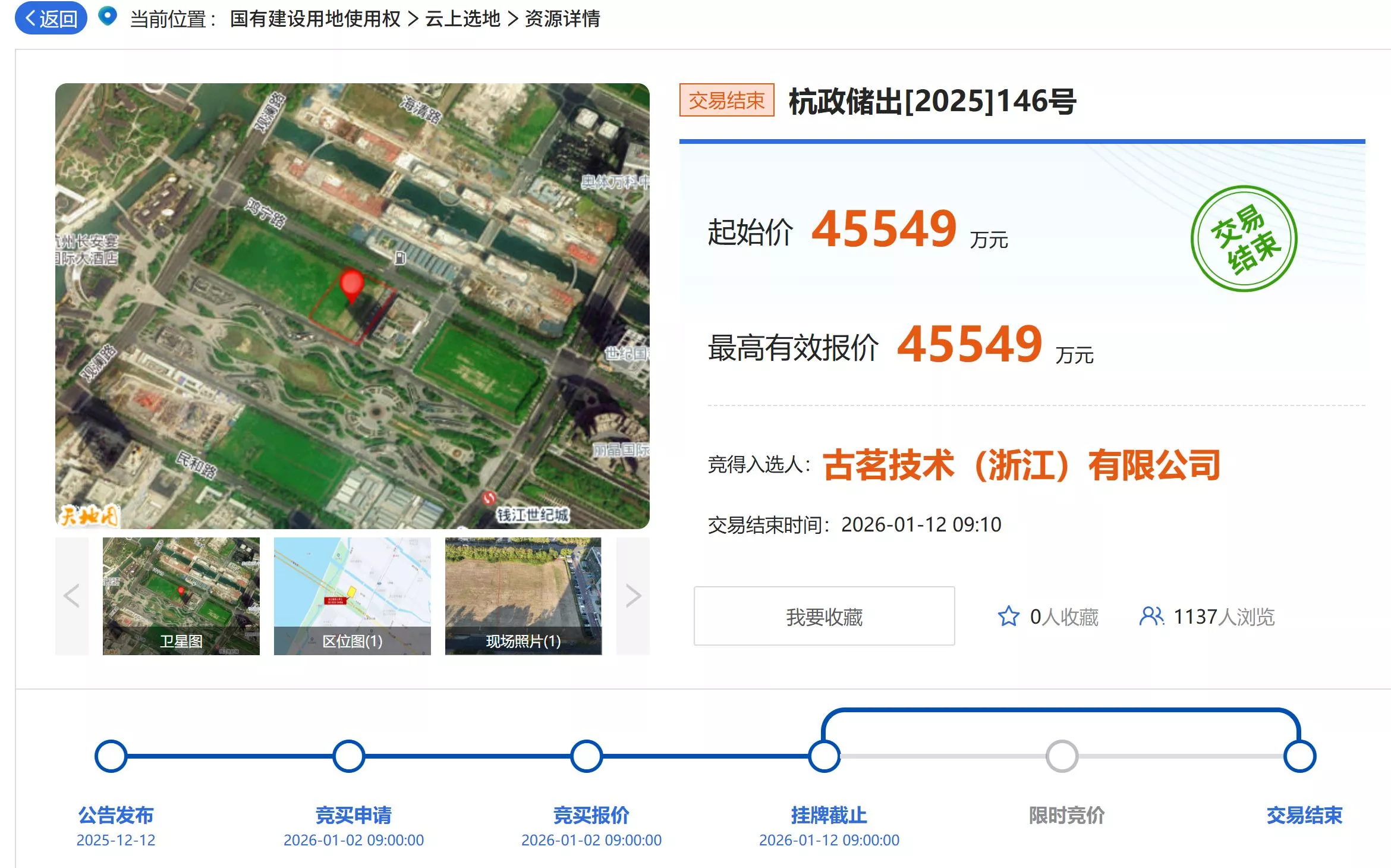
浙江奶茶巨头为何要花4.55亿元在杭州拿地?
3 6 Ke· 2026-01-13 02:57
Core Insights - The tea beverage industry is witnessing a shift from front-end competition focused on store density and product iteration to back-end competition emphasizing organizational capability, resource integration, and capital strength [2][7]. Group 1: Land Acquisition and Strategic Moves - Gu Ming Technology (Zhejiang) Co., Ltd. acquired a commercial financial land parcel in Hangzhou for 455 million yuan, marking a significant investment in real estate amidst a competitive landscape [2][3]. - The land is suitable for developing a mixed-use commercial and business building, with a total area of 12,445 square meters and a maximum building height of 190 meters [3][5]. - Other leading tea brands, such as Yi He Tang and Nayuki, are also investing in real estate, indicating a trend among top brands to establish headquarters and enhance operational capabilities [6][7]. Group 2: Market Position and Financial Performance - Gu Ming's revenue for the first half of 2025 reached approximately 5.66 billion yuan, reflecting a year-on-year increase of 41.2% [8]. - The company has a significant presence in lower-tier cities, with 81% of its stores located in second-tier and below cities, showcasing its strategy of targeting less saturated markets [9][10]. - The company’s supply chain management and franchisee support systems are highlighted as key competitive advantages, enabling efficient operations and lower costs [10]. Group 3: Long-term Strategy and Confidence - The trend of acquiring land during a downturn in the real estate market reflects the confidence of leading tea brands in their cash flow and long-term value [10]. - The mixed strategy of maintaining light operations while investing in heavy assets is seen as a new anti-cyclical approach, allowing companies to hedge against inflation and secure long-term operational costs [10].
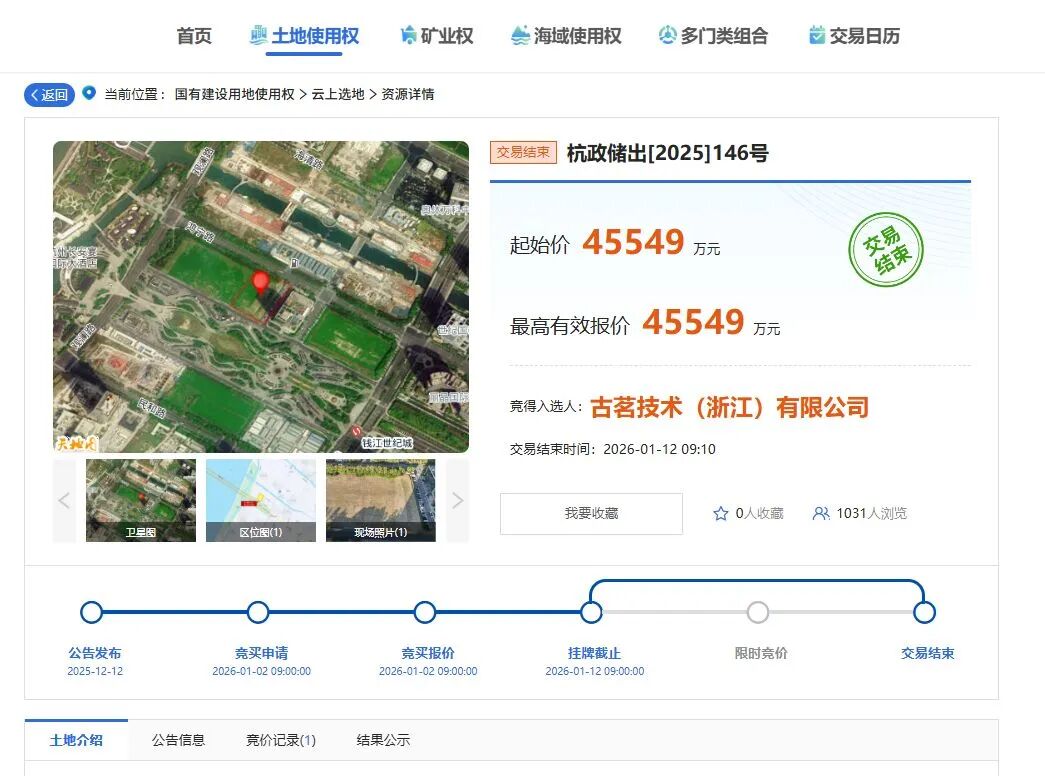
4.55亿!茶饮品牌古茗在杭州拿地
Xin Lang Cai Jing· 2026-01-13 02:35
1月12日上午,位于杭州钱江世纪城核心区一宗商业用地挂牌出让。古茗技术(浙江)有限公司以4.55亿元总价竞得该地块,成交楼面价6100元/㎡。 浙江省自然资源网上交易中心官网显示,该地块位于萧山区世纪城核心单元,东至广孚中心,南至秋韵街,西至规划经二路,北至鸿宁路。土地用途为商务 金融用地,用地面积约1.24万平方米,容积率不大于6.0且不低于1.5,建筑高度不大于190米、不小于15米。 根据《建设用地规划条件》和《地块出让合同》,该地块整体自持比例不低于80%,自持年限为40年,自持期间不得分割转让、不得分割登记。该地块被明 确定位为总部经济类用地,竞得者须与杭州市萧山钱江世纪城管理委员会签订《杭州市萧山钱江世纪城核心单元XS010203-04地块投资开发协议》。 《投资开发协议》约定,竞得者及其在杭下属控股企业需达到明确的经营指标,包括年度营业收入不低于10亿元;自土地合同签订之日起至2027年12月31 日,须被认定为杭州市总部企业;2026年至2030年,在钱江世纪城范围内每年合计实现营收分别不低于17亿元、18亿元、20亿元、22亿元及23亿元,累计达 百亿元。 在杭州拿地之前,2022年5月,古 ...
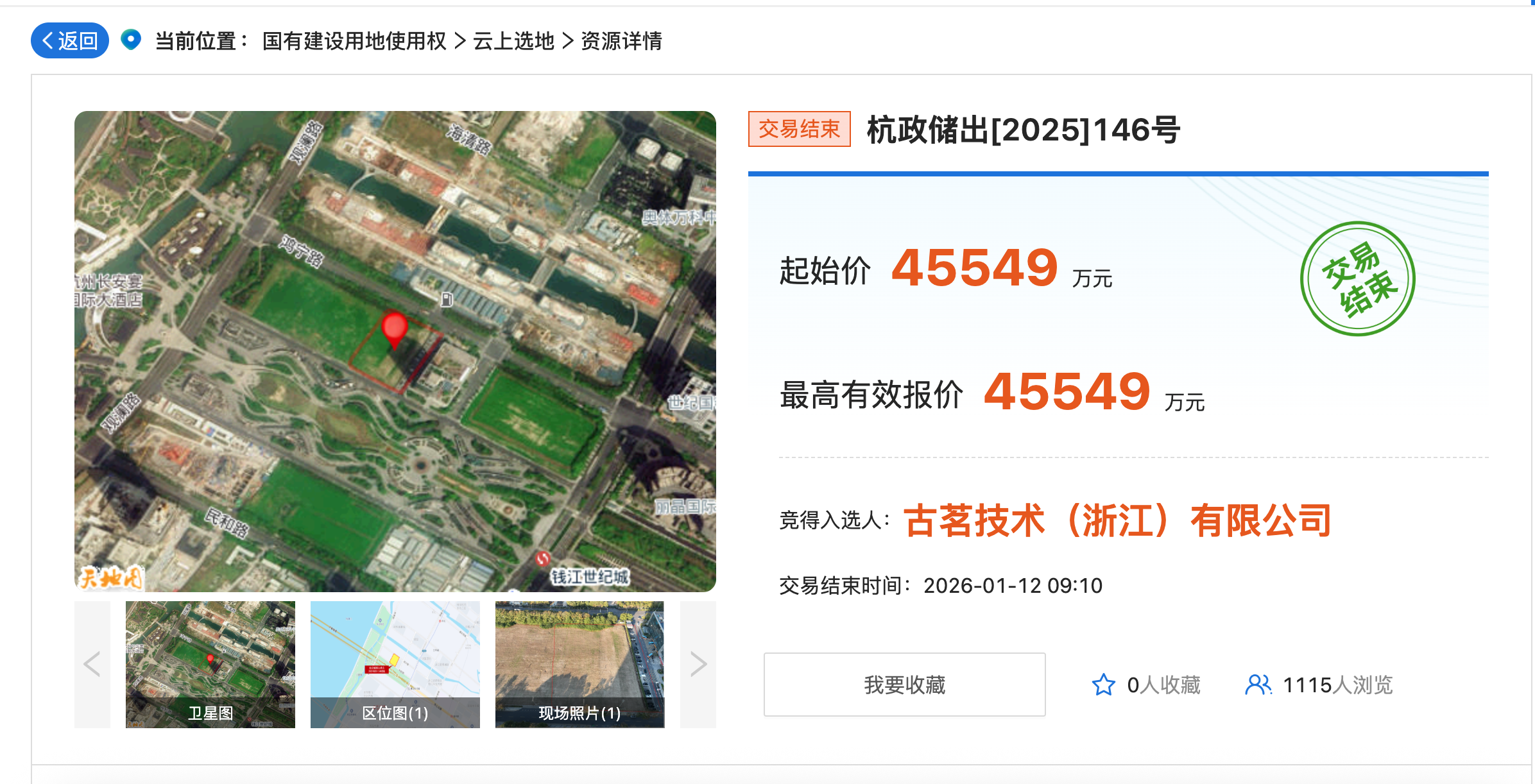
浙江奶茶巨头,花4.55亿元在杭州拿地,地块面积超1.2万平方米
Mei Ri Jing Ji Xin Wen· 2026-01-12 14:53
Core Insights - The tea beverage industry is witnessing a shift in competitive dynamics, moving from front-end competition focused on store density and product iteration to back-end competition emphasizing organizational capability, resource integration, and capital strength [2][8] Group 1: Company Developments - Gu Ming (古茗) has acquired a commercial and financial land parcel in Hangzhou for 455 million yuan, indicating a strategic move towards asset-heavy investments [2][3] - The land is suitable for developing a mixed-use commercial and business building, with a minimum plot size of 800 square meters and a self-holding ratio of at least 80% for 40 years [5] - Gu Ming's revenue for the first half of 2025 reached approximately 5.66 billion yuan, reflecting a year-on-year increase of 41.2% [8][10] Group 2: Industry Trends - Major tea brands, including Gu Ming, are increasingly investing in real estate, which signifies a transition to a platform and ecosystem-based business model [8] - The competitive landscape is evolving as companies focus on building headquarters that enhance supply chain management, digital operations, and product development [8][10] - The trend of "building headquarters" is not limited to Gu Ming; other leading brands like Nayuki and Mixue are also engaging in similar asset acquisitions to strengthen their market positions [6][7] Group 3: Market Positioning - Gu Ming's store distribution is heavily concentrated in second-tier and lower cities, with 81% of its outlets located in these areas, showcasing its strategy of targeting less saturated markets [9][10] - The company has a robust supply chain management system, providing efficient cold chain logistics to 97% of its stores, which contributes to lower operational costs [10] - Analysts predict that Gu Ming could potentially expand its store count to over 40,000 nationwide, indicating significant growth potential in the market [11]

外媒关注2026开年中国消费市场新趋势——中国消费迎来“开门红”(国际论道)
Xin Lang Cai Jing· 2026-01-12 14:51
Core Insights - The Chinese consumer market is experiencing a significant transformation, shifting from quantity to quality, driven by increased consumer confidence and innovative policies [6][9][10]. Consumer Activity - During the New Year holiday, 142 million domestic trips were made in China, with total spending reaching 84.789 billion yuan, indicating a robust recovery in consumer activity [6][14]. - Hainan's duty-free sales on January 1 reached 251 million yuan, a year-on-year increase of 93.8%, showcasing the growing appeal of domestic tourism and shopping [7][14]. Market Trends - The rise of "China Shopping" alongside "China Travel" reflects a shift in consumer preferences, with tourists increasingly purchasing high-tech products and cultural items rather than traditional souvenirs [7][8]. - The Z-generation in China is gravitating towards new domestic products and services that blend tradition with modern technology, enhancing the appeal of local brands [7][8]. Policy Support - The Chinese government is implementing a series of policies aimed at stimulating consumption, including financial incentives and support for green technology products [9][10]. - The Central Economic Work Conference emphasized the continuation of proactive fiscal policies in 2026 to maintain high growth rates, focusing on boosting consumer spending and investment [9][10]. Economic Resilience - China's consumer market is not only recovering but also reflecting structural optimization and enhanced internal dynamics, contributing to economic resilience [11][19]. - The retail sales of consumer goods increased by 4% year-on-year in the first eleven months of 2025, indicating a steady release of consumer demand [11][19]. Global Perspective - International media highlight the opportunities for global businesses to adapt to the evolving Chinese market, particularly in sectors like retail and services, where consumer preferences are shifting towards local and value-driven products [12][19]. - The focus on service experiences among younger consumers presents significant opportunities for foreign companies in sectors such as tourism, cultural events, and entertainment [12][19].


外媒关注2026开年中国消费市场新趋势——中国消费迎来“开门红”
Ren Min Ri Bao· 2026-01-12 06:51
Core Insights - The Chinese consumer market is experiencing a significant transformation, moving from quantity to quality, which presents substantial opportunities for global markets [1][2][6] Group 1: Consumer Trends - During the New Year holiday, 142 million domestic trips were made in China, with total spending reaching 84.789 billion yuan, indicating strong consumer activity [1] - The "ice and snow tourism" has become a key driver of winter consumption, with record visitor numbers to ski resorts and hot springs [2] - The shopping preferences of travelers to China are evolving, with a shift towards high-tech products and cultural items, reflecting the diversity and quality of Chinese products [2][3] Group 2: Policy Support - China's 14th Five-Year Plan emphasizes promoting consumption as a key strategy for balanced economic growth [5] - The Central Economic Work Conference highlighted the implementation of proactive fiscal policies to stimulate consumption and investment in 2026 [4] - Recent policies aim to enhance consumer confidence through measures like consumption subsidies and improved social security systems [5][6] Group 3: Economic Resilience - The retail sales of consumer goods in China increased by 4% year-on-year in the first eleven months of 2025, showcasing the steady recovery of consumer demand [6] - The focus on domestic consumption is expected to drive sustainable economic growth, shifting the emphasis from investment and exports to services and consumption [5][6] - The resilience of the Chinese economy is further supported by targeted measures to expand domestic demand and enhance social security [6] Group 4: Global Market Opportunities - Global brands are encouraged to adapt their strategies to align with the evolving preferences of Chinese consumers, particularly in terms of value and local tastes [7] - There is significant potential for investment in China's smaller cities, where daily consumer spending shows remarkable resilience [7] - The younger generation in China is increasingly spending on experiences, such as travel and cultural events, presenting opportunities for service-oriented businesses [7]
国际论道丨中国消费迎来“开门红”
Ren Min Ri Bao Hai Wai Ban· 2026-01-12 04:24
Core Insights - The Chinese consumer market is experiencing a significant transformation, moving from quantity to quality, driven by various factors including government policies and changing consumer preferences [1][4][6] Group 1: Consumer Activity - During the New Year holiday, 142 million domestic trips were made in China, with total spending reaching 84.789 billion yuan [1] - Hainan's duty-free sales on January 1 reached 251 million yuan, a year-on-year increase of 93.8% [2] - The rise of "China Shopping" reflects a shift in foreign tourists' purchasing habits towards high-tech products and cultural items [2][3] Group 2: Policy Support - The Chinese government is implementing a series of policies aimed at boosting consumption, including a more proactive fiscal policy and specific actions to stimulate consumer spending [4][5] - The "14th Five-Year Plan" emphasizes the importance of consumption in achieving balanced economic growth [5] Group 3: Economic Resilience - China's consumer market growth indicates a recovery in demand and an ongoing optimization of the economic structure, enhancing internal momentum and resilience [6] - Retail sales of consumer goods increased by 4% year-on-year in the first eleven months of 2025, showcasing the effectiveness of consumption-boosting measures [6] Group 4: Global Opportunities - Global companies and investors are encouraged to adapt to the evolving Chinese market, particularly in retail and service sectors, where local preferences are becoming increasingly important [7] - There is a notable opportunity in smaller Chinese cities, where daily consumer spending shows remarkable resilience, presenting long-term investment potential [7]