工业互联网

Search documents
视频丨生产场景直接搬进赛场?这个大赛专挑技术尖兵
Yang Shi Xin Wen Ke Hu Duan· 2025-11-28 01:12
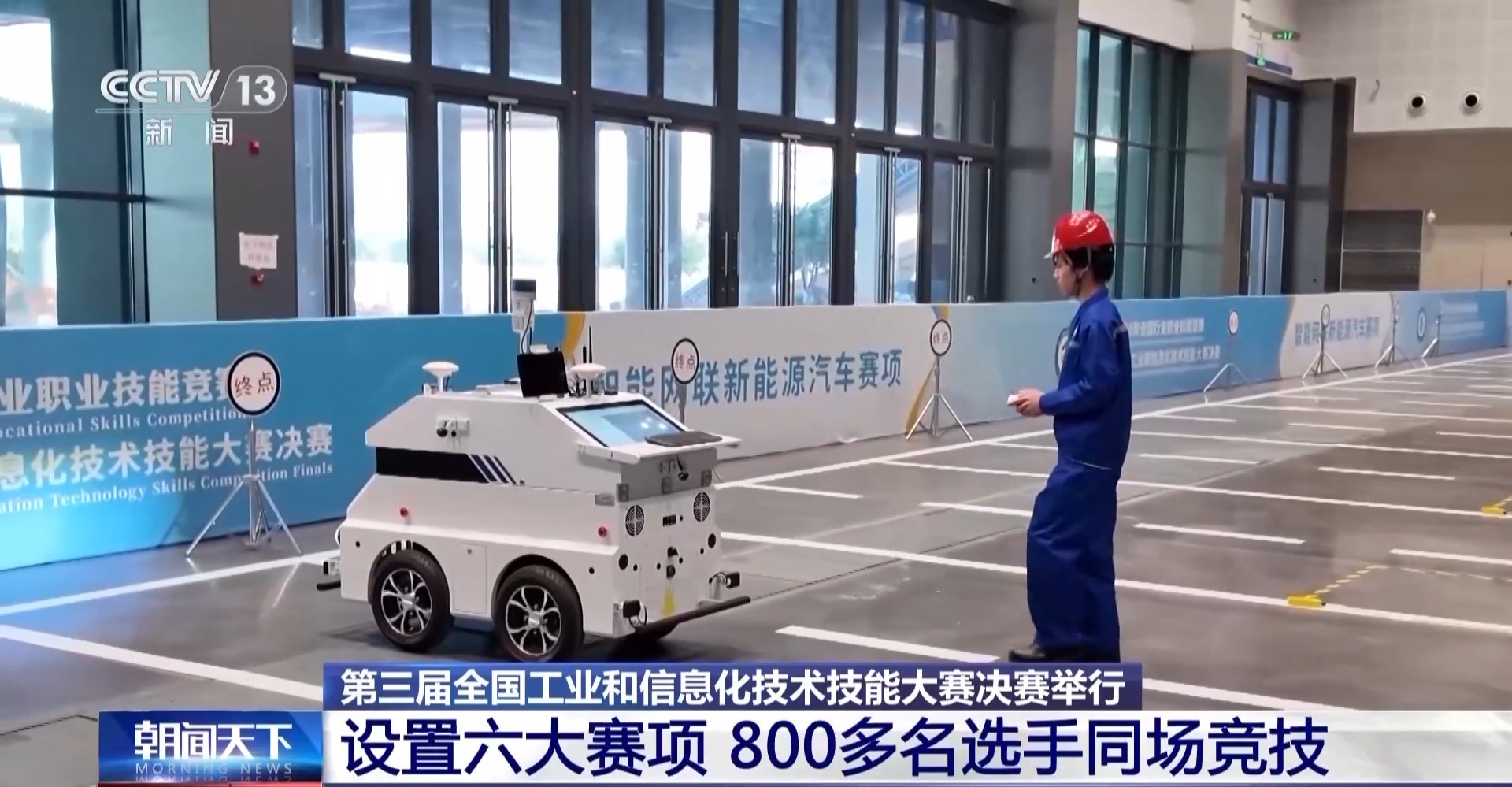
Core Points - The third National Industrial and Information Technology Skills Competition was held in Chongqing, focusing on key areas such as industrial robots, new energy vehicles, industrial internet, and digital transformation of manufacturing [1][3] - The competition attracted 408 teams and 834 participants, with six major events designed to address real-world issues from the production line [3][5] Group 1: Competition Overview - The competition featured six major events that emphasize practical applications and solutions derived from real industrial scenarios [3] - Participants showcased their skills in tasks involving humanoid robots, including industrial inspection, operation, and transportation [5][9] Group 2: Technological Integration - The competition integrated humanoid robots with industrial scenarios, enhancing their capabilities in tasks such as autonomous navigation and obstacle avoidance [5][9] - The introduction of open-source large models combined AI technology with industrial robots, promoting an upgrade from execution to understanding and interaction [5] Group 3: Talent Development - The competition aims to foster interdisciplinary engineering talent with system integration capabilities and innovative thinking [7] - It serves as a platform for identifying and nurturing skilled technical personnel, with previous competitions yielding numerous national technical experts and award winners [13] Group 4: Industry Impact - The event promotes vocational talent cultivation and technological innovation, while also accelerating the digital transformation of related industries [13] - The industrial internet sector has seen significant growth, with 17 provinces achieving over 100 billion yuan in added value, and over 1 million industrial devices connected [15] Group 5: Market Potential - The humanoid robotics sector is experiencing rapid growth, with over 150 companies and an expected market size of 100 billion yuan by 2030 [15] - There is a strong demand for talent in robot control, algorithms, and AI applications, particularly in the humanoid robotics field [15]

以赛育才,锻造新质生产力“生力军”——全国工业和信息化技术技能大赛破解人才瓶颈观察
Zheng Quan Shi Bao Wang· 2025-11-27 10:55
Core Viewpoint - The development of new quality productivity is essential for promoting high-quality development in China, driven by technological breakthroughs and the need for high-quality technical talent [1] Group 1: Talent Gap and Skills Demand - The rise of new industries and the transformation of traditional industries have created a significant talent gap, particularly for interdisciplinary and composite talents in fields like smart connected vehicles and artificial intelligence [2] - By 2025, the talent shortage in smart connected vehicle technology is expected to reach 256,000 personnel, highlighting the urgent need for skilled workers who understand both industrial mechanisms and digital technologies [2] Group 2: Competition and Industry Relevance - The national industrial and information technology skills competition is designed to address the talent gap by focusing on real industry challenges, ensuring that the competition topics are derived from actual pain points faced by enterprises [3] - The competition's practical assessment model simulates real industrial scenarios, aiming to quickly cultivate composite talents capable of solving practical problems [3] Group 3: Market Value of Skills - Participants who excel in the competition become highly sought after by companies, demonstrating the market value of the skills acquired through the competition [3] - The shift in focus from traditional qualifications to practical problem-solving abilities reflects a new talent perspective under the framework of new quality productivity [4] Group 4: Knowledge Transfer and Mentorship - The competition serves as a platform for knowledge transfer between generations of skilled workers, exemplified by the mentorship relationship between teachers and students [5][6] - The integration of new technologies such as big data and artificial intelligence into the competition reflects an ongoing evolution in skill development, ensuring that the talent pool remains relevant and innovative [6] Group 5: Overall Impact on Manufacturing - The national industrial and information technology skills competition embodies a model for talent cultivation that combines competition with education, providing robust support for the development of new quality productivity [6][7] - The competition not only showcases skilled elites but also fosters the growth of future craftsmen, contributing to the high-end, intelligent, and green transformation of China's manufacturing industry [7]
晚报 | 11月27日主题前瞻
Xuan Gu Bao· 2025-11-26 14:37
Group 1: Organic Silicon - Dow Chemical announced a price increase of 10-20% for its Xiameter organic silicon products starting December 10, with variations depending on the product line [1] - Recent discussions in the domestic organic silicon industry have focused on pricing mechanisms and production reduction strategies, leading to a significant price increase in organic silicon products, improving profitability [1] - As of November 24, the market price for DMC in East China reached 13,200 yuan/ton, reflecting a 20% increase for the month [1] Group 2: DRAM Industry - TrendForce forecasts a 30.9% revenue growth for the DRAM industry in Q3 2025, reaching $41.4 billion, driven by rising contract prices and increased shipment volumes [2] - The fourth quarter is expected to see a 45-50% increase in conventional DRAM contract prices, with overall contract prices for conventional DRAM and HBM projected to rise by 50-55% [2] - The demand for core storage chips related to AI systems is driving a "super cycle" in the storage market, with price increases expected to continue through 2026 and possibly into 2027 [2] Group 3: Industrial Internet - Six Chinese government departments issued a plan to enhance the adaptability of consumer goods supply and demand, promoting flexible and customized manufacturing models [3] - The core of flexible manufacturing is "production based on demand," which addresses mismatches in supply and demand and enhances responsiveness to external shocks [3] - The integration of new technologies like industrial internet and AI is strengthening the foundation for flexible manufacturing systems [3] Group 4: Data Elements - The National Data Bureau is supporting the establishment of a comprehensive service system for data circulation and trading [4] - Data trading markets are experiencing growth driven by policy support and technological breakthroughs, with high-value sectors like finance and healthcare leading the way [4] - The data circulation market is projected to exceed 200 billion yuan by 2025 and reach 700 billion yuan by 2030, with significant value release expected in various sectors [4] Group 5: Energy Storage - Huawei's digital energy division is innovating in grid-connected energy storage technologies, achieving significant breakthroughs in performance testing and application [5] - The construction of a new power system is increasing the share of renewable energy, presenting new challenges for grid stability [5] - Grid-connected energy storage is becoming a key measure to support high levels of renewable energy integration and enhance the stability of power systems [5] Group 6: Smart Glasses - Li Xiang, CEO of Li Auto, announced the upcoming launch of smart glasses, indicating a shift towards a multi-scenario intelligent solution provider [6] - The AI glasses market is entering a competitive phase, with major tech companies releasing new products [6] - Global AI glasses sales are expected to reach 5.1 million units by 2025, with the Chinese market projected to grow by over 200% [6] Group 7: Macro and Industry News - A joint plan by six government departments aims to optimize the supply structure of consumer goods by 2027, creating three trillion-level consumption sectors and ten hundred-billion-level consumption hotspots [7] Group 8: Miscellaneous - Tesla's Austin Robotaxi fleet is expected to double in size next month, indicating growth in autonomous vehicle deployment [8] - The Ministry of Industry and Information Technology has initiated commercial trials for satellite IoT services, with a two-year trial period [10] - The market for flu medications has surged, with sales of antiviral drugs experiencing significant increases due to rising flu cases [10]
宝通科技20251125
2025-11-26 14:15
Summary of Baotong Technology Conference Call Company Overview - **Company**: Baotong Technology - **Date**: November 25, 2025 Key Points Financial Performance - **Revenue**: In the first three quarters, revenue reached 1.645 billion CNY, a year-on-year increase of 9.24% [2][3] - **Net Profit**: Net profit decreased by 12% to 209 million CNY [2][3] - **Q3 Performance**: Q3 revenue was 850 million CNY, up 16% year-on-year, with net profit exceeding 69 million CNY, a 47% increase [3] Business Segments - **Industrial Sector**: Revenue was 525 million CNY in Q3, slightly impacted by inventory impairment and initial operational challenges at the Thailand factory [4] - **Mobile Gaming**: Revenue from mobile gaming was 325 million CNY in Q3, with net profit from subsidiaries exceeding 70 million CNY [4][6] - **Game Performance**: The self-developed game "Project Third" generated 175 million CNY in revenue in the first three quarters, performing well in the European and American markets [6] Robotics and Automation - **Inspection Robots**: Rapid expansion in overseas markets, particularly with BHP, where a single robot sells for approximately 200,000 USD, with higher profit margins than domestic sales [4][6] - **Pilot Projects**: Ongoing trials in domestic mines and steel plants to address hazardous environment detection [9] Thailand Factory - **Operational Status**: The Thailand factory has passed inspections from major Australian clients and is expected to significantly contribute to revenue by 2026, offsetting domestic market pressures [5][14] - **Production Capacity**: The factory's annual capacity is 10 million square meters, expanding overall capacity by 25% to 30% [14] Future Developments - **Investment in Technology**: Continued investment in integrated smart hardware and software services to enhance operational efficiency [9] - **New Product Launches**: Upcoming releases include "Fate: The Holy Contract" in Japan and "Saint Seiya" in Europe, with expectations for stable performance [19] Market Strategy - **Game Localization**: Tailored strategies for different cultural markets in Europe, including localized adaptations for various countries [17] - **Sales Expenses**: Sales expenses increased by nearly 50% due to significant promotional investments for the game "Athena" in Europe [20] AI Integration - **AI Applications**: Utilization of AI for cost reduction and efficiency improvements in game development, including content generation for text-based adventure games [21] Challenges and Risks - **Market Competition**: Intense competition in the domestic market affecting profit margins, particularly in the industrial internet sector [13][15] Conclusion - Baotong Technology is focusing on expanding its international presence, particularly in robotics and gaming, while addressing challenges in the domestic market through strategic investments and product innovations. The Thailand factory is poised to play a crucial role in future revenue growth.

数智赋能 制造升级
Liao Ning Ri Bao· 2025-11-25 00:40
Core Viewpoint - The digital transformation in manufacturing is essential for the development of the industry in Liaoning, with a focus on integrating advanced manufacturing and digital technologies to enhance productivity and efficiency [1][3]. Group 1: Digital Transformation in Manufacturing - Liaoning is accelerating its transition from traditional manufacturing to "Liaoning Intelligent Manufacturing" through intelligent upgrades and digital transformations [3]. - The province has achieved significant progress in digitalization, with a digital design tool penetration rate of 84.8% and a key process CNC rate of 68.5%, ranking 13th and 10th nationally, respectively [3]. - Companies like ShenGu Group and Dalian Yaming Auto Parts are implementing digital management systems that enhance production efficiency and reduce resource waste [2][3]. Group 2: Infrastructure Development - New infrastructure, such as data centers and 5G networks, is being established to support the digital economy, with 147,000 5G base stations planned by September 2025 [5]. - Liaoning has developed a multi-layered industrial internet platform system, with 112 provincial-level platforms and several national-level platforms recognized [5][6]. - The establishment of AI computing centers and blockchain nodes further strengthens the province's digital infrastructure [5]. Group 3: Support and Ecosystem - The provincial government is addressing challenges faced by enterprises in digital transformation by selecting service providers and establishing national-level digital transformation promotion centers [6]. - Events like the Global Industrial Internet Conference are fostering knowledge exchange and promoting digital transformation among local industries [6]. - Liaoning is creating a conducive environment for industrial internet development, enhancing collaboration between supply and demand sides [6].
向新、向绿加速布局,青岛城市能级持续跃升
Xin Hua Wang· 2025-11-24 02:39
Core Insights - The article emphasizes the dual focus of Qingdao's economic development on innovation ("向新") and green transformation ("向绿") during the 14th Five-Year Plan period [2][7]. Group 1: Innovation and Economic Growth - Qingdao aims to achieve a GDP of 1.67 trillion yuan by 2024, with per capita disposable income reaching 59,900 yuan, and retail sales exceeding 650 billion yuan [2]. - The city is constructing an innovative industrial system supported by a "10+1" model, prioritizing two leading industries, developing five emerging industries, and enhancing three advantageous industries [3][5]. - The number of high-tech enterprises and technology-based SMEs in Qingdao has doubled, reaching 8,628 and 9,776 respectively, with over 93% of large-scale industrial enterprises having R&D institutions [6]. Group 2: Green Transformation - Qingdao's renewable energy generation capacity has increased to 806,000 kW, with renewable energy accounting for 60.5% of total installed capacity, contributing to 71% of the city's new power generation since the 14th Five-Year Plan began [7][8]. - The city has initiated large-scale offshore wind power development and aims to create a million-kilowatt offshore renewable energy base [8]. - Qingdao has built 67 national-level green factories and 17 green supply chain management enterprises, with a solid waste generation intensity of 0.24 tons per 10,000 yuan, ranking first in the province [8]. Group 3: Industrial Cluster Development - Major industrial players are increasingly gathering in Qingdao, with BOE's base projected to generate over 50 billion yuan in revenue by 2024 [4]. - The Chery base in Qingdao is expected to produce 160,000 vehicles annually, including 92,700 new energy vehicles [4]. - Haier's investment in the industrial internet ecosystem is expected to produce 26 million units annually, attracting over 30 related enterprises to the region [4]. Group 4: Urban Development and Infrastructure - Qingdao is enhancing its urban resource allocation and service capabilities, with significant infrastructure developments including over 1,200 kilometers of railway and more than 1,500 kilometers of expressways [11]. - The city is positioned as a key economic hub in the Yellow River Basin, facilitating high-quality development and connectivity with global resources [10][11]. - Qingdao's port has expanded its container foreign trade routes to 230, maintaining its position as a leading northern port in China [10].
工信部: 实施工业互联网和人工智能融合赋能行动
Zhong Guo Zheng Quan Bao· 2025-11-23 21:46
Core Insights - China has made significant advancements in the 5G and industrial internet infrastructure, with a total of 4.705 million 5G base stations and over 20,000 industrial 5G private networks established [1][2] - The country has over 340 influential industrial internet platforms, achieving full coverage across 41 major industrial categories, promoting new models and scenarios such as personalized customization and networked collaboration [1] - The cost of industrial-grade 5G products has decreased by 90% compared to initial commercial stages, with these products accounting for over 40% of the global market [1] Group 1 - The Ministry of Industry and Information Technology emphasizes the integration of the real economy and digital economy, aiming for high-quality development of the industrial internet [1] - The ministry plans to implement actions that enhance the integration of industrial internet and artificial intelligence, optimizing the industrial internet system architecture [2] Group 2 - There is a focus on the coordinated development of new infrastructure, including the deployment of networks, identification, platforms, data, and security systems [2] - The initiative includes the establishment of independent industrial 5G networks and the construction of intelligent digital information infrastructure [2] Group 3 - The ministry aims to expand industry integration applications by creating guidelines for various industries and accelerating the construction of 5G factories [2] - There is an emphasis on international collaboration and enhancing the value of industrial internet connections through deepening industry-education integration [2] Group 4 - A memorandum for regional cooperation in industrial internet development was signed by the industrial and information authorities of Jiangxi, Hubei, and Hunan provinces, focusing on breaking regional limitations and promoting deep application of identification [2] - The initiative targets key industries such as equipment manufacturing, automotive parts, electronic information, non-ferrous metals, building materials, and food processing in the Yangtze River middle urban agglomeration [2]
实施工业互联网和人工智能融合赋能行动
Zhong Guo Zheng Quan Bao· 2025-11-23 20:06
Core Insights - The 2025 China 5G + Industrial Internet Conference highlighted China's advanced layout in 5G and industrial internet infrastructure, with a total of 4.705 million 5G base stations and over 20,000 industrial 5G private networks [1][2] - The industrial internet has achieved full coverage across 41 major industrial categories, with over 340 influential industrial internet platforms, promoting significant transformations in manufacturing production methods and enterprise forms [1][2] - The cost of industrial-grade 5G products has decreased by 90% compared to initial commercial stages, with these products accounting for over 40% of the global market [1] Group 1 - The Ministry of Industry and Information Technology emphasized the integration of the real economy and digital economy, aiming for high-quality development of the industrial internet [1] - Key initiatives include promoting the leap towards intelligent industrial internet, optimizing the industrial internet system architecture, and expanding services through the integration of industrial internet and artificial intelligence [1][2] Group 2 - The strategy includes a coordinated layout of new infrastructure, focusing on the integration of networks, identification, platforms, data, and security [2] - There is an emphasis on accelerating the application of industrial internet across various industries, with plans for 5G factory construction and research on the integration of 6G with industry [2] Group 3 - The conference also saw the signing of a memorandum for regional cooperation in the Yangtze River Middle Reaches Urban Agglomeration, aiming to enhance the application of industrial internet identification across provinces [2] - The focus will be on key industries such as equipment manufacturing, automotive parts, electronic information, non-ferrous metals, building materials, and food processing [2]
成果丰、动力足 “5G+工业互联网”发展正当时
Zheng Quan Ri Bao· 2025-11-23 17:09
Core Viewpoint - The 2025 China 5G + Industrial Internet Conference emphasizes the integration of 5G technology with industrial internet to enhance the resilience and security of supply chains and promote high-quality economic development in China [1][2]. Policy Support - The "5G + Industrial Internet" initiative aims to leverage new-generation information and communication technologies to create a new infrastructure and application model that deeply integrates with the industrial economy [2][3]. - Continuous policy support has been observed at both national and local levels, with significant plans and action initiatives being rolled out since 2019 to promote the integration and application of "5G + Industrial Internet" [3][4]. Achievements - Over 20,000 "5G + Industrial Internet" construction projects have been initiated during the 14th Five-Year Plan period, with more than 340 influential industrial internet platforms cultivated [4]. - As of September, the total number of 5G base stations reached 4.705 million, an increase of 455,000 from the previous year, accounting for 36.6% of all mobile base stations [4]. Industry Development - The integration of 5G and industrial internet is not merely a technical overlay but a synergistic relationship that drives new production models and service formats [5]. - Experts suggest that the development of "5G + Industrial Internet" should focus on upgrading infrastructure, embracing artificial intelligence, and deepening the integration with key industrial chains [5].
中国启动卫星物联网商用试验,低空经济与商业航天站上新风口
Di Yi Cai Jing· 2025-11-23 13:13
Group 1 - The core viewpoint is that the launch of satellite IoT commercial trials is a key link connecting commercial aerospace and low-altitude economy, aiming to enhance service capabilities and establish a regulatory framework for emerging industries [1][2] - The Ministry of Industry and Information Technology (MIIT) announced the official start of satellite IoT commercial trials, which will last for two years, to stimulate market vitality and support the healthy development of new industries [1][4] - Satellite IoT is expected to enable real-time tracking and data transmission for low-altitude vehicles, addressing communication gaps in the low-altitude economy and fostering deep integration between commercial aerospace and low-altitude sectors [2][3] Group 2 - The satellite IoT business connects various IoT devices through satellite communication technology, providing wide-area IoT connectivity in regions where terrestrial networks are unavailable [3][4] - The MIIT has proposed 19 specific measures to promote the development of the satellite communication industry, including organizing satellite IoT commercial trials and expanding market access for private enterprises [4][5] - Major telecommunications companies like China Telecom, China Mobile, and China Unicom are actively expanding their satellite communication services, enhancing applications in emergency communication and remote area connectivity [5][6] Group 3 - The integration of satellite IoT technology is expected to attract more capital and resources into the low-altitude sector, promoting collaborative development across various industry segments such as drone manufacturing and airspace management [3][5] - The commercial trials are anticipated to create opportunities for upstream and downstream enterprises in the satellite IoT industry chain, leading to a more complete industrial ecosystem [2][5] - The MIIT aims to enhance the synergy between industrial internet and artificial intelligence, promoting the development of smart manufacturing and digital infrastructure [6][7]