
电子信息

Search documents
苏州市2026年锚定规上工业总产值迈上5万亿元台阶
Zhong Guo Xin Wen Wang· 2026-01-23 03:31
Core Insights - Suzhou aims to achieve a total industrial output value of 5 trillion yuan by 2026, with a projected GDP of 2.77 trillion yuan and an industrial output value of 4.9 trillion yuan by 2025 [1][2] Economic Development Goals - The main economic and social development goals for Suzhou in 2026 include: GDP growth of over 5%, public budget revenue growth of around 2%, industrial investment growth of approximately 10%, and a steady increase in retail sales of consumer goods [2] Industrial and Economic Structure - Suzhou's industrial structure is rapidly transforming, with an average annual growth of 8.1% in industrial investment, expected to exceed 225 billion yuan by 2025 [1] - The city has established three trillion-yuan industries: electronic information, equipment manufacturing, and new materials, with manufacturing value added accounting for over 40% of GDP [1] Trade and Foreign Relations - Suzhou's foreign trade structure has been continuously optimized over the past five years, with general trade and private enterprise import-export shares increasing by 4 percentage points and 13.3 percentage points, respectively [2] - The city has seen significant growth in service trade (15%) and cross-border e-commerce (127 times), with over 40% of imports and exports related to countries and regions involved in the Belt and Road Initiative [2] Tourism and Cultural Events - The "Su Super" events have gained popularity, contributing to the rapid development of the performing arts and event economy in Suzhou, with over 200 million tourists received in the year and a 23% increase in inbound tourists [2] Innovation and Technology - High-tech industries and strategic emerging industries account for 56.2% and 49% of the total industrial output value, respectively, with Suzhou leading in the number of global lighthouse factories and national-level 5G factories [1]
“十四五”交卷成绩单沉甸甸
Su Zhou Ri Bao· 2026-01-23 00:26
"十四五"规划收官,苏州如期兑现五年之约,向全市人民交出了一份沉甸甸的"成绩单"。 产业"作业"稳扎稳打。锚定"十四五"规划提出的制造业增加值占比40%左右的目标,苏州坚持产业 立市,产业结构加快转型,工业投资年均增长8.1%,2025年突破2250亿元,占固定资产投资比重提高 10.2个百分点,成为拉动投资增长的第一动力。当下,苏州已形成电子信息、装备制造、新材料3个万 亿级产业,获批6个国家先进制造业集群、4个国家级中小企业特色产业集群,制造业增加值占GDP比重 保持在40%以上。高新技术产业、工业战略性新兴产业产值占规上工业总产值比重分别达到56.2%和 49%,分别提高5.3个和4.1个百分点。 平安法治建设持续发力,"十四五"规划提出的公众安全感98%的目标,被99%以上的实际成效超 越,苏州获评首批全国法治政府示范城市等多项荣誉。 创新"作业"超额完成。"十四五"规划提出,R&D支出占GDP比重达4%左右。五年来,苏州坚持长 期主义,保持创新投入刚性增长,年度全社会研发投入、技术合同成交额双双突破"千亿"大关,R&D 支出占GDP比重从3.69%稳步提升至4.2%以上,超额完成目标任务。 ...
政企同向发力 以科技创新驱动产业提质增效
Xin Lang Cai Jing· 2026-01-22 22:14
本报讯 首席记者杜托 记者任翊翔报道 1月22日,市委副书记、市长杨承新深入经开区调研企业发展情 况,强调要牢固树立新发展理念,抢抓产业发展机遇,政企同向发力,以科技创新引领产业提质增效, 以精准服务破解发展梗阻,持续赋能本土企业做优做强。 在云南南天电子信息产业股份有限公司,杨承新详细了解数字化产品研发、信创生态建设等情况,对企 业积极服务数字经济、深度融入"数字中国"建设取得的成效给予肯定。他指出,南天信息作为本土电子 信息产业龙头企业,要加快核心技术迭代升级,持续优化产品结构,不断拓展应用场景,在金融科技、 智慧政务等领域深耕细作、持续发力,进一步巩固行业领先地位。相关部门要精准对接企业研发发展需 求,在政策扶持、人才引育、市场拓展等方面给予有力支持,助力企业做大做强。 云南变压器电气股份有限公司是一家专精特新"小巨人"企业。杨承新走进企业生产车间,听取企业产品 研发、生产经营及市场布局等情况介绍。他鼓励企业牢牢把握资源优势,持续加大研发投入,不断提升 科技创新水平,以核心技术突破赋能产品迭代升级,进一步开拓国内外市场。经开区要主动靠前服务、 精准对接需求,在技术改造、要素保障等方面强化支持,为企业发展 ...
多维赋能筑生态 成都科产融合跑出加速度
Zhong Guo Xin Wen Wang· 2026-01-22 15:34
Core Insights - Chengdu is building an innovation system that integrates high-level talent, service platforms, and technology-industry collaboration, aiming for rapid transformation of research outcomes into practical applications [1][3] Group 1: Talent and Innovation - Chengdu has gathered nearly 400 high-level scientific talents to provide industry insights and has established 300 academician workstations to facilitate innovation [1][2] - The Chengdu Academician Alliance has organized over 30 industry-academia-research matching events annually, enhancing the connection between market advantages and research capabilities [1][2] Group 2: Service and Support - The Chengdu Park Science and Technology Association has achieved full coverage across 23 districts, providing extensive services to enterprises, including 654 service engagements and addressing 415 specific enterprise needs [2] - A "nanny-style" service model has been implemented to assist local AI detection studios with registration, funding, and technical challenges, promoting their rapid growth [2] Group 3: Research and Development - The establishment of academician innovation workstations has become a core component of technology-industry integration, with 300 workstations created and over 400 industry-academia-research projects implemented in the last three years [2] - These workstations have facilitated the introduction of 171 high-level experts and the authorization of nearly 1,500 patents, focusing on key technologies in the oil and gas sector [2] Group 4: Public Engagement and Education - The Chengdu Science Popularization Cultural Industry Association has conducted over 400 public engagement activities, reaching over 5 million people, and is working on integrating science popularization with emerging sectors like AI and low-altitude economy [3] - Future plans include enhancing the talent attraction strategy and optimizing the layout of innovation workstations to support the development of a national technology innovation center [3]
企业融资“大礼包”来了!这些新政策帮你获得资金支持
Sou Hu Cai Jing· 2026-01-22 11:00
财政部五份文件同时发布,从贷款贴息到专项担保,一套组合拳为企业融资打开新通道。 财政部官网连续发布5个政策文件,涉及服务业贷款贴息、设备更新贷款支持、个人消费贷款优惠、中小微企业贷款贴息和民间投资专项担保计划。这一 系列政策从2026年1月1日起实施,核心特点是"延长、扩大、提高"。 01 政策概览 一揽子金融支持政策密集出台,涵盖多个关键领域。这些政策自2026年1月1日起施行,实施期限均延长至2026年12月31日,后续还可视情况进一步延长。 政策的突出特点是支持范围和力度全面提升:贴息上限提高、支持领域扩大、申请门槛降低。 针对民间投资,国家融资担保基金设立了规模达5000亿元的专项担保计划,分两年实施。这一计划为符合条件的中小微企业民间投资贷款提供担保,支持 范围包括场景拓展、升级改造、厂房扩建、店面装修和经营周转等。 专项担保计划在分险比例、代偿上限、担保额度和担保费等方面均有政策优惠,大大降低了中小微企业的融资门槛和成本。 04 个人消费贷款与申请要点 这一系列政策形成了从服务业到制造业、从企业贷款到民间投资的完整支持体系,为企业获得资金提供了全方位保障。 02 服务业与设备更新支持 针对服务业经 ...


如何成为「领航级智能工厂」?6大核心要素!
Xin Lang Cai Jing· 2026-01-22 10:09
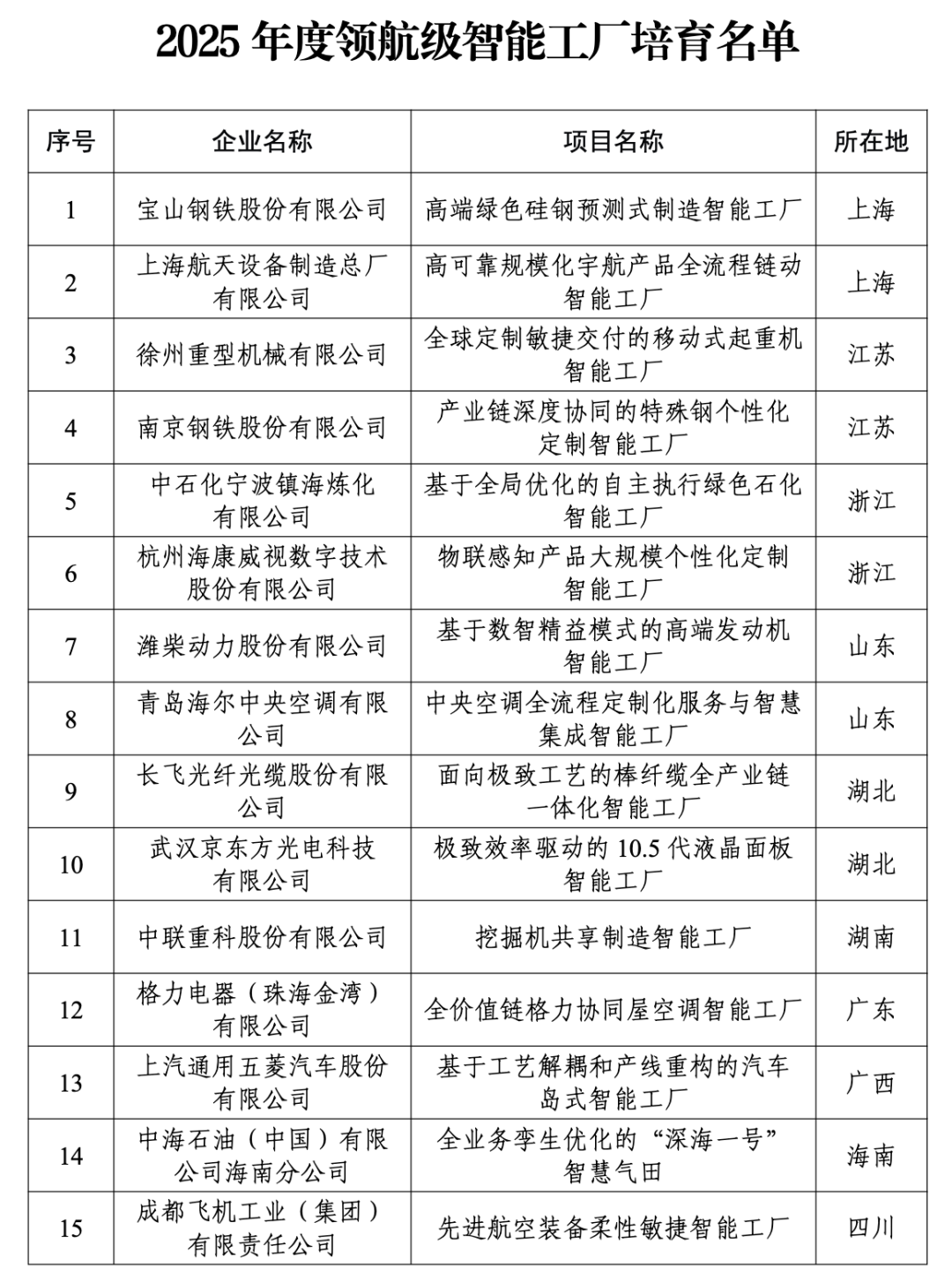
Core Viewpoint - The announcement of the first batch of 15 leading smart factories marks a significant leap in China's manufacturing sector from digitization and networking to a new stage characterized by deep applications of artificial intelligence, representing the highest level of intelligent manufacturing in the country [1][3][21]. Group 1: Overview of Leading Smart Factories - The first batch of leading smart factories includes companies from key industries such as equipment manufacturing, raw materials, and electronic information, showcasing the breadth and depth of China's intelligent manufacturing development [1][19]. - The 15 selected factories are distributed across 10 provinces and regions, including Shanghai, Jiangsu, Zhejiang, Shandong, and Hubei, reflecting a "multi-point breakthrough and full coverage" layout [2][20]. Group 2: Characteristics of Leading Smart Factories - Leading smart factories integrate advanced manufacturing technologies, next-generation information technologies, and lean management concepts, taking on the responsibility of exploring future manufacturing models [3][21]. - To qualify as a leading smart factory, six key elements are required: industry leadership, AI technology application leadership, innovative smart manufacturing model leadership, performance leadership, replication leadership, and nurturing plan leadership [6][24]. Group 3: Case Studies of Selected Companies - Changfei Fiber Optic has become a benchmark in the electronic information sector by integrating AI algorithms throughout its production process, achieving a drawing speed of 3,500 meters per minute with micro-level precision control [9][27]. - Weichai Power has implemented a digital and intelligent management system that reduces customer maintenance costs by an average of 30% through remote diagnostics and alerts for every engine sold [30]. - Baosteel is innovating with an AI-driven predictive manufacturing model that anticipates market demand, optimizing the entire supply chain and production process, with plans to establish 1,200 AI scenarios and 25 benchmark production lines by 2027 [14][34]. Group 4: Future Directions and Strategic Goals - The development of leading smart factories aligns with national strategies to promote intelligent, green, and service-oriented manufacturing, aiming to enhance China's position in the global supply chain [34][35]. - The exploration of future manufacturing models focuses on achieving high customization, complex production, and maintaining high efficiency, low costs, and high quality [28][36].



深圳外贸蝉联内地城市首位,出口“33连冠”背后意味着啥?
Nan Fang Du Shi Bao· 2026-01-22 09:49
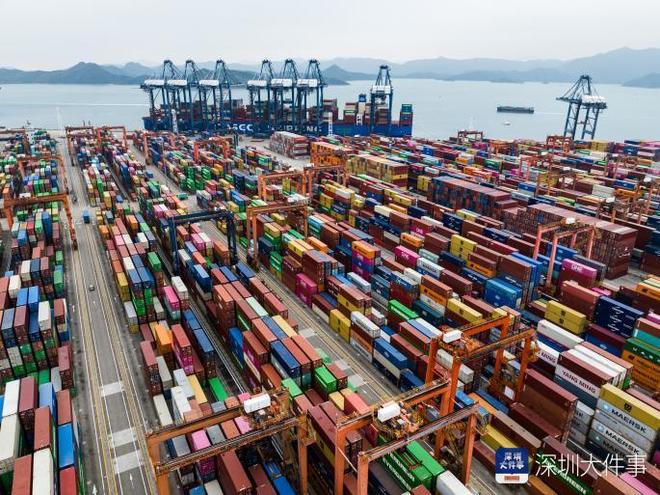
Group 1 - In 2025, Shenzhen's total import and export volume reached 4.55 trillion RMB, a year-on-year increase of 1.4%, marking a historical high and maintaining its position as the leading city in mainland China for foreign trade [1] - Shenzhen's import and export scale has maintained positive growth for six consecutive years, accounting for 10% of the national total and 48% of Guangdong's total, contributing 15.5% to the province's growth [1] - The export scale reached 2.74 trillion RMB, while imports grew by 8% to 1.81 trillion RMB, contributing 53.2% to the province's import growth [1] Group 2 - There were 62,300 enterprises engaged in import and export activities in Shenzhen, a 16% increase year-on-year, with over 8,600 new enterprises added [3] - The top 100 enterprises in Shenzhen achieved an import and export scale of 2.5 trillion RMB, growing by 13.6%, significantly driving overall growth [3] Group 3 - Private enterprises are the main force in foreign trade, with 55,100 private enterprises generating an import and export value of 3.12 trillion RMB, accounting for nearly 70% of the city's total [4] - Shenzhen's high-tech product import and export scale reached 1.4 trillion RMB, ranking first in the country and accounting for 30.7% of the city's total [5] Group 4 - Shenzhen's exports of modern manufacturing products, including digital cameras and medical devices, ranked first in the country, totaling 109.77 billion RMB, with a growth of 17.4% [5] - The AEO (Authorized Economic Operator) system has become a "pass" for many enterprises, with 181 AEO enterprises benefiting from approximately 100 million RMB in fee reductions in 2025 [6] Group 5 - In 2025, Shenzhen's imports and exports to countries involved in the Belt and Road Initiative reached 1.571 trillion RMB, accounting for 34.5% of the city's total [8] - The international logistics network has been enhanced, with the number of international and regional air routes from Shenzhen Airport increasing to 43, covering 27 countries and regions [8] Group 6 - Shenzhen's cross-border e-commerce overseas warehouse export scale ranks first in the country, with simplified customs declaration processes improving efficiency by nearly one-third [10] - The city is poised to continue its high-level opening and high-quality development in the face of complex external environments, leveraging its optimized structure and resilient industries [10]
驱动“13+34”产业链量质齐升
Qi Lu Wan Bao· 2026-01-22 09:44
Core Viewpoint - Jinan's Industrial and Information Technology Bureau aims to drive economic and social development through a "Project Empowerment Year," focusing on the industrial strong city development strategy Group 1: Industrial Growth Targets - Jinan aims to achieve over 1 trillion yuan in industrial revenue for the first time in 2024, with a target of approximately 8% growth in 2025 [2] - The automotive and electronic information industries account for about one-third of the city's industrial output, serving as the "dual core engines" for industrial optimization and upgrading [2] - The automotive industry is expected to reach a scale of 180 billion yuan by 2026, promoting coordinated development and strengthening advantageous industries [2] Group 2: Industry Chain Development - Jinan has identified 13 signature industrial chains and 34 key industrial chains, focusing on core areas such as electronic information, automotive manufacturing, and modern medicine [3] - Six major industrial chains, including artificial intelligence and new energy equipment, have achieved double-digit revenue growth in the first three quarters of 2025 [3] Group 3: Industrial Upgrading Initiatives - The city plans to implement the "Double Thousand" project, advancing 300 key technological transformation projects exceeding 100 million yuan [5] - Jinan aims to cultivate over 1,000 high-quality enterprises, enhancing digital transformation in manufacturing and increasing the CNC rate of key processes to over 70% [6] - The city will support the establishment of industry-leading and common technology platforms, focusing on the development of "Artificial Intelligence + Manufacturing" applications [6]
深圳外贸蝉联内地城市首位
2 1 Shi Ji Jing Ji Bao Dao· 2026-01-22 09:34
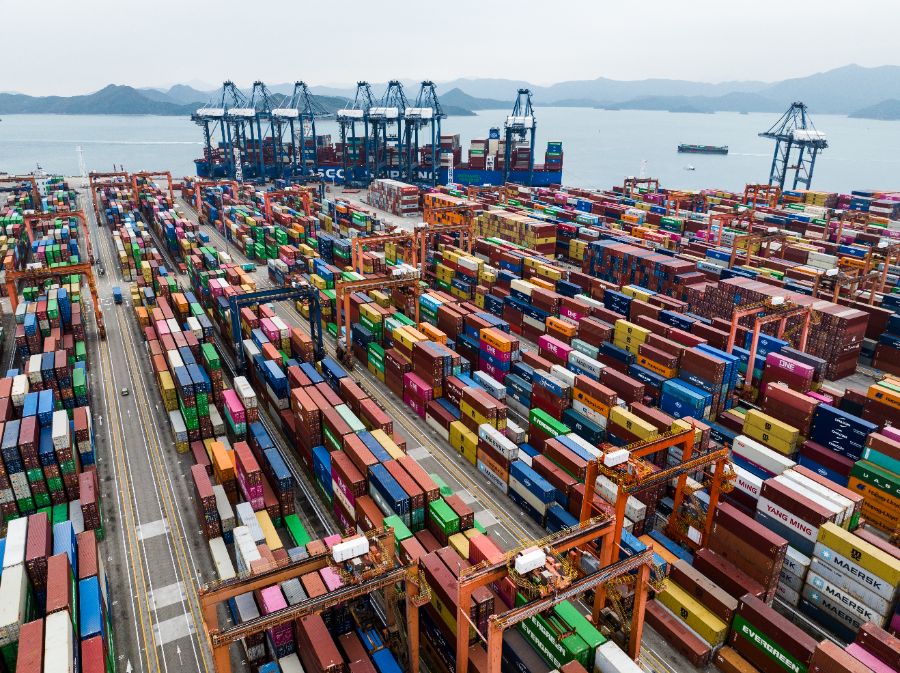
21世纪经济报道记者 李金萍 深圳报道 1月22日,21世纪经济报道记者从深圳海关获悉,2025年,深圳全年进出口总额达4.55万亿元人民币,同比增长1.4%。规模再创 历史新高,继续位居内地城市首位,出口实现"33连冠"。 全国城市中,外贸总额超过4万亿的外贸城市,只有深圳和上海。外贸总额3万亿的城市中,有北京一座城市。外贸规模第四大 市苏州(2025年为28119.26亿元)距离3万亿仅一步之遥。昨日上海公布外贸数据,2025年1-12月,上海实现外贸进出口总额 45103.40亿元,比上年同期增长5.6%。其中,出口20150.38亿元,增长10.8%;进口24953.02亿元,增长1.8%。 从体量看,深圳进出口规模连续6年保持正增长,占全国进出口总额的10%;占广东全省比重达48%,对全省增长贡献率达 15.5%,在稳住外贸基本盘中发挥"压舱石"作用。 从结构看,深圳出口规模长期保持领先,全年出口2.74万亿元;进口更是值得关注,全年进口1.81万亿元,增长8%,对全省进 口增长贡献率达53.2%,这意味着深圳不仅"卖得出去",更"接得住、用得好",以开放的需求端,推动全球资源要素高效流动。 企业集 ...
统筹顶层设计和问计于民,四川人大开展“十五五”规划纲要和计划报告初审
Mei Ri Jing Ji Xin Wen· 2026-01-22 09:33
Core Viewpoint - The Sichuan Province's "14th Five-Year" planning outline has been preliminarily reviewed, focusing on enhancing economic development, addressing demographic challenges, and promoting technological innovation and infrastructure modernization [1][2]. Group 1: Economic and Social Development - The planning outline includes sections on collaborative enhancement of the Chengdu-Chongqing economic circle, industrial development, technological innovation, and the construction of a modern infrastructure system [1]. - The outline emphasizes strengthening social welfare, particularly in response to demographic changes, highlighting the urgency of addressing aging and declining birth rates [1]. Group 2: Population and Social Services - Recommendations include improving public service systems to cover all demographics and increasing investment in pension projects to enhance the basic pension levels for urban and rural residents [1]. - There is a call for higher targets in disposable income growth, aiming for it to exceed economic growth rates, and for the establishment of a family-friendly society through enhanced childcare services [2]. Group 3: Industry and Innovation - The need to elevate the capabilities of industries such as electronic information, artificial intelligence, and new energy is emphasized, along with the role of universities as innovation hubs [2]. - The construction of a new energy system is highlighted, with a focus on improving infrastructure for demand-side needs, particularly in the context of electric vehicle charging facilities [2]. - The integration of legal frameworks with technological and industrial innovation is seen as crucial for fostering new industries, with a focus on pilot programs to facilitate commercialization [2].