装备制造

Search documents
21省抢先发布2025经济成绩单:谁在提速,谁在刹车?
Sou Hu Cai Jing· 2026-01-25 17:21
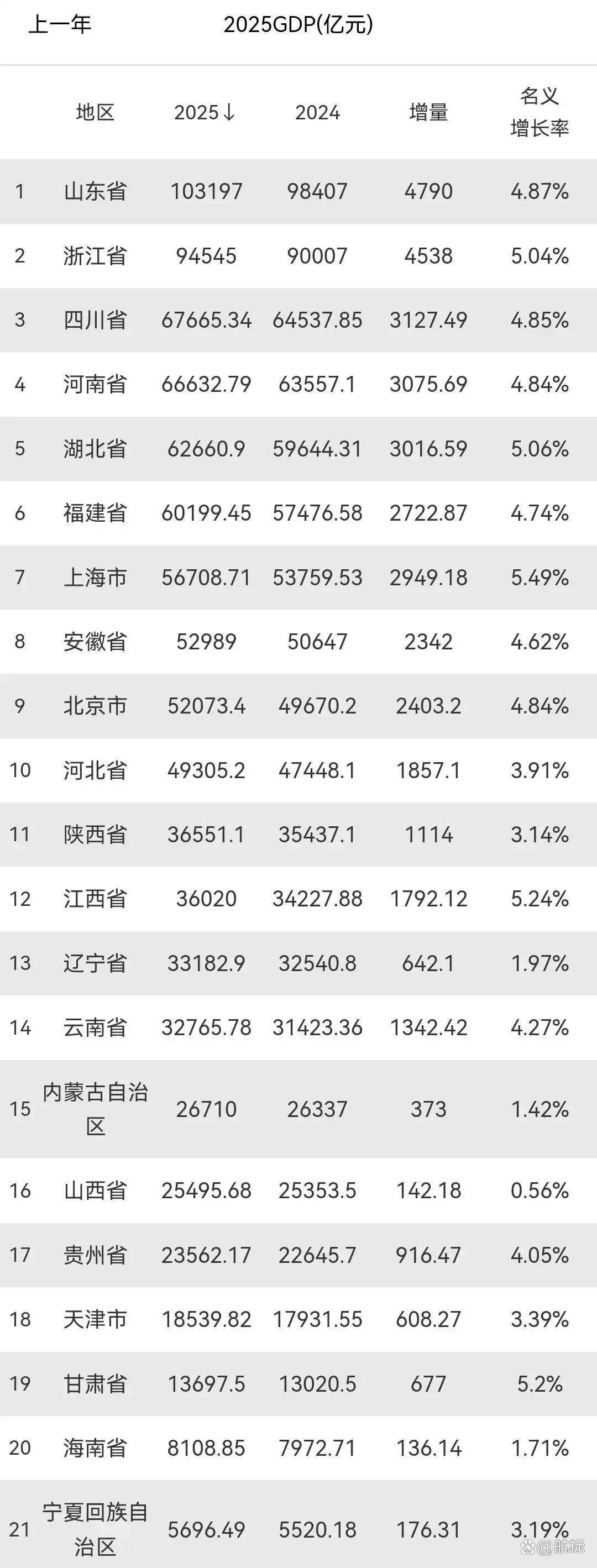
Core Insights - The economic performance of 21 provinces and cities in China for 2025 shows significant variations, with some regions accelerating growth while others are slowing down [1] Group 1: Economic Performance Overview - Shandong Province leads with a GDP of 10.32 trillion yuan and a nominal growth rate of 4.87% [2] - Shanghai has the highest nominal growth rate at 5.49%, driven by its digital economy, with a transaction scale in the data factor market exceeding 500 billion yuan [4] - Jiangxi Province achieved a notable growth rate of 5.24%, largely due to a 42% increase in investment in the new energy sector [4] - Gansu Province, despite a lower total GDP, shows a strong growth momentum with a rate of 5.20% [4] Group 2: Growth Leaders - Zhejiang and Hubei provinces both reported growth rates above 5%, with Zhejiang's resilient private economy and Hubei's optoelectronic information industry being key growth drivers [4] - Anhui Province also demonstrated a stable growth rate of 4.62%, supported by advancements in quantum computing [9] Group 3: Growth Slowdowns - Shanxi Province recorded the lowest growth rate at 0.56%, struggling with a high dependency on traditional energy sectors [7] - Hainan's growth rate of 1.71% fell short of expectations, with tourism recovery lagging [7] - Liaoning Province's growth rate of 1.97% reflects the challenges faced by old industrial bases in transitioning to new industries [7] Group 4: Trends and Observations - New growth drivers are crucial for achieving higher growth rates, with provinces exceeding 5% growth showing over 20% investment growth in strategic emerging industries [12] - Regions with growth rates below 2% typically have a high proportion of traditional industries, indicating a longer transition period to new sectors [12] - Collaborative regional effects are evident, with faster-growing provinces often located in urban clusters that enhance efficiency and reduce costs [12]

21省公开2025年GDP:山东领先浙江,河北近5万亿,山西正增长
Sou Hu Cai Jing· 2026-01-25 01:47
Core Insights - The latest economic performance report for 21 provinces in China reveals a steady growth trajectory, with a collective GDP growth rate of approximately 4.5%, slightly higher than the previous year, indicating resilience in the Chinese economy [12]. Group 1: Leading Provinces - Shandong Province leads with a GDP of 103.197 trillion yuan, an increase of 479 billion yuan, reflecting a growth rate of 4.87%. This growth is attributed to its strong industrial foundation and the rise of emerging manufacturing sectors [3]. - Zhejiang Province follows with a GDP of 94.545 trillion yuan, growing by 453.8 billion yuan at a rate of 5.04%. The province benefits from a vibrant private sector and a booming e-commerce and technology industry [5]. - Hebei Province's GDP stands at 49.305 trillion yuan, nearing the 50 trillion yuan mark, with a growth of 185.7 billion yuan and a rate of 3.91%. The province's traditional industries face challenges, but new development initiatives are underway [6]. Group 2: Notable Performances - Shanxi Province, with a GDP of 25.495 trillion yuan, shows a modest growth of 142 million yuan, marking a significant recovery from previous downturns. The growth is driven by the emergence of new energy and advanced manufacturing sectors [6]. - Shanghai leads the nation with a growth rate of 5.49%, achieving a GDP of 56.708 trillion yuan, primarily fueled by its financial and technology sectors [8]. - Other provinces like Jiangxi and Hubei also report strong growth rates of 5.24% and 5.06%, respectively, indicating a trend of regional balance in economic development [8]. Group 3: Economic Challenges - Provinces such as Liaoning and Inner Mongolia exhibit slower growth rates of 1.97% and 1.42%, respectively, attributed to their single-industry structures and population outflows [8]. - The overall economic landscape shows that while eastern provinces leverage innovation for rapid growth, central and western regions rely on policy incentives to catch up [12].
扎实做好“人、产、城”三篇文章
Xin Lang Cai Jing· 2026-01-24 22:40
Group 1: Core Perspectives - The 20th Central Committee's Fourth Plenary Session accurately identifies the historical position of the Party and the country's development, making top-level designs and strategic plans for the next five years [1] - The Kunming Municipal Committee's 12th Plenary Session outlines a development blueprint and key work tasks, emphasizing the integration of "people, industry, and city" to achieve a virtuous cycle [1] Group 2: Focus on "People" - During the 14th Five-Year Plan period, there is a focus on seizing urbanization opportunities, planning population issues with a systematic approach, and promoting high-quality population development linked to improved living standards [2] - Strategies include attracting talent through effective recruitment plans, enhancing employment through industry collaboration, and creating a welcoming urban culture to increase population growth and quality [2] - Efforts to retain people involve integrated planning of population, industry, and public services, optimizing urban space, and improving service systems to enhance the city's capacity for population and economic development [2] - Enhancing people's well-being by addressing education, healthcare, social security, and employment gaps to create an ideal living and working environment [2] Group 3: Focus on "Industry" - The 14th Five-Year Plan emphasizes the importance of the real economy, focusing on intelligent, green, and integrated development while strengthening industrial growth [3] - Strategies include optimizing existing industries through technological updates and innovation, transforming traditional industries into high-end service-oriented sectors [3] - The plan aims to expand new industries in areas where Kunming has competitive advantages, such as new materials, renewable energy batteries, biomedicine, electronic information, and equipment manufacturing [3] - Actions to improve the business environment are highlighted, aiming to enhance Kunming's overall business climate to support high-quality industrial development [3] Group 4: Focus on "City" - The "People's City" concept is promoted, focusing on urban structure optimization, energy transformation, quality enhancement, and green transition [3] - Urban planning will leverage Kunming's natural advantages, improving functional structures and spatial layouts while integrating ecological and urban development [3] - Enhancements in urban functions will be driven by urban renewal, fostering innovation ecosystems, and addressing infrastructure gaps to improve urban quality [3] - Smart city initiatives will be advanced to address traditional governance challenges, improving the quality of urban management and enhancing residents' quality of life [3]
华蓥市:书写高质量转型发展新篇章
Si Chuan Ri Bao· 2026-01-24 21:50
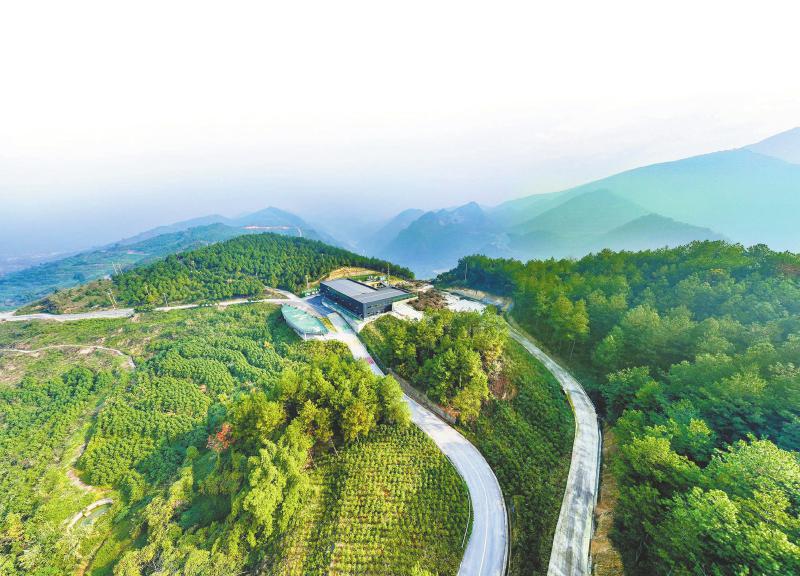
Core Viewpoint - The transformation of Huaying City from a resource-dependent coal and cement economy to a diversified, sustainable urban environment is highlighted, showcasing a successful model for resource-exhausted cities in China [3][4][6]. Group 1: Industrial Transformation - Huaying City is shifting from a reliance on coal and cement ("one black, one white") to a diversified industrial structure, focusing on modern industries such as basalt fiber, electronic information, and equipment manufacturing [4][5]. - The city has established four key industrial clusters: basalt fiber new materials, electronic information, equipment manufacturing, and energy building materials, with significant projects like the world's first large basalt steel material deep-sea aquaculture platform [4][5]. - By 2025, Huaying's GDP is projected to exceed 21 billion, a 239% increase since 2009, with specialized industries contributing over 10 billion, accounting for 89.4% of the total industrial output [5]. Group 2: Ecological Restoration - Huaying is actively addressing historical environmental damage from mining by implementing comprehensive ecological restoration projects, including the rehabilitation of mining subsidence areas and the protection of forest resources [6][7]. - The city has developed a significant oil camellia industry, with over 78,000 acres planted, generating an annual output value of 1,300 per acre, and has created a provincial-level modern forestry park [6][7]. - As of now, Huaying has added 100,000 acres of forest land and effectively managed 44 square kilometers of mining subsidence areas, increasing the forest coverage rate [7]. Group 3: Urban Renewal - Huaying is enhancing urban living conditions by improving infrastructure and public services, with 22 urban renewal projects completed, revitalizing over 190 old residential communities [9][10]. - The city has been recognized as a model for systematic urban sponge city construction, with new parks and improved public amenities contributing to a more livable environment [9]. - Significant investments in transportation and education have been made, including the construction of new highways and partnerships with quality educational institutions, enhancing overall community welfare [10].
哈电集团:坚决拥护党中央决定
中国基金报· 2026-01-24 10:54
Core Viewpoint - The article discusses the disciplinary investigation of Yang Hongyong, former member of the Party Committee and Secretary of the Discipline Inspection Commission of Harbin Electric Group, highlighting the company's support for the central government's anti-corruption efforts and the importance of maintaining political integrity within the organization [2][5][6]. Group 1 - Harbin Electric Group acknowledges the decision of the Central Commission for Discipline Inspection and the National Supervisory Commission regarding Yang Hongyong's serious violations of discipline and law, emphasizing their commitment to the central government's directives [2][3]. - The company's leadership convened a special meeting to study the important speech by General Secretary Xi Jinping at the Fifth Plenary Session of the 20th Central Commission for Discipline Inspection, reinforcing their stance on strict governance and self-reform [5][6]. - The meeting underscored the necessity of aligning thoughts and actions with the central government's decisions, promoting a culture of integrity and accountability within the organization [5][6]. Group 2 - The company aims to deepen the implementation of strict party governance, emphasizing the importance of political loyalty and the need for a clean and transparent working environment [6]. - There is a strong focus on enhancing party character and maintaining a correct view of power, performance, and career, ensuring that all members adhere to high ethical standards [6]. - The leadership is committed to creating a positive political ecology to support the goal of building a world-class equipment manufacturing enterprise [6].
哈电集团:坚决拥护党中央决定
Xin Jing Bao· 2026-01-24 09:18
Group 1 - The Harbin Electric Group's former party committee member and discipline inspection secretary, Yang Hongyong, voluntarily surrendered amid allegations of serious violations of discipline and law [1] - The Harbin Electric Group's party committee held a meeting to study the important speech by General Secretary Xi Jinping and the spirit of the Fifth Plenary Session of the 20th Central Commission for Discipline Inspection [1] - The meeting emphasized the need for all party organizations within the company to align their thoughts and actions with the decisions of the Central Committee, and to fully cooperate with the disciplinary investigation [1] Group 2 - The meeting stressed the importance of adhering to Xi Jinping's thoughts on socialism with Chinese characteristics, prioritizing political construction, and maintaining absolute loyalty to the party [2] - It called for strengthening party character cultivation and establishing a correct view of power, performance, and career, while promoting a culture of accountability and integrity [2] - The meeting highlighted the need to deepen the comprehensive and strict governance of the party, ensuring that responsibilities for party management are effectively implemented at all levels [2]
上海规上工业产值再上4万亿元台阶
Xin Lang Cai Jing· 2026-01-24 07:16
Core Insights - Shanghai's industrial output is projected to reach 4.07 trillion yuan by 2025, marking a historical high and a growth rate of 5.1%, the fastest in four years [1] - The city's industrial output value is expected to grow by 4.6% compared to 2024, accelerating by 3.9 percentage points [1] Group 1: Industrial Growth - The equipment manufacturing sector is accelerating, with railway, shipbuilding, aerospace, and other transport equipment manufacturing growing by 15.8% [1] - Electrical machinery and equipment manufacturing increased by 11.1%, while automotive manufacturing grew by 7.8% [1] - The computer, communication, and other electronic equipment manufacturing sectors saw a growth of 7.7% [1] Group 2: Emerging Industries - Strategic emerging manufacturing industries are projected to grow by 6.5%, with new energy and high-end equipment achieving double-digit growth rates of 12.9% and 11.1%, respectively [1] - The three leading manufacturing sectors are expected to grow by 9.6% by 2025, with an 85% increase in output scale during the "14th Five-Year Plan" period [1] - The share of these sectors in the city's industrial output is expected to rise from 7.8% to 12.4% [1] Group 3: Integrated Circuits and AI - By 2025, the integrated circuit and artificial intelligence manufacturing sectors are projected to grow by 15.1% and 13.6%, respectively, becoming key supports for Shanghai's industrial economy [1] Group 4: Automotive and Electronics - The cumulative promotion of new energy vehicles is expected to exceed 360,000 units by 2025, representing a year-on-year growth of 31% [2] - The integrated circuit industry is projected to generate over 480 billion yuan in revenue, fostering a number of leading enterprises in niche sectors [2] - Shanghai's electronic industry is expected to grow by 7.7% due to the rapid development of the integrated circuit sector [2] Group 5: Future Plans - Shanghai has launched a three-year action plan (2026-2028) to support the transformation and upgrading of advanced manufacturing [2] - The plan aims to add 100 manufacturing enterprises with an annual output value exceeding 1 billion yuan by 2028, leading to the establishment of 500 new industrial enterprises [2] - A total of 133 projects are planned to commence in 2026, with a total investment of 110 billion yuan, focusing on significant projects to achieve a strong start in the first quarter [2]
向“新”而行!上海归上工业总产值创历史新高,解码4.07万亿元背后的转型定力
Sou Hu Cai Jing· 2026-01-24 05:13
Core Insights - Shanghai's GDP is projected to grow by 5.4% in 2025, outpacing the national average by 0.4 percentage points, indicating a stable and improving economic outlook [1] - The total industrial output value of Shanghai is expected to reach 4.07 trillion yuan, marking a historical high and a significant recovery after two years [3] - The contribution of the industrial and software information industry to GDP growth is 50%, highlighting its critical role in the economy [1] Industrial Growth - The industrial output value of 4.07 trillion yuan represents a 5.1% increase, the fastest growth rate in four years, accelerating by 2.9 percentage points compared to 2024 [3] - Key sectors such as equipment manufacturing, particularly in transportation equipment, saw substantial growth, with a 15.8% increase in output [3] - The strategic emerging industries are expected to grow by 6.5%, outpacing overall industrial growth by 1.9 percentage points, with integrated circuits and AI manufacturing growing by 15.1% and 13.6% respectively [3] Green Transition - The automotive sector accounts for 19% of the total industrial output, with over 360,000 new energy vehicles promoted in 2025, maintaining Shanghai's position as a global leader [4] Software and Information Industry - The software and information industry is projected to achieve a revenue of approximately 17.3 trillion yuan by 2025, up from 6.83 trillion yuan in 2020, establishing it as the third-largest industry in Shanghai [5] - The value added by the information transmission, software, and IT services sector is 12.6% of the city's GDP, the highest contribution among all sectors [6] Cost Reduction and Efficiency - Shanghai aims to reduce industrial costs by an additional 1.033 billion yuan in 2025, following a reduction of 11.84 billion yuan in 2024, leading to a 23% increase in industrial profits [7] - Industrial investment is expected to grow by 20%, with manufacturing investment increasing by 22.8%, driven by national strategic projects [7] Service Environment - Shanghai's service package system has addressed over 13,400 requests from 33,000 high-capacity enterprises, enhancing the business environment [8] - The city has maintained its top ranking in the national evaluation of the development environment for small and medium-sized enterprises [8] Future Outlook - By the end of 2025, Shanghai plans to release a three-year action plan to support advanced manufacturing, aiming to add 100 manufacturing enterprises with an annual output value exceeding 1 billion yuan by 2028 [9] - The city is set to initiate 133 projects in 2026 with a total investment of 110 billion yuan, focusing on industrial chain development [9]
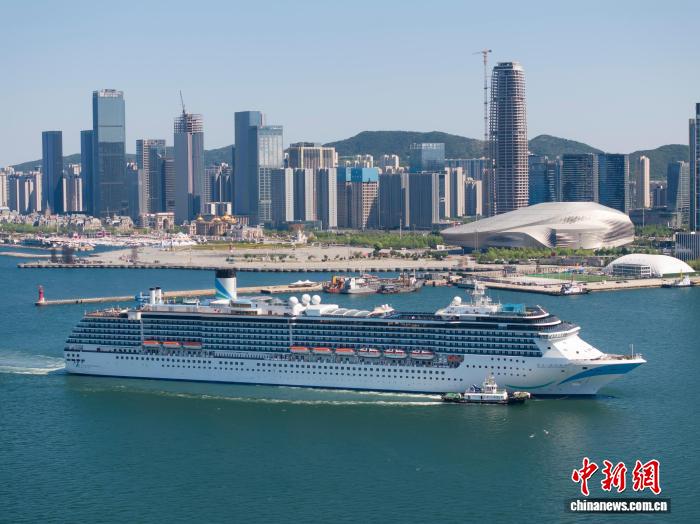
经济观察|大连GDP破万亿元:为东北振兴注入更多信心
Zhong Guo Xin Wen Wang· 2026-01-24 03:37
Core Insights - Dalian has achieved a significant milestone by becoming the first city in Northeast China to surpass a GDP of 1 trillion yuan, with a projected GDP of 1,000.21 billion yuan in 2025, reflecting a year-on-year growth of 5.7% at constant prices [1][4] Economic Growth Trajectory - Dalian's GDP growth has been a result of eight years of consistent progress, starting from 650.09 billion yuan in 2018, crossing the 700 billion yuan mark in 2020, and accelerating to 900 billion yuan in 2023, with a solid foundation of 951.69 billion yuan in 2024 [2] - The industrial economy has been a core pillar, contributing significantly to GDP growth, with the industrial sector's contribution rate reaching 60% in 2023 [2] Industrial and Economic Structure - Dalian's industrial base is robust, with strengths in traditional sectors such as equipment manufacturing, shipbuilding, and petrochemicals, where the petrochemical industry ranks first in Northeast China and fourth nationally [2] - The port economy plays a crucial role, with Dalian Port handling over 98% of Northeast China's foreign trade containers and over 60% of imported crude oil, facilitating logistics, trade, and financial services [2] New Growth Drivers - New economic drivers are emerging, with significant projected increases in the value added by key industries such as railways, shipbuilding, pharmaceuticals, and automotive manufacturing, expected to grow by 57.5%, 30.9%, and 19.5% respectively by 2025 [3] Regional Economic Impact - Dalian's GDP milestone is seen as a beacon of hope for the revitalization of Northeast China, addressing the region's previous lack of a trillion-yuan city and providing a model for transformation for other cities [4] - The breakthrough is expected to reshape the regional economic landscape, enhancing scale effects and radiating growth potential to surrounding areas [4] Future Challenges and Initiatives - Dalian is committed to maintaining a stable and sustainable growth path, having launched a comprehensive plan to optimize the business environment, focusing on six key areas to enhance enterprise support and policy precision [5] - Despite the achievements, challenges remain in optimizing industrial structure, transitioning between old and new growth drivers, and fostering regional collaboration [5]
大连GDP破万亿元:为东北振兴注入更多信心
Zhong Guo Xin Wen Wang· 2026-01-24 02:45
Core Insights - Dalian has achieved a GDP of 1 trillion yuan, becoming the first city in Northeast China to reach this milestone, which injects confidence and momentum into the region's revitalization efforts [1][6]. Economic Growth - Dalian's GDP reached 1,002.1 billion yuan in 2025, reflecting a year-on-year growth of 5.7% at constant prices [1]. - The city’s GDP has seen significant growth from 650.1 billion yuan in 2018, surpassing 700 billion yuan in 2020, and accelerating to over 900 billion yuan in 2023 [3][6]. Industrial Contribution - The industrial economy is a core pillar of Dalian's growth, contributing significantly to GDP. The city is a major industrial base with strengths in equipment manufacturing, shipbuilding, and petrochemicals [3][5]. - The petrochemical industry is particularly strong, ranking first in Northeast China and fourth nationally, with a contribution rate of 60% to GDP growth in 2023 [5]. Port Economy - Dalian Port plays a crucial role in the regional economy, handling over 98% of Northeast China's foreign trade containers and more than 60% of crude oil transshipment [5]. - The port's container throughput is expected to exceed 4 million standard containers by 2025, driving growth in logistics, trade, and finance [5]. New Growth Drivers - New economic drivers are emerging, with significant projected increases in the value added by the railway, shipbuilding, pharmaceutical, and automotive sectors by 2025 [5]. - Major projects, including the Jinzhou Bay International Airport, are accelerating, contributing to the feasibility of achieving the 1 trillion yuan GDP target [5]. Regional Impact - Dalian's achievement serves as a "growth lighthouse" for Northeast China, potentially reshaping the regional economic landscape and providing a model for other cities [6]. - The city aims to address challenges such as industrial structure optimization and regional collaboration to sustain its growth trajectory [8]. Business Environment - Prior to announcing its GDP milestone, Dalian held a conference to optimize the business environment, launching a new enhancement plan focused on six key areas [8]. - The city is committed to continuous improvement in its business environment, reflecting a clear understanding of the need for sustained effort and focus [8].