医疗保险

Search documents
医药行业深度报告:2024年基本医保收支平稳,结构调整和扩覆盖继续推进
Guohai Securities· 2025-07-18 11:33
Investment Rating - The report does not explicitly state an investment rating for the pharmaceutical industry Core Insights - The report addresses key issues regarding the trends in medical insurance income and expenditure for 2024, the relationship between insurance income and macroeconomic factors, and the policy drivers behind data changes [2] - The basic medical insurance coverage rate is maintained at 95% by the end of 2024, with 1.32662 billion insured individuals, a decrease of 7.27 million from the previous year [4][5] - Basic medical insurance income for 2024 is projected at 3.4913 trillion yuan, a year-on-year increase of 4.2%, with employee insurance income at 2.3733 trillion yuan (up 3.5%) and resident insurance income at 1.1181 trillion yuan (up 5.8%) [21][36] - Basic medical insurance expenditure for 2024 is expected to reach 2.9764 trillion yuan, reflecting a year-on-year growth of 5.5% [36] - The report highlights significant disparities in the surplus rates of resident medical insurance across provinces, with 17 provinces showing positive rates and 14 negative [2] Summary by Sections 1. Medical Insurance Coverage - By the end of 2024, the basic medical insurance coverage rate is solidified at 95%, with 1.32662 billion insured individuals [4][5] - The structure of insured individuals shows an increase in employee insurance participants while resident insurance participants have decreased [7] 2. Income and Expenditure Trends - Basic medical insurance income for 2024 is projected at 3.4913 trillion yuan, with a 4.2% increase year-on-year [21] - Employee insurance income is expected to be 2.3733 trillion yuan, growing by 3.5%, while resident insurance income is anticipated to be 1.1181 trillion yuan, increasing by 5.8% [21] - Basic medical insurance expenditure is projected at 2.9764 trillion yuan, with a year-on-year growth of 5.5% [36] 3. Provincial Analysis - The report notes significant differences in the surplus rates of resident medical insurance across 31 provincial-level units, with 17 showing positive rates and 14 negative [2] 4. Fund Operation Overview - From January to May 2025, the medical insurance fund's operation is reported to be stable, with income of 1.2295 trillion yuan (up 5.9%) and expenditure of 944.3 billion yuan (up 1.2%) [69]
退休参保人员首超1亿,快速老龄化下医保面临这些挑战|晋观医养
Di Yi Cai Jing· 2025-07-17 12:17
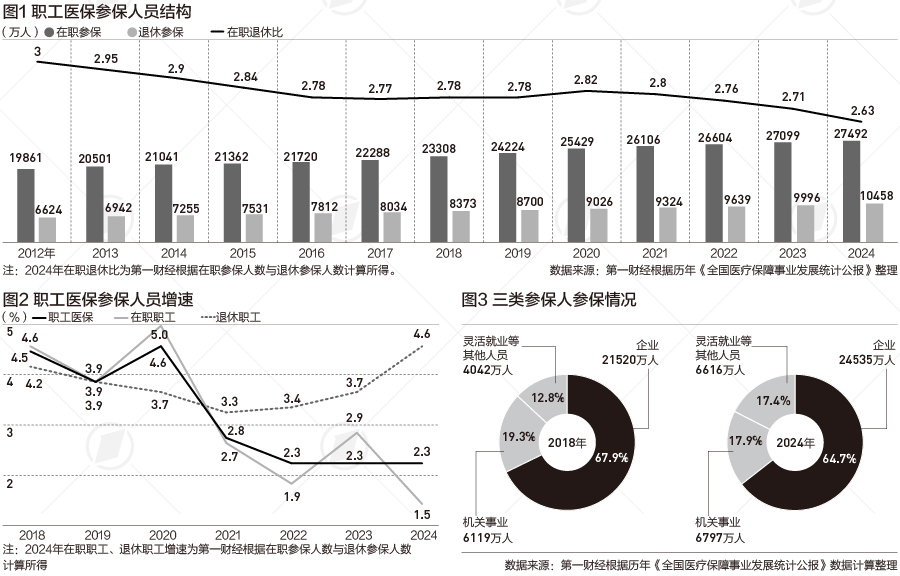
Core Insights - The aging population and increased life expectancy are putting significant pressure on pension and medical insurance systems, necessitating reforms during the 14th Five-Year Plan period [1][8] - By 2024, the number of insured retirees in China's employee medical insurance will exceed 100 million, marking a new phase in the impact of aging on the medical insurance system [1][2] Group 1: Medical Insurance Statistics - As of the end of 2024, the total number of participants in basic medical insurance reached 1.32662 billion, maintaining a coverage rate of 95% [1] - The total revenue of basic medical insurance (including maternity insurance) for 2024 was 3.491337 trillion yuan, while total expenditures were 2.976403 trillion yuan, resulting in a current balance of 463.917 billion yuan [1] - The number of participants in employee medical insurance increased by 8.537 million to 379.4834 million, reflecting a growth rate of 2.3% [3][4] Group 2: Challenges and Trends - The growth rate of insured retirees has surpassed that of employed workers since 2021, indicating a shift in demographic dynamics [3][4] - The ratio of employed to retired participants in employee medical insurance has been declining, from 3 in 2012 to an estimated 2.63 in 2024 [3][4] - The total medical expenses for employee medical insurance participants reached 2.058746 trillion yuan in 2024, with a year-on-year increase of 3.6% [4] Group 3: Resident Medical Insurance - The number of participants in resident medical insurance has been declining for three consecutive years, dropping from a peak of 1.02 billion in 2019 to 950 million in 2024 [6][7] - In 2024, the revenue for resident medical insurance was 1.118091 trillion yuan, with expenditures of 1.066149 trillion yuan, resulting in a current balance of 51.942 billion yuan [7] Group 4: Long-term Care Insurance - A nationwide long-term care insurance system is expected to be introduced within the year, with 18.78634 million participants in pilot cities as of 2024 [10] - The long-term care insurance fund had a revenue of 24.415 billion yuan and expenditures of 13.108 billion yuan in 2024 [10] Group 5: Policy Recommendations - To address the challenges posed by an aging population, reforms in pension and medical insurance systems are essential, including the introduction of long-term care insurance [8][9] - The medical insurance system must enhance its capacity to meet the structural demands of elderly care, focusing on both the quantity and quality of medical services [9]

职工医保基金支出近2万亿,全国医保最新“年报”透露哪些信息
Xin Jing Bao· 2025-07-16 10:47
Core Insights - The National Healthcare Security Administration (NHSA) released the "2024 National Medical Security Development Statistical Bulletin," highlighting key figures related to health insurance enrollment and fund operations [1][2]. Group 1: Health Insurance Enrollment and Fund Operations - As of the end of 2024, the total number of basic medical insurance participants reached 1.32662 billion, maintaining a coverage rate of 95% [2]. - The total revenue for the basic medical insurance fund (including maternity insurance) in 2024 was CNY 34,913.37 billion, while total expenditures reached CNY 29,764.03 billion, resulting in a cumulative fund balance of CNY 38,628.52 billion [2]. - The employee medical insurance fund (including maternity insurance) reported a revenue of CNY 23,732.47 billion in 2024, a 3.5% increase from the previous year, with expenditures of CNY 19,102.54 billion, marking a 7.6% increase [2]. Group 2: Medical Treatment and Benefits - In 2024, the number of treatment beneficiaries under employee medical insurance was 5.308 billion, reflecting a 9.9% increase year-on-year [3]. - The total medical expenses for employee medical insurance participants reached CNY 20,587.46 billion, which is a 3.6% increase compared to the previous year [3]. Group 3: Long-term Care and Cross-Region Medical Services - By 2024, 49 pilot cities had a total of 18,786.34 million participants in long-term care insurance, with the number of beneficiaries rising from 835,000 in 2020 to 1,462,500 in 2024 [5]. - The number of cross-region medical service visits reached 397 million in 2024, with associated costs amounting to CNY 7,867.74 billion [5]. Group 4: Drug Procurement and Insurance Directory Adjustments - The NHSA has conducted ten rounds of national drug procurement, covering 435 types of drugs, with the eleventh round focusing on established drugs with strict quality requirements [6][7]. - Since its establishment in 2018, the NHSA has dynamically adjusted the medical insurance drug directory for seven consecutive years, adding a total of 835 drugs, with 91 new drugs included in 2024 [8][9].
镇江实现基本医保参保人员长护险全覆盖
Xin Hua Ri Bao· 2025-07-15 21:46
Core Viewpoint - The inclusion of urban and rural residents' basic medical insurance participants into the long-term care insurance (LTCI) system in Zhenjiang is a significant step in addressing the challenges of an aging population and improving the medical insurance system [1][2]. Group 1: Long-term Care Insurance Implementation - Starting from July 1, urban and rural residents' basic medical insurance participants are officially included in the LTCI coverage, providing essential support for disabled individuals [1]. - Since the implementation of the LTCI system on October 1, 2023, 3,463 severely disabled individuals have benefited from LTCI-related services, reducing the financial burden on families by over 35 million yuan [1][2]. - The LTCI fund reimburses 50 yuan per day for individuals requiring 24-hour care in nursing facilities, which can offset 1,500 yuan in care costs per month [2]. Group 2: Care Services and Support - The LTCI program offers diverse support options for families of severely disabled individuals, including institutional care, family care subsidies, home care services, and specialized care services [2]. - The family care subsidy is set at 10 yuan per person per day, providing financial support to family members who care for their loved ones [2]. Group 3: Policy Implementation and Optimization - To ensure smooth implementation of the new policy, the Zhenjiang Medical Insurance Bureau has optimized the application process, allowing online applications through the "Zhenjiang Long-term Care" app or in-person at designated service points [3]. - The bureau will continuously monitor the policy's effectiveness and make adjustments as necessary to enhance service quality and ensure that severely disabled individuals receive safe and standardized care [3].
2024年医保支出2.98万亿元,钱都花哪里了
第一财经· 2025-07-15 15:53
Core Viewpoint - The latest report from the National Medical Insurance Administration highlights a stable medical insurance system in China, with a focus on governance reform aimed at enhancing service quality, innovation, and regulatory oversight [1][3]. Group 1: Medical Insurance Coverage and Financials - By the end of 2024, approximately 1.327 billion people were covered by basic medical insurance, maintaining a coverage rate of over 95% [3]. - The total income of the national basic medical insurance fund (including maternity insurance) was about 3.49 trillion yuan, while total expenditures reached 2.98 trillion yuan in 2024 [3]. - The income from employee medical insurance (including maternity insurance) was approximately 2.37 trillion yuan, reflecting a 3.5% increase from the previous year, while expenditures were about 1.91 trillion yuan, up 7.6% [3]. Group 2: Medical Expenses and Utilization - In 2024, the total medical expenses for employee insurance participants were around 2.06 trillion yuan, marking a 3.6% increase year-on-year, while for residents, it was approximately 2.03 trillion yuan, with a 3.7% increase [7]. - The number of treatment instances for employee insurance participants reached 5.308 billion, a 9.9% increase from the previous year, while for residents, it was 3.035 billion, up 14.9% [3][7]. Group 3: Trends in Medical Costs - The growth rate of total medical expenses significantly decreased from over 20% in 2023 to single digits in 2024, attributed to a reduction in demand following the pandemic [6][7]. - The structure of medical expenses showed a notable decline in drug prices, while the prices for certain medical services, particularly those reflecting physician labor value, increased [8]. Group 4: Policy and Innovation Support - The establishment of a new mechanism for drug access and negotiation has significantly shortened the time for innovative drugs to be included in the insurance system, with over 540 billion yuan in sales from newly negotiated drugs between 2018 and 2024 [4]. - Recent measures support the use of medical insurance data for innovative drug research and development, aiming to enhance the efficiency of drug innovation [4].

2024年医保“成绩单”:超13亿人参保 基本医疗保险运行安全稳健
Ren Min Wang· 2025-07-15 08:41
Group 1 - The core viewpoint of the report highlights the stable operation and development of the national medical insurance system, with a participation rate exceeding 95% and a total enrollment of 1.3266208 billion people by the end of 2024 [1] - The total revenue of the basic medical insurance fund, including maternity insurance, is projected to be 3.491337 trillion yuan, while total expenditures are expected to reach 2.976403 trillion yuan in 2024 [1] - Since the establishment of the National Medical Insurance Administration, the cumulative expenditure of the medical insurance fund has reached 16.48 trillion yuan, with an average annual growth rate of 11% [1] Group 2 - The report emphasizes the deepening of outpatient mutual aid reforms in employee medical insurance, expanding the scope of personal account mutual aid to close relatives and facilitating cross-province mutual aid [2] - In 2024, the mutual aid usage of personal accounts is expected to be 51.2 billion yuan, which will help activate existing funds and effectively reduce the medical burden on insured individuals [2] - The report reflects the characteristics of medical insurance work, focusing on empowerment, innovation, service optimization, and stable operation, providing solid support for public healthcare and the development of the pharmaceutical industry [2]
医药总费用增速高位回落,超13亿人医保账本释放这些关键信号
Di Yi Cai Jing· 2025-07-15 08:38
Core Insights - The core message of the news highlights the comprehensive reforms in China's medical insurance system, which have led to a more regulated medical service behavior and a reduction in overall medical expenses [1] Group 1: Medical Insurance Coverage and Financials - By the end of 2024, approximately 1.327 billion people are expected to be covered by basic medical insurance, maintaining a coverage rate of over 95% [2] - The total revenue of the national basic medical insurance fund (including maternity insurance) is projected to be around 3.49 trillion yuan, with total expenditures of 2.98 trillion yuan in 2024 [2] - The income from employee medical insurance (including maternity insurance) is estimated at 2.37 trillion yuan, reflecting a growth of 3.5% compared to the previous year, while expenditures are expected to reach 1.91 trillion yuan, an increase of 7.6% [2] Group 2: Medical Expenses and Utilization - The total medical expenses for employee insurance participants are projected to be approximately 2.06 trillion yuan in 2024, with a growth rate of 3.6% [6] - For resident insurance participants, medical expenses are expected to be around 2.03 trillion yuan, with a growth rate of 3.7% [6] - The number of treatment instances for employee insurance participants is projected to reach 5.308 billion, a 9.9% increase from the previous year, while resident insurance participants are expected to have 3.035 billion treatment instances, a 14.9% increase [2] Group 3: Impact of Policy Reforms - The integration of maternity insurance with employee basic medical insurance since 2019 has streamlined the calculation of medical expenses [3] - The cumulative expenditure of the medical insurance fund since the establishment of the National Medical Insurance Bureau has reached 16.48 trillion yuan, with an average annual growth rate of 11% [3] - The establishment of a new mechanism for the entry and negotiation of innovative drugs into the medical insurance system has significantly shortened the time from drug launch to inclusion in insurance [3] Group 4: Trends in Medical Costs - The growth rate of total medical expenses has decreased from over 20% to 3% due to the release of pent-up demand for medical services following the pandemic [5] - The structure of declining medical expenses indicates a notable decrease in drug prices, while the prices for certain medical services have shown mixed trends, with some prices increasing [6] - The overall trend in medical expenses is influenced by ongoing reforms in payment methods and service pricing, leading to a more regulated medical service environment [6]
长护险基金如何避免变成第二个“医保黑洞”?
Sou Hu Cai Jing· 2025-07-15 06:03
Core Insights - The article discusses the transformation of long-term care insurance (LTCI) management from traditional manual auditing to advanced algorithmic calculations, highlighting the use of AI and real-time data analysis to prevent fraud and improve service delivery [1][4]. Group 1: Fraud Prevention and Management - The new LTCI management system utilizes AI to detect anomalies, such as a "severely disabled" elderly person who is physically active, triggering alerts for potential fraud [1][4]. - The system has shifted from traditional sampling audits to real-time data processing, allowing for immediate identification of irregularities in care service claims [4]. - After implementing the system, a province saw the growth rate of fund expenditures drop from an annual average of 19% to 6%, while the satisfaction rate among genuinely disabled elderly individuals rose to 92% [4]. Group 2: Dynamic Fund Management - The system generates quarterly "fund stress test reports" based on 72 factors, including aging rates and healthcare costs, allowing for proactive adjustments in budget allocations [4]. - The introduction of a "dynamic rate adjustment valve" helps to balance funding across regions, ensuring that areas with increasing needs receive appropriate financial support [4]. Group 3: Transparency and Community Involvement - The "social co-governance" module allows family members to track expenditures through a mobile app, providing transparency with video evidence of care activities and electronic invoices [4]. - This level of transparency empowers families to monitor care services closely, reducing opportunities for fraudulent claims [4]. Group 4: Ethical Considerations in Care - The system includes a "terminal care fund pool" that allocates resources for pain management and psychological support for families when an elderly person is predicted to enter the end-of-life stage [5]. - The focus is not only on preventing fraud but also on ensuring dignity in care, emphasizing the ethical responsibility of the fund management [5].

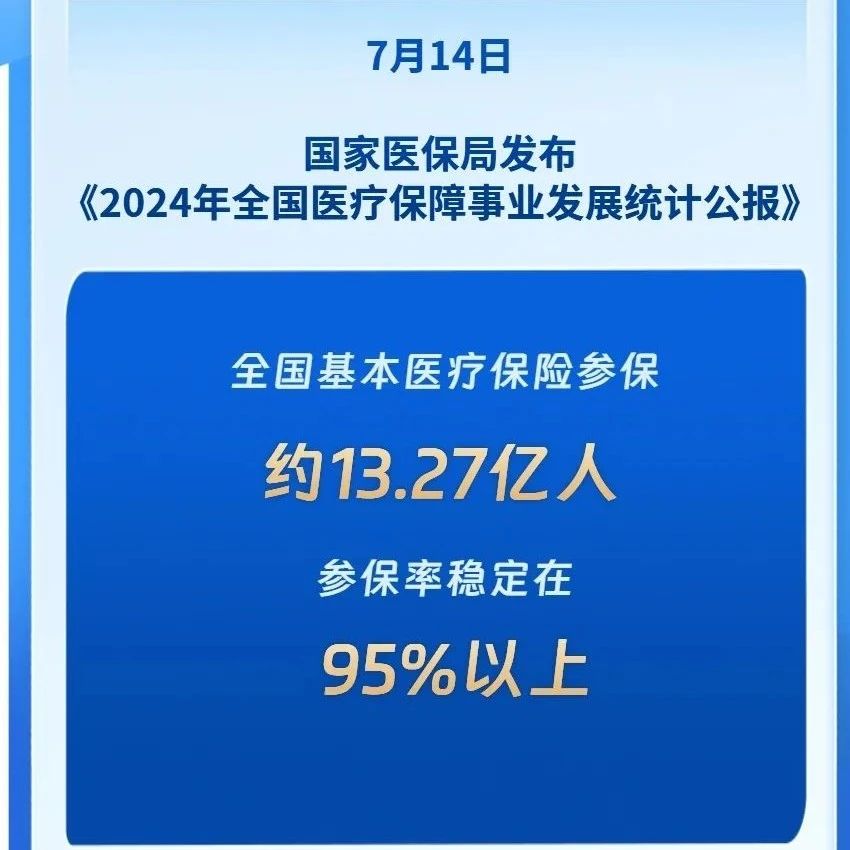
国家医保局发布二〇二四年度统计公报 基本医保参保率稳定在百分之九十五以上
Ren Min Ri Bao· 2025-07-14 21:49
Group 1 - The core viewpoint of the report indicates that the Chinese medical security system continues to improve, with enhanced benefits for the public, stable fund operations, and improved management services [1] Group 2 - As of the end of last year, approximately 1.327 billion people were covered by basic medical insurance, maintaining a coverage rate of over 95%. The total income of the basic medical insurance fund was 3.491337 trillion yuan, while total expenditures were 2.976403 trillion yuan [2] - The number of insured employees reached 37.94834 million, while the number of insured urban and rural residents was 94.71373 million. The average hospitalization cost for insured employees was 11,707 yuan, with a fund payment ratio of 84.8% [2] - The medical expenses for insured residents amounted to 2.031216 trillion yuan, reflecting a year-on-year growth of 3.7%. The number of treatment instances for insured residents was 3.035 billion, increasing by 14.9% [2] Group 3 - Over 90% of discharged patients were covered under the disease-based payment system, with approximately 80% of the fund expenditures for eligible inpatient medical insurance being allocated to this system [3] - Since the establishment of the National Medical Insurance Administration, the cumulative expenditure of the medical insurance fund has reached 16.48 trillion yuan, with an average annual growth rate of 11% [3] - From 2018 to 2024, the sales revenue of newly negotiated drugs during the agreement period exceeded 540 billion yuan, with medical insurance fund expenditures surpassing 370 billion yuan [3] Group 4 - Approximately 253 million people participated in maternity insurance, with fund expenditures reaching 140.293 billion yuan, a year-on-year increase of 19.2% [4] - The long-term care insurance pilot program is progressing steadily, with 18.78634 million participants in 49 pilot cities and 146,250 individuals receiving benefits [4] Group 5 - Last year, there were 397 million instances of outpatient and inpatient care, with medical expenses totaling 786.774 billion yuan. The medical insurance system recovered 27.5 billion yuan through intelligent supervision, saving 3.1 billion yuan in losses [5] - The National Medical Insurance Administration conducted 64 inspection groups, checking 506 designated medical institutions, and awarded 754 individuals for reporting, totaling 1.866 million yuan in rewards [5]
我国基本医保参保率稳定在95%以上
证券时报· 2025-07-14 10:51
Core Viewpoint - The National Healthcare Security Administration released the "2024 National Medical Security Development Statistical Bulletin," highlighting the stability and growth of China's basic medical insurance system, with a significant number of insured individuals and robust financial performance [5]. Group 1: Basic Medical Insurance - As of the end of 2024, approximately 1.327 billion people are covered by basic medical insurance in China, maintaining a coverage rate of over 95% [5]. - The total revenue of the national basic medical insurance fund for 2024 is projected to be 34,913.37 billion yuan, while total expenditures are expected to reach 29,764.03 billion yuan [5]. Group 2: Fund Management and Impact - Since the establishment of the National Healthcare Security Administration, the cumulative expenditure of the medical insurance fund has reached 16.48 trillion yuan, with an average annual growth rate of 11% [5]. - The medical insurance system provides substantial support for the healthcare needs of the population and contributes to the development of the pharmaceutical industry, medical technology advancements, and overall industry capacity enhancement [5].