
先进制造业

Search documents
7个名字带“州”城市GDP过万亿
Di Yi Cai Jing· 2025-11-28 11:07
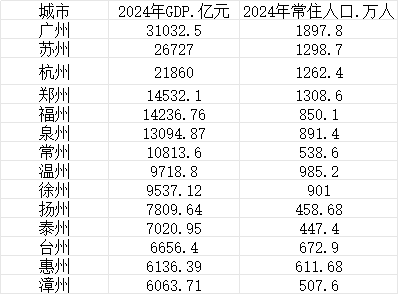
Core Points - The city of Taizhou is leveraging its recent victory in the Jiangsu Provincial Urban Football League to promote tourism by offering free admission to certain attractions for residents of cities with "zhou" in their names until 2026 [1] - A total of 43 cities in China have "zhou" in their names, with a combined GDP of 25.8 trillion yuan, accounting for 19.1% of the national GDP [1] - Among these cities, Guangzhou leads with a GDP of 3.10325 trillion yuan in 2024, followed by Suzhou and Hangzhou with GDPs of 2.6727 trillion yuan and 2.186 trillion yuan respectively [2][3] Summary by Category Economic Performance - Guangzhou's GDP is projected to be 3.10325 trillion yuan in 2024, with significant growth in sectors such as aerospace and advanced manufacturing [2] - Suzhou's GDP is expected to reach 2.6727 trillion yuan, with notable advancements in biopharmaceuticals and artificial intelligence [2] - Hangzhou's GDP is forecasted at 2.186 trillion yuan, benefiting from its strong internet and smart manufacturing sectors [2] City Rankings - The top seven cities with "zhou" in their names based on GDP are Guangzhou, Suzhou, Hangzhou, Zhengzhou, Fuzhou, Quanzhou, and Changzhou, with GDPs exceeding 1 trillion yuan [3] - Cities like Wenzhou and Xuzhou are projected to surpass the 1 trillion yuan GDP mark soon, indicating strong economic growth [3] Regional Distribution - Of the 14 cities with GDPs over 500 billion yuan, 13 are located in eastern coastal provinces, highlighting a regional economic concentration [3]

深刻认识山东经济动能强劲的内在逻辑
Da Zhong Ri Bao· 2025-11-28 01:05
Core Viewpoint - Shandong's economic strength is attributed to multiple advantages, strategic guidance, and enhanced internal dynamics, reflecting a deep internal logic that supports its robust economic performance [2][6]. Group 1: Political Leadership - The comprehensive leadership of the Party is fundamental to the strong economic momentum, with the central government optimizing macro policies and providing guidance for local development [2][3]. - Shandong's government aligns closely with the central government's strategies, ensuring effective responses to economic fluctuations and promoting stable growth [2][3]. Group 2: Strong Real Economy - The solid foundation of the real economy serves as a stabilizing force, with Shandong leveraging its diverse industrial base to focus on the development of the real economy [3][4]. - The province emphasizes the importance of advanced manufacturing and the integration of digital and real economies to enhance industrial stability [3]. Group 3: New and Old Momentum Conversion - Continuous conversion between new and old economic drivers is crucial, with Shandong actively eliminating outdated capacities and fostering new growth areas [4][5]. - The province is undergoing a significant transformation, optimizing traditional industries while nurturing emerging sectors like high-end equipment and quantum technology [4]. Group 4: Innovation Leadership - Innovation is identified as the primary driver of economic momentum, with Shandong prioritizing technological advancements and the establishment of high-level innovation platforms [5][6]. - The province is witnessing a shift from resource-driven to innovation-driven development, significantly enhancing its growth potential [5]. Group 5: Geographic and Open Economy Advantages - Shandong's strategic geographic location facilitates extensive connectivity and trade, enhancing its economic dynamism [5][6]. - The province's open economic framework allows it to efficiently gather global resources, maintaining a leading position in import and export activities among northern provinces [5][6]. Group 6: Implementation of New Development Concepts - Shandong's economic dynamics reflect the effective implementation of new development concepts, showcasing the province's commitment to high-quality growth and national development goals [6].
把握科学思维建设全国统一大市场
Jing Ji Ri Bao· 2025-11-25 23:02
Core Viewpoint - The article emphasizes the necessity of accelerating the construction of a new development pattern in China, focusing on building a unified national market to strengthen domestic circulation and enhance economic resilience while addressing international uncertainties [1] Group 1: Building a Unified National Market - Establishing a unified national market is a key reform for enhancing domestic circulation and stimulating internal demand, as highlighted by Xi Jinping [1] - The 20th Central Committee's Fourth Plenary Session stresses the importance of a strong domestic market as a strategic foundation for Chinese modernization and calls for the removal of barriers to market construction [1] Group 2: Combining Establishment and Removal - The approach of "establishing" and "removing" should be integrated, where "establishing" focuses on creating necessary institutional rules and "removing" aims to eliminate outdated regulations that hinder fair competition [2] - A unified property rights protection system and a negative list for market access are essential for promoting a strong domestic market [2] Group 3: Breaking Down Institutional Barriers - There is a need to eliminate institutional barriers that restrict economic circulation, such as local protectionism and market segmentation [3] - Strengthening anti-monopoly enforcement and ensuring equal market access for all entities are crucial steps in this process [3] Group 4: Focusing on the Real Economy - The real economy is fundamental for national strength, and the article advocates for a balanced development between the real and virtual economies [4] - Emphasis is placed on advancing manufacturing capabilities and fostering innovation in key technologies to enhance economic self-reliance [4] Group 5: Promoting Supply and Demand Interaction - The article highlights the importance of creating a dynamic balance between supply and demand, where new demand leads to new supply and vice versa [5] - A modern circulation system and effective market information transmission mechanisms are necessary for achieving this balance [5] Group 6: Streamlining Administration and Empowering Markets - The government should reduce direct intervention in market activities while enhancing regulatory oversight to maintain order and fairness [7] - The focus should be on creating a conducive environment for various business entities to thrive [7] Group 7: Central-Local Coordination - Strengthening coordination between central and local governments, as well as among various departments, is essential for building a unified national market [8] - Encouraging regional market integration and collaboration can enhance overall development efficiency [8]
从三个视角看中国式现代化宜宾实践
Si Chuan Ri Bao· 2025-11-25 21:11
Economic Growth - The regional GDP of Yibin is projected to grow from 286.35 billion yuan in 2020 to 400.58 billion yuan by 2024, crossing two 100 billion yuan thresholds and ranking 87th among the top 100 cities in China [1] - By 2024, the total industrial added value is expected to reach 160.79 billion yuan, which is 1.5 times that of the end of the 13th Five-Year Plan [1] - The service sector's added value is projected to be 169.63 billion yuan by 2024, also 1.5 times that of the end of the 13th Five-Year Plan [1] - The total output value of agriculture, forestry, animal husbandry, and fishery is expected to reach 68.33 billion yuan by 2024, which is 1.2 times that of the end of the 13th Five-Year Plan [1] Urban and Rural Integration - Yibin is developing 31 urban-rural integration experimental zones, with the number of counties (districts) with a GDP exceeding 20 billion yuan increasing from 2 in 2020 to 9 by 2024 [2] - The city has achieved "county-level highway connectivity" and integrated into the Chengdu-Chongqing "one-hour economic circle" [2] Innovation and Technology - Yibin has signed contracts for 26 key industrial projects in 2023, establishing a distinctive and efficient new energy storage industry chain [5] - The city has seen a 49.5% increase in total R&D expenditure over five years, with the number of high-tech enterprises growing by 337 to a total of 487 [2][3] - The city is focusing on new energy storage, digital economy, and other emerging industries, transitioning from traditional industries to modern sectors [6] Environmental and Urban Development - Yibin has implemented strict controls on industrial wastewater discharge and upgraded urban sewage treatment facilities, significantly improving water quality [8] - The city has added over 1 million square meters of urban green space, enhancing the living environment [8] Education and Healthcare - The annual public budget for education exceeds 10 billion yuan, with 315 educational projects completed, adding 71,700 new student places [9] - New hospitals and healthcare facilities have been established, expanding access to quality medical resources [9] Industry Leadership - Yibin has become a leading hub for the energy storage industry, with a production capacity of 13 GWh and a market value of 3.628 billion yuan in the first three quarters of 2023, representing a 377% increase year-on-year [5] - The city is home to the largest production base for energy storage equipment in China, contributing significantly to the national energy transition [5][11]
金融价值观|在变局中开新局 在改革中聚合力
Xin Hua Wang· 2025-11-25 09:21
2025年,我国经济呈现稳中有变、变中有机的态势,在曲折中显露向好趋势,为"十五五"规划的系 统部署奠定了坚实基础。一方面,居民消费从信心筑底走向温和改善,企业盈利压力逐步缓解、应收账 款增速明显回落,经济运行的微观根基持续巩固。另一方面,外部环境仍存不确定性,但外部经贸摩擦 的边际扰动趋于弱化,有助于稳定企业预期。同时,新阶段供给侧结构性改革的政策框架日益明晰,改 革的系统性增强为培育新动能打开了更广阔空间。 过去数年,多方面因素共同导致经济循环一度受阻。针对这些结构性掣肘,国家相继推出"反内 卷"、账款清理、发展现代服务业、稳妥化解地方债务等一系列举措,着力疏通堵点、修复循环、提振 预期。随着政策持续显效,微观活力正在逐步恢复,经济具备进一步向好的基础。在此背景下,2026年 作为"十五五"规划的开局之年,其重要性愈加凸显。开局之年不仅承担着稳预期、强动能的任务,也关 系到未来五年现代化建设的整体布局。要巩固恢复势头、增强增长后劲,改革必须在更深层次、更宽领 域同步推进,以提升经济体系的韧性与竞争力。 构建现代化产业体系 构建现代化产业体系,是提升国家竞争力、推动高质量发展的核心抓手。 从整体看,传统产业 ...
推进江苏高校县域办学与县域现代化融合共生
Xin Hua Ri Bao· 2025-11-24 21:53
Core Viewpoint - The integration of urban and rural development is essential for China's modernization, with county-level modernization being a key support for this process [1] Group 1: Higher Education's Role - Higher education is crucial for serving national strategies and regional economic development, but its resources are unevenly distributed, primarily concentrated in large cities [1] - The "Education Strong Country Construction Plan Outline (2024-2035)" emphasizes the need to push higher vocational education resources into counties, providing a policy basis for county-level higher education [2] Group 2: County-Level Higher Education as a Pathway - County-level higher education is an innovative model that enhances the service radius of higher education and promotes the balanced allocation of quality educational resources [2] - This model fosters a bidirectional empowerment mechanism between universities and counties, allowing for practical applications of theoretical knowledge and enhancing research and talent cultivation [2] Group 3: Strategic Planning and Regional Coordination - A differentiated policy approach is necessary to address the diverse economic conditions and development stages of counties in Jiangsu, promoting precise connections between universities and counties [3] - Support for strong economic counties includes establishing industry technology research institutes and professional degree training bases focused on advanced manufacturing sectors [3] Group 4: Collaborative Innovation Systems - Establishing a collaborative innovation mechanism that aligns with county development needs is essential to avoid mismatches in higher education [4] - A "four-in-one" connection mechanism is proposed to link universities with local industries and projects, enhancing the relevance of higher education to local economic needs [4] Group 5: Talent Development and Policy Support - Innovative talent cultivation and support mechanisms are needed to address challenges such as population loss and talent shortages in counties [5] - The establishment of modern industry colleges and vocational training bases is encouraged to provide high-quality technical talent tailored to local industries [5] - Government roles and responsibilities should be clearly defined to support the integration of higher education with county development, including the establishment of special funds for this purpose [6]
学习规划建议每日问答丨为什么要保持制造业合理比重
Xin Hua Wang· 2025-11-24 09:41
Core Viewpoint - The emphasis on maintaining a reasonable proportion of manufacturing is a strategic deployment to accelerate the construction of a manufacturing powerhouse and build a modern industrial system centered on advanced manufacturing [1][2]. Group 1: Importance of Manufacturing - Maintaining a reasonable proportion of manufacturing is essential for building a modern industrial system, as the level of industrial modernization determines the overall level of the industrial system [2]. - China has maintained its position as the world's largest manufacturing country for 15 consecutive years, with a manufacturing value added projected to reach 33.6 trillion yuan in 2024, accounting for 24.9% of GDP [2]. - The current global environment presents complex challenges for manufacturing, necessitating a strong commitment to the manufacturing powerhouse strategy to support the modernization of the industrial system [2][3]. Group 2: Economic Foundation - Manufacturing is a crucial pillar of the national economy and is fundamental to national strength, making it imperative to focus on the real economy by maintaining a reasonable manufacturing proportion [3]. - Historical examples show that countries that neglect manufacturing can fall into the "middle-income trap," highlighting the importance of a robust manufacturing sector for economic resilience [3]. Group 3: Social Awareness and Policy Direction - There is a need to establish a clear societal focus on the importance of manufacturing, with policies tailored to local conditions rather than a one-size-fits-all approach [4]. - The government aims to optimize the development environment for manufacturing, enhance traditional industries, and foster emerging sectors while promoting intelligent, green, and integrated development [4]. - Actions will be taken to ensure high-quality development of key manufacturing industry chains, enhance self-sufficiency, and maintain industrial security [4].
光启技术:公司已基本完成规模化生产体系的迭代
Zheng Quan Ri Bao Wang· 2025-11-24 09:29
Core Viewpoint - The company has completed the iteration of its large-scale production system, achieving "Mass Production 2.0" with enhanced cost-effective capacity expansion [1] Group 1: Production Optimization - The company has optimized its production processes, line organization, and personnel structure at the Shunde base [1] - Significant improvements have been made in production rhythm, standardized processes, and automated auxiliary equipment [1] Group 2: Future Production Plans - The 905 base is a crucial part of the company's multi-base collaborative layout and is expected to commence production by mid-January next year [1] - Preparations for the first phase of the 905 base have accelerated, with 90% of infrastructure completed, 60% of electromechanical installation done, and 70% of the first batch of production equipment being debugged [1] - The company has completed the selection process for personnel for the first phase of the 905 base and is enhancing skills training [1]
湖北发布“十五五”发展新蓝图 12项重点任务推动“基本建成支点”
Chang Jiang Shang Bao· 2025-11-24 00:32
Core Objectives - Hubei has set a strategic goal for the next five years to accelerate the establishment of a significant strategic support point for the rise of the central region [3][4] - The overall target emphasizes the continuity and stability of Hubei's strategic deployment for support point construction [3] Development Strategies - Hubei plans to implement "seven major strategies" and enhance "seven capabilities" to achieve greater results in five key areas [4] - The province aims to solidify its economic foundation, promote technological innovation, and deepen the integration of innovation and industry [7][10] Economic Growth and Achievements - During the "14th Five-Year" period, Hubei's economic total surpassed 5 trillion and 6 trillion yuan, achieving its planning goals a year ahead of schedule [5] - The province has effectively responded to various risks and challenges, making significant progress in support point construction [5][6] Key Tasks and Focus Areas - The provincial government has outlined 12 key tasks, including building a modern industrial system, promoting agricultural modernization, and enhancing infrastructure [7][8] - Specific initiatives include optimizing regional economic layout, expanding high-level openness, and ensuring social welfare improvements [7][9] Regional Collaboration - The plan emphasizes regional collaboration and strategic synergy with other areas to promote balanced and coordinated high-quality development [9] - Hubei will support the development of key cities like Wuhan, Xiangyang, and Yichang as regional centers [9] Agricultural Development - Hubei is hosting the 2025 Agricultural Expo to showcase its advancements in modern agriculture and promote brand awareness [11][12] - The expo will feature a comprehensive display of agricultural innovations and aims to enhance consumer experience and market connections [12][14] Financial Support for Agriculture - Hubei has initiated various financial reforms to activate rural assets and provide diverse financing channels for agricultural entities [15] - The province is focusing on facilitating the listing of agricultural companies to enhance industry upgrades and attract investment [15]

视频丨韧性、创新、稳定、开放 国内外机构看好中国经济增长前景
Yang Shi Xin Wen Ke Hu Duan· 2025-11-23 07:23
Core Viewpoint - Multiple domestic and foreign institutions predict that China's economy will continue to show steady growth in 2026, supported by policy measures, structural upgrades, and the release of potential [1][3][4] Group 1: Economic Growth Predictions - Foreign institutions generally forecast that China's economy will maintain steady growth in 2026 due to policy support [3] - Morgan Stanley anticipates moderate growth driven by appropriate easing policies and gradual rebalancing [3] - UBS expects more precise policy support to enhance economic resilience [3] Group 2: Structural and Policy Support - The chief macro analyst at Everbright Securities highlights significant growth potential and quality upgrade space in China's economy due to its vast market and strong industrial system [4] - UBS emphasizes targeted support measures such as energy cost subsidies for businesses and consumer incentives [6] - Goldman Sachs has raised its forecasts for China's export growth and real GDP growth, citing the "14th Five-Year Plan" as a confidence booster for advanced manufacturing competitiveness [6] Group 3: Trade and Domestic Demand - The dual drivers of foreign trade and domestic demand are crucial for high-quality economic growth, with exports remaining a core support force [7] - Analysts from CITIC Securities predict stronger overall exports in 2026 compared to 2025, with a focus on mid-to-high-end manufacturing competitiveness [9] - The potential of the domestic market is accelerating, with consumer and livelihood policies expected to play a key role in expanding domestic demand [9] Group 4: Innovation and Stability - Analysts identify "innovation" as a key theme for the economy in 2026, with a shift from traditional factor-driven growth to technology-driven growth [14] - The IMF representative notes that expanding consumption is a priority for the government, contributing to high-quality growth [11] - UBS economists highlight the stability of domestic policies as a solid foundation for innovation and a crucial guarantee for steady economic progress [18][20] Group 5: Open and Sustainable Development - The concept of institutional openness in finance, particularly in RMB internationalization and capital market openness, is seen as a positive factor for economic vitality [22] - The emphasis on green finance and support for high-tech industries is expected to enhance the overall economic landscape [22]
