智能眼镜

Search documents
Meta (META.US)加码AI眼镜领域,向全球最大眼镜制造商投资35亿美元
智通财经网· 2025-07-08 23:32
Group 1 - Meta has acquired a minority stake of nearly 3% in EssilorLuxottica, valued at approximately €3 billion ($3.5 billion), indicating a significant investment in the growing smart glasses industry [1] - The investment deepens the collaboration between Meta and EssilorLuxottica, which has developed several AI smart glasses together, including the Ray-Ban glasses launched in 2021 [1][2] - Meta's CEO Mark Zuckerberg emphasizes that smart glasses are a core component of the company's strategic focus on AI, allowing Meta to build its own hardware ecosystem and control distribution channels [2] Group 2 - The partnership enhances EssilorLuxottica's presence in the tech sector, with potential significant synergies if Meta's investments in smart glasses succeed [2] - Meta's strategy reflects a belief that consumers will increasingly use headsets or glasses for work and entertainment in the future [2]

小米AI眼镜来了,但“智能眼镜时代”离我们还有多远?
3 6 Ke· 2025-07-08 08:11
Core Insights - Xiaomi's AI smart glasses launch marks a significant step towards the era of smart glasses, but several key hurdles remain before widespread adoption can occur [1][16] - The competition among various brands in the "hundred glasses battle" may ultimately determine the leading players in the smart glasses market [16] Product Highlights - The Xiaomi AI smart glasses are priced starting at 1999 yuan, which is significantly lower than competitors like Ray-Ban Meta priced at 299 USD, indicating a shift towards making smart glasses more accessible [3] - Initial sales figures show that Xiaomi's AI smart glasses have sold over 50,000 units within three days, achieving the fastest sales rate for AI smart glasses in China [2][3] Market Dynamics - The entry of major smartphone manufacturers like Xiaomi and Huawei into the smart glasses market is expected to accelerate the industry's growth, leveraging their advantages in funding, supply chains, and brand recognition [4][6] - The global market for AI smart glasses is projected to grow rapidly, with sales expected to reach 4 million units by 2025, up from 210,000 units in 2023 [5][10] Competitive Landscape - The smart glasses market is currently characterized by a clear tiered structure, with companies like Thunderbird Innovation leading with a 35.6% market share in China's consumer-grade AR market [9] - The "hundred glasses battle" has seen over 60 Chinese and 80 international companies participating in AI glasses showcases, indicating a heightened interest and competition in the market [8] Technological Challenges - Current smart glasses face challenges related to battery life, privacy concerns, and the need for improved interaction capabilities, which must be addressed for broader acceptance [14][15] - The main chip solutions for high-end smart glasses are dominated by Qualcomm, which poses challenges for domestic manufacturers in terms of cost control and supply chain independence [4][14] Future Outlook - The smart glasses market is anticipated to experience explosive growth, with IDC predicting that global shipments will reach 12.05 million units by 2025, driven by consumer curiosity and technological advancements [12][10] - Industry experts believe that smart glasses could potentially replace smartphones as the next universal smart device, provided that privacy and usability issues are effectively managed [12][13]

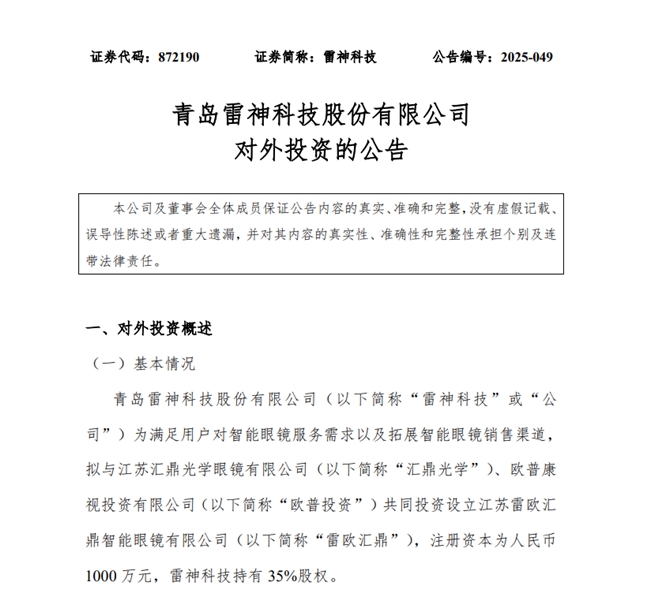
聚焦智能眼镜业务,雷神科技与欧普康视、汇鼎光学签约成立合资公司
Cai Fu Zai Xian· 2025-07-07 06:29
Group 1 - Raytheon Technology announced a joint investment with Jiangsu Huiding Optical Glasses Co., Ltd. and Optecon Vision Investment Co., Ltd. to establish Jiangsu Rayou Huiding Smart Glasses Co., Ltd., with Raytheon holding a 35% stake [1] - The establishment of the joint venture is expected to enhance the market expansion and strategic layout of Raytheon's smart glasses business [1] Group 2 - Raytheon Technology is recognized as the "first stock in e-sports equipment" on the Beijing Stock Exchange and has been listed in the "China's 500 Most Valuable Brands" for five consecutive years, with a brand value of 21.839 billion [3] - The Raytheon AI Magic Mirror (Raytheon Aura AI Smart Shooting Glasses) was officially launched on June 17, featuring a 1.2 million pixel camera, Sony IMX681 sensor, and Qualcomm Snapdragon AR1 chip, weighing only 39g [3] - Huiding Optical is one of the top three optical brands in China by lens sales, with a service network covering over 2,100 clients nationwide [3] - Optecon Vision is the first listed high-tech enterprise in the eye care sector in China, collaborating with over 1,500 well-known medical institutions and covering more than 2,000 professional optical channel partners [3] Group 3 - The partnership aims to leverage Huiding Optical and Optecon Vision's nationwide sales channels and user resources to accelerate the penetration of Raytheon AI Magic Mirror into offline channels [4] - The collaboration will also provide professional support for the development and upgrade of Raytheon's smart glasses through their teams specializing in myopia prevention and eye health management [4] - This initiative is part of Raytheon Technology's strategy to create a closed-loop ecosystem encompassing product development, channel access, and terminal services [4] Group 4 - According to the National Health Commission, the number of myopia patients in China has exceeded 700 million, with offline optical stores being the primary sales channel for glasses [6] - Euromonitor International indicates that offline optical stores will account for 81.8% of the eyewear sales channels in China by 2024, making them a crucial channel for promoting AI/AR glasses [6] - Raytheon Technology aims to transform into a diversified multi-channel layout, seizing the initiative in the industry chain layout [6] - The company is committed to providing an exceptional user experience and plans to collaborate with more ecosystem partners in product development, market expansion, and service ecosystem construction [6]

AI眼镜市场正催生产业变革 深圳智能眼镜产业“登高望远”
Shen Zhen Shang Bao· 2025-07-06 16:53
Core Insights - The launch of Xiaomi's first AI glasses marks the beginning of a competitive landscape in the AI glasses market, with nearly 20 brands, including Meta, Huawei, and Google, releasing new products in the past six months [1][2] - The rapid advancement of AI technologies is driving the application of AI in consumer electronics, indicating the arrival of a "golden age" for AI glasses [1][2] Industry Trends - In June, Xiaomi's AI glasses sold approximately 31,000 units across major e-commerce platforms, with total sales expected to approach 50,000 units, significantly exceeding industry expectations [2] - The Chinese AI glasses market saw online sales of only 116,000 units in Q1 2023, highlighting Xiaomi's strong market entry [2] - Government policies, such as the "Consumption Promotion Action Plan," are supporting the growth of the AI glasses sector, with Shenzhen focusing on AI wearable devices as a key area for development [2][3] Market Dynamics - The AI glasses market is expected to evolve into a long-term trend over the next five years, transitioning from niche products to mainstream consumer electronics [3] - Current consumer perceptions indicate that AI glasses need to diversify their applications and enhance their appeal through design and marketing strategies [3] - Traditional eyewear brands in Shenzhen are well-positioned to leverage their retail channels to introduce AI glasses, enhancing consumer acceptance [3][4] Regional Development - Shenzhen is a significant player in the global eyewear market, producing over half of the mid-to-high-end eyewear, which strengthens its bargaining power internationally [4][6] - The city is fostering innovation in AI glasses technology, with companies like Huawei and others contributing to a robust supply chain [4][5] - Various districts in Shenzhen are developing specialized clusters for AI technology and manufacturing, creating a comprehensive ecosystem for the AI glasses industry [6]
雷神科技拟投资加码 智能眼镜赛道热度高涨
Zheng Quan Shi Bao Wang· 2025-07-04 07:40
Group 1 - The core viewpoint of the articles highlights the increasing interest and investment in the smart glasses sector, with companies like Thunderobot Technology actively expanding their presence in this market [1][2][3][4] - Thunderobot Technology announced a joint investment with Huiding Optical and Opteck to establish Jiangsu Leo Huiding Smart Glasses Co., Ltd., with a registered capital of 10 million yuan, where Thunderobot holds a 35% stake [1] - The company aims to meet user demand for smart glasses services and expand sales channels by integrating resources such as services, technology, and market channels [1][2] Group 2 - In May, Thunderobot Technology signed a strategic cooperation agreement with Doctor Glasses and Huiding Optical to jointly explore the smart glasses market, launching the Thunderobot Aura AI smart shooting glasses equipped with advanced features [2] - The AI glasses market is experiencing rapid growth, with a projected 45% year-on-year increase in sales of consumer-grade AI/AR glasses in Q1 2025, reaching 96,000 units [2][3] - The entry of multiple manufacturers is expected to enhance collaboration across the industry chain, improving overall efficiency and competitiveness [2][3] Group 3 - The surge in AR/AI glasses releases is driven by breakthroughs in AI technology, enabling features like real-time translation and health monitoring [3] - Companies in the acoustic and optical sectors are increasingly entering the smart glasses market, with notable collaborations among various firms [3] - IDC suggests that the competition in the AR/VR market is intensifying as new players enter, shifting the focus from online to a diversified multi-channel approach [3] Group 4 - According to research from Vision, the AI glasses market is transitioning from an exploratory phase to a high-growth phase, with global sales expected to reach 5.5 million units by 2025, representing a 135% year-on-year increase [4]
2025年中国AI眼镜行业研究报告
艾瑞咨询· 2025-07-02 09:51
Core Viewpoint - The AI glasses industry is on the verge of a significant breakthrough, potentially marking the next "iPhone moment" in technology, where AI glasses could transform daily life and communication [2][3]. Industry Overview - AI glasses are innovative wearable devices that integrate artificial intelligence with traditional eyewear, enhancing functionality and practicality [3]. - The global shipment of AI glasses is projected to reach 20 million units by 2028, driven by rapid advancements in AI and AR technologies [9]. Market Dynamics - The AI glasses market is experiencing explosive growth, with major brands entering the space and pushing for deeper integration of AI models and AR technology [14]. - As of September 2023, Meta and Ray-Ban's collaboration has resulted in over 2 million units sold, indicating a strong market interest [9]. Consumer Insights - A significant portion of consumers (61%) have either purchased or plan to purchase smart glasses, with a notable preference for AI-enabled products [25][28]. - The price range of 2000-3000 RMB is widely accepted by consumers, aligning with their monthly income levels [25][28]. User Preferences - Functionality is the primary consideration for consumers when purchasing AI glasses, with a focus on audio playback, photography, AI interaction, and navigation features [32]. - Users show a strong interest in mid-range priced products, often willing to exceed their budget for enhanced features [27][28]. Competitive Landscape - Major players in the AI glasses market include companies like Bose, Huawei, and Rokid, each offering unique products that cater to different consumer needs [15][16][19]. - The industry is characterized by a diverse range of products, including AI audio glasses, AI display glasses (AI+AR), and AI photography glasses [15][16]. Technological Advancements - The industry is witnessing significant technological breakthroughs, including improved hardware performance, local AI functionality, and enhanced user experience through lightweight designs and extended battery life [42]. - The integration of AI capabilities is expected to transition AI glasses from niche products to mainstream necessities [42][43]. Retail and Marketing Strategies - The retail landscape for AI glasses is evolving, with a focus on experiential marketing and the integration of online and offline sales channels [45]. - Consumer engagement through social media and experiential marketing is crucial for driving awareness and sales in the AI glasses market [23][45].

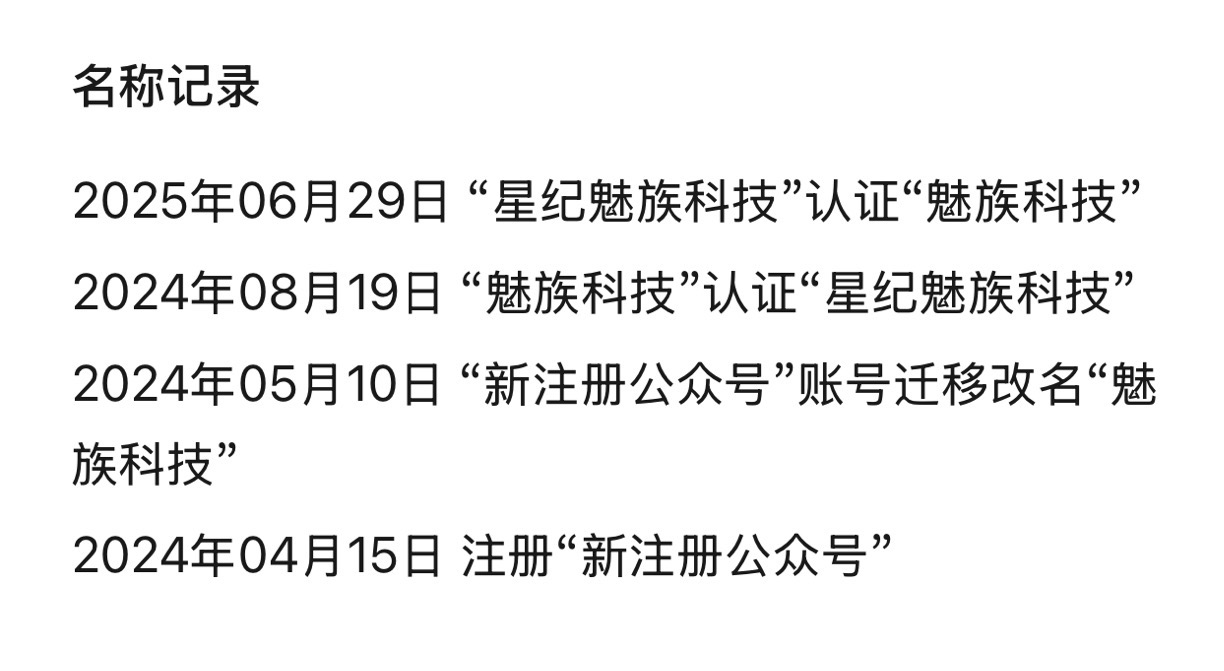
更名不到一年,“星纪魅族科技”改回原名“魅族科技”
Guo Ji Jin Rong Bao· 2025-07-01 14:41
Core Viewpoint - The recent rebranding of "Starry Meizu Technology" back to "Meizu Technology" raises questions about potential strategic adjustments within the company, occurring less than a year after a previous major rebranding effort [1] Group 1: Company Changes - The official accounts related to Meizu Technology have removed the "Starry" prefix, indicating a shift back to the original branding [1] - Personnel changes have been noted, with Huang Zhipan taking over as the legal representative and CEO of Zhuhai Starry Meizu Information Technology Co., Ltd., succeeding Su Jing [2] - The company structure shows that Zhuhai Meizu Technology Co., Ltd. and Hubei Starry Meizu Technology Co., Ltd. each hold a 50% stake in the company, with Huang Zhipan being the brother of the founder, Huang Zhang [2] Group 2: Strategic Developments - The rebranding coincides with the third anniversary of Geely's acquisition of Meizu Technology, which has led to significant structural changes and strategic investments [4] - The establishment of the Starry Meizu Group aimed to integrate various technologies, including automotive systems and XR technology, alongside traditional smartphone offerings [4] - The Flyme Auto system has achieved over 1.16 million sales in collaboration with various automotive brands, indicating a successful entry into the automotive technology market [4] Group 3: Product Focus and Market Position - Meizu has launched several AR smart glasses, but the domestic market for smart glasses remains underdeveloped, with no standout products achieving significant sales [5] - The company aims to regain a top position in the domestic mid-to-high-end smartphone market within three years, with plans to establish 1,000 integrated offline experience stores [6] - The upcoming Meizu 22 series is positioned as a flagship product focusing on AI capabilities and compact design, with a strategic shift towards enhancing camera performance [7]
难怪罗永浩泼冷水?这个行业超40%“PPT产品”正透支用户信任
3 6 Ke· 2025-07-01 11:19
Core Insights - The smart glasses industry is facing significant delivery challenges, with multiple companies issuing apologies for delays and lack of transparency in communication [2][9][15] - Despite the market's vibrancy, with 56 new smart glasses launched in 2024, over 40% of products showcased have not been made available for purchase, leading to a perception of them as "concept products" [3][4][9] Industry Overview - The smart glasses market has seen a surge in new product launches, with 56 models introduced in 2024 alone, surpassing the total from the previous year [3][4] - Major players in the market include both startups and established tech companies, such as XREAL, Rokid, and Xiaomi, indicating a diverse competitive landscape [4][5] Product Launch Challenges - Companies like Yingmu Technology and Shanjing Technology have faced repeated delays in product deliveries, leading to customer dissatisfaction and refund incidents [2][9] - A significant number of products, approximately 25, remain unavailable for purchase despite being announced, highlighting supply chain constraints [9][10] Sales Performance - Among the launched products, 31 are currently available for purchase, with brands like XREAL and Xiaomi performing particularly well in sales [11][12] - Xiaomi's AI glasses quickly became a top seller on platforms like JD.com, indicating strong consumer interest despite the overall market challenges [12][14] Market Dynamics - The industry is characterized by rapid product introductions, with 15 products claiming to be "first in the world," raising concerns about potential marketing gimmicks [15][16] - The smart glasses sector is compared to the smart speaker market, which faced a decline due to lack of innovation and consumer interest, suggesting a cautionary tale for smart glasses [17][18] Future Outlook - The smart glasses industry must focus on overcoming technical challenges and ensuring reliable product availability to build consumer trust [18][19] - There is a need for companies to prioritize functional simplicity and user experience over excessive features to avoid the pitfalls seen in other tech markets [19][20]
智能眼镜开启视觉交互新体验
Zheng Quan Ri Bao· 2025-06-29 16:42
Group 1 - The smart glasses market is experiencing significant growth, particularly during the 618 shopping festival, with products like Xiaomi's AI glasses selling over 10,000 units on JD.com [1] - The main categories of smart glasses in the market are VR, AR/XR, and AI glasses, each with unique features and user experiences [2] - VR glasses provide immersive experiences but are often criticized for their bulkiness and discomfort during prolonged use [2] - AR/XR glasses excel in lightweight design and comfort, offering a cinema-like viewing experience while still being stylish [2] - AI glasses, while lacking in immersive experiences, fulfill daily needs such as translation and navigation, but face challenges like high prices and short battery life [3] Group 2 - The rapid development of AI models and optical display technology, along with the proliferation of 5G, is enhancing the functionality and user experience of smart glasses [3] - The smart glasses market is supported by government policies, including consumer subsidies, which are expected to boost market growth [3] - Industry experts predict that 2025 could be a pivotal year for the smart glasses market, leading to intense competition among manufacturers [4] - Major companies, including Xiaomi and Douyin, are entering the smart glasses market, indicating a growing interest from tech giants [4] - Smart glasses are not limited to younger consumers; they are also being designed for elderly users, providing services like voice navigation and companionship [4] Group 3 - Despite the market's potential, challenges remain for widespread adoption, including privacy concerns related to built-in cameras and the need for a stable content ecosystem to support long-term usage [5]
汽车吃肉,眼镜喝汤?小米YU7带飞"含米量"基金收益40%+,智能眼镜ETF却集体沉没!
市值风云· 2025-06-27 10:02
Core Viewpoint - The article warns against the hype surrounding smart glasses, suggesting that investment opportunities should focus on the "content" of companies like Xiaomi rather than the popularity of concepts [1][12]. Group 1: Xiaomi's Automotive Launch - Xiaomi's first SUV, YU7, was launched at a price of 253,500 yuan, and within three minutes, 200,000 units were sold [3][4]. - The launch event also introduced Xiaomi's first AI glasses, priced approximately 15% lower than Meta's Ray-Ban, featuring voice calls, photo and video recording, and real-time translation capabilities [6]. Group 2: Investment Performance - Xiaomi-related ETFs have seen a return of over 40% due to the company's strong cash flow and marketing capabilities [8]. - The average return for high "Xiaomi content" funds was 21.5% for 2024 and 23.5% year-to-date, indicating significant gains for investors who followed previous recommendations [12]. Group 3: Smart Glasses Market Outlook - The global smart glasses market is expected to grow significantly, with an estimated shipment of over 12 million units in 2025, reflecting an 18.3% year-on-year increase, particularly strong in China with a 113.8% increase in online sales [15]. - The smart glasses industry is segmented into three main areas: chips, optics, and sensors, which are closely related to various consumer electronics indices [15][16]. Group 4: ETF Performance and Industry Analysis - Seven ETFs tracking consumer electronics indices have reported negative returns this year, indicating challenges in the sector despite the hype around smart glasses [17]. - The only ETF tracking the virtual reality theme index is VRETF (159786.SZ), which covers upstream industries like electronic components and digital chip design [19][20]. Group 5: Consumer Demand and Market Sentiment - Smart glasses are not considered a necessity for average consumers, and despite recent interest, they may not become essential personal items [23]. - The product's limitations, such as not catering to the needs of the visually impaired, may lead to lower adoption rates, suggesting that investors should be cautious and not be swayed by market sentiment [23].