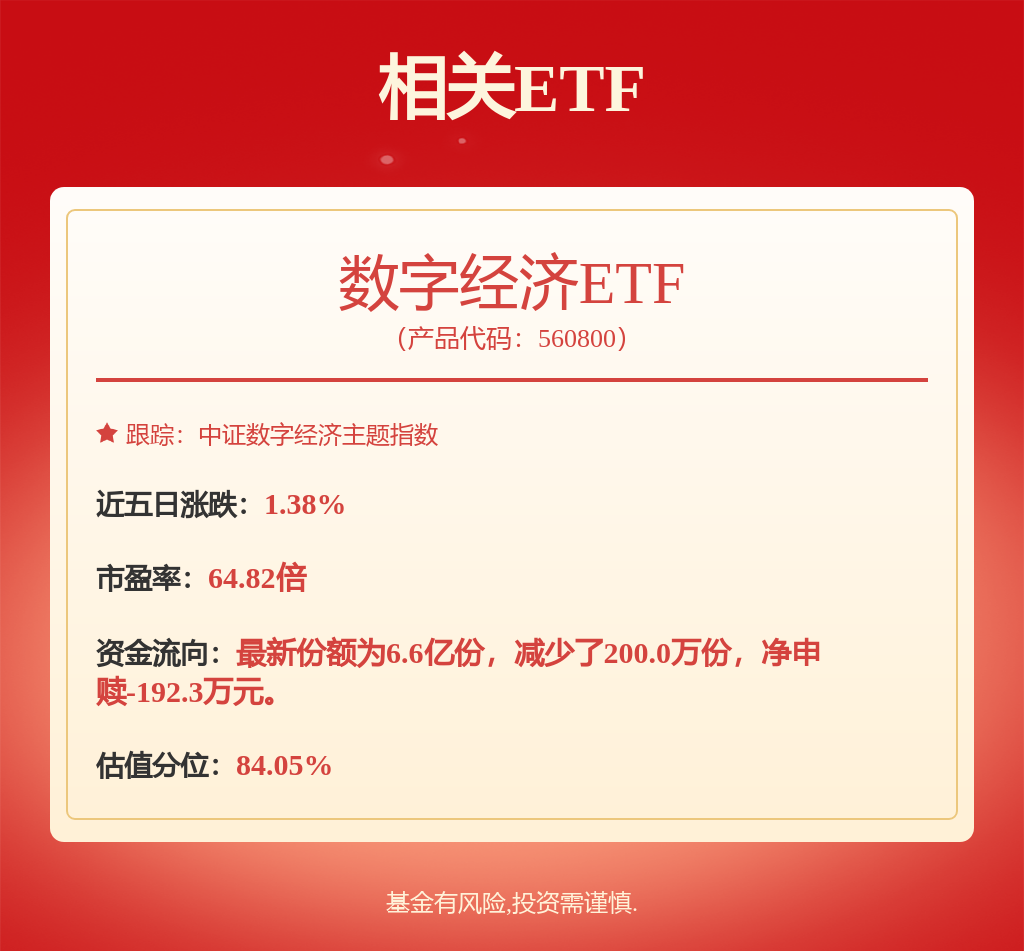
数字经济

Search documents
重磅!广东“十五五”规划建议全文发布
21世纪经济报道· 2025-12-08 03:06
中共广东省委关于制定广东省国民经济和 社会发展第十五个五年规划的建议 (2025年11月27日中国共产党广东省 第十三届委员会第七次全体会议通过) 中国共产党广东省第十三届委员会第七次全体会议,全面贯彻党的二十届四中全会精神,深入 贯彻习近平总书记对广东系列重要讲话和重要指示精神,就制定广东省国民经济和社会发 展"十五五"规划提出以下建议。 一、牢记习近平总书记厚望重托,奋力在推进中国式现代化建设中走在前列 (1)"十四五"时期广东取得的发展成就。 "十四五"时期广东发展历程极不寻常、极不平凡。 在以习近平同志为核心的党中央坚强领导下,广东省委团结带领全省广大干部群众,锚定"走 在前列"的总目标,激活改革、开放、创新三大动力,扎实推进"1310"具体部署,迎难而上、 砥砺前行,有力应对百年变局和世纪疫情,坚定扛起经济大省挑大梁的责任,推动经济社会发 展取得新成就,续写了经济快速发展和社会长期稳定两大奇迹的广东新篇章。高质量发展主旋 律鲜明唱响,产业科技互促双强深入推进,关键核心技术多点突破,制造业家底更加厚实,新 质生产力加快壮大,经济总量迈上14万亿元大台阶。改革开放活力动力有效释放,粤港澳大湾 区牵引作用 ...


聚新势扩内需推改革 经济大省冲刺“交答卷”
Shang Hai Zheng Quan Bao· 2025-12-07 18:11
Group 1 - Economic provinces are focusing on high-quality development by promoting emerging industries, enhancing consumption, and improving the business environment to achieve annual goals and lay the foundation for future growth [1][2] - The "One Person Company" model in Jiangsu, supported by AI, allows entrepreneurs to manage the entire product lifecycle, with over 110 cases reported in Suzhou [1] - Guangdong's digital economy plan aims for the AI core industry to exceed 440 billion yuan by 2027, with over 60,000 industrial enterprises undergoing digital transformation [2] Group 2 - Domestic demand is emphasized as a key driver of economic growth, with provinces launching consumption campaigns and major projects to stimulate internal circulation [3][4] - Guangdong's "Warm Winter, Enjoy Guangdong" campaign includes 35 billion yuan in consumer vouchers, while Jiangsu's shopping festival offers over 4 billion yuan in coupons [3] - Investment in major infrastructure projects is progressing, with significant milestones achieved in various provinces, such as the completion of key bridge works in Sichuan and water resource projects in Guangdong [3][4] Group 3 - Economic provinces are implementing deep reforms and high-level openness to enhance growth, with measures to improve the business environment and address challenges faced by enterprises [5] - Sichuan has introduced 25 measures to improve the business environment, while Henan is working on integrating into the national market with a comprehensive implementation plan [5] - Economic performance indicators show strong growth, with Guangdong's GDP reaching 10.52 trillion yuan, followed by Jiangsu at 10.28 trillion yuan and Shandong at 7.71 trillion yuan [5] Group 4 - Future strategies for economic provinces include breaking down regional barriers and innovating in areas like low-altitude economy to inject more growth potential [6]
港股科技ETF(513020)近10日净流入超2亿元,市场关注科技板块长期逻辑
Mei Ri Jing Ji Xin Wen· 2025-12-05 03:09
Core Insights - The Hong Kong technology sector is expected to benefit from a dual drive of global AI recovery and Chinese policy dividends, with the Hang Seng Technology Index showing a year-to-date increase of over 25% in 2025 [1] - The technology sector's stock price growth and performance have significantly outpaced the overall A-share market, indicating a robust growth phase for China's tech industry [1] - Concerns regarding an "AI bubble" have eased since late November 2025, attributed to signals of interest rate cuts from the Federal Reserve, better-than-expected corporate earnings, and the practical implementation of AI applications [1] Sector Performance - The technology sector encompasses areas such as semiconductors, digital economy, and biotechnology, showcasing comprehensive growth potential [1] - The Hong Kong Technology ETF (513020) tracks the Hong Kong Stock Connect Technology Index (931573), which selects the top 30 listed companies in sectors like information technology, electronic components, interactive media and services, online retail, and payment services based on market capitalization [1] - The index focuses on high R&D investment and high-growth technology companies, reflecting the overall performance of core technology industry securities in the Hong Kong market [1]
四川商界网:四川省川商经济国际合作商会与澳门特别行政区招商投资促进局开展座谈交流
Sou Hu Cai Jing· 2025-12-03 13:51
随后,澳门特别行政区招商投资促进局李思寻主任详细介绍了该局的职能与新一年的业务规划。她提 到,基于澳门计划在2029年底前建设澳门科技产业园的目标,投促局将重点围绕集成电路、航空航天、 生物医药、数字经济等领域,与内地赴澳企业开展合作,并配套推出包括税收优惠在内的一系列支持政 策。同时,李主任也欢迎内地企业积极参与澳门国际贸易投资展览会(MIF)、环保展等本地知名展 会。 在之后的交流中,双方就川商企业产业出海、重点产业招商引资合作,以及展会会议、葡语国家经贸考 察等板块进行了深入探讨,共同期待在新的一年里推动具体合作项目落地。 为贯彻商会"聚合川商,融通国际,创享未来"的核心价值观。12月2日,四川省川商经济国际合作商会 秘书长王璐(代)携国际部刘金菲女士一行,拜访了澳门特别行政区招商投资促进局成都代表处,受到 该局李思寻主任、梁洁副主任、周田副主任一行的热情接待。 会上,商会秘书长王璐(代)首先介绍了商会的职能定位、业务布局及会员企业出海近况。他表示,商 会持续助力会员企业进行政策申报、外贸拓展与产业孵化,今年更着力构建专委会机制,以进一步提升 行业服务的针对性与渗透力。商会目前拥有近300多家会员企业, ...

德勤:中企出海已由“产品出海”升级为“价值链出海”
Zheng Quan Shi Bao Wang· 2025-12-03 12:52
Core Insights - Deloitte's report highlights that Chinese enterprises' overseas expansion has evolved from "product export" to "value chain export" [1] - The report emphasizes the establishment of a comprehensive industrial chain collaboration, technological innovation, and advantages in large-scale management [1] Group 1: Trends in Overseas Expansion - Chinese companies are now focusing on three major trends: new markets, new capabilities, and new patterns [1] - Emerging industries such as new materials, pharmaceuticals, and e-commerce are accelerating their international presence [1] Group 2: Key Sectors - The report identifies key sectors for overseas expansion, including digital economy, green energy, and artificial intelligence [1]
福州方向民营经济培训心得
Sou Hu Cai Jing· 2025-12-03 08:29
Core Insights - The training in Fuzhou highlighted the importance of optimizing the business environment and supporting the transformation and upgrading of private enterprises, showcasing practical explorations in promoting high-quality development of the private economy [1][2] Group 1: Government and Business Relations - The concept of a "new type of government-business relationship" emphasizes that it should not be devoid of interaction but rather involve "precise services with boundaries," where the government actively addresses enterprise challenges while maintaining integrity [2] - The training underscored the dual role of the government as both a "service provider" to alleviate enterprise difficulties and a "referee" to ensure fair competition in the market [2] Group 2: Digital Economy and SMEs - The integration of digital technology in small and medium-sized enterprises (SMEs) was highlighted, demonstrating that digitalization is not exclusive to large companies; SMEs can also benefit from lightweight digital tools to reduce costs and enhance efficiency [2] - The training provided a clear path for local private economic transformation by showing that SMEs can leverage online marketing and smart management to enjoy the benefits of the digital economy [2] Group 3: Financing Innovations - The course on "Innovative Financing Models and Risk Avoidance" focused on the "funding pain points" of the private economy, with Fuzhou's initiatives like the "government-bank-enterprise docking platform" and "credit loan reforms" effectively alleviating financing difficulties for SMEs [3] Group 4: Practical Applications in Fuzhou - Fuzhou's high-tech zone exemplified best practices in optimizing the business environment, achieving a one-day business setup time and a 40% reduction in project approval times through reforms like "one-stop service" [4] - The "Digital Empowerment of the Private Economy" initiative in Fuzhou Software Park showcased the provision of low-cost cloud computing and big data services to help traditional manufacturing enterprises digitize their production processes [4] - The economic and technological development zone's approach to empowering the private economy through specialized industrial parks and comprehensive ecosystem development was noted as a new paradigm for industrial cluster growth [4][5] Group 5: Communication and Support for Enterprises - The "Entrepreneurs' Home" model in Fuzhou facilitates government-enterprise communication through regular policy briefings and business matchmaking events, providing legal, management, and market support to help private enterprises overcome development challenges [5] - The training emphasized that promoting the private economy is not merely about policy support but requires systematic environmental optimization, precise service empowerment, and continuous innovation [5]
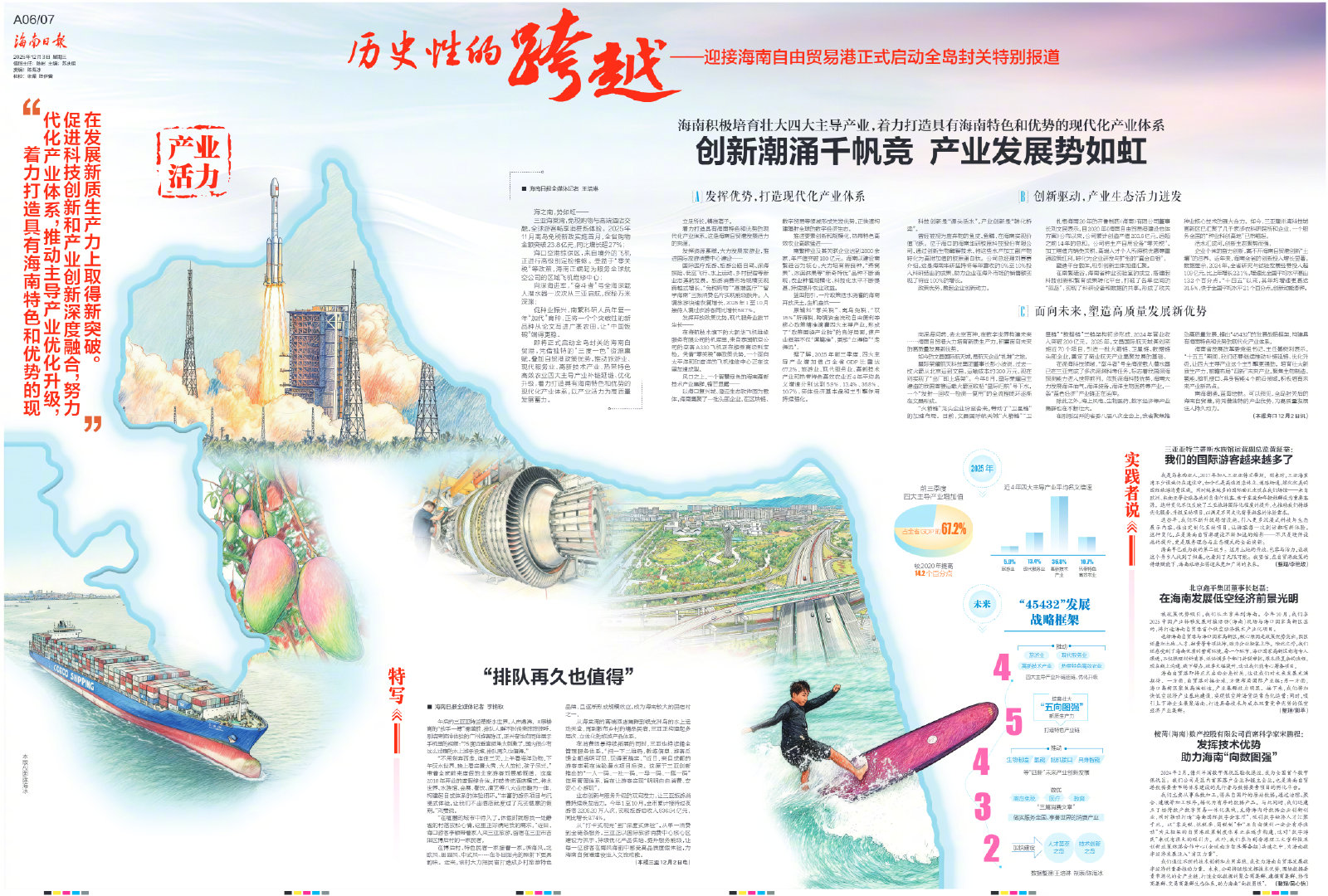
海南积极培育壮大四大主导产业
Hai Nan Ri Bao· 2025-12-03 07:08
Group 1 - Hainan is focusing on building a modern industrial system with unique characteristics and advantages, aiming for high-quality development through the optimization and upgrading of leading industries [3][8] - The tourism sector is experiencing significant growth, with a 58.7% year-on-year increase in overnight international visitors from January to October 2025, and a notable rise in consumption driven by duty-free shopping and high-end medical services [4][20] - The modern service industry is rapidly developing, with Hainan becoming a regional aircraft maintenance center benefiting from zero tariff policies, attracting international airlines [5][8] Group 2 - Hainan is establishing a high-tech industrial cluster, particularly in blockchain and digital trade, with significant investments in innovation and technology [6][12] - The tropical agriculture sector is thriving, with over 2,800 seed industry-related enterprises generating an annual output value exceeding 18 billion yuan, focusing on the development of new varieties [7][8] - The province's innovation ecosystem is being strengthened through increased R&D investment, which reached over 10.9 billion yuan in 2024, growing by 22.1% year-on-year [12] Group 3 - Hainan is positioning itself for future high-quality development by fostering new productive forces in sectors such as deep-sea exploration and space breeding, with a focus on emerging industries [13][16] - The Wenchang International Space City is becoming a hub for aerospace companies, with a projected revenue of over 20 billion yuan in 2024, driven by a comprehensive supply chain for rockets and satellites [14][16] - The province is also expanding its blue economy, focusing on marine oil and gas, marine equipment, and marine biomedicine, creating a robust industrial chain [14][15]
不足全国5%国土面积,四大湾区贡献全国约1/4经济总量
Di Yi Cai Jing· 2025-12-03 04:00
Core Insights - The Bay Area economy in China is evolving into a strategic hub for high-quality development, contributing approximately 25% of the national economic output while occupying less than 5% of the country's land area [1][3] Group 1: Economic Development - The report emphasizes the need for a global perspective to enhance the high-quality development of the Bay Area economy, focusing on key areas such as planning, industry, transportation, and innovation [1][3] - The Central Economic Work Conference of 2024 highlighted the importance of developing marine and Bay Area economies [1][3] Group 2: Regional Collaboration - The report outlines that cities within the Guangdong-Hong Kong-Macao Greater Bay Area are increasingly connected through infrastructure projects, transforming the "one-hour living circle" from a vision into reality [1][2] - In the Northern Bay Area, the "two-hour road circle" and "one-hour high-speed rail circle" significantly enhance internal connectivity among major cities [2] Group 3: Challenges and Recommendations - Current challenges include a gap in innovation capabilities compared to world-class Bay Areas, insufficient resource aggregation, and limited connectivity with global markets [3][4] - Recommendations include creating a high-level collaborative Bay Area economy, focusing on innovation, green transformation, and digital empowerment to enhance competitiveness [3][4] Group 4: Infrastructure and Ecosystem - The report suggests breaking development bottlenecks by optimizing spatial layouts and enhancing industrial upgrades, while also addressing transportation issues [4] - Emphasis is placed on ecological protection and low-carbon development, advocating for a system that prioritizes environmental governance and pollution control [4]
创新潮涌千帆竞 产业发展势如虹
Hai Nan Ri Bao· 2025-12-03 02:03
Core Viewpoint - Hainan is actively cultivating and strengthening four leading industries to create a modern industrial system with Hainan characteristics and advantages, focusing on optimizing and upgrading these industries through deep integration of technological and industrial innovation [2][4]. Group 1: Industry Development - Hainan's shopping amount during the first month of the new offshore duty-free policy in November 2025 exceeded 2.38 billion, a year-on-year increase of over 27% [2]. - The province is emerging as a regional aircraft maintenance center benefiting from "zero tariff" policies, with high-level inspections and maintenance for international airlines [6]. - The agricultural sector is seeing significant advancements, with over 2,800 enterprises in seed industry achieving an annual output value exceeding 18 billion [9]. Group 2: Tourism and Services - The tourism market is experiencing rapid growth, with inbound overnight visitors increasing by 58.7% from January to October 2025 [5]. - New tourism formats such as international medical tourism and deep-sea exploration are flourishing, contributing to the construction of an international tourism consumption center [5]. Group 3: High-tech Industry - Hainan is building a smart and green high-tech industry cluster, with significant developments in blockchain and digital trade, establishing a global digital economy ecosystem [8]. - The province's innovation investment has seen a notable increase, with R&D funding exceeding 10.9 billion in 2024, a growth of 22.1% year-on-year, outpacing the national average [14]. Group 4: Policy and Innovation - Core policies such as "zero tariffs" on raw materials and preferential tax rates are fostering a conducive environment for the four leading industries, with their added value accounting for 67.2% of the provincial GDP in the first three quarters of 2025 [10]. - Companies like Qilu Pharmaceutical have significantly increased their output value, reaching 20.36 billion, leveraging the benefits of the free trade port policies [12]. Group 5: Future Development - Hainan is focusing on nurturing new productive forces and planning for future industries in fields such as biomanufacturing and hydrogen energy, aiming to enhance high-quality development [17]. - The Wenchang International Space City is becoming a hub for aerospace enterprises, with a projected revenue of over 20 billion in 2024, indicating a robust commercial space industry [16].
天润科技12月2日龙虎榜数据
Zheng Quan Shi Bao Wang· 2025-12-02 15:00
(原标题:天润科技12月2日龙虎榜数据) 天润科技(920564)今日下跌1.11%,全天换手率24.56%,成交额2.49亿元,振幅12.35%。龙虎榜数据显示,机构净卖出47.24万元,营业部席位 合计净买入2.96万元。 北交所公开信息显示,当日该股因日换手率达24.56%上榜,机构专用席位净卖出47.24万元。 证券时报•数据宝统计显示,上榜的前五大买卖营业部合计成交6339.64万元,其中,买入成交额为3147.68万元,卖出成交额为3191.96万元,合计 净卖出44.28万元。 | 买/卖 | 会员营业部名称 | 买入金额(万元) | 卖出金额(万元) | | --- | --- | --- | --- | | 买一 | 国金证券股份有限公司深圳分公司 | 850.39 | 1212.36 | | 买二 | 国信证券股份有限公司深圳互联网分公司 | 753.18 | 73.25 | | 买三 | 国信证券股份有限公司深圳红岭中路证券营业部 | 502.09 | 210.71 | | 买四 | 中信建投证券股份有限公司上海营口路证券营业部 | 483.06 | 2.63 | | 买五 | 机构专用 ...