
卫星制造

Search documents
天仪研究院启动IPO,辅导机构为国泰海通
Xin Jing Bao· 2026-02-03 03:00
Group 1 - The core point of the article is that Tianyi Space Technology Co., Ltd. has initiated its IPO process, signing a counseling agreement with Guotai Junan Securities on January 27 [1] - Tianyi Space was established on May 18, 2015, focusing on commercial Synthetic Aperture Radar (SAR) remote sensing satellites and scientific research satellites [1] - Yang Feng is the controlling shareholder and actual controller of the company, holding 9.72% of the company's shares [1] Group 2 - The company has previously received investments from various entities, including Bohua Capital, Shunheng Fund, Longhua Capital, Mianyang Kefa Fund, Hefei Industrial Investment Fund, and Yunbo Capital [1]

商业航天出海再添佳绩,一个月在轨交付两国际卫星;特斯拉最新人形机器人2026年底前启动量产;九部门完善支付环境,便利春节入境游客支付——《投资早参》
Mei Ri Jing Ji Xin Wen· 2026-02-03 00:26
Market News - The three major US stock indices closed higher, with the Dow Jones up 1.05%, S&P 500 up 0.54%, and Nasdaq up 0.56%. Major tech stocks had mixed results, with Apple rising over 4%, and Google and Amazon increasing by over 1% [1] - The Nasdaq Golden Dragon China Index fell by 0.65%, while notable Chinese stocks like Century Internet rose nearly 4% and Kingsoft Cloud increased by over 3% [1] - European stock indices also closed higher, with the Euro Stoxx 50 up 1.00%, FTSE 100 up 1.16%, CAC 40 up 0.67%, DAX 30 up 1.15%, and FTSE MIB up 1.05% [1] Currency and Commodity Market - The US dollar index rose by 0.67%, closing at 97.635. The onshore RMB against the USD was reported at 6.9448, an increase of 118 points from the previous Friday [2] - Spot gold experienced a "V" shaped reversal, reaching a peak of $4800 per ounce before settling at $4665 per ounce. Spot silver saw a decline of 2.3%, fluctuating around $80.00 per ounce [2] - WTI crude oil futures fell by 4.71%, closing at $62.14 per barrel, while Brent crude oil futures dropped by 4.36%, closing at $66.30 per barrel [2] Industry Insights - The Long March 2C rocket successfully launched Algeria's remote sensing satellite B into orbit, marking the second launch of the satellite within 16 days. This project represents ongoing cooperation between China and Algeria in the aerospace sector [3] - The satellite internet sector is projected to grow significantly, with the satellite-ground communication industry expected to reach between 200 billion to 400 billion yuan by 2030, with an annual growth rate of 10%-28% [4] - Tesla announced the upcoming launch of its third-generation humanoid robot, with plans for annual production of one million units by 2026. The production line for Model S/X at the Fremont factory will be converted to humanoid robot manufacturing [4][5] - The Ministry of Commerce and other departments released a plan for the "2026 Spring Festival Special Activity," promoting inbound tourism and enhancing payment environments for international visitors [5][6]

100万颗卫星,撑起马斯克的AI太空基建梦
Sou Hu Cai Jing· 2026-02-02 13:23
智东西 编译|万贵霞 编辑|云鹏 马斯克随后在X平台上就相关报道作出回应称:"我认为我们会从小规模开始,逐步发展壮大。" 根据SpaceX提交给美国联邦通信委员会的文件,这些卫星将通过激光链路实现相互通信,运行高度介于500公里至2000公里之 间,其轨道设计将使卫星几乎能够持续接触太阳,以获取稳定的能源供应。 另据彭博社报道,SpaceX还在评估与马斯克旗下AI公司xAI进行潜在合并的可能性,并计划在今年6月IPO。与此同时,美国联 邦通信委员会也已就相关事项提出要求。 智东西2月2日消息,据美国《财富》杂志今日报道,火箭制造独角兽SpaceX正在向美国联邦通信委员会申请批准,计划将多达 100万颗卫星发射至地球轨道,以在太空中建设数据中心,用于支撑AI的复杂计算。 这一构想被外媒视为埃隆·马斯克(Elon Musk)最新、也是最为宏伟的愿景。 SpaceX向美国联邦通信委员会申请的文件上显示,该公司正在打造一个基于太阳能的卫星网络,以"满足AI驱动的数据需求所带 来的爆炸式增长"。 一、百万颗卫星搭建轨道数据中心,采用太空专属散热与供电模式 SpaceX提交的文件中写道,由100万颗卫星组成的星座将作为轨 ...

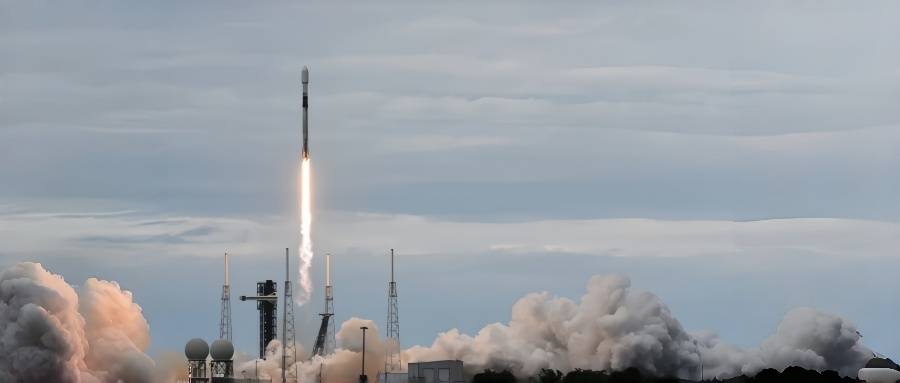
Spacex太空感知-天银机电星敏感器产业解读电话会
2026-02-02 02:22
Summary of SpaceX and Tianyin Electromechanical Conference Call Industry Overview - The low Earth orbit (LEO) internet satellite market is transitioning to the second generation, increasing the configuration of star sensors to 6-8 units per satellite, alongside a rising demand for laser communication devices, significantly boosting market demand [1][2] - China's laser communication devices now standardly include star sensors, which have become a national standard [1] Key Points on Star Sensors - The price of star sensors varies based on orbital height and precision requirements: - Low orbit: 60,000 to 100,000 yuan - Medium orbit: several hundred thousand yuan - High orbit: can exceed 3 million yuan [1][3] - The demand for star sensors is expected to increase significantly as China plans to launch 25,000 LEO internet satellites over the next 14 years, with an annual market value potentially reaching 15 billion yuan based on a price of 500,000 yuan per sensor [3][9] Technological Developments - SpaceX's Starlink has integrated data from approximately 30,000 star sensors to create a new space situational awareness system, enhancing collision avoidance capabilities without the need for additional equipment [1][5] - The Chinese commercial space sector is actively developing, with a gradually improving star sensor supply chain, though it still lags behind companies like SpaceX in terms of technological innovation and market influence [1][6] Competitive Landscape - Tianyin Electromechanical holds over 50% market share in the LEO internet constellation market, with technology levels close to international standards and significant price advantages [1][7] - The company has achieved domestic substitution for star sensors, with competitive pricing compared to international markets [7] Market Segmentation and Client Base - The satellite market is segmented into communication, navigation, remote sensing, and scientific experimental satellites, with communication satellites being the primary focus for Tianyin Electromechanical [7][8] - The demand for star sensors is high in the communication sector, with projects like the G60 satellite requiring multiple sensors per unit [8] Future Projections - China is expected to launch 250,000 LEO internet communication satellites over the next 14 years, with a significant annual replenishment demand of over 30,000 units after an 8-year lifecycle [9] - The company is planning to expand production capacity to meet future market demands, including the potential introduction of a new flexible production line [15] Challenges and Opportunities - The Chinese commercial space sector faces challenges in rocket launch capacity, with a need to enhance capabilities to meet the growing satellite launch demand [11][14] - Tianyin Electromechanical has previously attempted to export to the U.S. but faced restrictions; however, it continues to explore markets in Europe, Africa, and Asia [12] Conclusion - The star sensor market is poised for significant growth driven by the transition to second-generation satellites and increasing demand for laser communication systems. Companies like Tianyin Electromechanical are well-positioned to capitalize on these trends, although they must navigate competitive and regulatory challenges in the global market.

“未来之城”的快与慢——雄安新区疏解人员工作生活见闻
Xin Lang Cai Jing· 2026-01-28 23:07
Group 1: Development and Investment - The Xiong'an New Area has maintained an annual investment scale of 200 billion yuan since the 14th Five-Year Plan, with cumulative investments exceeding 1 trillion yuan and an average annual GDP growth of 17.1% [5] - The area is focused on balancing rapid development with sustainable urban planning, emphasizing the importance of both speed and quality in modern city construction [1][5] Group 2: Innovation and Technology - Blue Arrow Hongqing, a company specializing in low-orbit broadband satellite internet, has made significant progress, with the "Xiong'an No. 1" satellite expected to launch in the first half of 2026 [2] - The establishment of Xiong'an Miaoxin Biotechnology Co., which aims to build clinics and has attracted top scientists, highlights the rapid growth of innovative enterprises in the region [3] Group 3: Infrastructure and Community - The China Sinochem Tower, the tallest building in Xiong'an, is set to house nearly a thousand employees by October 2025, contributing to the area's industrial cluster and talent aggregation [4] - The Xiong'an New Area has developed over 740,000 acres of green space, integrating ecological corridors with community and industrial zones to enhance the quality of life [8]

商业航天的星辰大海-2026产业节奏与核心赛道洞察
2026-01-28 03:01
Summary of Key Points from the Conference Call Industry Overview - The conference discusses the commercial aerospace industry, focusing on satellite deployment plans and technological advancements in satellite manufacturing and communication systems. Key Insights and Arguments 1. **National Satellite Constellation Plans** - The National Grid Constellation aims to deploy 12,992 satellites, with 145 launched as of January 2026, targeting 300 by 2025 and 1,200 by 2029. Delays in reusable rocket technology may impact these timelines [1][2][3] 2. **Shift in Satellite Configuration** - Transition from closed to flat-panel satellite designs signifies a shift from artisanal to assembly line production, enhancing electronic integration and necessitating advancements in flexible solar wings and laser terminal technologies [1][5] 3. **Phased Array Antenna Development** - Phased array antennas enable multi-target tracking without mechanical rotation, crucial for low Earth orbit communications. Focus is on developing ultra-low-cost TR components while addressing heat dissipation challenges [1][6] 4. **Challenges in Laser Communication Technology** - Despite high bandwidth, laser communication faces issues like long chain establishment times and instability due to high-energy particles and momentum wheel vibrations, necessitating reliable mass production [1][7] 5. **Electric Propulsion Technology** - Electric propulsion, particularly Hall thrusters, is vital for satellite maneuvering. Common propellants include xenon and krypton, with SpaceX using cost-effective argon. Cost differences are significant, with xenon at 40,000 CNY/kg and argon at 20 CNY/kg [1][8][9] 6. **Satellite Superfactory Efficiency** - Modern satellite superfactories, like SpaceX's, can produce over 3,000 satellites annually, significantly reducing production time from 10 months to a streamlined process. Domestic factories aim for similar efficiencies [1][10] 7. **Market Size Projections** - Anticipated satellite launches during the 15th Five-Year Plan exceed 10,000, with market sizes projected for various components: laser terminals (300 billion CNY), flexible solar wings (150-300 billion CNY), and phased array antennas (250-300 billion CNY) [1][12] 8. **Impact of Space Environment on Satellite Operations** - The operational environment affects satellite longevity and necessitates high-quality components to mitigate risks from radiation and atmospheric drag, particularly in the South Atlantic Anomaly [1][14] 9. **Advancements in Reusable Rocket Technology** - Reusable rocket technology is evolving, with materials like stainless steel being used for better strength at low temperatures. The use of methane fuel is increasing due to its advantages over kerosene [1][15][21] 10. **Future of Space Tourism** - Space tourism is emerging, with companies planning suborbital flights by 2028. Current ticket prices range from 2 to 3 million CNY, expected to decrease as launch costs drop [1][17] Additional Important Insights - **Cost Reduction in Testing** - Companies are exploring data-driven methods to optimize testing processes and reduce costs while ensuring reliability through component-level testing [1][11] - **Trends in Downstream Applications** - The competition between IoT and satellite internet is intensifying, with significant potential in remote sensing and space tourism. The development of composite satellites with both optical and communication capabilities is still in progress [1][20] - **Challenges in Satellite Lifespan Extension** - Extending the lifespan of low Earth orbit satellites is critical to reduce replacement costs, with fuel replenishment methods facing technical barriers [1][16] This summary encapsulates the critical points discussed in the conference call, highlighting the advancements, challenges, and market dynamics within the commercial aerospace sector.
人形机器人+航空航天双轮驱动,旋转变压器迎广阔新兴市场
Huaxin Securities· 2026-01-26 09:29
证 券 研 究 报 告 行业周报 人形机器人+航空航天双轮驱动,旋转变压器迎广阔新兴市场 汽车行业周报 投资评级: ( ) 报告日期: 推荐 维持 2026年01月26日 ◼ 分析师:林子健 ◼ SAC编号:S1050523090001 投 资 要 点 ▌人形机器人+航空航天双轮驱动,旋转变压器迎来广阔新兴市场 依托极强的抗冲击抗振特性,旋转变压器有望适配人形机器人关节。旋变采用无接触式电磁感应原理,无 磨损部件仅轴承存在微量损耗,实现近乎无限的使用寿命,无需频繁维护更换,完美契合人形机器人对关 节部件高可靠性、长耐久性、抗复杂工况的严苛要求。人形机器人旋变市场规模有望远超传统旋变市场空 间。我们认为出于人形机器人的抗冲击性要求和寿命要求,人形机器人将会应用旋转变压器用来替代编码 器。我们预测到2030年人形机器人旋变市场规模有望达到61.5亿元,到2035年有望达到471.0亿元市场 规模,2026-2035年CAGR为85.9%。 卫星发射数量快速上升,带动航天领域旋变市场放量。从发射计划数据看,SpaceX将在2033年完成4.2万 颗发射,国网星座将在2035年前发射1.3万颗,千帆星座将在2030年 ...

美国IPO一周回顾及前瞻:上周有8家企业上市,10家企业递交上市申请
Sou Hu Cai Jing· 2026-01-26 08:49
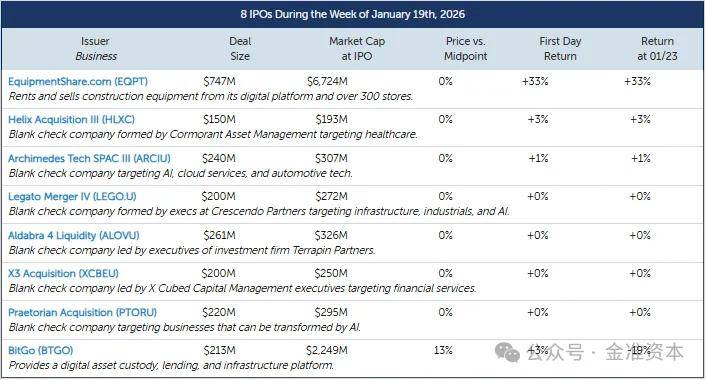
Group 1: IPO Market Overview - Last week, two companies and six SPACs completed IPO pricing, indicating a slow IPO market with only two traditional IPOs [1] - BitGo (BTGO) priced its IPO above the expected range, raising $213 million with a market cap of $2.24 billion, but saw a significant drop of 19% in its closing price [1] - EquipmentShare.com (EQPT) raised $747 million at a market cap of $6.72 billion, with a first-day return of 33% [1] Group 2: SPAC Activity - The remaining IPOs were all SPACs, with Helix Acquisition III (HLXC) and Archimedes Tech SPAC Partners III (ARCIU) expanding their issuance sizes [2] - Other newly listed SPACs included Legato Merger IV (LEGO.U), Aldabra 4 Liquidity (ALOVU), Praetorian Acquisition (PTORU), and X3 Acquisition (XCBEU) [2] Group 3: Upcoming IPOs - Four companies are set to go public in the upcoming week, including York Space Systems (YSS), which plans to raise $512 million with a market cap of $4 billion [5] - PicS (PICS) aims to raise $400 million with a market cap of $2.3 billion, providing digital financial services in Brazil [6] - Ethos Technologies (LIFE) plans to raise $200 million with a market cap of $1.31 billion, focusing on life insurance services [7] - Public Policy Holding Company (PPHC) intends to raise $58 million with a market cap of $418 million, offering government relations and consulting services [7]

IPO动态丨本周美股预告:Ethos Technologies等4家公司即将上市
Sou Hu Cai Jing· 2026-01-26 06:03
Summary of Key Points Core Viewpoint - The article discusses recent IPO activities, highlighting eight new stocks that went public, including six SPACs, and outlines upcoming IPO plans for four companies in early 2026. Group 1: Recent IPOs - Eight new stocks were listed last week, with six being SPACs [1] - BitGo (BTGO) raised $223 million by issuing 11.82 million shares at $18 per share [1] - EquipmentShare (EQPT) raised $747 million by issuing 30.5 million shares at $24.5 per share [1] - Other SPACs raised amounts ranging from $150 million to $261 million [1] - Ten companies submitted IPO applications, including two from China [1] Group 2: Upcoming IPOs - Four companies plan to go public in January 2026 [1] - Public Policy Holding Company, Inc. plans to list on NASDAQ under the ticker PPHC, aiming to raise $55.82 million by issuing 4.15 million shares at $13.45 each [2][3] - Picpay Holdings Netherlands B.V. plans to list on NASDAQ under the ticker PICS, with a target of raising approximately $434 million by issuing 22.86 million shares at $16 to $19 each [4][6] - Yellowstone Midco Holdings II/York Space Systems Inc. plans to list on NYSE under the ticker YSS, aiming to raise about $544 million by issuing 16 million shares at $30 to $34 each [7][9] - Ethos Technologies Inc. plans to list on NASDAQ under the ticker LIFE, targeting approximately $211 million by issuing 10.53 million shares at $18 to $20 each [13]

太阳翼专家交流
2026-01-26 02:49
Summary of Key Points from the Conference Call Industry Overview - The commercial space market is currently experiencing rapid growth, supported by favorable policies, technological advancements, and significant market opportunities. The market is projected to reach trillions, with specific projects like satellite internet and lunar base construction having clear timelines for development [3][4]. Solar Wing Technology - Solar wings are critical for satellite energy supply, evolving from polycrystalline silicon to triple-junction gallium arsenide (GaAs), with conversion efficiencies increasing from approximately 20%-22% for polycrystalline silicon to 30%-33% for GaAs. New perovskite materials have emerged with efficiencies around 25%, but they require further validation in space environments [2][4]. - Flexible solar wings are becoming a trend due to their lightweight and foldable nature, which aids in satellite weight reduction. However, they currently have lower shock resistance and higher costs compared to rigid solar wings [2][5]. Material Comparisons - Perovskite materials weigh about 100 grams per square meter, significantly lighter than GaAs, which weighs around 600-700 grams per square meter. This weight advantage makes perovskite suitable for flexible solar wings, although its application is still limited and requires more testing [6][20]. - Rigid solar wings offer better shock resistance and lower costs but are bulkier, making them less suitable for multi-satellite launches. Flexible solar wings, while lighter and more adaptable, face challenges in durability and cost [7][21]. Satellite Power Requirements - Different satellite types have varying power requirements, influencing the size and efficiency of solar wings needed. For instance, remote sensing satellites have lower power needs, while communication satellites, like the first-generation Hope satellite, require around 7 kW and approximately 16-17 square meters of solar wing area. High-performance satellites demand even larger and more efficient solar wings [8][18]. Polyimide (PI) Material Usage - Polyimide films are widely used in flexible solar wings due to their lightweight, durability, and insulation properties. They play a crucial role in enhancing the overall performance of flexible solar wings [9][11]. Cost and Market Adoption - The current cost of flexible solar wings is approximately 400,000 to 500,000 yuan per square meter, which limits widespread adoption. However, ongoing advancements and cost-reduction efforts may lead to broader acceptance in the future [21][16]. Future Prospects - The flexible solar wing technology is still maturing but shows potential for cost reduction and efficiency improvements through optimized production processes and design innovations. The demand for flexible solar wings is expected to increase, especially for high-power satellites [23][17]. Conclusion - The transition from rigid to flexible solar wings is anticipated as the industry evolves, with perovskite materials potentially playing a significant role in the future, contingent on further validation and testing [20][22].