
文化

Search documents
金观平:文商旅体展融合不能简单“拼盘”
Jing Ji Ri Bao· 2026-02-14 02:16
Core Insights - The emphasis on developing modern service industries and leveraging cultural resources is crucial for expanding service consumption and creating new growth opportunities in China [1] Group 1: Industry Trends - There is a significant shift in consumer spending in China, moving from a focus on goods to a balanced emphasis on both goods and services, with cultural tourism, sports, and exhibitions becoming key areas for unleashing domestic demand [1] - The cultural service industry is projected to achieve a revenue of 8.58 trillion yuan by 2025, reflecting a year-on-year growth of 12.0% [1] Group 2: Integration Strategies - Effective integration of culture, commerce, tourism, sports, and exhibitions is essential, requiring deeper collaboration rather than mere co-location of services [2] - Innovative immersive experiences should be developed, such as linking museums and sports venues with commercial spaces to create thematic product lines that enhance consumer engagement [2] Group 3: Systematic Development - The integration of cultural, commercial, tourism, sports, and exhibition sectors is a complex system that requires coordinated efforts across spatial, temporal, and policy dimensions [3] - Utilizing existing resources creatively, such as transforming old factories into cultural parks and extending operational hours for venues, can enhance consumer experiences and extend consumption periods [3] - Policies should support integration projects through local government financing and encourage financial institutions to develop credit products tailored for cultural enterprises [3]
经济日报金观平:文商旅体展融合不能简单“拼盘”
Jing Ji Ri Bao· 2026-02-14 00:15
Core Insights - The emphasis on developing modern service industries and leveraging cultural resources is crucial for expanding service consumption and creating new growth opportunities in China [1] Group 1: Industry Trends - There is a significant shift in China's consumer spending from goods to a balanced focus on both goods and services, with cultural tourism, sports, and exhibitions becoming key areas for unleashing domestic demand [1] - The cultural service industry is projected to achieve a revenue of 8.58 trillion yuan by 2025, reflecting a year-on-year growth of 12.0% [1] Group 2: Integration Strategies - Integration is not merely about combining different sectors but involves mutual empowerment among industries, as seen in events like the Shanghai F1 and Beijing International Film Festival, which enhance urban comprehensive consumption [2] - To sustain this momentum, it is essential to deepen the integration from mere formality to substantive content, creating immersive experiences that connect museums, sports venues, and commercial complexes [2] Group 3: Systematic Development - The integration of culture, commerce, tourism, sports, and exhibitions requires a systematic approach, necessitating collaboration across spatial, temporal, and policy dimensions [3] - Utilizing existing resources creatively, such as transforming old factories into cultural parks and extending operational hours for venues, can enhance consumer engagement [3] - Policy support is vital, including incorporating integration projects into local government financing and encouraging financial institutions to develop suitable credit products for cultural enterprises [3]
一封来自大湾区的春节请柬
Guang Zhou Ri Bao· 2026-02-13 06:47
从广州出发到香港最快不到50分钟,广深港高铁平均约2.8分钟就有一趟列车开行,交通"硬联通",让 大湾区"一小时生活圈"加快从愿景走向现实。广府、客家、潮汕民系在年味中交融共生,英歌舞、舞 龙、飘色等巡游活动接续上演,文化"软联通",让大湾区如一盅文火慢炖的老火靓汤,醇厚中见包容。 如今,来广东过大年,可以透过一场灯会感受多元文化交响,也可以在这里感知"此心安处是吾乡"的湾 区归属感。 珠江潮涌,华灯如昼。2026年粤港澳大湾区灯会2月10日璀璨开幕:近千场特色演艺活动接续上演、骏 马腾云与十五运会吉祥物共同登场、"白+黑"全时游玩模式上线。这还只是岭南新春的序章——烟花璀 璨映珠江、新春花市人潮涌动、广府庙会非遗荟萃、商圈巡游笑语盈盈、醒狮英歌腾跃生风……大湾区 正以全域联动的年味盛宴,向世界发出一封春节请柬:请到广东过大年! 来广东,过个"可触可感"的传承年。 在这里,不止能观灯,更能亲手扎一盏广彩宫灯,学一段英歌舞步,将草药香囊、广绣书签带回家。昔 日广彩远销重洋靠品质,今朝岭南年俗打动世界凭体验:在陈家祠广场非遗体验区感受西关文化,永庆 坊数字粤剧戏服令人惊艳,非遗推介让"广货行天下"从商品升华为文化 ...
兰州市有奖发票活动启动 发票抽奖最高赢800元
Xin Lang Cai Jing· 2026-02-11 01:13
Core Viewpoint - Lanzhou City is launching a consumer promotion activity through a lottery system based on electronic invoices, aimed at stimulating local consumption during the upcoming Spring Festival and beyond [1]. Group 1: Promotion Details - The lottery activity will run from now until July 31 and covers eight major consumer sectors including retail, dining, accommodation, tourism, culture, sports, education, and transportation [1]. - Consumers can participate in the lottery by spending a minimum of 100 yuan and obtaining a valid electronic invoice, with a maximum prize of 800 yuan [1]. - The promotion features three main lottery segments: daily instant prizes for invoices over 100 yuan, weekly prizes for invoices over 1,000 yuan, and dynamic bonuses during major holidays [1]. Group 2: Participation Process - The activity is facilitated through a local service platform called "Xiao Lan You Li," where consumers can easily participate by verifying their identity, uploading invoices, and receiving lottery chances automatically [2]. - Each invoice of 100 yuan or more grants one lottery chance, with a maximum of three entries per user per day; invoices of 1,000 yuan or more can choose to participate in either daily or weekly activities [2]. - Winnings will be transferred to the winner's bank account within 1 to 7 days, provided there are no returns or exchanges [2].
李大伟:积极扩大自主开放的内涵和方向
Jing Ji Ri Bao· 2026-02-11 00:55
Core Viewpoint - The concept of "autonomous opening" is emphasized as a key task in China's strategy for high-level opening to the outside world, transitioning from "following" to "leading" in global cooperation [1][2]. Group 1: Significance of Autonomous Opening - Autonomous opening is essential for promoting high-quality economic development, addressing domestic demand shortfalls, and enhancing economic efficiency and resilience [3]. - It serves as a strategic choice to navigate changes in the global landscape, countering trade protectionism and fostering diversified international markets [3]. Group 2: Characteristics of Autonomous Opening - It involves innovating foreign cooperation models based on national conditions rather than merely imitating other economies [2]. - The approach requires a balanced handling of high-level opening and security, aiming for simultaneous improvements in openness and risk management capabilities [2]. Group 3: Implementation Strategies - There is a focus on aligning with international high-standard economic and trade rules while creating new rules in areas like trade facilitation and fair competition [4]. - The strategy includes expanding unilateral opening measures in service sectors and enhancing market access [4][6]. Group 4: Sector-Specific Focus - Emphasis is placed on attracting quality factors in the service industry, such as telecommunications, culture, healthcare, and education, as key areas for autonomous opening [5][6]. - Development of new trade and investment cooperation models is prioritized, including digital and green trade, to stimulate consumption and investment [6]. Group 5: Belt and Road Initiative - High-quality co-construction of the Belt and Road Initiative is highlighted, with a focus on expanding cooperation in green development, artificial intelligence, and digital economy [7].
四川开江2026成渝新春文旅推介在成都召开
Zhong Guo Jing Ji Wang· 2026-02-10 11:19
新春佳节期间,开江还备下三重专属礼遇,为游客的旅途增添惊喜与实惠。趣玩之礼推出珍珠盲盒开 蚌、"元九登高"趣味游园等互动体验,解锁新年新玩法;观赏之礼集结"耍火龙"非遗巡演、水乡花火烟 花秀、美食马戏嘉年华、特色商品展会等多元活动,沉浸式感受川东民俗年味;惠购之礼更是诚意满 满,即日起至三月底,开江全城发放百万消费券,涵盖消费发票抽5000元锦鲤大奖、珍珠消费专用券免 费申领、"开鑫码"8-9折满减等福利,让游客畅游畅购、实惠无忧。 据了解,开江兼具油橄榄之乡、虾蟹之乡、珍珠之乡、田园原乡的多重美誉,此次蓉城推介,是开江深 度融入成渝地区双城经济圈,推动文旅融合发展的重要举措。活动现场,开江向60万成渝市民发出诚挚 邀请,趁新春佳节,赴开江之约,在湖光山色、诗意田园与人间烟火中,共度美好新春时光。(谯朝 元) 2月8日,四川省达州市开江县2026年成渝新春文旅推介活动于成都温情启幕,以"'珍'好时光 从'蓉'赴 开"为主题,向成渝各界发出诚挚邀约,邀八方宾客共赴川东田城,邂逅山水之美、体验田园之乐、尽 享新春之趣。 开江坐落于四川省东部、大巴山南麓,坐拥"三山微水七分田"的独特地貌,素有"中国田城"的美誉。这 ...
2025年郑州市GDP破1.5万亿!
Zheng Zhou Ri Bao· 2026-02-03 06:57
Core Viewpoint - In 2025, Zhengzhou's economy is projected to exceed 1.5 trillion yuan, demonstrating a stable and progressive development trend with a focus on high-quality growth [1] Economic Performance - The GDP of Zhengzhou in 2025 is estimated at 15,244.6 billion yuan, reflecting a year-on-year growth of 5.4% [1] - The primary industry added value is 189.9 billion yuan, growing by 3.7%; the secondary industry added value is 5,576.8 billion yuan, also growing by 5.4%; the tertiary industry added value is 9,477.8 billion yuan, with a growth rate of 5.4% [1] Production Supply - Agricultural production remains stable, with a total output value of agriculture, forestry, animal husbandry, and fishery increasing by 4% year-on-year [2] - The total grain output is 1.511 million tons, maintaining above 1.5 million tons for two consecutive years [2] - Industrial production shows robust growth, with the added value of large-scale industries increasing by 9% year-on-year, with over 70% of industries experiencing growth [2] Service Sector Development - The revenue of large-scale service industries increased by 10.1% year-on-year, with eight out of ten major sectors achieving positive growth [3] - Financial institutions' deposits reached 35,505.7 billion yuan, growing by 7.4%, while loans amounted to 41,660.5 billion yuan, increasing by 3.6% [3] Demand Release - Investment in major projects increased by 9.9% year-on-year, driving overall investment growth by 5.4 percentage points [4] - Industrial investment grew by 17.9% year-on-year, surpassing the provincial average by 4.6 percentage points [4] Consumer Market Growth - The total retail sales of consumer goods reached 6,629.4 billion yuan, with a year-on-year growth of 5% [5] - Retail sales of essential goods such as food and daily necessities saw significant increases, with food retail up by 21% [5] Foreign Trade - The total import and export volume reached 6,501.8 billion yuan, growing by 16.8% year-on-year, with exports increasing by 20.3% [6] Emerging Dynamics - The added value of high-tech manufacturing and strategic emerging industries grew by 14.9% and 11.8% respectively [7] - New consumption models such as live streaming and social e-commerce saw a year-on-year growth of 11.9% in retail sales through public networks [7] Quality and Efficiency Improvement - Public budget revenue reached 1,181.3 billion yuan, with social welfare and health spending increasing by 13.6% and 8% respectively [8] - Consumer price index (CPI) remained stable, with some categories experiencing price increases while others saw declines [8] Overall Economic Outlook - The economic outlook for Zhengzhou remains positive, with strong resilience and potential, although external uncertainties persist [9] - Future efforts will focus on enhancing technological innovation, industrial renewal, and urban development to support sustainable economic growth [9]
国办印发《加快培育服务消费新增长点工作方案》 | 激活文旅消费有了新方向
Sou Hu Cai Jing· 2026-02-02 05:51
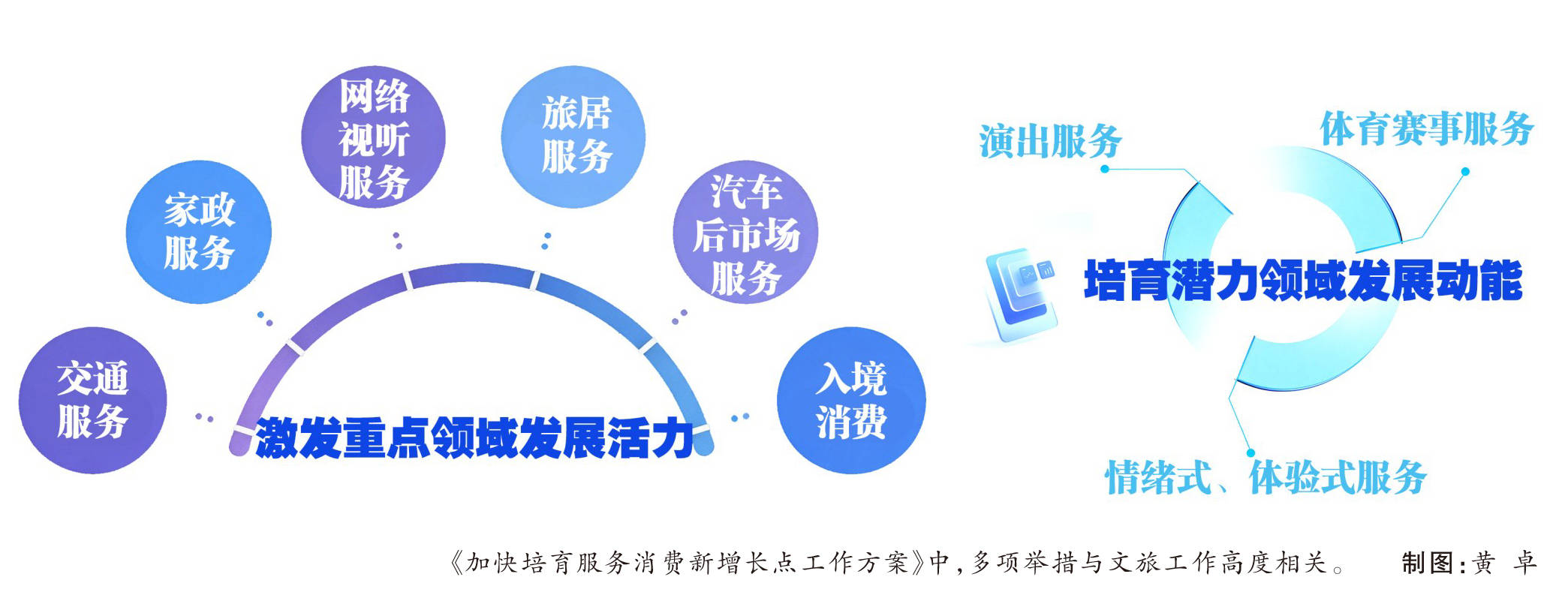
日前,国务院办公厅印发《加快培育服务消费新增长点工作方案》(简称《方案》),围绕激发重点领域发展活力、培育潜力领域发展动能、加强支持保障 3个方向出台12条举措,聚焦文旅消费领域作出具体部署,为文旅消费提质升级划定清晰路径,为文旅产业高质量发展注入强劲动力。 政策精准发力 锚定文旅消费新方向 作为扩大内需的重要抓手,服务消费正成为拉动内需的新引擎。 过去一年来,随着一系列大力提振消费政策举措的落地见效,国内消费市场活力不断提升,服务消费潜能进一步激发,消费市场持续扩容提质升级。在这一 背景下,《方案》的出台恰逢其时。 在业界看来,《方案》明确聚焦文旅消费领域提出具体举措要求,不仅呼应了当前消费升级的整体趋势,也为文旅产业跨界融合、提质增效指明了方向。 南开大学旅游与服务学院副教授于海波表示,文旅消费具有频次高、乘数效应强、绿色低碳等特点,是推动经济高质量发展的关键抓手。"《方案》的出 台,通过顶层设计引导资源有效配置,旨在形成'政府引导、市场主导'的健康发展格局。"于海波说,《方案》对"情绪式、体验式服务"提出包容审慎监管, 这也向市场释放了鼓励新业态、拥抱新趋势的明确信号。 "交通服务、旅居服务、体育赛事、 ...

春节泉州文旅打造盛宴
Xin Lang Cai Jing· 2026-02-01 23:26
结合马年生肖,当地已推出"六合同风马"及各区县特色"马"IP矩阵,全市设置20多处马年主题打卡装 置,并配套有奖互动,吸引游客"追着马儿游泉州"。文旅促消费活动将持续至3月,涵盖特色活动及惠 民举措共500项,累计让利超5亿元。 面向各地游客,该市推出系列暖心举措。比如,假日期间中心市区131条公交线路及古城"小白"全部免 费且运营时间延长,上线"行李无忧"寄存寄送服务,全市提供超2.4万个免费停车位并开通免费接驳专 线。当地将在"一部手机游泉州"小程序上线非遗踩街、烟花秀等5张主题地图,为游客提供一站式智慧 服务。 本报讯 (记者 何金 黄琼芬) 记者日前从"2026年春节元宵泉州文旅主题新闻发布会"上获悉,为迎接 2026年农历新年,当地以"泉州非遗年·生活加点甜"为主题,推出超过1000场特色文旅活动及总额超5亿 元的消费让利,打造一场集非遗、烟火、文创、美食、国潮于一体的春节文旅盛宴。 2026年春节,该市计划把丰富的非遗资源转化为可体验的新场景:全市40条地标街区推出超280场非遗 踩街,每日主题不同,涵盖刣狮、南音、木偶等百余个项目;115处非遗手作坊可提供花灯、陶瓷等80 余项非遗DIY体验;1 ...
国务院办公厅出台方案激活服务消费新动能
Xin Lang Cai Jing· 2026-01-30 01:00
为强化政策保障,《工作方案》提出加强财政金融支持。支持符合条件的文化、旅游、教育、体育、家 政等服务消费领域企业发行债券,拓宽融资渠道;同时,支持符合条件的消费基础设施项目发行基础设 施领域不动产投资信托基金(REITs),盘活存量资产,为服务消费发展提供有力资金支持。 1月29日,国务院办公厅印发《加快培育服务消费新增长点工作方案》(以下简称《工作方案》)的通 知,旨在通过优化和扩大服务供给,聚焦重点领域、潜力领域,促进服务消费提质惠民,为经济高质量 发展注入新动能。 《工作方案》明确优化大型群众性活动安全管理,合理核定赛场安全容量,为体育赛事服务提供安全保 障。同时,增加优质赛事供给,鼓励引进国外优秀赛事,支持地方举办群众性赛事,打造知名精品赛 事、职业联赛等多元化品牌,并推动高质量户外运动目的地建设。《工作方案》还提出加快重点赛事市 场化、商业化运作,促进赛事消费发展。针对冰雪服务消费,《工作方案》支持相关载体建设,鼓励地 方创新打造多元化冰雪消费场景,满足消费者多样化需求。 ...