
电子商务

Search documents
JD LOGISTICS(02618) - 2025 Q4 - Earnings Call Transcript
2026-03-05 13:00
Financial Data and Key Metrics Changes - Total net revenues for Q4 increased by 2% year-on-year to RMB 352 billion, while full-year revenues grew by 13% to RMB 1.3 trillion [20] - Non-GAAP net profit for Q4 was RMB 1.1 billion, reflecting resilience despite short-term headwinds in electronics and home appliances [19] - JD Retail's operating margin improved by 52 basis points to 4.6% for the full year, with a consistent growth trajectory from 2.7% in 2019 [24] Business Line Data and Key Metrics Changes - JD Retail revenues decreased by 2% year-on-year in Q4 but increased by 11% for the full year, driven by growth in general merchandise and advertising revenues [22] - General merchandise revenue grew by 12.1% year-on-year in Q4 and 15.3% for the full year, with strong performance in supermarkets and fashion categories [10][21] - Advertising revenues increased by 15% in Q4 and 19% for the full year, supported by enhanced traffic allocation and AI-driven algorithms [11][21] Market Data and Key Metrics Changes - Monthly active customers grew by 30% year-on-year in Q4, surpassing 700 million annual active customers [6] - User shopping frequency surged by over 40% year-on-year for the full year, indicating strong engagement across all user groups [8] - JD Food Delivery maintained steady order momentum while reducing total investment by nearly 20% quarter-on-quarter [12] Company Strategy and Development Direction - The company is focused on leveraging supply chain capabilities to enhance user experience and operational efficiency, positioning itself for sustainable growth [6][14] - Strategic investments in R&D and technology are aimed at maintaining competitive advantages and driving future growth [14][41] - The company is committed to expanding its presence in new markets and business initiatives, including JD Food Delivery and Joybuy in Europe [13][43] Management's Comments on Operating Environment and Future Outlook - Management expressed confidence in achieving healthy growth in 2026, driven by robust user engagement and improved operational efficiency [34][40] - The company anticipates a recovery in the electronics and home appliances category in the second half of 2026, despite facing a high base effect in the first half [32] - Regulatory oversight is viewed as a catalyst for healthy industry growth, with the company committed to compliant operations [58] Other Important Information - The board approved a total annual cash dividend of approximately US $1.4 billion for 2025, representing $0.005 per ordinary share [19] - The company repurchased about 6.3% of its outstanding shares for a total of $3 billion in 2025, reflecting confidence in long-term development [20] Q&A Session Questions and Answers Question: What is the growth outlook for JD Retail in 2026? - Management expects healthy growth in JD Retail, particularly in general merchandise, with a robust recovery anticipated in the second half of 2026 [32] Question: How will JD Food Delivery improve unit economics compared to competitors? - JD Food Delivery aims to enhance operational efficiency and revenue generation while leveraging supply chain advantages and maintaining a focus on high-quality service [35]

京东县域生活观察1:县城生活新貌 “乐活”/“自洽”、情感浓度高、看重自我成长
Sou Hu Wang· 2026-03-04 10:28
Core Insights - The trend of urban residents moving to small counties is gaining popularity, with a significant increase in travel and hotel bookings in these areas during holidays, indicating a shift in lifestyle preferences [2][3] Group 1: Travel and Lifestyle Changes - During the 2025 Spring Festival, 35.8% of urban residents chose to travel to small counties for the holiday, while 69% of county-born individuals returned to their hometowns [2][3] - Over 76.1% of returning residents stayed for more than five days, experiencing a "deep return" to their roots, with many expressing a desire to relocate back permanently [3][6] - The appeal of county life is attributed to fresh local markets, a slower pace of life, and a relaxed atmosphere, with 53.4% enjoying local markets and 51.8% appreciating the leisurely lifestyle [3][6] Group 2: Economic and Social Dynamics - County residents exhibit a strong sense of self-identity, with 77.9% feeling "happy" or "self-consistent," and 35% rating their life satisfaction at 9-10 out of 10, surpassing urban counterparts [4][10] - Economic stability is evident, with 41.3% of residents reporting a surplus in their finances, and 36.3% having no debts, indicating a lower financial burden compared to urban areas [4][14] - The social fabric in counties is characterized by high emotional connectivity, with over 51.7% having stable social circles and 59.3% dining with family weekly, contributing to a higher sense of happiness [16][18] Group 3: Consumer Behavior and Self-Improvement - There is a notable shift in consumer behavior, with 49.5% of residents observing an increase in available products and services in their hometowns, reflecting a growing market [8][13] - Nearly 90% of county residents prioritize self-improvement, with 43% investing in personal development over the past year, focusing on practical skills and health [19][20] - Families place significant importance on child-rearing expenses, with 88.5% of households considering it a major financial commitment, emphasizing the value placed on education and development [22][23]


对话日本趣天:打开日本Z世代消费者心域的秘钥
FBeauty未来迹· 2026-03-02 09:02
Core Viewpoint - The article emphasizes that entering the Japanese beauty market is a strategic move for Chinese beauty brands seeking growth, with "Japan Qutian" serving as a vital platform for low-risk and efficient market entry [4][5][15]. Group 1: Market Context - The domestic beauty market in China is evolving, leading brands to seek growth opportunities abroad, particularly in Japan, which offers a mature consumer market and cultural similarities [3]. - Japan's beauty market is characterized by discerning consumers with high-quality expectations, presenting challenges for foreign brands [3][6]. Group 2: Japan Qutian's Role - Japan Qutian, an established e-commerce platform, has a significant advantage in the beauty category, with over 27 million active users and a monthly visit rate of 620 million, indicating strong user engagement [8][10]. - The platform captures 70% of beauty category transactions in Japan, positioning itself as a leader in the beauty e-commerce space [8][10]. - The platform's user base is predominantly young, with over 69% of buyers aged 10 to 39, primarily female, who are trendsetters and actively engage in social sharing [10][12]. Group 3: Consumer Behavior and Trends - Japanese consumers, especially the younger generation, are increasingly influenced by social media and content-driven purchasing decisions, moving from brand-centric to content-centric consumption [17][19]. - Nearly 80% of Japanese youth aged 15-24 have purchased overseas products, driven by a desire for design and emotional resonance rather than just price [19]. Group 4: Strategic Opportunities for Chinese Brands - Japan Qutian serves as a bridge for Chinese beauty brands, aligning with the structural changes in the Japanese market and the evolving capabilities of Chinese brands [17][22]. - The platform recognizes the quality and innovation of Chinese products, shifting perceptions from low-cost to high-value offerings [22]. - There are opportunities in niche markets, particularly for brands that can effectively communicate unique ingredient stories, as certain concepts are still emerging in Japan [23]. Group 5: Challenges and Support - Despite the opportunities, brands face cultural and consumer behavior barriers, such as the need for precise product descriptions and packaging standards [25]. - Japan Qutian acts as a local accelerator, providing essential support in compliance, marketing, and operational guidance to reduce initial entry costs and risks [25][28]. Group 6: Practical Implementation - The platform offers a clear framework for new brands, including a low entry fee and a commission-based model, allowing brands to test the market without heavy upfront costs [26][28]. - Successful brands leverage content marketing and platform tools to create a positive feedback loop of purchase and sharing, enhancing brand visibility and trust [29][31]. Group 7: Brand Characteristics for Success - Brands that excel in design and storytelling, particularly in fashion and color cosmetics, are likely to thrive on the platform [32]. - Brands with strong ingredient narratives and innovative functions can penetrate niche markets effectively [32]. - Agility in supply chain and rapid product iteration is crucial for maintaining consumer interest in a fast-paced market [32].

2026春节消费观察:春节情感浓度高
京东· 2026-03-01 07:31
Group 1: Consumer Behavior and Trends - 78% of consumers searched for "gifts for elders" during the Spring Festival, making it the highest searched term for holiday gifts[1] - 68.8% of consumers start their New Year shopping plans more than half a month in advance, reflecting a strong sense of ritual[19] - 82.6% of consumers create shopping plans before purchasing New Year goods, indicating a high level of planning[19] Group 2: Gift Preferences for Elders - 77.2% of consumers plan to buy nutritional supplements for elders, with a focus on easy-to-use formats like ready-to-eat products (38.2%) and small packaging (32.8%)[7] - Health and safety are the top considerations for gifts to elders, with 47.1% prioritizing these factors[5] - 83.6% of consumers choose food gift boxes for elders, with "clean ingredient lists" being the most important factor at 54.2%[14] Group 3: Product Trends and Innovations - Smart home devices are increasingly popular, with 73.5% of consumers looking for tech products that assist with health monitoring and household chores[10] - In rural areas, sales of smart appliances like robotic vacuum cleaners surged by 121% during the New Year shopping season[17] - The search volume for "horse year" themed products increased significantly, with 84.5% of consumers expressing interest in these items[38]
国家统计局:2025年GDP首破140万亿!人均可支配收入43377元,同比增长5.0%,A股累计筹资12583亿元
Xin Lang Cai Jing· 2026-02-28 04:14
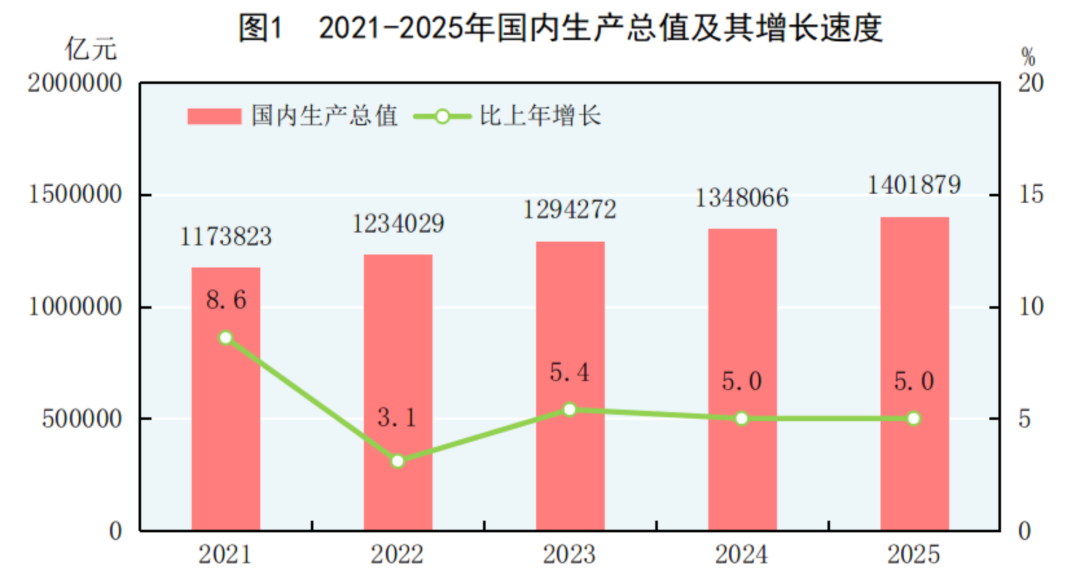
Economic Overview - In 2025, China's GDP reached 1401879 billion yuan, growing by 5.0% compared to the previous year [2][25] - The primary industry added value was 93347 billion yuan (3.9% growth), the secondary industry was 499653 billion yuan (4.5% growth), and the tertiary industry was 808879 billion yuan (5.4% growth) [2][25] - The contribution of final consumption expenditure to GDP growth was 2.6 percentage points, while capital formation contributed 0.8 percentage points and net exports contributed 1.6 percentage points [2][25] Population and Employment - The national population at the end of 2025 was 140489 million, a decrease of 339 million from the previous year, with urban residents accounting for 95380 million [5][28] - The total employment was 72504 million, with urban employment at 47535 million (65.6% of total employment) [5][29] - The urban surveyed unemployment rate averaged 5.2% for the year, with a year-end rate of 5.1% [5][29] Consumer Prices and Spending - The overall consumer price index remained stable compared to the previous year, while industrial producer prices fell by 2.6% [7][30] - The average per capita consumption expenditure was 29476 yuan, an increase of 4.4% year-on-year [15][38] - The Engel coefficient for residents was 29.3%, with urban residents at 28.3% and rural residents at 31.8% [15][38] Investment and Financing - The total fundraising through the Shanghai and Shenzhen stock exchanges reached 12583 billion yuan, an increase of 8332 billion yuan from the previous year [19][42] - A total of 90 new A-share listings raised 1242 billion yuan, with 19 on the Sci-Tech Innovation Board raising 381 billion yuan [19][42] - The bond issuance across various entities through the exchanges totaled 16.3 trillion yuan [21][44] Industrial Growth - The value added of the equipment manufacturing industry grew by 9.2%, accounting for 36.8% of the total industrial output [9][32] - High-tech manufacturing saw a 9.4% increase in value added, contributing 17.1% to the industrial total [9][32] - E-commerce transactions reached 467339 billion yuan, growing by 2.5% year-on-year [9][32] Green Development - Carbon dioxide emissions per ten thousand yuan of GDP decreased by 5.0% [13][36] - The production of new energy vehicles reached 1652.4 million units, a 25.1% increase from the previous year [13][36] - Clean energy generation increased by 14.4%, totaling 42481 billion kilowatt-hours [13][36]
看不清方向时,如何决策?
3 6 Ke· 2026-02-28 04:03
Core Insights - The article emphasizes that market analysis often reflects perceived phenomena rather than the true nature of the market, suggesting that businesses should focus on experimentation rather than solely relying on predictive models [3][22][46] Group 1: Historical Context of Financial Crises - The article discusses the Great Depression of the 1920s, highlighting the initial optimism in the U.S. economy and the subsequent stock market crash that led to widespread financial ruin [4][5] - It notes that classical economics initially downplayed the crisis, believing in the market's self-correcting nature, which ultimately failed as unemployment soared to 20%-25% [6][7] Group 2: Economic Theories and Their Limitations - The article outlines the evolution of economic thought, from classical economics to Keynesianism, and the resurgence of Austrian economics post-2000 financial crisis, indicating that no single theory can fully explain economic phenomena [9][10][11] - It argues that all economic theories are merely models and interpretations of reality, not absolute truths [11][44] Group 3: Insights from Kant's Philosophy - Kant's philosophy suggests that humans perceive the world through a subjective lens, which limits their understanding of the true nature of reality [12][16] - The article posits that all market analyses are interpretations of market phenomena rather than the market itself, urging businesses to focus on real-world interactions [22][44] Group 4: Case Study of Pinduoduo - Pinduoduo's success is attributed to its innovative approach of integrating social interaction and gamification into shopping, rather than optimizing traditional search functions [24][25][26] - The company exemplifies how businesses can create new market opportunities through experimental interactions rather than relying on existing market analyses [24][25] Group 5: Organizational Culture and Strategy - The article advocates for a shift from deterministic planning to exploratory experimentation within organizations, emphasizing the need for flexibility and adaptability [27][30] - It suggests that leaders should act as chief experimenters, fostering a culture that encourages trial and error while minimizing the costs of failure [32][39] Group 6: Embracing Failure as a Learning Tool - The article highlights the importance of creating a culture that rewards learning from failures rather than punishing them, which can lead to innovation and growth [39][40] - It calls for the establishment of a knowledge base that documents both successful and unsuccessful experiments to enhance organizational memory and learning [41][42]

京东超级供应链硬实力支撑,让七鲜自有品牌商品加速“出海”
Sou Hu Wang· 2026-02-28 02:44
Core Insights - The demand for traditional Chinese ingredients among overseas Chinese has surged as the Lantern Festival approaches, with JD's Joybuy successfully selling a variety of its private label products in the UK market [1][3][4] Group 1: Product Offerings - JD's Joybuy offers a wide range of private label products, including essential cooking ingredients, snacks, and health drinks, catering to the needs of overseas Chinese for traditional festival foods [3][4] - Popular items such as mung beans, red beans, and lotus seeds are in high demand for making traditional dishes like tangyuan, allowing overseas Chinese to enjoy a taste of home [3][7] - Unique products like yumaibai oil, dragon mouth vermicelli, and lychee sparkling wine have also gained popularity among local UK consumers due to their distinctive flavors and high quality [3][4] Group 2: Logistics and Operations - JD has accelerated its global logistics and supply chain layout, operating over 130 warehouses with a total management area of 1.3 million square meters and multiple international freight routes [4] - Joybuy has launched trial operations in several European countries, including the UK, Netherlands, Germany, France, Belgium, and Luxembourg, providing efficient delivery services such as same-day and next-day delivery [4][7] - The ability to deliver products quickly ensures freshness and enhances the shopping experience for consumers in the UK [4] Group 3: Market Expansion and Cultural Impact - Following the success in the UK, Joybuy plans to expand its offerings to more regions in Europe, including the Netherlands, Belgium, Luxembourg, France, and Germany, to meet the growing demand for Chinese traditional ingredients [7] - The introduction of JD's products not only satisfies the cravings of overseas Chinese but also serves as a cultural connection to their homeland [7][10] - The popularity of products like jasmine tea and innovative drinks among local consumers highlights the increasing interest in exploring Eastern culinary culture [10] Group 4: Future Outlook - JD aims to leverage its global supply chain and overseas logistics network to promote more high-quality Chinese products worldwide, enhancing the shopping experience for global consumers [10]

美团、淘宝、京东齐发声!响应外卖新规
Di Yi Cai Jing· 2026-02-28 01:39
Group 1 - The National Market Supervision Administration has issued new regulations to clarify food safety responsibilities for online food service providers and platforms [1] - Taobao and Meituan have responded positively to the new regulations, committing to enhance food safety measures and integrate them into their operations [1][2] - Meituan plans to promote transparency through initiatives like "Bright Kitchen" and aims to support over 400,000 merchants by 2025 with cash, traffic, and technical assistance [1] Group 2 - Meituan is inviting delivery riders to act as food safety supervisors and is exploring social governance by involving consumers and industry participants in oversight [2] - JD.com emphasizes its commitment to high-quality delivery standards and has implemented multiple verification mechanisms to ensure food safety [2] - The use of AI and big data is being adopted by platforms to enhance the verification of food service providers and to monitor their operational status [2][3] Group 3 - Food safety has become a significant societal concern, leading to increased management efforts by food delivery platforms and the establishment of industry self-regulatory agreements [3] - The new regulations are expected to improve consumer food safety guarantees and create a more competitive environment for legitimate businesses, while expediting the removal of illegal operations [3]

刘强东雷军同框C位!中德交流排面拉满,宇树王兴兴携机器人出圈
Sou Hu Cai Jing· 2026-02-27 15:35
Group 1 - Liu Qiangdong and Lei Jun were seen together at the Sino-German Economic Advisory Committee meeting, highlighting their prominent positions alongside other industry leaders [2][5] - The German delegation's visit included a tour of Yushutech, where they showcased robotic performances, indicating a push for collaboration in the intelligent robotics industry [5][4] - Lei Jun announced plans to open 150 offline stores in the UK within four years, which is expected to create numerous job opportunities [9][11] Group 2 - Liu Qiangdong's recent investment of 5 billion in the yacht industry reflects his strategy to expand into new business areas, contrasting with Lei Jun's focus on electric vehicles [14][16] - Both leaders are recognized for their down-to-earth personas and have a history of collaboration, such as Xiaomi's entry into the automotive market through JD.com [14][16] - The upcoming Mobile World Congress (MWC) will showcase advancements in AI, IoT, and other technologies, indicating a significant focus on innovation in the tech industry [18][19]



比特元宇宙(08645)发布中期业绩,股东应占亏损791.5万港元 同比增加6.36%
Zhi Tong Cai Jing· 2026-02-27 11:14
Core Viewpoint - Bit Metaverse (08645) reported a mid-term loss attributable to shareholders of HKD 7.915 million, an increase of 6.36% year-on-year, despite a revenue increase of 27.63% to HKD 81.54 million [1] Group 1: Financial Performance - The company achieved a revenue of HKD 81.54 million for the six months ending December 31, 2025, representing a year-on-year increase of 27.63% [1] - The loss attributable to equity holders for the period was HKD 7.915 million, which is a 6.36% increase compared to the previous year [1] - The loss per share was reported at HKD 0.0105 [1] Group 2: Revenue Drivers - The increase in revenue was primarily driven by the e-commerce business, which saw an increase of approximately HKD 11.347 million or 126.6%, reaching about HKD 20.307 million (previous year: approximately HKD 8.96 million) [1] - The online gaming IP licensing management services also contributed to revenue growth, with an increase of approximately HKD 4.513 million or 24.6%, totaling about HKD 22.888 million (previous year: approximately HKD 18.375 million) [1]