科研仪器

Search documents
海尔生物(688139.SH):当前公司已布局光谱类科研仪器产业
Ge Long Hui· 2025-11-24 10:16
Core Viewpoint - Haier Biomedical (688139.SH) has established a presence in the spectral scientific instrument industry and aims to enhance its overall competitiveness by selectively acquiring companies with high technological barriers and significant growth potential [1] Group 1 - The company is currently focused on the spectral scientific instrument sector [1] - Future strategies include careful selection of companies that possess high technological barriers [1] - The goal is to continue strengthening the company's overall competitiveness in the market [1]

预算1.46亿元!中国科学院上海微系统所近期大批仪器采购意向
仪器信息网· 2025-11-19 03:55
Core Viewpoint - The Chinese Academy of Sciences Shanghai Institute of Microsystem and Information Technology has announced procurement intentions for 23 types of instruments and equipment, with a total budget of 146 million yuan, expected to be procured between August and November 2025 [1][2]. Procurement Overview - The procurement includes various advanced equipment such as MEMS wafer alignment and lithography systems, high-quality oxide dielectric film preparation units, and plasma stripping machines [2][5]. - The total budget for the procurement is 146 million yuan, which is approximately 21 million USD [1][2]. Procurement Details - A detailed list of procurement items includes: - Ion beam adjustment unit: 18 million yuan - High-quality oxide dielectric film preparation unit: 2 million yuan - Organic sacrificial layer removal unit: 2.1 million yuan - High-density multi-layer metal material preparation unit: 5 million yuan - MEMS wafer alignment and lithography system: 4.5 million yuan - Wafer cleaning machine: 5 million yuan - Plasma stripping machine: 3 million yuan - Wafer laser debonding machine: 5 million yuan - And several other specialized equipment [5][7]. Institute Background - The Shanghai Institute of Microsystem and Information Technology is one of the earliest engineering research institutions in China, originally established in 1928. It has undergone several name changes and is now focused on fields such as electronic science and technology, information and communication engineering, and microsystem technology [2][3].


西部科学城重庆高新区:深入推进人才工作机制创新 助力重庆打造西部人才中心和创新高地
Ren Min Ri Bao· 2025-11-17 22:12
Core Insights - The article highlights the development of a talent-driven ecosystem in Chongqing High-tech Zone, emphasizing the importance of attracting and retaining high-level talent for scientific and technological innovation [1][2][3][4][5][6][7]. Talent Attraction and Integration - Chongqing High-tech Zone has successfully attracted over 200 postdoctoral researchers and established long-term collaborations between 49 enterprise postdoctoral workstations and renowned universities, facilitating over 200 collaborative research projects [2]. - The zone has implemented a policy framework that supports strategic scientific talent, allowing for shared rights and resources, which has led to the convergence of 33 external academic teams and 107 high-level talents during the 14th Five-Year Plan period [1]. Mechanism Innovation - The region has introduced a dual-employment system that allows talents to retain their original positions while forming new teams in Chongqing, fostering innovation and collaboration [3]. - The Goldfinch Laboratory focuses on next-generation diagnostics for major diseases, granting project leaders significant decision-making powers, which has resulted in the development of a proprietary fluorescence imaging system with sales exceeding 10 million yuan [3]. Service Empowerment - Chongqing High-tech Zone has established a comprehensive talent service system, including an innovation and entrepreneurship service port that assists technology companies in overcoming challenges [5][6]. - The zone has created a support system for innovation and entrepreneurship that integrates various resources, facilitating the transition from research to market [6]. Future Outlook - The article concludes with a commitment to advancing education, technology, and talent initiatives, positioning Chongqing as a key hub for talent and innovation in the western region of China [7].
填补空白!我国首台,交付使用
Huan Qiu Wang Zi Xun· 2025-11-16 14:03
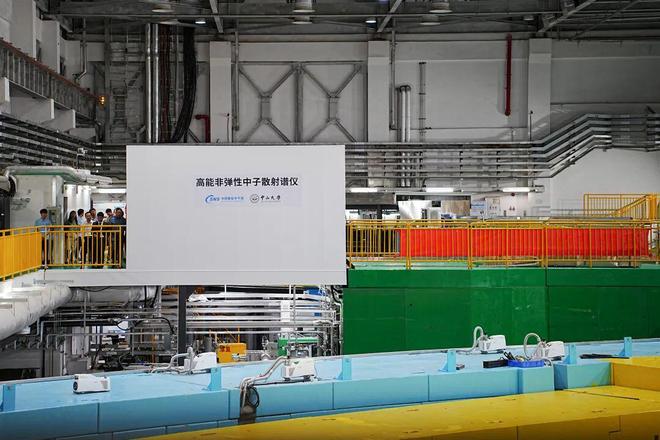
Core Points - The first high-energy direct geometry inelastic neutron scattering time-of-flight spectrometer in China has been accepted and put into use, marking a significant advancement in material dynamics research [1][3] - This spectrometer will provide experimental conditions for research in physics, chemistry, materials science, mechanics, and interdisciplinary studies [1] Group 1 - The unique feature of the spectrometer is its ability to utilize the non-charged and penetrating nature of neutrons to directly probe the microscopic movements within materials [3] - It fills the gap in inelastic neutron scattering above 100 meV in China, allowing for the measurement of both spatial distribution and energy changes of scattered neutrons [3] - The spectrometer can measure the dynamic behavior of microscopic structures in both momentum and energy space, enhancing the understanding of material properties [3] Group 2 - The spectrometer employs a combination of Fermi chopper and bandwidth chopper to enable rapid switching between multi-wavelength and single-wavelength modes [3]
这只年底睁开的“超级眼睛”, 为何是我国科技自立自强的利器
Guan Cha Zhe Wang· 2025-11-05 05:11
Core Insights - The High Energy Photon Source (HEPS) has successfully passed process acceptance and is set to begin trial operations by the end of the year, marking a significant advancement in China's synchrotron radiation capabilities [1][18] - HEPS is the first fourth-generation synchrotron radiation source in China and Asia, designed to provide unprecedented brightness and energy levels for advanced scientific research [6][14] Technical Features - HEPS generates X-rays with a wavelength between 0.01 to 100 angstroms, making it ideal for probing the microstructure of materials [3][4] - The energy of the electron beam in HEPS reaches 6 GeV, enabling the production of hard X-rays with energies up to 300 keV, crucial for analyzing internal defects in large samples [4][15] - The brightness of HEPS is 10 trillion times that of conventional X-ray machines and 1 trillion times that of the sun, significantly enhancing signal-to-noise ratios and detection precision [5][18] Technological Innovations - The design of HEPS incorporates a "three-stage rocket" structure with three independent accelerators, achieving a low electron emittance of approximately 35 pm·rad, which is among the best in the world [6][9] - HEPS employs innovative techniques to achieve ultra-low emittance, enhancing the quality of the electron beam and, consequently, the brightness of the X-ray output [9][10] Research and Development - A decade-long effort has led to the development of domestic X-ray detectors, overcoming reliance on foreign technology and significantly reducing costs [11][12] - The new detectors feature high dynamic range and fast imaging capabilities, with the ability to capture over 1000 images per second, surpassing international standards [12][13] Applications and Impact - HEPS will support groundbreaking research in various fields, including life sciences, materials science, and industrial innovation, providing nanometer-level spatial resolution and picosecond-level time resolution [14][15] - The facility is expected to save significant research costs, with estimates suggesting savings of hundreds of millions of RMB through the use of domestically developed detector systems [18][20] - HEPS will enhance China's capabilities in energy, environment, biomedical research, and new materials, fostering deep integration of technological and industrial innovation [18][20]

国产仪器进校园,上海交大破局“格新坊”
仪器信息网· 2025-11-03 09:07
Core Points - The event held on November 1 at Shanghai Jiao Tong University focused on the construction and management of a scientific instrument platform and the promotion of domestic instruments in educational institutions, aiming to enhance collaboration among government, industry, academia, and research [3][26] - The event was attended by nearly 260 participants, including experts from over 40 universities and research institutions, and representatives from more than 30 domestic instrument companies [3][26] Group 1: Event Overview - The event was guided by the Shanghai Municipal Science and Technology Commission and supported by the National Technology Resources Sharing Service Engineering Research Center [3] - Keynote speeches were delivered by notable figures, including Academician Ding Hong and Vice President Jiang Xinghao of Shanghai Jiao Tong University, emphasizing the importance of scientific instruments in research and innovation [7][9] Group 2: Objectives and Expectations - Zhang Lulu, a researcher from the Shanghai Municipal Science and Technology Commission, highlighted that scientific instruments are the "hardware foundation" for basic and applied research, aligning with Shanghai's goal of becoming a global technology innovation center [7] - Jiang Xinghao expressed hopes for closer communication, smoother channels for ideas to products, and a more robust mechanism for generating results from the platform [9] Group 3: Expert Contributions - Academician Ding Hong presented a report on the impact of high-end scientific instruments and large scientific devices on research, alongside contributions from experts from prestigious institutions like Tsinghua University and Peking University [21][22] - Discussions included topics such as open sharing of large instruments, the construction of shared service platforms for scientific instruments, and the innovation and promotion of domestic scientific instruments [22] Group 4: Practical Engagement - The event featured a visit to the Shanghai Jiao Tong University Analysis and Testing Center and the "Ge Xin Fang" facility, which aims to enhance the maintenance and low-cost upgrading of high-precision instruments [24][17] - A domestic instrument exhibition facilitated in-depth discussions between universities, research institutions, and manufacturers regarding research needs and technological advancements [26]

比芯片还“棘手”的行业!美日垄断90%中企花3800亿造不出山寨版
Sou Hu Cai Jing· 2025-10-25 08:08
Core Insights - The Chinese manufacturing industry faces significant challenges in high-end scientific instruments, which are crucial for technological innovation, with over 90% of the global market dominated by US and Japanese companies [7][9] - Despite investing 380 billion yuan in research and development, the domestic production rate for high-end scientific instruments remains below 20%, with some sectors like mass spectrometry having less than 5% localization [7][9][15] Group 1: Market Overview - The global market for scientific instruments is primarily controlled by companies such as Thermo Fisher, Agilent, and Shimadzu, with China being the second-largest market but struggling with high import dependency [7][9] - In 2023, China imported scientific instruments worth 16.98 billion USD while exporting only 4.27 billion USD, resulting in a trade deficit exceeding 10 billion USD [7][9] - The import rate for analytical instruments is 83.67%, with mass spectrometers and chromatographs having over 85% of their market supplied by imports [7][9] Group 2: Challenges in Localization - The high precision and complexity of scientific instruments create significant barriers to domestic production, with Chinese companies facing difficulties in replicating the technology due to a lack of accumulated expertise [9][15] - The market for semiconductor testing equipment is projected to reach 12 billion USD in 2024, with domestic production increasing from 5% to 12%, but overall localization in scientific instruments remains low [9][15] Group 3: Government Initiatives - The Chinese government has outlined plans to enhance high-end instrument research and development, with significant funding allocated to support domestic innovation [11][13] - The 14th Five-Year Plan emphasizes the importance of localizing high-end scientific instruments, with various initiatives launched to support research and development [11][13] Group 4: Future Outlook - The scientific instrument market is expected to grow, with the mass spectrometry market projected to reach 16.7 billion USD in 2023, reflecting a growth rate of 19.53%, although foreign companies still dominate [15] - The government is providing tax incentives and funding to encourage mergers and acquisitions, but challenges remain due to the small scale of Chinese companies [15]

河南20条降本增效新政发布,科研仪器与技术创新获重点支持!
仪器信息网· 2025-08-19 03:58
Core Viewpoint - The article outlines the Henan Provincial Government's comprehensive policy measures aimed at reducing operational costs for enterprises across various dimensions, including R&D, transformation, human resources, funding, energy, logistics, land use, import/export, and operational costs, to promote high-quality development [2][5][6]. Group 1: R&D Cost Reduction - The policy encourages key industry chain enterprises to collaborate with research institutions to establish provincial manufacturing innovation centers, providing a subsidy of 30% of actual investment in technology introduction and research equipment, capped at 5 million yuan [2][7]. - For the first set of major technical equipment and new materials developed by enterprises, a reward based on a certain percentage of sales is available, with a maximum of 5 million yuan per enterprise annually [2][7]. - Support for key core technology projects includes a subsidy of 30% of the approved total investment, with a maximum of 20 million yuan per project [2][7]. Group 2: Transformation and Upgrade Cost Reduction - The policy includes loan interest subsidies for equipment updates and financing leasing support, with a 15% subsidy for major technical transformation projects exceeding 50 million yuan, capped at 10 million yuan [3][7]. - Digital transformation initiatives are supported, including subsidies for industrial internet platform construction, with a maximum of 5 million yuan [3][7]. - Green transformation projects recognized as national-level green factories can receive a subsidy of 20% of actual investment in equipment and software, up to 5 million yuan [3][7]. Group 3: Human Resource Cost Reduction - Social insurance subsidies are available for enterprises hiring unemployed individuals, covering the actual social insurance contributions made by the employer [8]. - A stable employment return policy allows enterprises that maintain employment levels to receive a return of 30% for large enterprises and 60% for small and micro enterprises on their unemployment insurance contributions [8]. - A one-time expansion subsidy of 1,500 yuan per person is available for enterprises hiring recent graduates or unemployed youth [8]. Group 4: Funding Cost Reduction - The policy aims to enhance credit services for small and micro enterprises, with a target of 160 billion yuan in new loans for technology enterprises in 2025 [9][10]. - Tax incentives include VAT refunds and deductions for R&D expenses, as well as exemptions from certain taxes for small loans to micro enterprises [10]. - Measures to clear overdue payments to small and medium enterprises are emphasized, ensuring timely payments from state-owned enterprises [10][11]. Group 5: Energy and Logistics Cost Reduction - The policy promotes the use of renewable energy sources and aims to reduce electricity and water costs through various measures, including direct supply trials for large users [11]. - Logistics cost reductions include toll exemptions for hydrogen and electric trucks and subsidies for updating older vehicles [11][12]. Group 6: Land Use and Import/Export Cost Reduction - The policy encourages the use of standard land supply for industrial use and supports flexible land leasing arrangements [12][13]. - Measures to enhance customs efficiency and support for import/export enterprises are outlined, including simplified procedures and financial support for certifications [13][14]. Group 7: Operational Cost Reduction - The article emphasizes improving service quality for enterprises through streamlined administrative processes and enhanced support for industrial parks [13][14]. - Initiatives to establish modern enterprise systems and training programs for private enterprises are also highlighted [14].

Bruker(BRKR) - 2025 Q2 - Earnings Call Transcript
2025-08-04 13:32
Financial Data and Key Metrics Changes - Bruker's reported revenues for Q2 2025 decreased by 0.4% year over year to $797.4 million, with an organic revenue decline of 7% [16][26][27] - Non-GAAP diluted EPS was $0.32, down 39% from $0.52 in 2024, primarily due to organic revenue decline, tariff impacts, and foreign exchange headwinds [18][29] - Non-GAAP operating margin was 9%, a decrease of 480 basis points year over year, impacted by lower revenue absorption and additional costs [18][28] Business Line Data and Key Metrics Changes - The Scientific Instruments (BSI) segment experienced a 7.2% organic revenue decline, with BSI Systems declining roughly 10% [27][28] - The CALID Group revenue increased in the low teens percentage, driven by strong growth in microbiology and infection diagnostics [20] - BEST revenues declined in the low teens percentage due to softness in the clinical MRI market [21] Market Data and Key Metrics Changes - Americas revenue declined in the low double digits percentage, while European revenue also saw a similar decline [27] - Asia Pacific revenue grew in the low single digits percentage, despite a low single-digit decline in China [27] - EMEA region revenue was up in the high single digits percentage [27] Company Strategy and Development Direction - The company is expanding cost-saving initiatives, aiming to reduce annual costs by €100 million to €120 million, affecting all business areas [14][31] - Bruker is focused on reaccelerating growth in the post-genomic era, particularly in biopharma drug discovery tools [12][24] - The company anticipates a return to organic revenue growth of 200 to 300 basis points above market levels beyond 2026 [15] Management's Comments on Operating Environment and Future Outlook - Management noted that the life science research instruments market is under pressure due to U.S. academic funding headwinds and delays in China stimulus [8][9] - The company expects a flat constant exchange rate revenue growth and an organic revenue decline of 2% to 4% for fiscal year 2025 [15][32] - Management remains cautiously optimistic about a partial recovery in fiscal year 2026, driven by significant margin improvements and cost reduction initiatives [35] Other Important Information - The company is observing tariff settlements and anticipates that global biopharma and industrial companies will accelerate investments once uncertainties are resolved [11][12] - Bruker is leveraging its backlog, which has slightly decreased from seven months to 6.5 months, to manage revenue expectations [39][98] Q&A Session Summary Question: Why is the backlog not helping this year? - Management indicated that while the backlog is being utilized, production and delivery times are planned and locked in by customers, leading to a slight decrease in backlog duration from seven months to 6.5 months [39] Question: What is the expectation for ultra-high field revenue recognition? - Management does not expect ultra-high field revenue recognition in Q3 but anticipates it in Q4 [43] Question: Why were cost-saving initiatives not initiated sooner? - Management explained that initial savings programs were started earlier in the year, but the expansion of cost-saving measures was necessary due to emerging headwinds [48][50] Question: What is the outlook for fiscal year 2026? - Management expressed uncertainty about growth in 2026 but emphasized the commitment to significant margin expansion and EPS growth regardless of market conditions [51][56] Question: How is the company addressing the free cash flow burn in Q2? - Management noted unusual outflows related to tax payments, which are not expected to recur, and anticipates a return to normal cash flow levels [65][66] Question: What is the visibility into the Q4 ramp? - Management acknowledged that Q4 typically sees a significant ramp, but visibility remains challenging due to current market conditions [101]

河南,1865万支持13个科研仪器设备购置项目
仪器信息网· 2025-07-24 02:39
Core Viewpoint - The Henan Provincial Science and Technology Department announced a funding plan of 31.22 million yuan for 27 projects in three major areas, with a focus on the purchase of scientific research instruments and equipment, which constitutes the core direction of this funding support [1]. Group 1: Funding Allocation - A total of 31.22 million yuan will be allocated to support 27 projects aimed at enhancing the research infrastructure in Henan Province [1]. - The funding is primarily directed towards the purchase of scientific research instruments, with 18.65 million yuan allocated to 13 projects in this category, making it the dominant area of investment [3]. Group 2: Project Categories - The funding is divided into three main categories: 1. **Shared Platform Construction**: 8 projects with a total funding of 9.4 million yuan, including various genetic resource libraries [2]. 2. **Research Facility Renovation**: 6 projects with a total funding of 3.17 million yuan, focusing on upgrading and repairing research buildings [3]. 3. **Scientific Instrument Purchase**: 13 projects with a total funding of 18.65 million yuan, aimed at acquiring advanced testing and analysis systems [3]. Group 3: Specific Projects and Funding - Notable projects under the scientific instrument purchase category include: - Food and drug quality safety testing system: 1.4 million yuan [3]. - High-throughput precise analysis system for volatile substances: 1.6 million yuan [3]. - Automated culture and detection system for organoids: 1.6 million yuan [3]. - The shared platform construction includes projects like the establishment of various genetic resource libraries, each receiving funding of 100,000 yuan [2].