
蛋鸡养殖

Search documents
300万鲁担惠农贷注入“硒”望 宁阳西岭家庭农场孵出致富“金蛋”
Qi Lu Wan Bao· 2025-12-30 06:20
Core Insights - The article highlights the transformative impact of the "鲁担惠农贷" agricultural loan on the development of Xiling Family Farm, enabling it to scale up its operations and adopt smart farming technologies [1][2][3] Group 1: Financial Support - The "鲁担惠农贷" provided a crucial funding of 3 million yuan, which was essential for the farm's transition to a large-scale, intelligent production model [1][2] - The loan's features, such as no complex collateral requirements and a 1% interest subsidy from the municipal government, made it highly accessible for agricultural businesses [2] Group 2: Operational Upgrades - With the loan, Xiling Family Farm constructed four high-standard automated chicken houses, increasing its poultry capacity to 200,000, and implemented full-process automation for temperature control, feeding, and waste management [2] - The farm achieved a 100% resource utilization rate for waste through an accompanying waste treatment system, ensuring environmental sustainability [2] Group 3: Product Innovation - The farm launched new products like "西岭凤凰" five-spice marinated eggs, leveraging its antibiotic-free, selenium-rich egg sources and natural preservation techniques, which gained rapid market acceptance [3] - Daily production reached 20,000 jin of quality eggs, with a diversified product line including selenium-rich old hens and egg noodles [3] Group 4: Community Impact - The farm established a breeding cooperative to promote standardized farming practices among local farmers, providing equipment upgrade guidance and antibiotic-free farming training, thus creating numerous job opportunities [3] - The initiative aims to make selenium-rich farming a key to shared prosperity for the surrounding community [3] Group 5: Future Plans - The farm plans to further expand its selenium-rich farming operations and develop new products like selenium-rich roasted chicken and medicinal chicken soup, aiming to enhance the influence of the "西岭凤凰" brand [3]
2025年四季度鸡蛋价格底部震荡 2026年一季度或先涨后降
Xin Hua Cai Jing· 2025-12-30 05:53
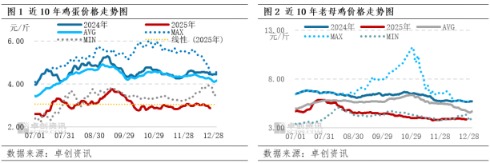
Core Viewpoint - The egg market is experiencing increased supply pressure and weak demand, leading to further declines in egg and old hen prices, pushing the industry into a loss-making zone [1] Group 1: Market Supply and Demand - In Q4 2025, the average price of eggs was 2.96 yuan per jin, down 5.73% from Q3, while the average price of old hens fell to 4.03 yuan per jin, a decrease of 18.75% [1] - The average inventory of laying hens was approximately 1.356 billion, a decrease of 0.51% quarter-on-quarter, although still at historically high levels [1][5] - Sales volume in consumption areas decreased by 10.56% quarter-on-quarter, indicating weakened terminal consumption and deepening supply-demand contradictions [1] Group 2: Cost and Profitability - The cost of producing eggs in Q4 was 2.95 yuan per jin, a decrease of 2.64% from Q3, primarily due to falling feed prices [3] - Despite lower production costs, the average gross profit per jin of eggs fell to -0.19 yuan, worsening by 0.10 yuan compared to Q3, indicating widespread losses in the breeding sector [3][6] Group 3: Future Outlook - For Q1 2026, the egg market is expected to see a rebalancing phase with supply pressure easing and demand initially increasing before declining [1][7] - The price of eggs is projected to rise initially in January, potentially reaching 3.30-3.50 yuan per jin, before declining again in February due to reduced demand [7]

“蛋”说无妨:供应压力未消、需求低于预期,四季度价格触底震荡
Xin Lang Cai Jing· 2025-12-29 03:00
Core Viewpoint - The egg market is experiencing a supply-demand imbalance in Q4, leading to a decline in prices for both eggs and hens, pushing the industry into a loss-making phase. Expectations for Q1 2026 suggest a potential rebalancing of supply and demand, with prices likely to rise initially before falling again [2][18]. Supply and Demand Dynamics - In Q4, the average price of eggs was 2.96 yuan per jin, down 5.73% from Q3, while the average price of hens fell to 4.03 yuan per jin, a decrease of 18.75% [3][19]. - The average cost of producing one jin of eggs decreased to 2.95 yuan, a reduction of 2.64%, but the drop in egg prices was more significant, leading to an average gross profit loss of 0.19 yuan per jin, worsening by 0.10 yuan compared to Q3 [19][25]. - The inventory of laying hens was approximately 1.356 billion, a slight decrease of 0.51% from the previous quarter, indicating a high historical level despite the downward trend [4][28]. Price Trends - Egg prices showed a "high-level retreat and bottom oscillation" pattern in Q4, peaking at 3.39 yuan per jin on October 1, then dropping to a low of 2.76 yuan per jin by October 13, marking a maximum decline of 18.58% [5][21]. - The average price of hens also followed a similar trend, with a quarterly average of 4.03 yuan per jin, down 18.75%, reflecting a significant drop from earlier in the quarter [7][24]. Profitability and Cost Structure - Despite a decrease in production costs, the decline in egg prices has led to an expanded loss in gross profit margins, with the average gross profit for eggs falling to -0.19 yuan per jin [8][25]. - The ongoing losses have resulted in a cautious approach to restocking among producers, with an increased willingness to sell off existing stock, indicating a shift towards reducing production capacity [10][27]. Market Demand and Sales - Sales in key markets decreased by 10.56% in Q4, attributed to the end of holiday demand and adverse weather conditions affecting storage [30]. - The overall demand for eggs has shown a structural change, with large-scale enterprises balancing their operations across regions, reducing inter-regional transport needs and impacting traditional sales channels [30]. Future Outlook - The egg production cycle suggests a continued decrease in inventory levels over the next three months, with expected reductions of 0.50% to 0.80% [31]. - Demand is anticipated to rise in January due to the Spring Festival, but a subsequent decline in February and March may lead to further price drops despite reduced supply [31][15].

鸡蛋周报:短期供需变动不大,蛋价窄幅震荡-20251228
Hua Lian Qi Huo· 2025-12-28 11:29
1. Report Industry Investment Rating - No relevant content provided 2. Core View of the Report - The egg market in 2025 shows significant supply - demand imbalance, with high inventory of laying hens, young age structure, slow old - hen culling, limited demand, and over - capacity throughout the year. Egg prices have bottomed out multiple times, and farmers are under great pressure and may accelerate the culling of old hens. In December, as the inventory of laying hens decreases and holiday stocking demand starts, the market is shifting from loose to tight - balance, but the upward space of egg prices is still restricted by substitute prices and terminal consumption. Mid - to long - term capacity reduction will dominate the probability of market reversal [8][9] - The strategy is that the main contract continues to fluctuate widely at a low level, with the pressure level referring to 2980 - 3000; mid - term, long positions in far - month contracts can be arranged, and call options can be bought with a light position [9] 3. Summaries According to the Directory 3.1 Weekly View and Strategy - The national egg spot price continued to fluctuate narrowly within the range this week. The average price in the main producing areas was 2.91 yuan/jin, a decrease of 0.01 yuan/jin from last week, a decline of 0.34%. As the egg price rises to the current level, the market trading has become cautious again, and the egg price may fall at the end of the month. In November 2025, the inventory of laying hens was about 1.307 billion, with a month - on - month decrease of 0.31%. It is expected that the inventory in December will still decline but remain at a high level in the past five - year average. The egg market is expected to shift from loose to tight - balance, and the egg price will be supported by fundamentals, but the upward space is restricted [8][9] - The strategy is to refer to the pressure level of 2980 - 3000 for the main contract, and arrange long positions in far - month contracts and buy call options with a light position in the mid - term [9] 3.2 Spot and Futures Market - Spot: The national egg spot price continued to fluctuate narrowly. The average price in the main producing areas was 2.91 yuan/jin, a decrease of 0.01 yuan/jin from last week, a decline of 0.34%. The price increase has weakened, and there may be a decline at the end of the month [8][20] 3.3 Supply - side - Inventory of laying hens: In November 2025, the national inventory of laying hens was about 1.307 billion, a month - on - month decrease of 0.31% and a year - on - year increase of 8.46%. It is expected that the inventory in December will still decline but remain at a high level in the past five - year average [8][33] - Chicken - chick replenishment: The average price of commercial chicken chicks in key regions this week was 2.71 yuan/feather, a month - on - month increase of 0.37% and a year - on - year decrease of 39.10%. The market showed a small rebound, and the replenishment enthusiasm of some breeding units was stimulated, but the overall replenishment sentiment was still divided [38] - Culling of old hens: The egg price is weak, and the supply of old hens in November increased month - on - month. The culling enthusiasm of breeding units increased, and the market was in a situation of strong supply and weak demand, and the price continued to be under pressure [40] 3.4 Demand - side - Egg demand shows seasonal characteristics. The price usually reaches the lowest level around April, the highest level in the first half of the year at the end of May, and the highest level in the year from September to mid - October. After that, the price declines and stabilizes from November to December [65] 3.5 Cost and Profit - Feed price: The cost of egg production is mainly affected by the prices of corn and soybean meal. In 2026, the annual average price of corn may slightly decrease, and the average price center of soybean meal may also decline slightly. Although the feed cost is expected to decrease by 1% - 2%, the overall cost of the industry is generally above 3.5 yuan/jin [71][75] - Breeding profit: This week, the cost per jin of eggs was 3.51 yuan/jin, a month - on - month decrease of 0.28%. The profit was - 0.52 yuan/jin, a month - on - month decrease of 15.56%. The breeding cost per chicken was 132.43 yuan, a month - on - month decrease of 0.32%, and the breeding profit was 8.50 yuan per chicken, a month - on - month decrease of 38.66% [84]
高速通衢启新程——大广高速曲周东互通助东部县域经济高质量发展
Xin Lang Cai Jing· 2025-12-28 09:12
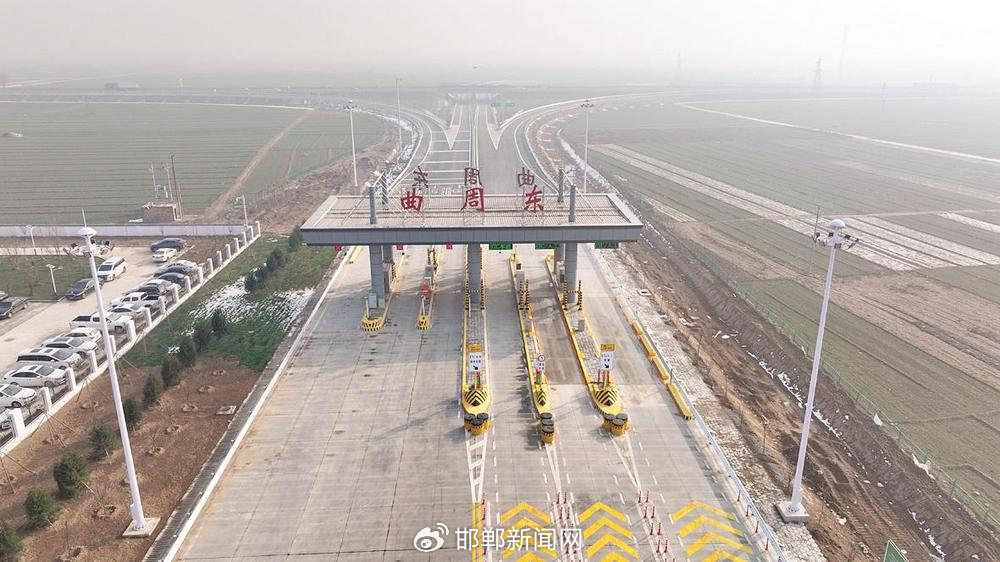
Core Viewpoint - The opening of the Daguang Expressway Quzhou East Interchange marks a significant development in the transportation infrastructure of Quzhou County, transforming it from a "traffic dead end" to an "open frontier" and enhancing connectivity with major cities in the Beijing-Tianjin-Hebei region and beyond [4][5]. Group 1: Transportation Infrastructure - The Daguang Expressway Quzhou East Interchange features a dual six-lane design, allowing for future traffic growth and improving travel efficiency and service quality [4]. - The interchange facilitates seamless connections between the Daguang Expressway and local transportation, significantly reducing travel times and enhancing logistics efficiency [4][5]. - The project is part of a broader plan to establish a comprehensive transportation hub in eastern Handan, integrating highways, trunk roads, rural roads, and logistics systems [8]. Group 2: Economic Impact - The improved transportation network is expected to boost local industries, particularly in sectors such as children's vehicles, seedling cultivation, biomedicine, and egg production [5]. - Quzhou County is a major egg production base, with a stock of 15 million hens producing approximately 9 million eggs daily. The new interchange allows for faster transportation, ensuring better freshness and market reach for local products [5][6]. - The "One Product, One Broadcast" e-commerce initiative in Quzhou has gained momentum, leveraging improved logistics to enhance the distribution of local specialty products through online platforms [6]. Group 3: Logistics and Supply Chain - The opening of the interchange has reduced logistics costs by nearly 30%, optimizing the supply chain for e-commerce and enhancing the efficiency of product delivery [6]. - The integration of the expressway with local logistics nodes has improved the overall logistics chain, facilitating better connections with external markets and increasing cooperation with e-commerce partners [6][8]. - The transportation advantages are translating into competitive benefits for local industries, particularly in the egg production sector, which is now able to deliver products more efficiently to major urban markets [8].
一枚鸡蛋的全产业链突围丨县域新气象
Xin Lang Cai Jing· 2025-12-25 14:16
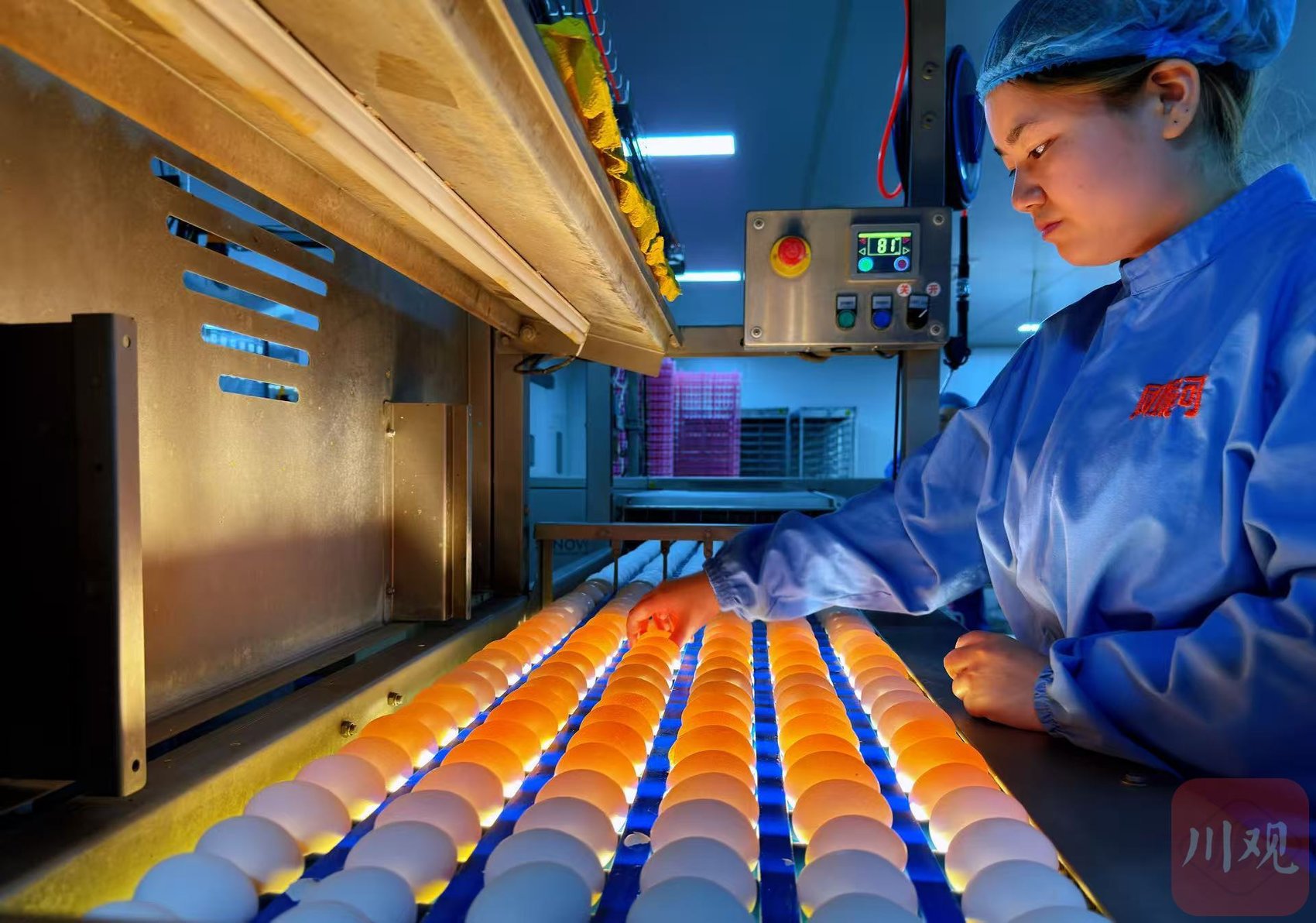
Core Viewpoint - The transformation of the egg production industry in Saltin County, Sichuan, is highlighted, showcasing advancements in breeding, smart farming, and value-added processing, leading to a complete industrial ecosystem with an annual output value of approximately 5 billion yuan [5]. Group 1: Industry Transformation - Saltin County has shifted from a traditional, fragmented egg production model to a more integrated approach, focusing on high-quality eggs and processed products [3][5]. - The county has developed its own breeding capabilities, successfully cultivating the "Tianfu Black Feather" chicken, which marks a significant breakthrough in self-sufficient breeding [5][6]. - The establishment of a modern breeding base and smart farming practices has led to a 30% increase in output value compared to traditional methods, with an annual production of 220 million eggs [6]. Group 2: Technological Advancements - The introduction of AI and automated systems in the farming process has improved efficiency and egg quality, allowing for precise feeding and monitoring of the chickens [6]. - The use of intelligent equipment in the incubation center has enhanced the selection process for breeding chickens, ensuring healthier and more uniform chicks [8]. Group 3: Economic Impact - The egg industry in Saltin has created over 400 local jobs, allowing residents to work closer to home and increase their income [9]. - The collaboration between local companies and community organizations has enabled villagers to share in the economic benefits through land leasing and profit-sharing [9]. Group 4: Product Diversification - The production line at Fengji Food Group has expanded to include various high-value products such as soft-boiled eggs and flavored eggs, with annual revenues reaching 400 million yuan [9]. - The partnership with Anhui Shike Food Co., Ltd. aims to develop local chicken resources into processed products, potentially generating over 300 million yuan in annual output [9].
直播预告 || 2025中国鸡蛋产业年终回顾
Xin Lang Cai Jing· 2025-12-24 09:40
Core Insights - In 2025, China's egg industry is at a dual juncture of cyclical adjustment and high-quality transformation, facing market pressure from supply-demand imbalance while also experiencing structural changes driven by policy guidance, technological innovation, and consumption upgrades [2][4] Supply Side - The average annual stock of laying hens in the national commodity layer reached 1.22 billion, a year-on-year increase of 1.3%, with a peak of over 1.27 billion in September, marking a recent high [2][4] - The profitability trend in 2024 encouraged farmers to actively replenish stocks at the beginning of 2025, alongside large enterprises expanding capacity, with plans for projects of over one million hens aiming for a total production capacity of 200 million [2][4] - However, continuous industry losses led to a significant decline in replenishment willingness in the second half of the year, with the number of young hens replenished decreasing for five consecutive months year-on-year, and the utilization rate of breeding eggs dropping to a near five-year low [2][4] Demand Side - Overall consumption exhibited characteristics of "stable total volume, differentiated structure," with the fresh egg market scale surpassing 420 billion yuan [2][4] - Demand for ordinary fresh eggs was weak due to declining prices of substitutes like pork, while sales of high-end egg products (such as raw-eating eggs, organic eggs, and selenium-enriched eggs) increased by 23% year-on-year, accounting for 18% of the total retail sales of fresh eggs, indicating a significant rise in consumer willingness to pay for quality and functional attributes [2][4] Price Trends - Egg prices showed a downward trend throughout the year, hitting a low of 5.06 yuan per kilogram mid-year, mostly operating below the industry breakeven point of 4.8-5.0 yuan per jin, with an average loss of approximately 0.93 yuan per kilogram, a substantial year-on-year decline of 289% [3][5] Technological Advancements - Breakthroughs in functional egg product technology have led to a 3-5 times increase in the content of nutrients like DHA and selenium, meeting national standards for "high-selenium foods," with the market size for functional egg products reaching 18.6 billion yuan and a compound annual growth rate of 12.7% [3][5] Industry Trends - The promotion of non-cage farming models is accelerating, with the industry awarding the "Non-Cage Farming Model Enterprise Award" for the first time, and companies like Sichuan Sandile and Dalian Lvxue Egg Products establishing standardized non-cage farming systems, achieving a product qualification rate of 99.8% [3][5] - The acceleration of brand building is evident as companies enhance recognition through "ecological farming positioning + storytelling marketing + customized packaging," with the repurchase rate of high-end egg products reaching 76%, significantly enhancing brand premium capabilities and driving the industry transition from "bulk commodities" to "value-added products" [3][5] Conclusion - In 2025, the Chinese egg industry faced deep adjustments and severe tests under the dual pressure of high supply and weak demand, entering a "micro-profit era" with significantly compressed breeding profit margins [5]
节假日备货拉动下游市场消费需求 全国鸡蛋价格出现反弹
Yang Shi Wang· 2025-12-19 09:29
Core Viewpoint - The national egg prices have shown a declining trend throughout the year, reaching a low point in November, but have started to rebound in December due to increased demand [1][3]. Group 1: Price Trends - In December, the average price of eggs in national wholesale markets was 7.45 yuan per kilogram, reflecting a 2% increase from December 1 [7]. - The rebound in egg prices is attributed to increased procurement and stocking by customers [3]. Group 2: Production and Cost Dynamics - In Shandong, a major egg production province, egg prices are rising, and production is recovering towards breakeven levels due to price increases and the adoption of new digital farming technologies [10]. - The use of automated equipment allows a single worker to manage 150,000 hens, significantly reducing labor costs and waste [10]. Group 3: Industry Challenges and Responses - Egg producers faced significant losses earlier in the year, with 80% of the time being unprofitable, but are now approaching breakeven due to recent price increases [10]. - To mitigate losses, local producers have implemented an "insurance + futures" project, which has helped 2,035 households reduce income losses [13]. Group 4: Supply Adjustments - The number of laying hens has been reduced as producers respond to low prices, with a decrease in the number of new chicks by approximately 15% compared to the second quarter [17]. - The total laying hen population reached a five-year high of 1.368 billion in September, contributing to an oversupply situation that led to a more than 20% year-on-year price drop [15]. Group 5: Future Outlook - Analysts predict that demand from upcoming holidays will support a gradual increase in egg prices, although the high inventory of laying hens may limit the extent of price increases [19].
成本核算 || 2025蛋鸡行业一只蛋鸡亏损多少?
Xin Lang Cai Jing· 2025-12-18 14:24
Core Insights - The egg-laying industry is entering a downturn in 2025, with egg prices significantly dropping to around 2.8 yuan per jin since February, leading to substantial losses for farmers [1][10] - The average loss per chicken is calculated to be 36.76 yuan from February to November, with small-scale farms particularly affected [13] Cost Assessment - Different farming scales have varying cost structures, with small-scale family farms facing high costs for feed, vaccines, and health care [1][10] - The cost for a 60-day-old chicken is 16.5 yuan, while the cost for chickens aged 60-150 days is approximately 20.3 yuan per chicken [11][12] - The production cost per egg is calculated at 3.003 yuan, leading to a loss of 0.203 yuan per egg sold at 2.8 yuan [12] Revenue Challenges - Egg prices and the prices of culling chickens have both weakened, with egg prices dropping to a low of 5.06 yuan per kilogram and culling prices reaching 8.45 yuan per kilogram [7][17] - The average loss per kilogram of egg production is approximately 0.93 yuan, representing a significant decline in profitability [17] Overcapacity Issues - The industry is facing overcapacity, with the national egg-laying hen population peaking at over 1.27 billion in September 2025, and an average annual stock of about 1.22 billion, a 1.3% increase year-on-year [8][18] - Farmers are delaying culling and implementing forced molting, extending the average culling age to over 520 days, which further slows down capacity reduction [18] Signs of Recovery - Recent market signals indicate a potential recovery, with egg prices in major production areas rising above 3 yuan per jin due to seasonal demand and reduced supply [19] - The number of replacement hens has decreased by 19 million, and there is still room for culling, suggesting a tightening supply-demand balance [19]
蛋鸡养殖行业补栏拐点已现
Qi Huo Ri Bao· 2025-12-16 00:22
Group 1 - The egg-laying chicken farming industry has entered a capacity clearing cycle, but the process will be prolonged due to the enhanced risk resistance of large-scale farming entities [1] - Since 2017, the egg-laying industry has experienced two significant phases of excessive culling, occurring in 2017 and 2020, driven by profit pressures [1] - In 2025, the level of losses in the egg-laying industry is expected to be comparable to that of 2020, with cumulative reductions in culling age approaching levels seen in 2017, yet the stock remains high [1] Group 2 - The market's supply and demand expectations influence the shape of the term structure, transitioning from a steep Contango to a flat Contango and eventually to a Back structure as prices reverse from the bottom [2] - The current egg futures market is in a Contango state, with the steepening trend due to hesitance in the culling process, and this low-near, high-far structure is expected to continue until supply-demand rebalancing occurs [2] - The overall industry is in a slow clearing phase, influenced by multiple factors including culling pace, restocking willingness, and market expectations, which require ongoing monitoring [2]