智能手机

Search documents
存储、金属涨价搅动供应链,手机市场面临新战役
2 1 Shi Ji Jing Ji Bao Dao· 2026-01-28 13:31
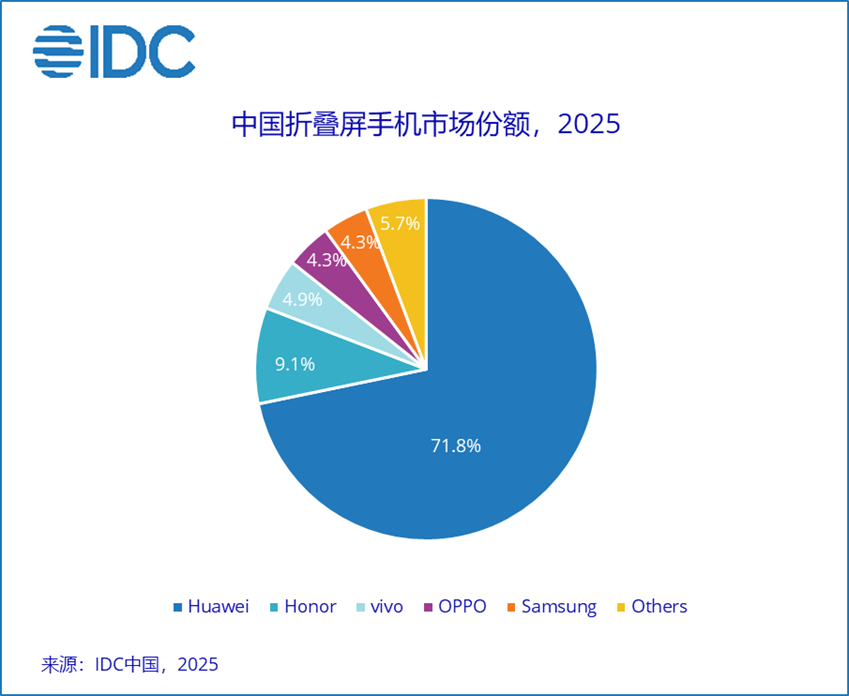
Core Insights - The smartphone market in 2026 is facing significant changes due to rising prices and supply chain challenges, with manufacturers needing to enhance their collaborative response capabilities [1] - The competition is shifting from merely pricing and configuration to a multidimensional battle involving supply chain resilience, cost control, AI technology implementation, and new hardware innovation [1] Supply Chain and Cost Dynamics - The ongoing rise in storage prices is creating pressure on manufacturers, leading them to reconsider their pricing strategies and cost structures [2][3] - Smaller manufacturers, particularly those targeting the budget segment, are under greater pressure compared to larger brands that can afford to maintain their supply chains [2] - The impact of rising storage costs is significant, particularly for models priced under $100, which may face price increases, while higher-end models can offset costs through adjustments in configuration and marketing expenses [2][3] New Hardware and AI Integration - The exploration of new hardware forms, such as foldable phones and smart glasses, is becoming crucial as the smartphone market matures [4][5] - The global foldable phone shipment is expected to rise significantly in 2026, driven largely by Apple's entry into the market [4] - AI technology is increasingly influencing the development of new products, with a focus on optimizing performance and user experience in smart glasses and handheld imaging devices [8][9] Market Trends and Future Outlook - The first half of 2026 will be critical for smartphone brands to adjust their production and product structures in response to rising costs [3] - The rapid evolution of AI technology is expected to lead to a diverse range of new smart terminal products, enhancing market prospects for 2026 [8] - Collaboration and flexibility in product development are essential for companies to meet market demands and consumer expectations effectively [9]

“最薄iPhone”上市3个月即遇冷
Zheng Quan Ri Bao Wang· 2026-01-28 13:23
Core Viewpoint - The newly launched iPhone Air, which is the thinnest iPhone to date, has seen significant price reductions shortly after its release, indicating poor market performance and a need for inventory clearance [1][3]. Group 1: Product Performance - iPhone Air was launched on October 22, 2025, but has underperformed in the market, with cumulative activation numbers below 200,000 units by January 24, 2026, which is only about one-third of Apple's highest expectations [2]. - The device's thickness is only 5.6 mm and weighs 165 grams, making it the thinnest iPhone ever, but compromises were made in battery capacity and camera features to achieve this design [2]. - The resale value of iPhone Air has dropped significantly from over 6,000 yuan to around 4,000 yuan, reflecting its poor market reception [1]. Group 2: Pricing and Promotions - Apple has initiated multiple promotional activities for iPhone Air, including a recent price cut of 2,000 yuan from the original price of 7,999 yuan, bringing the effective price down to 5,499 yuan [1][3]. - The stock available for the promotional event was only 13,000 units, indicating limited inventory [2]. Group 3: Market Challenges - The use of eSIM technology in iPhone Air has posed challenges, as the process for activating eSIM is cumbersome compared to traditional SIM cards, which may deter potential buyers [4]. - The mismatch between innovative technology and local consumer habits has led to difficulties in market acceptance, highlighting the need for better adaptation to local infrastructure and consumer preferences [4][5].

通信行业月报:光模块上游关键物料供应持续紧张,AWS规模部署空芯光纤
Zhongyuan Securities· 2026-01-28 10:25
Investment Rating - The report maintains an "Outperform" investment rating for the communication industry [2][9]. Core Insights - The communication industry index outperformed the Shanghai Composite Index in December 2025, with a rise of 12.82% compared to +2.06% for the Shanghai Composite Index [8]. - Key material supply for optical modules remains tight, with major players like Longfei and Hengtong winning bids for China Unicom's hollow-core fiber cable procurement [8]. - The retail sales of communication equipment in China increased by 20.9% year-on-year in December 2025, driven by the demand for smartphones [8]. - The global smartphone shipment is projected to grow by 2% year-on-year in 2025, reaching 1.25 billion units, with AI smartphones expected to penetrate 34% of the market [8]. - The export value of optical modules from China decreased by 15.6% year-on-year in 2025, while Thailand's communication equipment exports surged by 152.1% [8]. - The capital expenditure of major North American cloud providers reached $112.43 billion in Q3 2025, a 76.9% increase year-on-year [8]. Summary by Sections Market Review - The communication industry index rose by 12.82% in December 2025, outperforming major indices [14]. - Various sub-sectors within the communication industry saw significant gains, with cable and network connection sectors increasing by 22.05% and 19.44% respectively [15]. Industry Tracking - The global ICT market is expected to grow from $5.9 trillion in 2025 to $7.6 trillion by 2029, with a CAGR of 7.0% [39]. - The Chinese enterprise ICT market is projected to reach approximately $314.7 billion in 2025, growing at a rate of 14.3% year-on-year [39]. - The telecom business revenue in China reached 1.6096 trillion yuan from January to November 2025, reflecting a 0.9% year-on-year increase [48]. Telecom Industry Insights - As of November 2025, the number of 5G mobile phone users in China reached 1.193 billion, accounting for 65.3% of total mobile users [49]. - The number of fixed broadband users with gigabit access reached 239 million, representing 34.3% of total broadband users [52]. Investment Recommendations - The report suggests focusing on companies involved in optical chips, optical devices, and optical modules, such as SourceJ, Shijia Photon, and Tianfu Communication [9]. - It also highlights the potential of AI smartphones and telecom operators like China Mobile, China Telecom, and China Unicom as key investment opportunities [9].
小米将发布小米17 Max手机:8000mAh超大电池,取消背屏
Xin Lang Cai Jing· 2026-01-28 10:13
Core Viewpoint - Xiaomi is set to launch the Xiaomi 17 Max smartphone, which focuses on a large battery capacity and fast charging capabilities, differing from the Xiaomi 17 Pro Max by omitting the back screen design [1][2][3] Group 1: Product Features - The Xiaomi 17 Max will feature an 8000mAh battery, supporting up to 100W wired fast charging and 50W wireless fast charging [2][3] - The smartphone will include a 200-megapixel Leica main camera and a 50-megapixel periscope lens [2][3] - It will be powered by the Qualcomm Snapdragon 8 Elite Gen5 processor and the latest Surge OS 3 system [2][3] Group 2: Market Positioning - The removal of the back screen design is expected to reduce production costs, allowing for a more competitive pricing strategy [2][3] - The traditional design of the Xiaomi 17 Max is anticipated to be more appealing to consumers who prefer conventional smartphones [2][3] - The official release of the Xiaomi 17 Max is expected in the second quarter of this year [2][3]

通信行业月报:光模块上游关键物料供应持续紧张,AWS规模部署空芯光纤-20260128
Zhongyuan Securities· 2026-01-28 08:29
Investment Rating - The report maintains an "Outperform" investment rating for the communication industry [2][9]. Core Insights - The communication industry index outperformed the Shanghai Composite Index in December 2025, rising by 12.82% compared to +2.06% for the Shanghai Composite Index and +2.28% for the CSI 300 Index [8][14]. - Key material supply for optical modules remains tight, with major players like Longfei and Hengtong winning bids for China Unicom's hollow-core fiber cable procurement [8][9]. - The retail sales of communication equipment in China increased by 20.9% year-on-year in December 2025, driven by the demand for smartphones [8][41]. - The global smartphone shipment is projected to grow by 2% year-on-year in 2025, reaching 1.25 billion units, with AI smartphones expected to penetrate 34% of the market [8][29]. - The export value of optical modules from China decreased by 15.6% year-on-year in 2025, while Thailand's communication equipment exports surged by 152.1% [8][9]. Summary by Sections Market Review - The communication industry index rose by 12.82% in December 2025, outperforming major indices [14]. - Sub-sectors such as cables and network equipment saw significant gains, with increases of 22.05% and 19.44% respectively [15][19]. Industry Tracking - The capital expenditure of major cloud providers in North America reached $112.43 billion in Q3 2025, a 76.9% increase year-on-year [25][28]. - AI applications are driving cloud business growth, with major companies like Amazon, Microsoft, Google, and Meta significantly increasing their capital expenditures [25][29]. - The Chinese ICT market is expected to grow to approximately $889.43 billion by 2029, with a CAGR of 7.0% [39][40]. Domestic Telecom Industry - Telecom business revenue in China reached 1.6096 trillion yuan from January to November 2025, a year-on-year increase of 0.9% [48]. - The number of 5G mobile phone users reached 1.193 billion by November 2025, accounting for 65.3% of total mobile phone users [49]. - The number of fixed broadband users with gigabit access reached 239 million, representing 34.3% of total users [52].





小米卢伟冰:必须以行业第一的标准来要求自己
Xin Lang Cai Jing· 2026-01-28 08:11
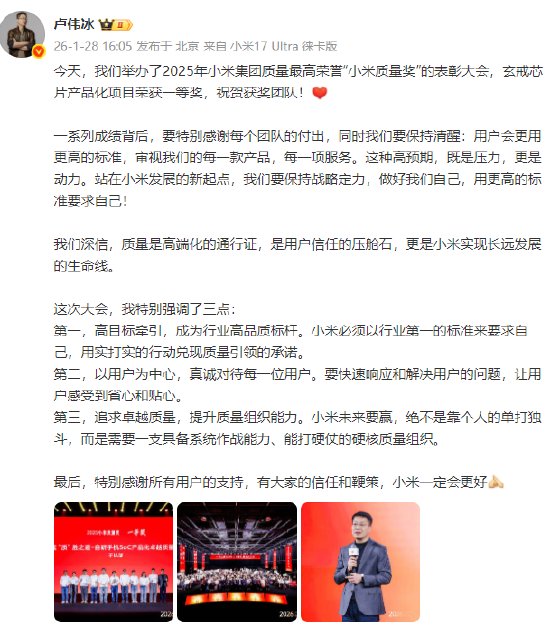
Core Viewpoint - Xiaomi Group emphasizes the importance of quality as a key driver for long-term development and user trust, as highlighted by the recent "Xiaomi Quality Award" ceremony where the玄戒 chip project won first prize [1][3]. Group 1: Quality Commitment - Xiaomi aims to set industry standards for high quality, committing to actions that reflect its promise of quality leadership [1][3]. - The company believes that quality is essential for high-end positioning and is crucial for gaining user trust [1][3]. Group 2: User-Centric Approach - Xiaomi stresses the importance of being user-centered, focusing on quickly addressing and resolving user issues to enhance user experience [1][3]. Group 3: Organizational Excellence - The company highlights the need for a robust quality organization capable of systematic operations and tackling challenges, rather than relying on individual efforts [1][3].
Clawdbot由AI开发;国产大模型集体上新丨早科技风向标
2 1 Shi Ji Jing Ji Bao Dao· 2026-01-28 05:47
Group 1: Technology Developments - The open-source project Clawdbot has gained significant attention, capable of running on Mac mini and integrating with various tools, developed almost entirely by AI [2] - DeepSeek has released a new model, DeepSeek-OCR 2, which utilizes an innovative method to enhance AI's visual understanding [4] - The domestic AI startup, Moonlight Dark Side, launched the Kimi K2.5 model, achieving top scores in multiple agent evaluations and integrating various capabilities into one model [5] Group 2: Market Trends and Pricing - Two major chip manufacturers, Zhongwei Semiconductor and Guoke Micro, have announced price increases for their products, with adjustments ranging from 15% to 80% [6] - OpenAI's advertising costs for ChatGPT are reported to be three times higher than Meta's, with limited data provided to advertisers [8] Group 3: Corporate News - OpenAI's Chief Information Security Officer, Matt Knight, announced his departure from the company after joining in 2020 [11] - Anthropic has completed a new funding round, achieving a valuation of $350 billion, with total financing between $10 billion and $15 billion [14][15] - Turing Quantum has secured hundreds of millions in Series B funding, continuing its trend of significant capital raises [16] Group 4: Product Launches - Samsung's Galaxy Z TriFold, the first three-fold smartphone, is set to launch in the U.S. at a price of $2,899, significantly higher than other smartphones on the market [17]
内存价格翻倍,iPhone变贵?天风郭明錤:苹果的策略是"承担成本抢份额,用服务赚回来"
Hua Er Jie Jian Wen· 2026-01-28 05:01
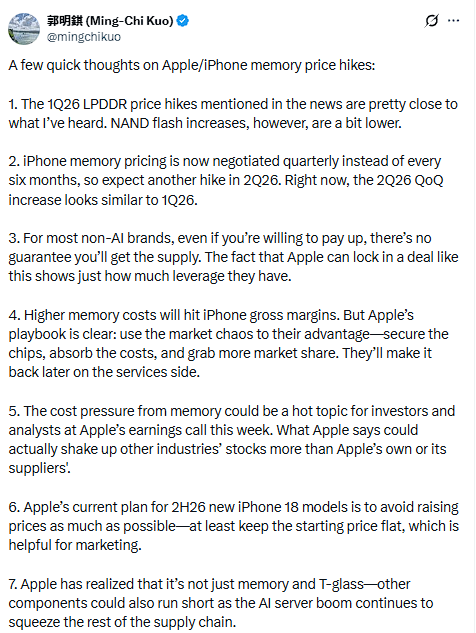
Core Viewpoint - Apple is expected to face a similar increase in memory prices in Q2 2026 as in Q1 2026, with a clear strategy to secure chip supply, absorb cost pressures, and capture market share, later compensating for losses through service revenue [1][2]. Memory Price Trends - Samsung and SK Hynix have recently increased the price of low-power DRAM supplied to Apple by nearly 100% compared to the previous quarter, with Samsung's LPDDR chip prices rising over 80% and SK Hynix's by approximately 100% [1][2]. - Apple's memory pricing negotiations have shifted from biannual to quarterly, indicating that price increases are likely to continue [2]. Impact on Profit Margins - The rising memory costs are expected to directly impact the gross margin of iPhones, with Apple’s strategy focusing on leveraging market chaos for profit while managing costs and increasing market share [2][4]. - The overall profitability of memory suppliers like Samsung and SK Hynix is anticipated to improve in Q1, following significant price increases in DRAM [4]. Pricing Strategy for New Products - Apple aims to maintain the starting price of the new iPhone 18 models in the second half of 2026, despite rising costs, which is beneficial for marketing [5]. - Unlike previous years, Apple has only completed negotiations for the first half of the year regarding memory pricing, rather than securing long-term agreements for the entire year [5]. Supply Chain Risks - Apple has recognized that supply chain risks are spreading beyond just memory and T-glass, with potential shortages in other components due to the booming demand for AI infrastructure [6]. - The sharp rise in memory prices is attributed to an imbalance in supply and demand, driven by large tech companies' investments in AI, while suppliers are focusing on more profitable HBM products, leading to tight supplies of traditional DRAM and LPDDR [6].
iPhone 18有望不涨价
Xin Lang Cai Jing· 2026-01-28 04:17
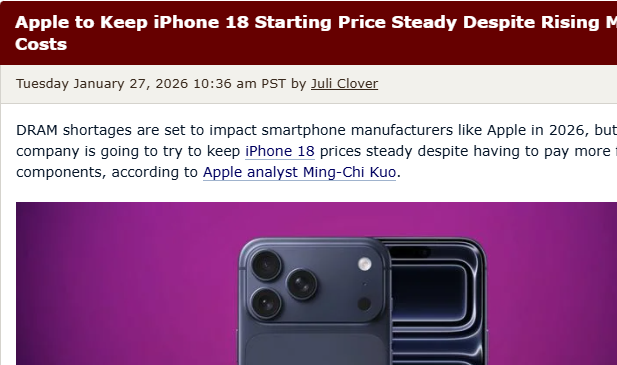
Core Viewpoint - Apple is adopting a pricing strategy for the iPhone 18 series that aims to keep initial prices stable, which is beneficial for marketing efforts. The company is aware of potential supply shortages for various components due to the impact of the AI server industry [2]. Group 1: Pricing Strategy and Component Supply - Apple is focusing on maintaining the starting price of the iPhone 18 series to enhance marketing [2]. - Memory prices for iPhones are now negotiated quarterly rather than semi-annually, with expectations of another price increase in Q2 2026 [2]. - Samsung and SK Hynix have proposed significant price increases for LPDDR memory used in iPhones, with Samsung seeking over an 80% quarterly increase and SK Hynix nearly doubling its prices [2]. Group 2: Financial Performance and Market Expectations - The upcoming earnings call on January 29 is expected to focus on the impact of rising memory costs on Apple's gross margins [3]. - Apple is projected to achieve revenue growth of 11.3% year-over-year, reaching $138.42 billion, with net profit expected to grow by 8.4% to $39.38 billion [3]. - Morgan Stanley expresses a cautious outlook for Apple's short-term fundamentals due to memory cost pressures, despite strong demand for the iPhone 17 [3]. - Long-term prospects remain positive, with potential catalysts such as the relaunch of Siri, the introduction of a foldable iPhone, and the release of the 2nm iPhone 18 expected to drive performance in the latter half of the fiscal year [4].

内存成本上涨10%-25%,苹果计划维持iPhone 18起售价
Huan Qiu Wang· 2026-01-28 02:40
Core Viewpoint - The smartphone industry, particularly Apple, is expected to face challenges due to a DRAM memory shortage in 2026, but Apple plans to maintain stable pricing for the iPhone 18 series despite rising component costs [1][4]. Group 1: Memory Pricing and Supply - Apple and memory suppliers are using a quarterly pricing model, with a new round of memory price increases expected in Q2 2026, similar to Q1 [4]. - Current memory prices have risen by 10% to 25% compared to the same period last year, which will directly impact the gross margin of iPhones [4]. - Apple has secured stable supply agreements, allowing it to absorb some of the increased costs due to its industry influence [4]. Group 2: Strategic Positioning - Apple's strategy is to leverage market fluctuations to gain a competitive edge, secure chip supplies, and absorb cost pressures to expand market share [4]. - The company aims to maintain its pricing strategy for the iPhone 18, avoiding price increases despite the memory shortage driven by AI industry demand [4]. - Apple plans to compensate for profit losses through its services business, indicating a clear and defined strategic approach [4].