
电子元件

Search documents
中石科技股价涨5.21%,广发基金旗下1只基金重仓,持有169.04万股浮盈赚取348.23万元
Xin Lang Cai Jing· 2025-11-26 03:42
Core Points - Zhongshi Technology's stock increased by 5.21%, reaching 41.61 CNY per share, with a trading volume of 383 million CNY and a turnover rate of 4.64%, resulting in a total market capitalization of 12.463 billion CNY [1] - The company, Beijing Zhongshi Weiye Technology Co., Ltd., specializes in the research, design, production, sales, and technical services of thermal materials, EMI shielding materials, and power filters, with thermal materials accounting for 98.05% of its main business revenue [1] Shareholder Analysis - According to data, one fund under GF Fund ranks among the top ten circulating shareholders of Zhongshi Technology. The GF Multi-Dimensional Emerging Stocks Fund (003745) increased its holdings by 579,900 shares in the third quarter, totaling 1.6904 million shares, which represents 0.83% of the circulating shares [2] - The fund has achieved a year-to-date return of 25.41%, ranking 1677 out of 4206 in its category, and a one-year return of 19.95%, ranking 2381 out of 3986 [2] - The fund manager, Zhou Zhishuo, has a total asset scale of 19.292 billion CNY, with the best fund return during his tenure being 47.06% and the worst being -24.96% [2] Fund Holdings - The GF Multi-Dimensional Emerging Stocks Fund (003745) holds 1.6904 million shares of Zhongshi Technology, accounting for 3.01% of the fund's net value, making it the fourth-largest holding [3] - The estimated floating profit from this position is approximately 3.4823 million CNY [3]

A股“普涨式”反弹能走多远?盯紧这些信号
Sou Hu Cai Jing· 2025-11-25 13:25
Market Overview - The A-share market continued its rebound, with a significant increase in investor confidence, as evidenced by nearly 4,300 stocks closing higher and a daily trading volume of 1.83 trillion yuan [1][2][9] - The Shanghai Composite Index rose by 0.87% to 3,870.02 points, while the ChiNext Index increased by 1.77% to 2,980.93 points [2] External and Internal Factors - External factors contributing to the market's performance include rising expectations for a Federal Reserve interest rate cut and strong performance in overseas tech stocks [1][9] - Internally, the market's technical recovery was driven by a need for correction after previous declines, alongside improvements in market sentiment and liquidity [1][9] Sector Performance - Key sectors that performed well include optical communication modules, CPO concepts, PCB, and F5G concepts, with gains exceeding 4% [2][3] - The communication, media, non-ferrous metals, and electronics sectors led the market, with 14 sectors showing gains of over 1% [3][5] Individual Stock Highlights - Notable stocks that hit the daily limit include Huanrui Century, Giant Network, and Xinhua Du, among others [4] - In the communication sector, stocks like Dekoli and Guangku Technology saw significant increases, with Dekoli rising by 20% [6][8] Investment Strategy - Analysts suggest a cautious approach, recommending a "left-side small position + selective leading stocks + event-driven" strategy, while waiting for further confirmation of market trends [9][12] - The focus is on sectors with structural opportunities, particularly in technology, as the market transitions from speculative trading to validating orders and revenues [12]

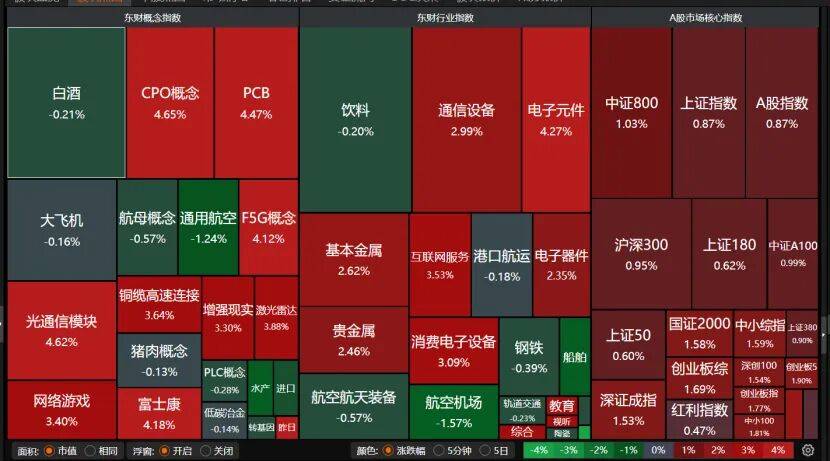
放量普涨
第一财经· 2025-11-25 11:06
Group 1 - The A-share market saw all three major indices rise, supported mainly by financial and consumer sectors, while technology sectors like electronics, computers, and media showed active performance, leading to an expanded increase in the Shenzhen Component Index [4] - A total of 4,297 stocks rose, with a rise-fall limit ratio of 96:7, indicating a broad market rally and improved profitability, with significant structural differentiation [5] - The trading volume in both markets reached over 1 trillion yuan, an increase of 4.9%, reflecting a high level of market activity driven by sector rotation, funding support, and policy expectations [5] Group 2 - Institutional investors focused on core technology assets, with significant capital inflows into communication equipment, electronic components, semiconductors, and photovoltaic equipment, while cultural media sectors faced selling pressure due to short-term valuation concerns [7] - Retail investor sentiment was recorded at 75.85%, indicating a generally optimistic outlook among individual investors [8] - The proportion of investors increasing their positions was 25.40%, while 21.82% reduced their holdings, with 52.78% choosing to maintain their current positions [10]

顺络电子:股东解除质押股份880.63万股,占总股本1.09%
Xin Lang Cai Jing· 2025-11-25 09:39
Core Viewpoint - The announcement indicates that shareholders Hengshuntong and President Shi Hongyang have released a portion of their pledged shares, totaling 8.81 million shares, which represents 1.09% of the company's total equity. This release is not expected to have a substantial impact on the company [1]. Summary by Relevant Sections - **Shareholder Actions** - Hengshuntong released 4.2 million shares and 2.5 million shares, while Shi Hongyang released 806,300 shares, 200,000 shares, and 1.1 million shares, totaling 8.81 million shares released [1]. - **Ownership Structure** - After the release of the pledged shares, Hengshuntong, Shi Hongyang, and their concerted actions hold a total of 92.87 million shares, accounting for 11.52% of the total shares [1]. - **Pledged Shares Status** - Following the release, the total pledged shares amount to 30.74 million shares, which is 3.81% of the total equity [1].

深证成指涨超2%,通信设备,电子元件板块领涨
Mei Ri Jing Ji Xin Wen· 2025-11-25 04:26
Core Viewpoint - The Shenzhen Component Index rose over 2% on November 25, with the communication equipment and electronic components sectors leading the gains [1] Group 1: Market Performance - The Shenzhen Component Index experienced a significant increase, surpassing 2% [1] - The communication equipment and electronic components sectors were the top performers in the market [1] Group 2: Notable Stocks - Several constituent stocks, including Huadian Co., Ltd. and China Materials Technology, reached their daily limit up [1]


ETF盘中资讯 | Meta斥巨资购买谷歌的TPU!算力硬件大涨,光模块+PCB走强!中际旭创涨超6%,双创龙头ETF(588330)盘中上探3.45%
Sou Hu Cai Jing· 2025-11-25 04:10
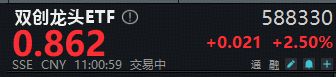
Group 1 - The technology growth sector is experiencing strong gains, with the ChiNext Index rising over 2.5% and the Sci-Tech Innovation Index increasing by more than 1.7% [1] - The Double Innovation Leader ETF (588330) saw a peak intraday increase of 3.45%, currently up 2.5%, with a trading volume exceeding 320 million yuan [1] - Key players in the optical module sector, including Zhongji Xuchuang and Xinyi Sheng, have seen stock increases of over 6%, while Tianfu Communication rose by more than 4% [1] Group 2 - The top ten components of the Double Innovation Leader ETF have shown significant price increases, with Zhongji Xuchuang up 6.70% and Shenghong Technology up 6.62% [2] - The report from HSBC indicates that the acceleration of AI server iterations is driving a dual cycle of technology and price increases for core components like PCBs and CCLs [3] - Citigroup previously projected that the supply-demand tension for AI PCBs will persist into next year, highlighting the ongoing demand in the sector [3] Group 3 - The Double Innovation Leader ETF is characterized by cross-market diversification, focusing on 50 large-cap strategic emerging industry companies from the Sci-Tech Innovation Board and ChiNext [4] - The ETF is positioned as a high-elasticity tool to capture technology market trends, with a low investment threshold allowing entry for less than 100 yuan [4] - The index that the ETF tracks has shown varied annual performance from 2020 to 2024, with a notable increase of 86.90% in 2020 [4]





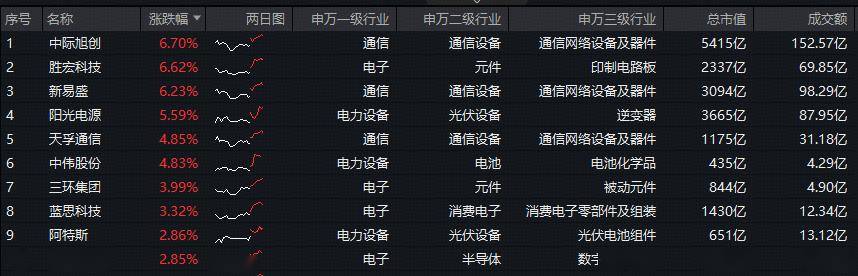
Meta斥巨资购买谷歌的TPU!算力硬件大涨
Xin Lang Cai Jing· 2025-11-25 03:21
Core Insights - The technology growth sector is experiencing strong momentum, with the ChiNext Index rising over 2.5% and the Sci-Tech Innovation Index increasing by more than 1.7% [1] - The Double Innovation Leader ETF (588330) saw a peak intraday increase of 3.45%, currently up by 2.5%, with a trading volume exceeding 320 million yuan, indicating active trading [1] Sector Summaries Communication Equipment - Major players in the optical module sector, including Zhongji Xuchuang and Xinyi Sheng, saw stock increases of over 6%, while Tianfu Communication rose by more than 4% [1] - The report highlights the strong performance of communication equipment stocks, driven by advancements in technology [2] PCB (Printed Circuit Board) - HSBC's latest report indicates that the acceleration of AI server iterations is driving a dual cycle of technological and price increases for PCBs and copper-clad laminates [2] - Citigroup previously projected that the supply-demand tension for AI PCBs will persist into next year [2] Renewable Energy - In the photovoltaic sector, Yangguang Electric Power increased by over 5%, and Canadian Solar rose by more than 2% [1] - The renewable energy sector continues to attract investment interest, reflecting its growth potential [1] Investment Opportunities - The Double Innovation Leader ETF is characterized by cross-market diversification, focusing on strategic emerging industries, including new energy, photovoltaics, optical modules, semiconductors, and medical devices [3] - The ETF offers a low entry point for investors, allowing participation in the technology sector with a minimum investment of less than 100 yuan [3]
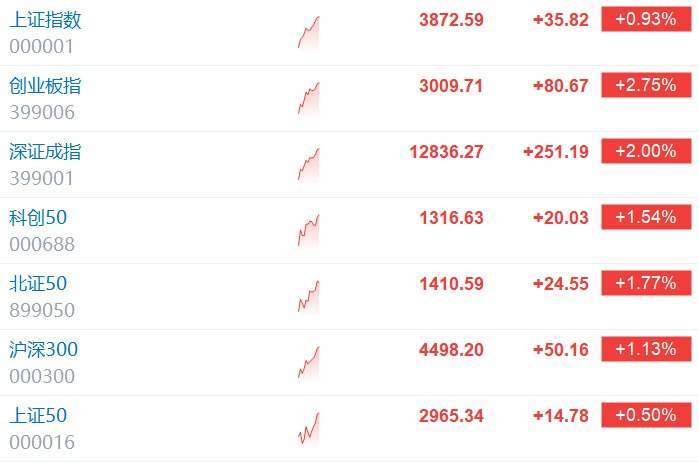
A股三大指数继续拉升,深证成指涨超2%,通信设备,电子元件板块领涨!沪电股份、中材科技等多股涨停
Ge Long Hui· 2025-11-25 02:50
| 上证指数 | 3872.59 | +35.82 | +0.93% | | --- | --- | --- | --- | | 000001 | | | | | 创业板指 | 3009.71 | +80.67 | +2.75% | | 399006 | | | | | 深证成指 | 12836.27 | +251.19 | +2.00% | | 399001 | | | | | 科创20 | 1316.63 | +20.03 | +1.54% | | 000688 | | | | | 北证50 | 1410.59 | +24.55 | +1.77% | | 899050 | | | | | 沪深300 | 4498.20 | +50.16 | +1.13% | | 000300 | | | | | 上证50 | 2965.34 | +14.78 | +0.50% | | 000016 | | | | 格隆汇11月25日|A股主要指数继续拉升,深证成指涨超2%,通信设备,电子元件板块领涨。成分股 中,沪电股份(002463)、中材科技等多股涨停。 ...
生益科技股价涨5.22%,银河基金旗下1只基金重仓,持有2.01万股浮盈赚取5.53万元
Xin Lang Cai Jing· 2025-11-25 01:59
Core Insights - Shengyi Technology's stock increased by 5.22% to 55.42 CNY per share, with a trading volume of 4.92 billion CNY and a market capitalization of 134.62 billion CNY [1] Company Overview - Shengyi Technology, established on June 27, 1985, and listed on October 28, 1998, is located in Dongguan, Guangdong Province. The company specializes in the design, production, and sales of copper-clad laminates, bonding sheets, printed circuit boards, ceramic electronic components, LCD products, electronic-grade glass cloth, epoxy resin, copper foil, flexible electronic materials, display materials, packaging materials, and insulation materials. It also engages in non-quota license management and the acquisition and export of non-specialized goods [1] - The main revenue composition includes: copper-clad laminates and bonding sheets (65.96%), printed circuit boards (28.63%), comprehensive utilization of waste resources (3.37%), and other (2.04%) [1] Fund Holdings - According to data, one fund under Galaxy Fund holds a significant position in Shengyi Technology. The Galaxy Technology Growth Mixed Fund A (022704) held 20,100 shares in the third quarter, accounting for 4.93% of the fund's net value, ranking as the seventh largest holding. The estimated floating profit for today is approximately 55,300 CNY [2] - The Galaxy Technology Growth Mixed Fund A (022704) was established on December 27, 2024, with a latest scale of 15.92 million CNY. Year-to-date returns stand at 46.62%, ranking 670 out of 8,136 in its category, with a cumulative return since inception of 46.61% [2] Fund Manager Information - The fund manager of Galaxy Technology Growth Mixed Fund A (022704) is Gao Peng, who has been in the position for 4 years and 192 days. The total asset size of the fund is 508 million CNY, with the best fund return during his tenure being 45.35% and the worst being -20.16% [3]

三大区域,外贸为啥跑得快?
Ren Min Ri Bao Hai Wai Ban· 2025-11-25 00:42
Core Insights - The foreign trade performance of China's three major regions—Yangtze River Delta, Guangdong-Hong Kong-Macau Greater Bay Area, and Beijing-Tianjin-Hebei—has shown strong resilience and vitality, with significant year-on-year growth in imports and exports [1][2][4] Group 1: Trade Performance - In the first ten months of this year, the Yangtze River Delta's import and export volume reached 14 trillion yuan, a year-on-year increase of 6% [2] - The Guangdong-Hong Kong-Macau Greater Bay Area's import and export volume was 7.52 trillion yuan, marking a historical high with a year-on-year growth of 4% [3] - The Beijing-Tianjin-Hebei region's import and export volume reached 3.91 trillion yuan, with exports hitting a historical high of 1.2 trillion yuan [4] Group 2: Sector Contributions - In the Yangtze River Delta, private enterprises contributed significantly, with their import and export volume reaching 7.83 trillion yuan, a year-on-year increase of 9.7%, accounting for 55.9% of the total trade [2] - The Guangdong-Hong Kong-Macau Greater Bay Area saw nearly 70% of its exports coming from electromechanical products, with electronic components and "new three types" products growing by 19.5% and 32.2% respectively [3] - The Beijing-Tianjin-Hebei region's exports were bolstered by the automotive sector, with automotive and parts exports increasing by 1.5 percentage points, now accounting for 8.2% of the region's total exports [5] Group 3: Structural Advantages - The three regions benefit from strong industrial foundations and innovation capabilities, transitioning from traditional cost advantages to innovation-driven growth [5] - The regions are deeply integrated into global supply chains, showcasing adaptability to external demand fluctuations, which has led to stable growth despite global challenges [6] - Institutional innovations, such as the establishment of free trade zones and comprehensive bonded zones, have created a favorable business environment for international trade [7] Group 4: Future Outlook - The regions are expected to further develop a multi-layered open system, with the Yangtze River Delta focusing on digital and green technologies, the Guangdong-Hong Kong-Macau area enhancing its role in global service trade, and the Beijing-Tianjin-Hebei region concentrating on high-end equipment exports [10] - Emerging markets and new trade areas, such as digital trade and green trade, are anticipated to become new growth drivers for these regions [10]