电池

Search documents
美媒:特朗普政府正酝酿征收新关税
Xin Lang Cai Jing· 2026-02-24 11:51
Core Viewpoint - The U.S. Supreme Court ruled that the large-scale tariffs imposed by the Trump administration under the International Emergency Economic Powers Act were illegal, leading to plans for new tariffs based on national security laws, which may increase economic uncertainty [1][6]. Group 1: New Tariff Investigations - The U.S. Department of Commerce is initiating new investigations under Section 232 of the Trade Expansion Act of 1962 for products in industries such as large batteries, cast iron and iron fittings, plastic pipes, industrial chemicals, and telecommunications equipment [1][6]. - The U.S. Trade Representative's office is also starting new trade investigations under Section 301 of the Trade Act of 1974, which may lead to tariffs on issues like drug pricing and discrimination against U.S. technology companies [2][6]. Group 2: Existing Tariffs and Changes - The Trump administration previously invoked Section 232 to investigate nine categories of products, including semiconductors and solar panels, with many investigations ongoing for nearly a year [2][7]. - There is an intention to modify the algorithm for steel and aluminum tariffs, potentially lowering nominal rates but taxing based on the total value of products rather than just their steel and aluminum content [7]. Group 3: Economic Uncertainty - Following the Supreme Court ruling, the Department of Homeland Security confirmed that tariffs under the International Emergency Economic Powers Act would cease, but tariffs under Sections 232 and 301 remain effective [9]. - The new tariffs announced under Section 122 of the Trade Act of 1974 will impose a 15% tariff on goods from all countries for a maximum of 150 days, requiring Congressional approval for extension [9]. - Experts predict that the complexity and unpredictability of trade policies will increase, leading to greater uncertainty regarding future tariffs [10].
摩根大通减持宁德时代(03750)约3.51万股 每股作价531.5港元
智通财经网· 2026-02-24 11:31
智通财经APP获悉,香港联交所最新数据显示,2月17日,摩根大通减持宁德时代(03750)3.5096万股, 每股作价531.5港元,总金额约为1865.35万港元。减持后最新持股数目约为1401.92万股,持股比例为 8.99%。 ...

摩根大通减持宁德时代约3.51万股 每股作价531.5港元
Zhi Tong Cai Jing· 2026-02-24 11:30
Group 1 - Morgan Stanley reduced its stake in Contemporary Amperex Technology Co., Limited (CATL) by selling 35,096 shares at a price of HKD 531.5 per share, totaling approximately HKD 18.65 million [1] - After the reduction, Morgan Stanley's remaining shareholding is approximately 14,019,200 shares, representing a holding percentage of 8.99% [1]

美政府关税政策被推翻后又出新招!多道关口在前,白宫“关税强国”的路走不通
Mei Ri Jing Ji Xin Wen· 2026-02-24 10:33
Group 1 - The U.S. Supreme Court ruled that the International Emergency Economic Powers Act (IEEPA) does not authorize the president to impose large-scale tariffs, declaring previous tariffs by the Trump administration illegal [1] - Following the ruling, the Trump administration announced new tariffs, initially planning a 10% tariff on all goods, which was later increased to 15%, based on the Trade Act of 1974 [1] - The ruling poses significant challenges to the Trump administration's tariff policies, particularly regarding potential tariff refunds, which could exceed $175 billion, with over 1,000 companies already involved in lawsuits [1] Group 2 - The Supreme Court's decision undermines the Trump administration's strategy of using tariffs as leverage in trade negotiations, as the basis for imposing tariffs has been removed, creating uncertainty around existing trade agreements [2] - The new 15% tariff will have varying impacts on different countries, with the UK expected to see a 2.1 percentage point increase in tariffs, while the EU will see an overall increase of 0.8 percentage points, leading to potential pushback in future negotiations [2] Group 3 - The Trump administration's focus on tariffs to balance trade deficits and revive the economy contradicts economic principles and has faced significant opposition from states and businesses, complicating the implementation of tariff policies [3] - A survey indicated that by 2025, about one-third of price increases for U.S. businesses could be attributed to tariffs, with inflation potentially dropping to the Federal Reserve's target of 2% without tariff impacts [3] Group 4 - The hollowing out of the U.S. economy is attributed to internal structural issues rather than external competition, with tariffs failing to address the root causes of trade imbalances and instead exacerbating the situation [4] - The U.S. economy's comparative advantages lie in technology, finance, and advanced services, while fiscal policies and low savings rates contribute to trade deficits, indicating that tariffs are not a sustainable solution [4]
不是15%?特朗普10%全球关税生效,还有六个行业关税或在路上
Di Yi Cai Jing· 2026-02-24 09:40
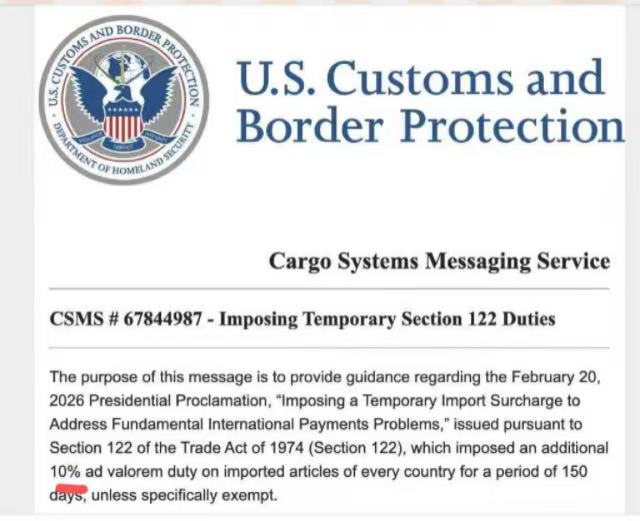
Group 1 - The Trump administration is set to impose a temporary 10% tariff on imports from all countries for 150 days, starting from February 24, 2026, unless explicitly exempted [1][3] - The 10% tariff is a result of the "temporary Section 122 tariff" and is intended to provide guidance on a presidential order issued on February 20, 2026 [4][5] - There is ongoing uncertainty regarding the potential increase of the tariff to 15%, as no official presidential executive order has been issued to implement this change [4][5] Group 2 - The U.S. government is planning to investigate six industries under Section 232 for national security reasons, which may include batteries, cast iron and iron fittings, plastics, industrial chemicals, grid equipment, and telecommunications equipment [1][7] - The Section 232 investigations can lead to indefinite tariffs based on national security assessments, with the process taking approximately nine months [7][8] - The current Section 122 tariff is seen as a transitional measure, allowing the administration time to develop more legally robust tariff measures [7]

美拟对铸铁等六个行业加征新一轮关税
Yang Shi Xin Wen Ke Hu Duan· 2026-02-24 08:03
Core Viewpoint - The U.S. government is considering imposing new tariffs on approximately six industries under the justification of "national security" [1] Group 1: Proposed Tariffs - The proposed tariffs may cover large batteries, cast iron and iron fittings, plastic pipes, industrial chemicals, and equipment for power grids and telecommunications [1] - These new tariffs will be implemented separately from the recently announced global 15% tariff measures [1] Group 2: Legal Framework - The measures will be introduced under Section 232 of the Trade Expansion Act of 1962, which grants the president broad authority to impose tariffs if certain imports are deemed a threat to national security [1] Group 3: Recent Developments - On February 21, former President Trump announced an increase in tariffs on imported goods to the U.S. from 10% to 15%, effective immediately [1] - The U.S. government will determine and announce new "legitimate tariffs" in the coming months [1]
中石科技:合成石墨产品暂未应用于HJT电池产业链相关环节
Ge Long Hui· 2026-02-24 07:14
Group 1 - The core point of the article is that Zhongshi Technology (300684.SZ) has stated that its synthetic graphite products are not yet applied in the HJT battery industry chain [1] Group 2 - The company has communicated this information through an interactive platform [1]

碳中和50ETF国泰(159861)盘中涨超1.5%,固态电池产业化加速推进
Mei Ri Jing Ji Xin Wen· 2026-02-24 07:10
Group 1 - The solid-state battery industry is accelerating its commercialization, with the first national standard for automotive solid-state batteries expected to be reviewed and approved in April and officially released in July [1] - On the equipment side, Lingge Technology has won a bid for a hundred-ton level sulfide solid electrolyte production line [1] - In terms of battery development, companies such as Dingsheng Technology and Huineng Technology have reached cooperation agreements on solid-state batteries, while Guoxuan High-Tech is collaborating with BASF to develop solid-state battery technology [1] Group 2 - Lithium salt prices are declining, while cell prices are on the rise [1] - The Carbon Neutrality 50 ETF from Guotai (159861) tracks the Environmental 50 Index (930614), which selects outstanding listed companies in the clean energy, energy conservation, and environmental governance sectors from the A-share market to reflect the overall development status and trends of China's environmental industry [1]


未知机构:深度东吴电新固态电池技术突破装车在即太空领域打开想象空间-20260224
未知机构· 2026-02-24 02:35
Summary of Conference Call on Solid-State Batteries Industry Overview - The focus is on the solid-state battery industry, which is expected to undergo significant advancements and commercialization in the coming years, particularly in 2025 and 2026 [1][1]. Key Points and Arguments - **Road Testing Phase**: Solid-state batteries are entering the road testing phase in 2026, with a shift in focus from cell technology to pack technology. The progress of vehicle road tests is crucial [1][1]. - **Commercialization Acceleration**: In 2025, the solid-state battery industry is expected to accelerate, with vehicle-grade cells being produced in the first half and pilot lines established in the second half, leading to two major market upswings [1][1]. - **Critical Year 2026**: The year 2026 is identified as a pivotal period, with vehicle-grade packs expected to be produced in the first half, initiating road test validations, and mass production lines anticipated in the second half. The core catalyst for 2026 is the tendering of GWh-level production lines and road tests of related vehicle models, which could lead to significant market movements similar to those seen in 2025 [1][1]. Space Industry Adaptation - **Suitability for Space Applications**: Solid-state batteries are naturally suited for space applications due to their wide temperature range, high energy density, and safety features. They can operate in extreme conditions from -200°C to +150°C, unlike liquid batteries which function only between -20°C and +60°C [2][2]. - **Market Demand in Space**: The demand for solid-state batteries in satellite applications is projected to reach tens to hundreds of GWh annually, with potential uses in deep space probes and lunar bases, expanding the market's imagination [2][2]. Investment Recommendations - **First Line**: Recommend investing in the battery segment with the highest barriers to entry, highlighting companies like CATL, and monitoring others such as Guoxuan High-Tech and Jinlongyu [2][2]. - **Second Line**: Focus on equipment manufacturers, recommending companies like Xianhui Technology, Naconor, and Xian Dao Intelligent, while keeping an eye on others like Honggong Technology and Lingge Technology [2][2]. - **Third Line**: Suggest investing in materials, particularly lithium sulfide and electrolytes, with top picks including Shanghai Xiba, Xiamen Tungsten, and Dangsheng Technology [2][2]. - **Fourth Line**: Monitor new technology firms, including Zhongyi Technology and Yuanhang Precision [2][2]. Risk Factors - **Technological Progress Risks**: There is a risk that advancements in new technologies may not meet expectations, which could impact the overall market and investment outlook [3][3].
美拟以国家安全为由推出新关税,超1000家企业起诉美国政府要求“退税”
Mei Ri Jing Ji Xin Wen· 2026-02-24 02:12
Group 1 - The U.S. government is considering imposing new tariffs on approximately six industries, citing "national security" as the reason, which may include large batteries, cast iron and iron fittings, plastic pipes, industrial chemicals, and grid and telecommunications equipment [1] - The proposed tariffs will be separate from the recently announced global 15% tariff measures [1] - Over 1,000 companies have joined legal actions against the government, seeking refunds for previously paid tariffs, including major firms like Costco and Reebok [1] Group 2 - U.S. Treasury Secretary Scott Bencet emphasized that the Supreme Court's ruling did not address the refund process for previously collected tariffs, leaving it to lower courts to decide [6][7] - The potential refund amount is estimated to be around $134 billion, with some models suggesting it could exceed $175 billion when considering future adjustments [10] - The refund process is expected to involve a combination of court actions, customs, and administrative departments, with the White House already signing an executive order to terminate additional tariffs under the IEEPA [11][12] Group 3 - The legal battle over the IEEPA tariffs represents a significant financial tug-of-war between companies and the Treasury, with the refund issue becoming a politically sensitive topic for the current U.S. administration [15]