自动驾驶

Search documents
美国自动驾驶公司Waymo完成新一轮融资 投后估值达1260亿美元
Xin Lang Cai Jing· 2026-02-03 04:21
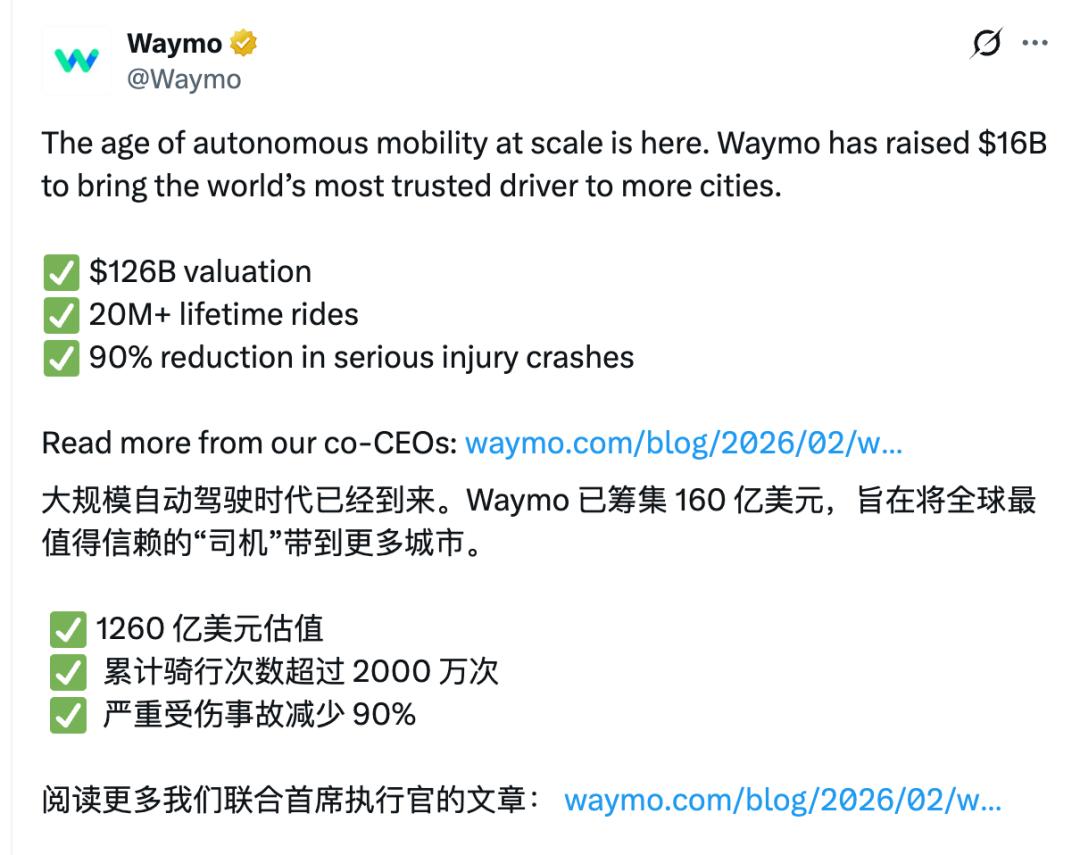
Group 1 - Waymo has raised $16 billion in funding at a valuation of $126 billion, highlighting its rapid rise as a leader in the autonomous taxi service sector [1] - The funding round was led by new investors Sequoia Capital, DST Global, and Dragoneer Investment Group, with Alphabet participating with an investment of $13 billion [1] - Waymo operates fully autonomous ride-hailing services in approximately six cities in the U.S. and plans to accelerate domestic expansion and enter the UK market this year [1] Group 2 - Waymo's per-vehicle cost is estimated to be two to three times that of Tesla's autonomous vehicles, which currently limits the expansion of its fleet size [1]

疯狂,也就2500辆车上路,完成8760亿估值新融资
3 6 Ke· 2026-02-03 04:20
Core Insights - Waymo has successfully raised $16 billion in its latest funding round, significantly increasing its valuation to $126 billion, which is nearly three times its valuation from 19 months ago [1][2][3] - The company aims to focus on global expansion, declaring that the era of large-scale autonomous driving has arrived [1][4] Funding Details - The latest funding round includes major investors such as Google, Sequoia Capital, Dragoneer Investment Group, and DST Global, with Google reportedly investing $13 billion [2][3] - Previous funding rounds included $3.2 billion in March 2020, $2.5 billion in June 2021, and $5 billion in July 2024, with the total amount raised now surpassing previous rounds combined [3] Business Segments - Waymo's operations are divided into two main segments: the core Robotaxi service and new business ventures [4][5] - The Robotaxi service has achieved over 400,000 weekly orders across six major U.S. metropolitan areas, with a projected total of 15 million orders for 2025, more than double that of 2024 [4] New Business Ventures - Waymo is exploring new business opportunities, including food delivery using Robotaxis, where meals are placed in the trunk for customers to pick up [5][7] - The company is also looking to license its autonomous driving technology to original equipment manufacturers (OEMs), although this segment has not yet seen significant progress [7] Market Competition - Other players in the autonomous driving sector, such as RoboTaxi, WeRide, and Pony.ai, are also expanding their operations, with RoboTaxi operating in over 10 cities and achieving significant order volumes [8][11] - Waymo's re-entry into the autonomous trucking market is noted, focusing on long-haul transportation after previously shutting down its truck division due to regulatory challenges [9] Valuation Discrepancies - Despite advancements in autonomous driving, there remains a significant valuation gap between Waymo and its competitors, with Waymo's valuation being tenfold or more compared to others in the market [15] - The recent funding and valuation increase for Waymo may prompt a reevaluation of other players in the autonomous driving space, particularly those in China [15]

国联民生证券:自动驾驶受益于RoboX规模化商用 规模化应用加速
Zhi Tong Cai Jing· 2026-02-03 03:14
Group 1: RoboX Industry Insights - RoboX is accelerating its industrialization, transitioning from technology validation to large-scale deployment, driven by strong policy support and urgent demand for cost reduction and efficiency improvement [1] - Since 2020, the Chinese government has introduced numerous supportive policies, enhancing institutional guarantees for RoboX's development [1] - The penetration rate of L2 and above intelligent functions in passenger vehicles is rapidly increasing, leading to significant cost reductions in core components like lidar and computing chips [1] - The demand for intelligent driving solutions is fueled by multiple factors, including cost reduction, safety enhancement, and labor shortages, positioning RoboX as a core driver of this industrial transformation [1] Group 2: Robotaxi Market Dynamics - Robotaxi's core advantage lies in its significant cost reduction, with operational costs expected to be $0.2 per km by 2027, a 50% decrease compared to traditional ride-sharing platforms [2] - The reduction in human error is anticipated to significantly lower accident rates, enhancing safety, with the global market projected to reach a trillion-dollar scale by 2030 [2] - The decline in hardware costs and improved operational efficiency are key factors driving the commercialization of Robotaxi, with Tesla entering the market using a pure vision approach [2] - Full autonomous commercialization is gradually being implemented in major cities in China, transitioning from technology validation to a commercial closed loop [2] Group 3: Robovan Demand and Supply - The demand for Robovan is driven by labor shortages and high costs in last-mile delivery, making it a critical solution for various high-frequency scenarios [3] - The price of unmanned delivery vehicles is expected to drop significantly from 500,000-600,000 yuan to around 20,000 yuan due to economies of scale in core components [3] - The penetration rate of L2 and above functions in passenger vehicles is projected to exceed 90% by 2030, facilitating the mass production of essential components [3] - Policy support is accelerating with the introduction of hard indicators for deploying unmanned vehicles, promoting the transition from demonstration to large-scale application [3] Group 4: Robotruck Commercialization - Robotruck applications are primarily in closed environments like ports and mines, as well as trunk logistics, with the market size expected to reach a trillion yuan [4] - The successful implementation of L4 in closed scenarios demonstrates the capability for high-intensity operations, while trunk logistics is becoming a core commercial direction [4] - Robotruck utilizes a "virtual driver" to significantly reduce the operating costs of electric tractors, enhancing its commercial viability [4] - National support is clear, but local authorities remain cautious due to the high accident risks associated with heavy trucks, with integrated vehicle-road-cloud trials expected to accelerate cross-province collaboration [4]

小马智行-W盘中涨近4% 近日与爱特博达成业务合作
Xin Lang Cai Jing· 2026-02-03 02:26
Core Viewpoint - The collaboration between Xiaoma Zhixing and Aitebo marks a significant step in expanding the "AI + Mobility" service sector into the high-end market, enhancing the commercialization path for Level 4 autonomous driving [1] Group 1: Business Collaboration - Xiaoma Zhixing has partnered with Aitebo to establish a fully autonomous driving service fleet, promoting the application of autonomous driving technology in urban and travel scenarios [1] - This partnership is seen as a new demonstration of "smart technology + luxury service," injecting new momentum into the commercialization of Level 4 autonomous driving [1] Group 2: Strategic Vision - The founder and CEO of Xiaoma Zhixing, Peng Jun, stated that this collaboration is a key implementation of the company's "light asset + AI empowerment" strategy across diverse mobility scenarios [1] - The company aims not only to provide technology but also to explore efficient paths for the commercialization of Robotaxi in partnership with service-oriented partners [1] Group 3: Market Presence - Xiaoma Zhixing's fully autonomous vehicle fleet and service network have already established a presence in major cities such as Beijing, Shanghai, Guangzhou, and Shenzhen, continuously transforming cutting-edge technology into accessible mobility experiences [1] - The collaboration is expected to leverage Aitebo and Xinghui Travel's deep understanding of high-end business travel scenarios to create a clear value blueprint for the fully autonomous driving industry [1]
小马智行-W涨近4% 近日与爱特博达成业务合作 将“AI+出行”服务赛道拓展至高端市场
Zhi Tong Cai Jing· 2026-02-03 02:17
Core Viewpoint - The collaboration between Xiaoma Zhixing and Aitebo marks a significant step in expanding the "AI + Mobility" service sector into the high-end market, enhancing the commercialization path for Level 4 autonomous driving [1] Group 1: Business Collaboration - Xiaoma Zhixing has partnered with Aitebo to establish a fully autonomous driving service fleet, promoting the application of autonomous driving technology in urban and travel scenarios [1] - This partnership is seen as a demonstration of "smart technology + luxury service," injecting new momentum into the commercialization of Level 4 autonomous driving [1] Group 2: Strategic Vision - The founder and CEO of Xiaoma Zhixing, Peng Jun, stated that this collaboration is a key implementation of the company's "light asset + AI empowerment" strategy across diverse mobility scenarios [1] - The company aims to not only provide technology but also to explore efficient paths for the commercialization of Robotaxi in partnership with service-oriented partners [1] Group 3: Market Presence - Xiaoma Zhixing's fully autonomous vehicle fleet and service network have already established a presence in major cities such as Beijing, Shanghai, Guangzhou, and Shenzhen, continuously transforming cutting-edge technology into accessible mobility experiences [1]
港股异动 | 小马智行-W(02026)涨近4% 近日与爱特博达成业务合作 将“AI+出行”服务赛道拓展至高端市场
智通财经网· 2026-02-03 02:14
Core Viewpoint - The collaboration between Pony.ai and Aitboda aims to establish a fully autonomous driving service fleet, expanding the application of autonomous driving technology in urban and travel scenarios, marking a significant step into the high-end market [1] Group 1: Business Collaboration - Pony.ai has partnered with Aitboda to co-build a fully autonomous driving service fleet [1] - This partnership signifies the expansion of the "AI + Mobility" service sector into the high-end market [1] - The collaboration introduces a new demonstration of "smart technology + luxury service" for the commercialization path of L4 autonomous driving [1] Group 2: Strategic Vision - The CEO of Pony.ai, Peng Jun, stated that this collaboration is a key implementation of the company's "light asset + AI empowerment" strategy in diverse mobility scenarios [1] - The company aims not only to provide technology but also to explore efficient paths for the commercialization of Robotaxi in partnership with service-oriented partners [1] - The collaboration leverages Aitboda and Xinghui Travel's deep understanding of high-end business travel scenarios to create a clear value blueprint for the fully autonomous driving industry [1]
希迪智驾20260202
2026-02-03 02:05
Summary of the Conference Call for Xidi Zhijia Company Overview - **Company**: Xidi Zhijia - **Focus**: L4 autonomous driving, intelligent connected products, and high-performance perception products in mining and logistics sectors - **Commercialization**: Achieved in unmanned mining and logistics, with flagship product "Yuanyuan Mining" connecting virtual and physical worlds, enabling remote scheduling and deployment of hundreds of vehicles in large mines [2][6] Industry Insights - **Market Potential**: The potential market size for China's unmanned mining sector is projected to reach 550 billion yuan in 2023, with the vehicle sales market around 200 billion yuan [2][9] - **Government Policy**: National policies are pushing for automation in mining, aiming for unmanned operations by 2030, with some regions targeting 80% unmanned vehicles by 2027 [3] Financial Performance - **Revenue Growth**: Revenue started at over 30 million yuan in 2022, expected to reach 410 million yuan in 2024, and projected to double in 2025 [12] - **Customer Base**: Increased from over 40 customers in 2022 to over 100 currently, with strong order backlog indicating continued growth [12] - **Gross Margin**: Maintains a gross margin of 20%-25%, which is high for autonomous driving companies [4][13] Technological Advantages - **Technical Barriers**: Key advantages include multi-agent cluster control and heavy vehicle motion control, which are difficult for competitors to replicate [17] - **Product Lines**: Three main product lines include L4 autonomous driving for mining and logistics, B to X intelligent connected products, and high-performance perception for rail transport [5] Commercialization Strategy - **Sales Model**: Focuses solely on product sales rather than vehicle operation, ensuring no conflict of interest with customers [28] - **International Expansion**: Actively pursuing overseas markets, with contracts signed in Australia and orders in Mongolia, aiming to expand into Russia and the Middle East [20][22] Market Dynamics - **Competition**: The mining autonomous driving market is competitive, but Xidi Zhijia has differentiated itself through its comprehensive technology stack and focus on product reliability [35] - **Operational Efficiency**: Autonomous vehicles can operate 21-22 hours a day, significantly improving efficiency compared to human drivers [27] Future Outlook - **Sales Projections**: Expected to maintain close to double growth in 2026 and 2027, with a focus on product sales [15] - **Pricing Strategy**: Currently employs a one-time payment model, with potential future adjustments to SaaS or per-transportation pricing based on customer type [39] Additional Insights - **Impact on Employment**: Automation in mining is expected to alleviate labor shortages and improve safety without significantly impacting employment levels [26] - **R&D Expenses**: Total expenses for 2024 are projected at around 450 million yuan, with a significant portion attributed to stock-based compensation [29] This summary encapsulates the key points from the conference call, highlighting the company's strategic focus, market potential, financial performance, technological advantages, and future outlook.
2.3犀牛财经早报:国有六大行强化黄金投资业务风险管控
Xi Niu Cai Jing· 2026-02-03 01:40
Group 1: Gold Investment and Market Dynamics - Gold prices have experienced significant volatility this year, prompting major state-owned banks in China to enhance risk management in gold investment businesses by raising entry barriers and adding risk assessment requirements [1] - Despite short-term price fluctuations, experts believe that gold and precious metals still hold medium to long-term investment value due to global risk aversion and changes in asset allocation logic [1] - A collective drop in 13 futures products occurred, attributed to panic selling and concentrated leverage, leading to a significant market downturn [1] Group 2: Central Enterprises and Performance Forecasts - Over 110 central enterprise-controlled listed companies in China have reported positive performance forecasts for 2025, with many achieving substantial profit increases or returning to profitability [2] - Industries such as military, steel, and chemicals are showing particularly strong performance [2] Group 3: Storage Market and Price Surge - The global storage market is entering a super cycle, with prices for DRAM and NAND flash memory chips rising over 300% since Q3 2025, and further increases are expected in early 2026 [3] - Many storage companies are reporting improved performance due to the high demand driven by AI and computing industries [3] Group 4: Fertilizer Market Trends - The fertilizer market is experiencing a structural price increase as the spring farming season approaches, with notable price rises in nitrogen, phosphorus, and potassium fertilizers [3] Group 5: Electricity Consumption Forecast - The China Electricity Council predicts a 5% to 6% year-on-year growth in national electricity consumption for 2026, with solar power generation capacity expected to surpass coal power for the first time [5] Group 6: Corporate Developments - Tianyi Space Technology Co., Ltd. has initiated the listing guidance process for its IPO [10] - Dream Garden has received approval for the full circulation listing of its H-shares on the Hong Kong Stock Exchange [11] - Dayang Shengxiang anticipates a 92.81% decline in net profit for 2025 due to decreased production and sales [12] - ZTE Corporation plans to invest 117 million yuan in a new equity investment fund focused on advanced technology sectors [13]
金融界财经早餐:国务院重磅批复!要建成以首都为核心的世界一流都市圈;十部门推动低空经济标准体系建设;沪市首份年报出炉;上百家央企控股上市公司业绩“预喜”(2月3日)
Jin Rong Jie· 2026-02-03 01:32
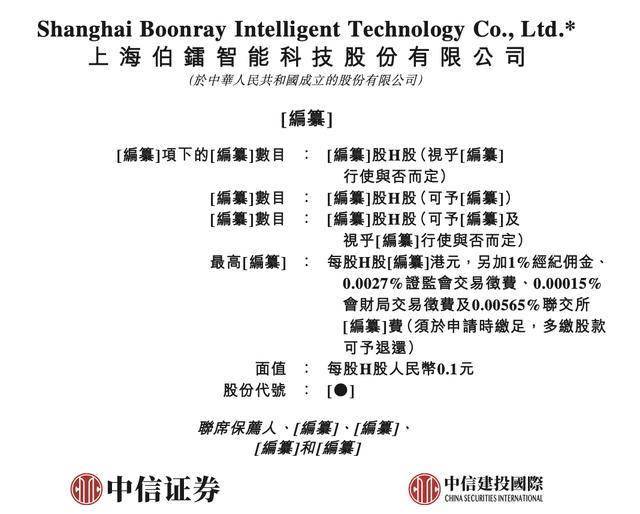
Company Highlights - Chip导科技 reported a revenue of 394 million yuan for 2025, an increase of 11.52% year-on-year, with a net profit of 106 million yuan, down 4.91% year-on-year, and plans to distribute a cash dividend of 4.3 yuan per 10 shares [7] - Shanghai Yizhong achieved a total revenue of 317 million yuan for 2025, a year-on-year increase of 82.72%, with a net profit of 64.13 million yuan, up 819.42% year-on-year, driven by the inclusion of its core product in the national medical insurance directory [8] - Changling Hydraulic disclosed a tender offer report, planning to acquire 12% of its total shares at a price of 35.82 yuan per share [8] - Aorede's subsidiary plans to invest approximately 145 million yuan in computing power equipment to provide services to clients [8] - Shanzi Gaoke completed a debt restructuring for its European subsidiary, expecting a reduction in liabilities by 1.94 billion yuan [9] - Xian Dao Intelligent plans to issue up to 93,616,000 H-shares, with a maximum price of 45.8 HKD per share, expected to start trading on February 11 [9] - Dream Gold Garden received approval for the listing of 40 million H-shares, which are to be converted and traded [9] - Restaurant Brands International announced a joint venture with CPE Yuanfeng, injecting 350 million USD into Burger King China, aiming to expand the number of stores from approximately 1,250 to over 4,000 by 2035 [9] - Oracle initiated a USD bond issuance plan, seeking to raise between 45 billion to 50 billion USD for cloud infrastructure expansion, with the bond transaction expected to be between 20 billion to 25 billion USD [10] - SpaceX announced a merger with AI startup xAI, covering AI, rocket technology, and satellite internet, with a projected valuation of 1.25 trillion USD for the combined entity [10] - Western Digital reported a quarterly revenue of 3.017 billion USD for Q2, up 25% year-on-year, with an operating profit of 908 million USD, a 62% increase year-on-year [10] - Douyin became the exclusive partner for the 2026 Spring Festival Gala's new media segment, offering various viewing experiences [10] Industry Insights - The real estate sector in Shanghai has initiated the acquisition of second-hand housing for affordable rental housing projects, while Tianjin has adjusted the minimum down payment ratio for commercial property loans to no less than 30% [5] - Goldman Sachs raised its forecast for DRAM contract prices, expecting a quarter-on-quarter increase of 90-95% in Q1 2026, despite fluctuations in the spot market [5] - Tesla announced the upcoming launch of its third-generation humanoid robot, with plans for annual production of one million units [5] - The AI computing power industry is seeing significant support, with Beijing Economic Development Zone establishing a large public computing power platform to reduce initial computing costs for enterprises by over 50% [5] - Waymo, Alphabet's autonomous driving company, completed a financing round of 16 billion USD, achieving a post-money valuation of 126 billion USD, indicating a growing interest in the autonomous driving sector [6]
伯镭科技40岁创始人胡心怡担任董事长,曾任职博世、丹纳赫等跨国公司
Sou Hu Cai Jing· 2026-02-03 01:16
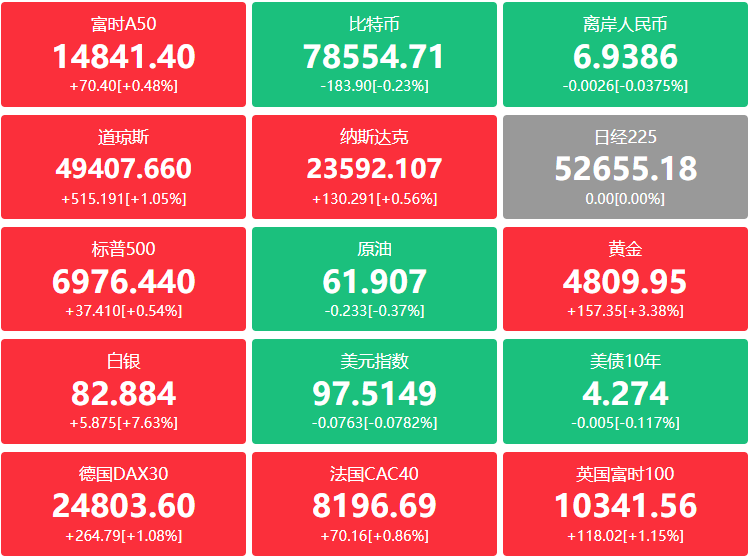
Core Viewpoint - Shanghai Berai Intelligent Technology Co., Ltd. (referred to as "Berai Technology") has submitted its prospectus to the Hong Kong Stock Exchange, with CITIC Securities and CITIC International as joint sponsors [2]. Group 1: Company Overview - As of 2024, Berai Technology is the largest pure electric autonomous mining truck provider globally by shipment volume and revenue, and the largest provider of electric and automated mining solutions by the cumulative number of mines adopting its solutions [3]. - By shipment volume in 2024, the company is also the second-largest provider of autonomous mining truck solutions in China [3]. Group 2: Financial Performance - In 2023 and 2024, Berai Technology achieved revenues of 69.565 million yuan and 171.836 million yuan, respectively, with losses of 32.479 million yuan and 60.986 million yuan for the same periods [4]. - For the first three quarters of 2025, the company reported revenues of 315.214 million yuan, representing a year-on-year growth of 819.9%, while the loss for the period was 58.666 million yuan, compared to a loss of 45.622 million yuan in the same period the previous year [4]. Group 3: Financial Metrics - The gross profit margin for 2023 was 11.3%, which increased to 15.1% in 2024, and further to 30.1% in the first three quarters of 2025 [5]. - The total revenue for 2024 was 171.836 million yuan, with a cost of sales of 145.029 million yuan, resulting in a gross profit of 25.807 million yuan [5]. - Administrative expenses for 2024 were 21.315 million yuan, accounting for 12.5% of total revenue, while research and development expenses were 37.256 million yuan, representing 21.8% of total revenue [5]. Group 4: Leadership - The company is led by Hu Xinyi, who is the Chairman, CEO, and Executive Director. She founded the company and has been in her current roles since its establishment in July 2015 [6][7]. - Hu Xinyi has extensive experience in industrial automation and engineering machinery, having worked in multinational companies such as Bosch and Danaher [6][7]. - She has received multiple accolades for her entrepreneurial achievements, including being named a Global Climate Leader by Yale University in 2024 [6][7].