装修建材

Search documents
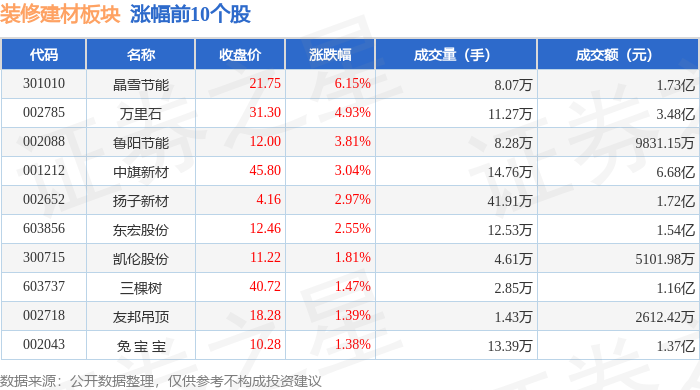
装修建材板块8月12日涨0.45%,晶雪节能领涨,主力资金净流出2000.31万元
Zheng Xing Xing Ye Ri Bao· 2025-08-12 08:31
Market Overview - The renovation and building materials sector increased by 0.45% compared to the previous trading day, with Jingxue Energy leading the gains [1] - The Shanghai Composite Index closed at 3665.92, up 0.5%, while the Shenzhen Component Index closed at 11351.63, up 0.53% [1] Top Performers - Jingxue Energy (301010) closed at 21.75, up 6.15%, with a trading volume of 80,700 shares and a transaction value of 173 million yuan [1] - Wanli Stone (002785) closed at 31.30, up 4.93%, with a trading volume of 112,700 shares and a transaction value of 348 million yuan [1] - Luyang Energy (002088) closed at 12.00, up 3.81%, with a trading volume of 82,800 shares and a transaction value of 98.31 million yuan [1] Underperformers - Puyuan Co. (002225) closed at 7.16, down 2.85%, with a trading volume of 534,700 shares and a transaction value of 383 million yuan [2] - Ruitai Technology (002066) closed at 12.66, down 1.94%, with a trading volume of 40,800 shares and a transaction value of 52.12 million yuan [2] - Gu Di Technology (002694) closed at 4.64, down 1.49%, with a trading volume of 59,300 shares and a transaction value of 27.64 million yuan [2] Capital Flow - The renovation and building materials sector experienced a net outflow of 20.0031 million yuan from institutional investors, while retail investors saw a net outflow of 54.4049 million yuan [2] - Speculative funds had a net inflow of 74.408 million yuan into the sector [2] Individual Stock Capital Flow - Zhongqi New Materials (001212) had a net inflow of 49.8093 million yuan from institutional investors, but a net outflow of 51.3746 million yuan from retail investors [3] - Wanli Stone (002785) saw a net inflow of 21.5154 million yuan from institutional investors, with a net outflow of 16.4976 million yuan from retail investors [3] - Donghong Co. (603856) had a net inflow of 17.0813 million yuan from institutional investors, but a net outflow of 18.5412 million yuan from retail investors [3]


装修建材板块午盘拉升 博雅股份股价涨幅4.32%
Bei Jing Shang Bao· 2025-08-11 06:17
Group 1: Market Performance - The renovation and building materials sector experienced a slight increase, closing at 14,604.44 points with a rise of 1.05% [1] - Several stocks in the renovation and building materials sector saw price increases, with Boya Co. leading at 1.69 CNY per share, up 4.32% [1] - Xiong Plastic Technology and Yangzi New Materials followed, closing at 8.82 CNY (up 3.64%) and 4.03 CNY (up 3.60%) respectively [1] - Conversely, Filinger led the decline in the sector, closing at 22.46 CNY per share, down 1.92% [1] - Songlin Technology and Wanli Stone also saw declines, closing at 29.95 CNY (down 1.35%) and 29.43 CNY (down 0.84%) respectively [1] Group 2: Industry Insights - According to a report by EEO Research Institute, the transaction volume in China's technology market is increasing annually, projected to reach 6.8 trillion CNY in 2024, a year-on-year growth of approximately 11.2% [1] - The robust development of the technology market supports the stable growth of China's whole-house smart industry, with higher technology maturity driving market prosperity and diversification [1] - By 2025, the scale of China's smart home market is expected to exceed 1 trillion CNY, with major players in the internet, home appliances, and traditional hardware sectors actively entering the smart home arena [1]
建筑材料行业跟踪周报:基建投入持续强化-20250811
Soochow Securities· 2025-08-11 03:09
Investment Rating - The report maintains an "Overweight" rating for the construction materials industry [1] Core Views - The construction materials sector is expected to benefit from increased infrastructure investment, with a notable focus on cement and glass fiber industries as key areas for growth [3][4] - The report highlights a potential recovery in cement prices due to supply-side discipline and government support for infrastructure projects [10][12] - The demand for construction materials is anticipated to improve as consumer confidence returns and government policies stimulate domestic consumption [13] Summary by Sections 1. Industry Overview - The construction materials sector has shown a 1.19% increase in the past week, underperforming compared to the Shanghai Composite Index which rose by 1.23% [3] - The report emphasizes the importance of government investment in infrastructure to stabilize demand in the sector [4] 2. Bulk Construction Materials Fundamentals 2.1 Cement - The national average price for high-standard cement is currently 339.7 CNY/ton, unchanged from last week but down 42.5 CNY/ton compared to the same period last year [3][17] - The average cement inventory level is at 67.4%, with an average shipment rate of 44.0%, indicating a slight decline in demand [24] - The report suggests that if self-discipline measures are effectively implemented, cement prices may begin to rise in late August [10][16] 2.2 Glass Fiber - The report notes a clear trend towards upgrading electronic glass fiber products, with high-end products expected to see increased market penetration [11] - The profitability of ordinary glass fiber remains resilient, supported by growth in domestic demand from sectors like wind power and thermal plastics [11] 2.3 Glass - The glass industry is expected to experience a supply-side contraction, which may improve the short-term supply-demand balance [12] - The report recommends focusing on leading companies in the glass sector that can leverage resource advantages and enjoy excess profits [12] 3. Renovation and Building Materials - The report highlights the potential for increased domestic demand for renovation materials due to government policies aimed at stimulating consumption [13] - It suggests that leading companies in the renovation materials sector are well-positioned to benefit from these trends, with many currently trading at low valuations [13][14]



北京出台地产政策,关注后续其他地区跟进情况
GOLDEN SUN SECURITIES· 2025-08-10 13:24
Investment Rating - The report recommends a "Buy" rating for companies such as Beixin Building Materials and China Jushi, while suggesting an "Overweight" rating for Weixing New Materials [9]. Core Views - The construction materials sector has shown a mixed performance, with cement prices stabilizing while glass and fiberglass sectors face challenges [2][3]. - The recent policy changes in Beijing regarding real estate are expected to influence demand dynamics across the sector [2]. - The report highlights the potential for recovery in the construction materials sector, particularly in municipal engineering projects due to increased government bond issuance [2]. Summary by Sections 1. Market Overview - From August 4 to August 8, 2025, the construction materials sector (SW) increased by 1.24%, with cement rising by 2.81% and glass manufacturing declining by 0.37% [12]. - The net capital inflow for the construction materials sector was -680 million yuan during this period [12]. 2. Cement Industry Tracking - As of August 8, 2025, the national cement price index was 335.96 yuan/ton, a decrease of 0.51% from the previous week [16]. - The national cement output was 2.6415 million tons, down 4.08% week-on-week, with infrastructure cement supply also declining [16]. - The report notes that while infrastructure remains a key demand driver, residential construction demand is weak, and recovery in civil demand is contingent on seasonal factors [16]. 3. Glass Industry Tracking - The average price of float glass was 1274.90 yuan/ton, reflecting a 1.57% decrease from the previous week [6]. - Inventory levels for glass have increased, indicating ongoing supply-demand imbalances [6]. 4. Fiberglass Industry Tracking - The report indicates that fiberglass prices have stabilized after a period of decline, with demand expected to improve due to growth in wind power installations [7]. - The market for electronic yarn remains stable, with high-end products experiencing strong demand [7]. 5. Consumer Building Materials - The consumer building materials sector is benefiting from improved second-hand housing transactions and consumption stimulus policies [2]. - The report continues to recommend companies like Beixin Building Materials and Weixing New Materials for their growth potential [9]. 6. Carbon Fiber Industry Tracking - The carbon fiber market is showing signs of stability, with production levels remaining consistent and demand expected to grow in various applications [8].


海螺新材股价微涨0.78% 拟挂牌出售资产优化资源配置
Jin Rong Jie· 2025-08-08 17:41
Core Viewpoint - The company, Conch New Materials, is actively managing its assets and financial structure, including a significant land sale to enhance liquidity while maintaining a strong focus on its core business in the construction materials sector [1]. Group 1: Company Performance - As of August 8, 2025, Conch New Materials' stock price is 6.46 yuan, reflecting an increase of 0.05 yuan from the previous trading day, with a trading volume of 0.29 billion yuan [1]. - The opening price for the day was 6.38 yuan, with a high of 6.46 yuan and a low of 6.37 yuan, resulting in a trading range of 1.40% and a turnover rate of 1.24% [1]. Group 2: Business Operations - The company's main business includes the research, production, and sales of mid-to-high-end plastic profiles, aluminum profiles, and doors and windows, primarily within the construction materials sector [1]. - In 2024, the construction materials segment is expected to account for 84.8% of the company's revenue structure [1]. Group 3: Asset Management - On August 8, the company announced plans to publicly sell part of its land, buildings, and related facilities located in Wuhu Economic and Technological Development Zone for a base price of 94.5 million yuan [1]. - The assessed market value of the asset is 89.85 million yuan, indicating an appreciation rate of 787.25%, with proceeds from the sale intended to supplement working capital [1]. Group 4: Financial Flow - On August 8, the net outflow of main funds was 654,100 yuan, with a cumulative net outflow of 3.0941 million yuan over the past five trading days [1].

东方雨虹股价12.40元 社保基金持股3793万股
Jin Rong Jie· 2025-08-08 16:27
Group 1 - The stock price of Dongfang Yuhong is 12.40 yuan, down 0.72% from the previous trading day, with an opening price of 12.49 yuan, a high of 12.54 yuan, and a low of 12.35 yuan, with a trading volume of 212,400 hands and a transaction amount of 264 million yuan [1] - Dongfang Yuhong operates in the construction materials sector, focusing on the research, production, and sales of building waterproof materials, which are widely used in various fields such as housing construction, highways, urban bridges, subways, and airports [1] - As of the end of the second quarter, the social security fund held 37.9341 million shares of Dongfang Yuhong, a decrease of 6.57% from the previous period, accounting for 1.98% of the circulating shares [1] Group 2 - The Kuwait Investment Authority and other QFII institutions are among the top ten circulating shareholders of the company [1] - MSCI China A-share Index will remove Dongfang Yuhong from its constituent stocks, with the adjustment effective after the close on August 26 [1] - On the same day, the net outflow of main funds from Dongfang Yuhong was 16.0331 million yuan, accounting for 0.07% of the circulating market value, while the cumulative net inflow of main funds over the past five trading days was 60.4932 million yuan, accounting for 0.25% of the circulating market value [1]

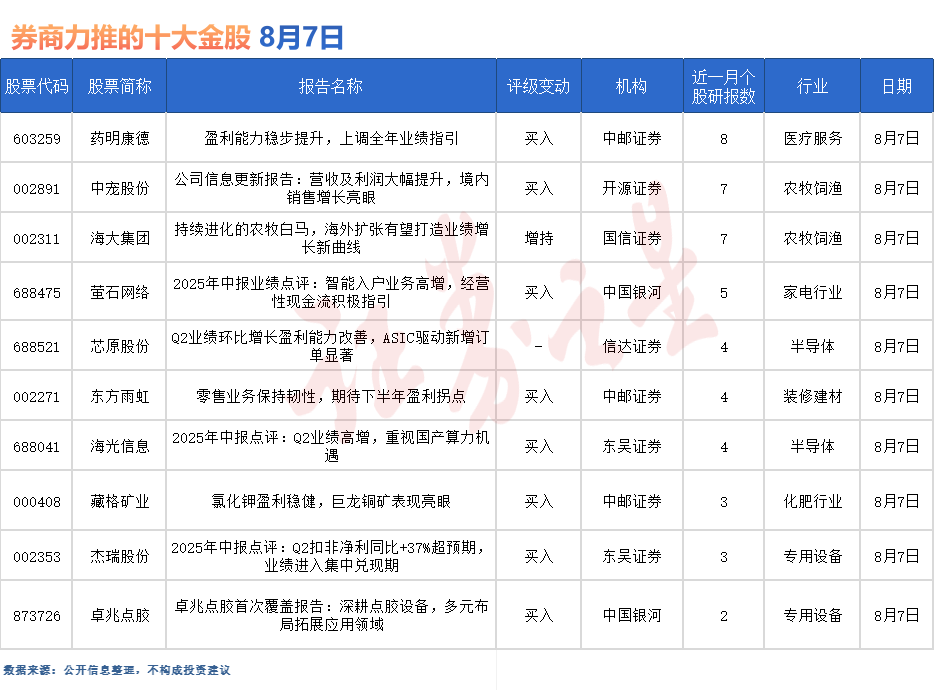
8月7日券商今日金股:8份研报力推一股(名单)
Zheng Quan Zhi Xing· 2025-08-07 08:17
Core Viewpoint - On August 7, securities firms issued "buy" ratings for over 20 A-share listed companies, focusing on sectors such as medical services, agriculture, home appliances, semiconductors, construction materials, fertilizers, and specialized equipment [1]. Group 1: Key Stocks Recommended by Securities Firms - WuXi AppTec (603259) received a "buy" rating from Zhongyou Securities, with an upward revision of its annual performance guidance, expecting revenues of 43.29 billion, 49.02 billion, and 55.85 billion yuan for 2025, 2026, and 2027, respectively, with a net profit of 14.91 billion, 13.88 billion, and 16.16 billion yuan [2][3]. - Zhong'an Shares (002891) was highlighted by Kaiyuan Securities for significant revenue and profit growth, with a focus on domestic sales [2]. - Haida Group (002311) is noted for its overseas expansion potential, with a report from Guoxin Securities emphasizing its status as a quality asset in the agriculture sector [3][4]. - Junshi Network (688475) was rated "buy" by Yuanyin Galaxy, citing strong growth in its smart home business [2]. - Chipone Technology (688521) showed improved profitability in Q2, with a report from Xinda Securities [2]. - Dongfang Yuhong (002271) is expected to reach a profitability turning point in the second half of the year, according to Zhongyou Securities [2]. - Haiguang Information (688041) received attention for its performance in the semiconductor sector [2]. - Cangge Mining (000408) was noted for stable profitability in potassium chloride and strong performance from its copper mine [2]. - Jereh Group (002353) reported a 37% year-on-year increase in net profit, exceeding expectations [2]. - Zhuozhao Dispensing (873726) received initial coverage for its diverse expansion in dispensing equipment [2]. Group 2: Overall Market Insights - The focus of securities firms on various sectors indicates a strategic interest in industries with growth potential, particularly in medical services and agriculture [1][4]. - The reports suggest that while "buy" or "increase" ratings are provided, they do not guarantee stock price increases, and investors should consider these ratings as references rather than definitive investment advice [4].

超半数装修建材股下跌 菲林格尔以21.10元/股收盘
Bei Jing Shang Bao· 2025-08-07 07:46
Group 1 - The renovation and building materials sector experienced a slight decline, closing at 14,357.55 points with a drop of 0.37% [1] - Filinger led the decline in the renovation and building materials stocks, closing at 21.10 CNY per share with a decrease of 4.18% [1] - Beijing Lier and Puyang Co. followed with declines of 3.16% and 2.79%, closing at 6.75 CNY and 7.32 CNY per share respectively [1] Group 2 - The report from Yiou Think Tank indicates that the transaction volume in China's technology market is increasing annually, with a projected contract transaction volume of 6.8 trillion CNY in 2024, reflecting a year-on-year growth of approximately 11.2% [1] - The development of the technology market is providing a stable foundation for the growth of the whole-house smart industry in China [1] - By 2025, the smart home market in China is expected to exceed 1 trillion CNY, driven by major players in the internet, home appliances, and traditional hardware sectors entering the smart home arena [1]


装修建材板块午盘微跌 北京利尔股价下跌2.87%
Bei Jing Shang Bao· 2025-08-07 06:03
银河证券发布研报称,AI与消费结合,首先将改变消费服务行业业态。其次,AI将逐步渗透到AI+玩 具、AI+清洁、AI+宠物用品等领域。在智慧家居时代,不同产品之间交互存在割裂,因此产生了对中 心平台的需求。而在万物拟人化时代,由于AI+产品都具备良好的AI支持,彼此之间有望进行密切的交 流和协作。 北京商报讯(记者 翟枫瑞)8月7日,装修建材板块午盘小幅下跌,以14367.01点收盘,跌幅为0.30%。 受板块影响,装修建材板块个股出现不同程度下跌。北京利尔午盘以6.77元/股收盘,跌幅为2.87%,领 跌装修建材股。大亚圣象午盘以7.74元/股收盘,跌幅为2.15%,跌幅位列装修建材股第二。松霖科技午 盘以28.44元/股收盘,跌幅为2.10%,跌幅位列装修建材股第三。除此之外,*ST松发午盘以49.93元/股 收盘,涨幅为3.61%,领涨装修建材股。好莱客午盘以11.34元/股收盘,涨幅为3.47%,涨幅位列装修建 材股第二。金牌家居午盘以21.11元/股收盘,涨幅为1.73%,涨幅位列装修建材股第三。 ...
装修建材业CFO群体观察:三棵树朱奇峰最高学历博士年收入达136.17万元
Xin Lang Cai Jing· 2025-08-07 04:38
Group 1 - The total salary scale of CFOs in A-share listed companies reached 4.27 billion yuan in 2024, with 66 companies in the building materials sector disclosing CFO information [1][2] - The average age of CFOs in the renovation and building materials sector is 48.03 years, with 41.4% aged over 50 and 40-50, while 17.2% are aged 30-40 [1] - The highest-paid CFO is Yao Yonghua from Luyuan Energy, earning 2.31 million yuan, which is 1.60 times the salary of the second-highest, Wang Shuai from Beixin Building Materials [2] Group 2 - The majority of CFOs in the renovation and building materials sector have a short tenure, with 44.8% serving for 1-3 years, while 27.6% and 24.1% have tenures of 5-10 years and over 10 years, respectively [2] - Approximately 53.6% of CFOs in the sector hold a bachelor's degree, while master's and associate degrees account for 25.0% and 17.9%, respectively [2] - The average annual salary for CFOs in the renovation and building materials sector is 692,700 yuan, which is nearly 10% lower than the average salary in the building materials industry, with a year-on-year increase of 19.9% [2]