
体育产业

Search documents
天府文旅10.0%涨停,总市值95.02亿元
Jin Rong Jie· 2025-08-01 07:40
截至3月31日,天府文旅股东户数8.1万,人均流通股1.59万股。 2025年1月-3月,天府文旅实现营业收入1.79亿元,同比增长90.54%;归属净利润2778.92万元,同比增 长4.98%。 8月1日,天府文旅盘中10.0%涨停,截至14:48,报7.37元/股,成交22.34亿元,换手率24.67%,总市值 95.02亿元。 资料显示,成都新天府文化旅游发展股份有限公司位于中国(四川)自由贸易试验区成都高新区府城大道 西段399号10栋5楼,公司专注于体育产业,涵盖体育空间、赛事、金融、教育、网络和传媒六大平台, 致力于打造融合发展的体育生态圈。公司实施"416战略",通过"空间+内容"商业模式,构建了完整的产 业链条,推动体育产业化发展。 ...

广州发布体育强市建设规划 全力建设三大国际中心
Zhong Guo Chan Ye Jing Ji Xin Xi Wang· 2025-07-30 22:17
Core Points - The Guangzhou Municipal Government has issued the "Guangzhou Sports Strong City Construction Plan (2024-2035)" aiming to establish three international centers: International Sports Consumption Center, International Bay Area Sports Center, and International Sports Events Center [1] - By 2035, the plan targets a per capita sports venue area of 3.4 square meters, a participation rate in sports activities of over 45%, and a sports industry value-added ratio of 2.4% to GDP [1][9] Group 1: Infrastructure and Accessibility - Guangzhou will enhance public sports facilities by utilizing old factories and under-bridge spaces, and will promote embedded sports facilities to improve community access to fitness resources [2] - The plan emphasizes the integration of sports and education, ensuring that students engage in at least 2 hours of physical activity daily and have access to regular physical education classes [2] - Public sports venues will be opened to the public for free or at low cost, with an increase in the proportion of schools that open their facilities to the community [2] Group 2: Competitive Sports Development - The plan supports the development of top-tier sports clubs and encourages social and market participation in athlete and coach training [3] - Guangzhou aims to strengthen its competitive sports by focusing on athletics and swimming while promoting traditional Chinese martial arts and emerging sports like e-sports [3] - The establishment of high-level training bases for key sports in collaboration with the National Sports Administration is also a priority [3] Group 3: Sports Consumption and Event Economy - The plan aims to enhance the sports industry's self-sustaining capabilities by developing new sports trends such as e-sports and water sports, and creating integrated consumption scenarios combining sports, commerce, and tourism [5][6] - Initiatives will be taken to promote night sports consumption and create themed sports consumption zones across the city [6] - The plan includes the introduction of international sailing events and the development of outdoor sports destinations to boost the local sports economy [6] Group 4: Regional Cooperation and Event Hosting - Guangzhou will establish a cooperation mechanism with Hong Kong and Macau to share resources and standards in sports [7] - The city plans to host high-profile international events and develop its own brand events, aiming to enhance its global sports presence [8] - The goal is to secure the hosting of over 10 significant international A-level events and to strengthen the local sports event ecosystem [8]
10年布局120座体育公园,周莉如何构筑她的“精神原乡”
Sou Hu Cai Jing· 2025-07-30 13:25
Core Insights - The article highlights the innovative approach of Happy Sports Group in integrating sports into community development and urban renewal, emphasizing the importance of sports parks as a means to enhance community engagement and quality of life [1][5][9] Group 1: Company Overview - Happy Sports Group, founded by Zhou Li, has been a pioneer in promoting "child-friendly cities" and exploring "sports consumption scenarios" in Chengdu, China [1] - The company has established over 120 sports park projects across more than 40 cities in China, focusing on community-based sports services and sustainable operations [8][9] Group 2: Industry Trends - The sports industry in China has seen rapid growth over the past decade, with a shift towards integrating sports into community life and urban planning [5][9] - Zhou Li's vision includes transforming sports parks into "spiritual homes" that continuously create a better lifestyle, rather than just being physical venues [1][5] Group 3: Community Engagement - The introduction of the WePark community smart football park model in Chengdu exemplifies the integration of advanced sports technology and community needs, allowing residents to access high-quality training facilities [8][9] - Events like the "Community World Cup Smart Football Challenge" have successfully engaged over 500,000 participants, showcasing the potential of sports to activate community vitality [8][9] Group 4: International Collaboration - Happy Sports Group actively engages in international partnerships, collaborating with top sports institutions from Finland and the Netherlands to enhance its offerings and expand its reach [5][16] - The company has facilitated over 300 international exchanges and established 47 cooperative projects between China and Nordic countries, promoting cross-cultural sports initiatives [18][19] Group 5: Future Plans - Looking ahead to the 2025 World University Games in Chengdu, Happy Sports Group aims to leverage this opportunity to deepen international cooperation and promote its successful sports industry practices nationwide [22] - The company plans to integrate the global vitality city assessment system into Chinese urban planning, aspiring to help more cities achieve "global vitality city" certification in the next five years [22]


天府文旅10.02%涨停,总市值84.96亿元
Jin Rong Jie· 2025-07-30 06:10
7月30日,天府文旅盘中10.02%涨停,截至13:34,报6.59元/股,成交15.1亿元,换手率18.79%,总市值 84.96亿元。 截至3月31日,天府文旅股东户数8.1万,人均流通股1.59万股。 2025年1月-3月,天府文旅实现营业收入1.79亿元,同比增长90.54%;归属净利润2778.92万元,同比增 长4.98%。 资料显示,成都新天府文化旅游发展股份有限公司位于中国(四川)自由贸易试验区成都高新区府城大道 西段399号10栋5楼,公司专注于体育产业,涵盖体育空间、赛事、金融、教育、网络和传媒六大平台, 致力于打造融合发展的体育生态圈。公司实施"416战略",通过"空间+内容"商业模式,构建了完整的产 业链条,推动体育产业化发展。 ...
“苏超”前六轮实现服务营收近380亿元!出行、餐饮场景的江苏省外游客支付占比分别达28.8%、19.7%
Ge Long Hui· 2025-07-30 05:28
Core Insights - Jiangsu Province's economic and social development report for the first half of 2025 indicates significant growth in service revenue, particularly in tourism, travel, dining, accommodation, and sports sectors [1] Group 1: Economic Performance - The total service revenue from the monitored sectors in Jiangsu reached 37.96 billion yuan, reflecting a year-on-year increase of 42.7% [1] - Among the service revenue, the share of payments from out-of-province tourists in the travel and dining sectors accounted for 28.8% and 19.7%, respectively [1]
体育流量如何转化为经济增量?各界专家共议体育商业化创新
Sou Hu Cai Jing· 2025-07-30 05:17
Core Insights - The global sports industry is rapidly developing, valued at $800 billion, accounting for approximately 1% of global GDP [1] - There is an imbalance in the development of the sports industry, particularly in "Global South" countries, which include developing nations in Africa, Latin America, the Middle East, and Southeast Asia [1] - China is enhancing its trade vitality and leading a new round of sports industry development through cooperation with "Global South" countries [1] Group 1 - The "Global South" countries represent two-thirds of the world's population and nearly 50% of the global economy, indicating significant potential for sports industry growth [1] - Experts emphasize the importance of promoting community and mass sports in these regions to harness their development potential [1] Group 2 - Foreign experts commend China's sports policies, highlighting the role of sports in shaping national identity and the systematic planning for sports development [6] - There is a call for increased international cooperation between China and South American countries in the sports sector, encouraging Chinese investment in overseas sports projects [6] Group 3 - The sports consumption landscape includes various segments such as apparel, marketing, event organization, and competitive sports, which can drive overall sports consumption [7] - There is a noted disparity in the promotion of mass sports in China compared to developed countries, particularly in school sports, where participation rates are significantly lower than in the U.S. [7] - To improve sports participation, there is a need for government support and better infrastructure for sports projects [7]
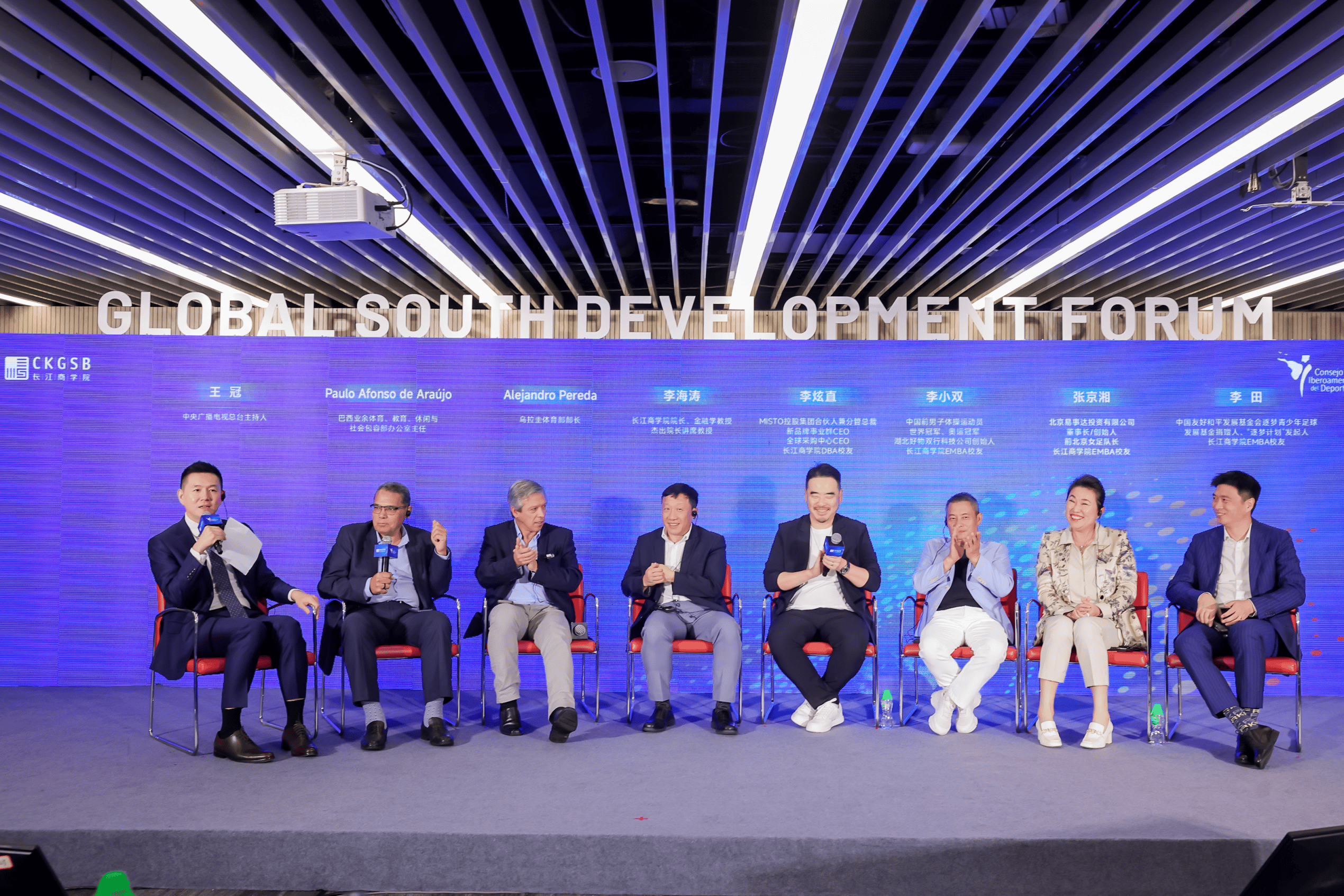
长江商学院全球南方发展论坛在京举行 共探全球南方体育商业化创新路径
Feng Huang Wang Cai Jing· 2025-07-30 02:24
Group 1 - The forum "Global South Development Forum - From Sports Traffic to Economic Increment" was successfully held, focusing on the economic development of the Global South through sports [1][2] - The Global South countries are becoming significant engines of world economic growth, with the sports industry driving many of these economies [2][5] - China is enhancing its trade vitality and leading a new round of industrial chain integration and global order reshaping through cooperation with Global South countries [5][28] Group 2 - The forum gathered senior officials from various Latin American countries and representatives from China's business, sports, and public welfare sectors to discuss sports as a means to stimulate economic growth [1][2] - The importance of sports in enhancing mutual trust and cultural exchange among countries was emphasized, with a call for collaboration in sports commercialization [28][23] - The potential for cooperation in sports talent development, hosting major events, and overseas investment by Chinese companies in Latin America was highlighted [8][23] Group 3 - The focus on the commercial viability of sports in the Global South was discussed, with an emphasis on consumer preferences for practical and functional sports products [11] - The relationship between competitive sports and mass sports was analyzed, advocating for a dual-track approach to enhance sports participation at all levels [15][30] - The integration of sports and public welfare was explored, with examples of sustainable models that combine commercial success with social responsibility [18][22] Group 4 - The forum featured discussions on the sustainable cycle between public welfare and business, emphasizing the need for deep ecological cooperation between enterprises and public organizations [22] - The significance of grassroots sports development, particularly in youth football, was underscored as a means to foster community engagement and economic growth [29][30] - The potential for sports to serve as a bridge for economic growth and cross-industry innovation between China and Latin America was reiterated [23][28]

广东:加快建设高水平体育强省 要以“三大球”振兴为抓手深化竞技体育改革
news flash· 2025-07-30 01:55
Core Viewpoint - Guangdong Province aims to accelerate the construction of a high-level sports province, focusing on the revitalization of the "three major ball sports" as a key strategy for deepening competitive sports reform [1] Group 1: High-Level Sports Development - The provincial government emphasizes the need to establish a high-level public service system for national fitness, enhancing the construction of sports facilities in urban and rural areas [1] - There is a focus on improving the comprehensive utilization efficiency of sports venues and developing leisure sports projects tailored to local conditions to promote public health literacy [1] Group 2: Modern Sports Industry System - The government plans to build a modern sports industry system, fostering well-known brands and leading enterprises in sports equipment and manufacturing [1] - The initiative aims to expand the supply of high-quality sports products and services, enhancing the scale and strength of regional brand events in Lingnan [1] Group 3: Competitive Sports Reform - The revitalization of the "three major ball sports" will serve as a key driver for deepening competitive sports reform [1] - There is an emphasis on strengthening youth training systems, enhancing professional talent cultivation, and promoting the healthy and stable development of professional clubs [1]
广州上半年GDP增长3.8%,专家这样看地产、汽车业表现
Di Yi Cai Jing· 2025-07-29 11:50
Economic Overview - Guangzhou's GDP grew by 3.8% year-on-year in the first half of the year, lagging behind Guangdong province (4.2%) and the national average (5.3%) but improving from the first quarter's growth of 3.0% [1] - The total GDP for Guangzhou reached 15,080.99 billion yuan, with the primary industry increasing by 4.2%, the secondary industry by 2.1%, and the tertiary industry by 4.3% [1] Real Estate Sector - Real estate development investment in Guangzhou turned positive with a growth of 4.1% in the first half of the year, attributed to sustained efforts in the real estate market since last year's fourth quarter [2] - The land market saw a significant increase, with 22 residential land plots sold in December last year, marking a peak for the year, and 19 plots sold in the first half of this year for a total of 19.54 billion yuan, compared to only 6.48 billion yuan from 4 plots in the same period last year [2] - The implementation of the new residential project regulations on May 1 has influenced buyer demand for quality housing, with new regulation projects accounting for 23% of total residential sales [2] Automotive Industry - The automotive manufacturing sector, as Guangzhou's largest industry, continues to face challenges, with a 5.7% year-on-year decline in value added for the sector [4] - However, the decline has narrowed by 0.7 percentage points compared to the first quarter, with new energy vehicle production increasing by 9.5% year-on-year [5] - Investment in the automotive manufacturing sector grew by 19.3% in the first half of the year, indicating ongoing transformation efforts [5] Service Sector - The service sector in Guangzhou is showing steady growth, with the profit-generating service industry achieving a revenue increase of 9.2% year-on-year [6] - Key industries such as internet, software, and information technology services saw significant growth, with increases of 8.7%, 13.3%, and 23.2% respectively [6] - High-tech service industry investment grew by 17.6%, with information service investment rising by 28.2%, reflecting a trend towards new technology integration [6] Sports Industry - The upcoming 15th National Games, set to open on November 9, is expected to boost the local sports industry, which saw a revenue increase of 16.7% in the first half of the year [7] - A new plan aims to enhance the sports industry's contribution to GDP, targeting a 2.4% share by 2035 and fostering globally competitive sports enterprises [7]
上半年债市政策复盘:“科技板”落地生花,优化债市生态
Zhong Cheng Xin Guo Ji· 2025-07-29 05:32
Report Industry Investment Rating No information provided. Core Viewpoints of the Report In the first half of 2025, China's bond market continued to strengthen its direct financing function, focusing on "improving quality and efficiency, serving the real economy." It launched the "Technology Board" of the bond market, increased targeted support for key areas such as technological innovation and private enterprises, strengthened requirements for issuance, trading, and valuation, promoted market standardization, and further advanced opening - up to promote the interconnection of domestic and foreign bond markets [5]. Summary by Relevant Catalogs 1. Key Areas: The "Technology Board" of the Bond Market Sets Sail, and Policy "Combinations" Inject New Development Momentum - **Policy for Technological Innovation**: Policies in the technological innovation field were intensively introduced. The "Technology Board" of the bond market was officially launched, supporting three types of entities to issue technological innovation bonds. The issuance scale of technological innovation bonds reached about 1 trillion yuan, a year - on - year increase of 86%. The risk - sharing tools and ETFs for technological innovation bonds made positive progress [4][6][11]. - **Support for Consumption and Sports Industries**: The bond market increased support for the consumption and sports industries. In the sports industry, relevant departments issued a guiding opinion to support sports enterprises in issuing bonds. In the consumption field, policies were introduced to support enterprises in service consumption areas to issue bonds [12][14]. 2. Weak Links: Policies Intensify to Release Positive Signals, and the Financing Situation of Private Enterprises Remains to Be Continuously Observed - **Policy Attention**: The central government deployed efforts to solve the financing problems of private enterprises. The "Private Economy Promotion Law" was officially implemented, emphasizing support for private enterprises to obtain direct financing through bonds [15][16][18]. - **Financing Situation**: Although the bond financing of private enterprises improved marginally, overall, it still faced constraints such as insufficient demand and high costs. The improvement of private enterprise bond financing requires time [21][22]. 3. Basic Systems: Adhere to the Main Line of Standardized System Construction and Promote the High - Quality Development of the Bond Market - **System Rule Optimization**: The bond market optimized rules for issuance, trading, and valuation. For example, it reduced bond trading and settlement fees, revised company bond review guidelines, and optimized bond valuation guidelines [25][26][27]. - **Risk Management**: It standardized debt - restructuring bond replacement business and improved the institutional framework of credit risk mitigation tools to enhance the flexibility of product creation [28][29]. 4. Opening - up: The Bond Connect Has Made Positive Progress, and Upgraded Measures May Accelerate the Opening - up Process - **Free - Trade Offshore Bonds**: There are expectations for the restart of free - trade offshore bonds, emphasizing the "two - ends - abroad" principle to support domestic enterprises' overseas financing and attract foreign investment [33]. - **Bond Connect Optimization**: The Bond Connect reached its eighth anniversary. The scope of "South - bound Connect" investors was expanded to non - banking institutions, and relevant mechanisms were optimized to promote the interconnection of domestic and foreign markets [34][37]. - **Bond Allocation Value**: China's bonds have good allocation value. Against the backdrop of Sino - US tariff frictions, they may attract more long - term allocation funds, and the bond market's opening - up level is expected to continue to deepen [38][39].