生物制造

Search documents
国寿成达阶段性减持落地,控股股东逆势增持托底信心
Xin Hua Cai Jing· 2025-11-04 11:31
Core Viewpoint - The orderly exit of institutional shareholders and the continuous increase in holdings by the controlling shareholder create a positive balance, optimizing the company's equity structure and enhancing market liquidity and capital stability, which is favorable for long-term investors [2] Group 1: Shareholder Actions - The shareholder Guoshou Chengda plans to reduce its stake in Huaxi Biotechnology by up to 2% of the total share capital between November 24, 2025, and February 20, 2026, as part of a normal exit within the fund's investment cycle [1] - After the reduction, Guoshou Chengda's shareholding will fall below 5%, eliminating its status as a related party, which may allow insurance and asset management funds to re-enter Huaxi Biotechnology for investment [1] - The controlling shareholder, Huaxi Xinyu Investment Co., completed an increase in holdings by acquiring approximately 4.519 million shares for about 257 million yuan, raising its stake to 60.11% [1] Group 2: Business Strategy and Market Position - Huaxi Biotechnology focuses on synthetic biology manufacturing, establishing an integrated business layout in the field of aging intervention, providing comprehensive solutions across pharmaceuticals, medical aesthetics, nutritional science, and dermatology [2] - The company is one of the few globally that covers almost all key materials in the ECM (extracellular matrix) field, with a core research direction centered on the overall synergy of ECM key materials [2] - Huaxi Biotechnology's growth stems from its ability to integrate various scientific dimensions, including ECM stability and regeneration, cellular energy maintenance, and precise intercellular communication [3] Group 3: Innovation and Development - The company exemplifies the transition of Chinese manufacturing enterprises towards foundational research and brand transformation, leveraging technological innovation to drive industry evolution [4] - Huaxi Biotechnology has become a global leader in hyaluronic acid production, transitioning from animal extraction to microbial fermentation and cell factory production, significantly reducing costs while improving quality and stability [4] - The profits generated are reinvested into foundational and applied research, particularly in aging and regenerative medicine, opening doors to cellular biology and glycoscience [4]

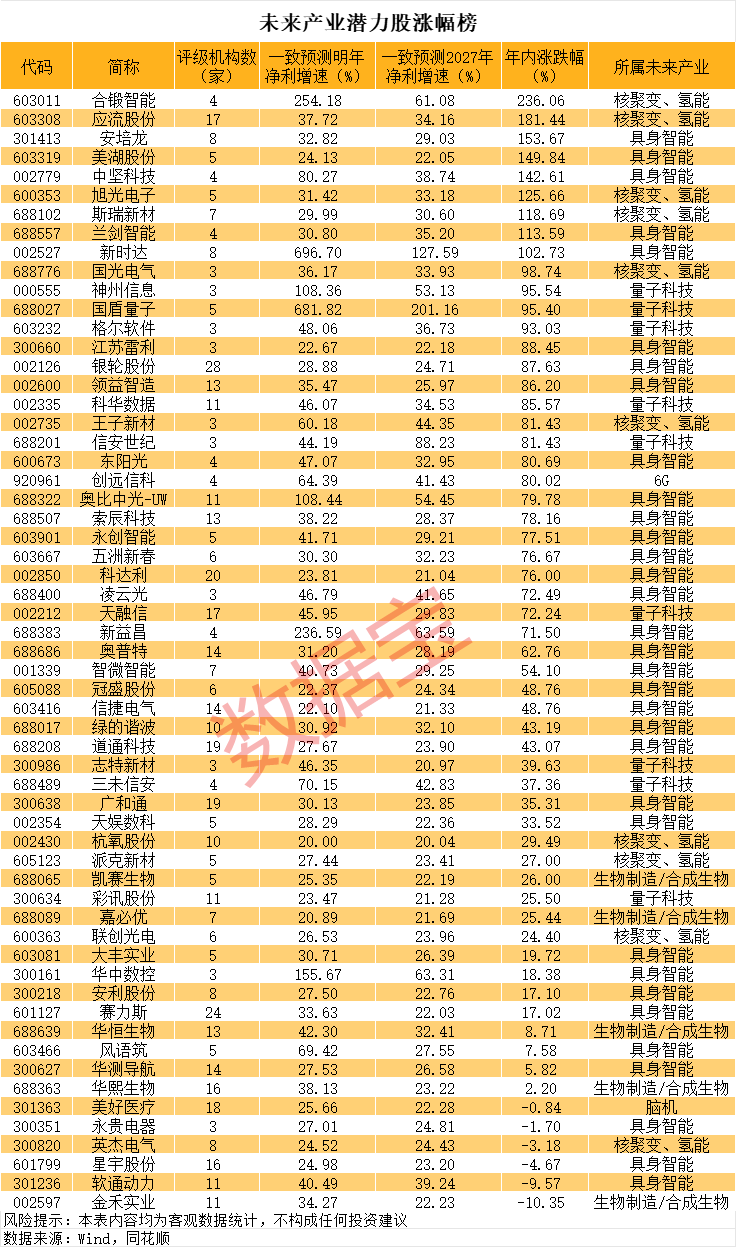
“十五五”未来产业潜力股,揭秘!
Zheng Quan Shi Bao· 2025-11-04 10:37
Group 1 - The core viewpoint of the articles highlights the strong performance of technology stocks in 2023, particularly in sectors related to AI, precious metals, robotics, and innovative pharmaceuticals, with significant gains observed in various indices and concept stocks [1][2]. - The "14th Five-Year Plan" emphasizes the strategic development of future industries, including quantum technology, biomanufacturing, hydrogen energy, nuclear fusion, brain-computer interfaces, embodied intelligence, and 6G technology, as new economic growth points [2][3]. - A total of 142 stocks have been identified by institutions as related to future industries, with 66 stocks specifically linked to embodied intelligence, indicating a growing interest and investment potential in this area [3][4]. Group 2 - Companies such as GuoDun Quantum and XinShiDa are projected to have net profit growth rates exceeding 100% over the next two years, reflecting strong market expectations for these firms [5][6]. - The average stock price increase for the identified potential stocks is approximately 62% year-to-date, significantly outperforming the broader market, with several stocks experiencing price doubling [5][6]. - The report lists specific stocks with high growth potential, including HeZuo Intelligent, YingLiu Technology, and AnPei Long, which are associated with future industries like nuclear fusion and embodied intelligence, showcasing their robust growth forecasts [6][8].



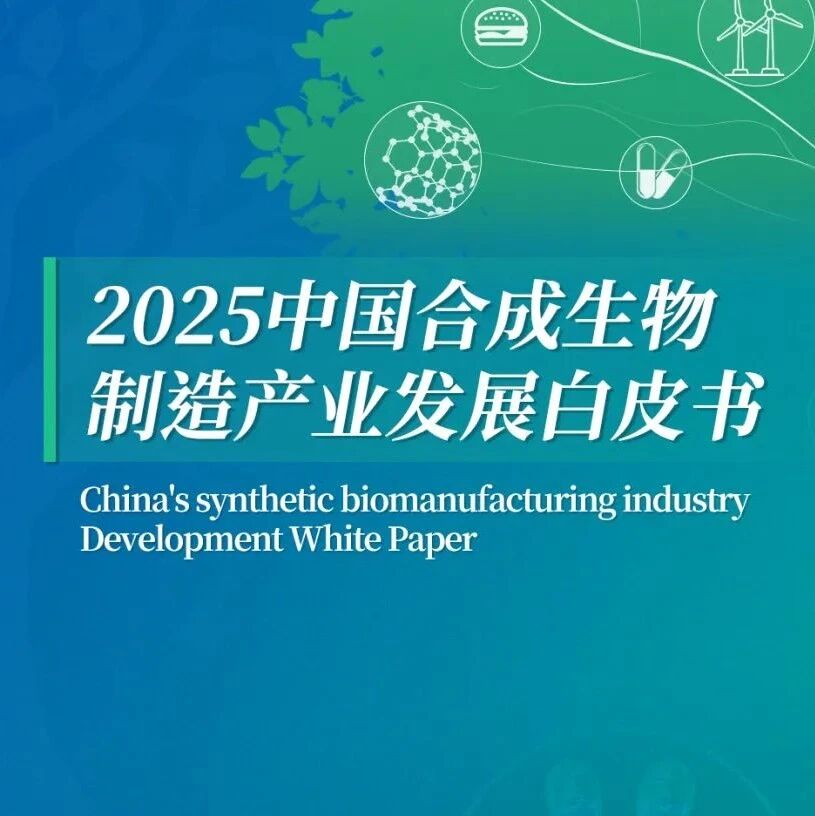
免费领取《2025中国合成生物制造产业发展白皮书》
synbio新材料· 2025-11-04 10:11
Core Viewpoint - The article emphasizes the rising importance of biomanufacturing as a strategic and innovative field that disrupts traditional production methods, presenting it as a new growth point for optimizing industrial structure and transforming economic models. The release of the "2025 China Synthetic Biomanufacturing Industry Development White Paper" highlights the current state, trends, and challenges of the biomanufacturing industry in China [1]. Group 1: Current State and Trends - The white paper outlines the development status and trends of biomanufacturing, analyzing the global landscape and key platform facilities [5]. - It compares the biomanufacturing sectors of China and the United States, identifying competitive advantages and areas for improvement [5]. - Future development trends in biomanufacturing are discussed, indicating a shift towards more integrated and sustainable practices [5]. Group 2: Policy Landscape - The report reviews major policies affecting biomanufacturing both domestically and internationally for the years 2024-2025, providing insights into regulatory frameworks that could impact industry growth [5]. - It categorizes foreign and domestic policies, highlighting their implications for the biomanufacturing sector [5]. Group 3: Industry Map and Applications - A comprehensive map of the Chinese biomanufacturing industry is presented, detailing the key players and their roles within the ecosystem [5]. - The report identifies critical application areas for biomanufacturing, including pharmaceuticals, food, personal care, agriculture, chemicals, materials, and energy [5]. Group 4: Key Enterprises - The white paper lists the top 10 chain leader enterprises in China's biomanufacturing industry, providing a snapshot of the leading companies driving innovation and growth [6]. - It also details the strategic directions of 15 publicly listed companies in the synthetic biology space, summarizing their approaches to market opportunities [6]. Group 5: Investment and Challenges - The report discusses the investment landscape for synthetic biology in China, covering trends and funding activities from 2024 to mid-2025 [6]. - It addresses the challenges faced by the biomanufacturing industry in China, proposing targeted policy recommendations to overcome these obstacles [6].
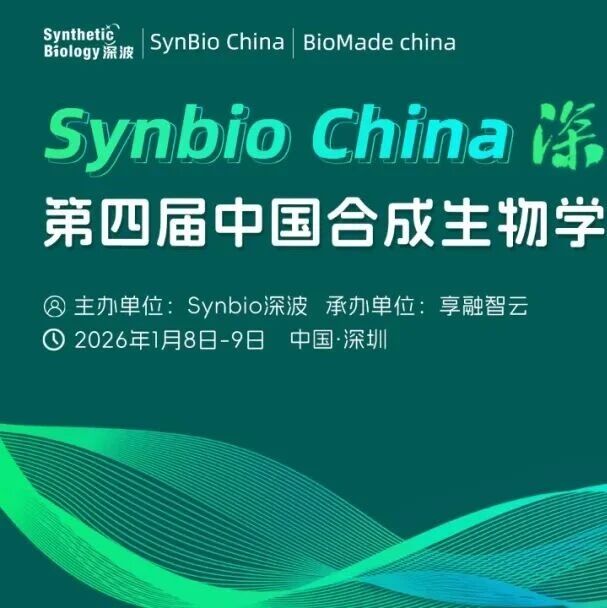
免费参会 | SynBio China第四届中国合成生物学及生物制造大会,2026年1月8-9日!
synbio新材料· 2025-11-04 10:11
Group 1 - The article emphasizes the strategic significance of synthetic biology and biomanufacturing as emerging industries that can reduce reliance on fossil resources, enhance agricultural productivity, and contribute to carbon neutrality goals [2] - The Chinese government has prioritized biomanufacturing in its 2025 work report, highlighting its immense development potential and strategic value [2] - Recent technological breakthroughs in China's biomanufacturing sector are accelerating its penetration into various fields, including biomedicine, bio-based materials, agriculture, and food ingredients [2] Group 2 - The "SynBio China Fourth Synthetic Biology and Biomanufacturing Conference" is scheduled for January 8-9, 2026, in Shenzhen, focusing on key topics such as industry trends, green medicine, and AI in biomanufacturing [3][4] - The conference aims to provide an efficient platform for learning, communication, and collaboration among participating companies [2] - The event is expected to attract around 1,000 attendees, including industry professionals and researchers [4] Group 3 - The main forum will address opportunities and challenges in the industrialization of synthetic biology, innovations in synthetic biology technology, and the transformative applications of synthetic biology in next-generation biomedicine [9] - Specialized sessions will cover topics such as precision fermentation, AI-driven biomanufacturing, and key technologies for industrialization [10][11][12] - The conference will also explore the integration of traditional Chinese medicine with synthetic biology and the development of functional food regulations [20][23]
华熙生物:国寿成达阶段性减持落地,控股股东逆势增持托底信心
Zheng Quan Shi Bao Wang· 2025-11-04 09:17
Core Viewpoint - The orderly exit of institutional shareholders and the continuous increase in holdings by the controlling shareholder create a positive balance, optimizing the company's equity structure and enhancing market liquidity and capital stability, which is favorable for long-term investors [2] Group 1: Shareholder Actions - Guoshou Chengda plans to reduce its stake in Huaxi Biological by up to 2% of the total share capital between November 24, 2025, and February 20, 2026, as part of a normal exit within the fund's investment cycle [1] - After the reduction, Guoshou Chengda's shareholding will fall below 5%, no longer constituting a related party relationship, potentially allowing insurance and asset management funds to reinvest in Huaxi Biological [1] - The controlling shareholder, Huaxi Xinyu Investment Co., completed an increase in holdings by acquiring approximately 4.519 million shares for about 257 million yuan, raising its stake to 60.11% [1] Group 2: Business Strategy and Market Position - Huaxi Biological focuses on synthetic biology manufacturing, establishing an integrated business layout in the field of aging intervention, providing comprehensive solutions across pharmaceuticals, medical aesthetics, nutritional science, and dermatology [2] - The company is one of the few globally that has a comprehensive layout in the ECM (extracellular matrix) field, with a core research direction centered on the overall synergy of ECM key substances [2] - Huaxi Biological's growth stems from its ability to integrate various scientific dimensions, forming a complete layout in life-active substances, medical aesthetics, functional skincare, and oral nutrition [3] Group 3: Innovation and Development - The company exemplifies the transition of Chinese manufacturing enterprises towards foundational research and brand transformation, leveraging technological innovation to drive industry iteration [4] - Huaxi Biological has become a global leader in hyaluronic acid production, transitioning from animal extraction to microbial fermentation, significantly reducing costs while improving quality and stability [4] - The profits generated are reinvested into foundational and applied research, opening doors to cell biology and glycoscience, and positioning the company for success in technological innovation and brand building [4]
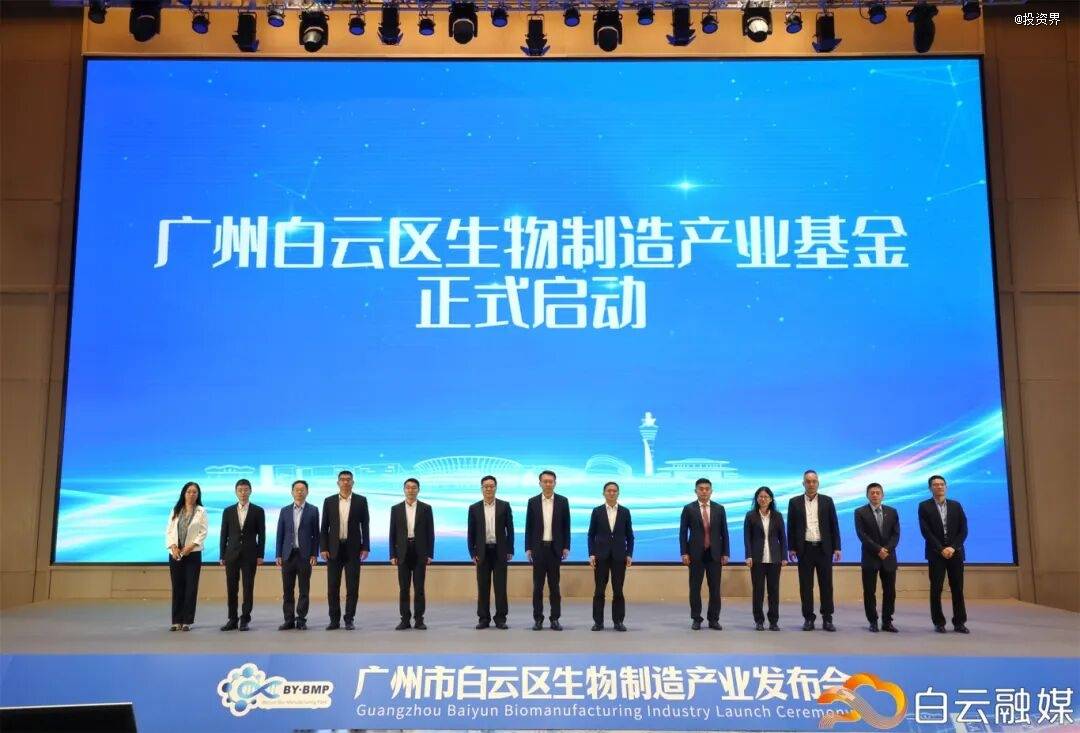
广州白云区生物制造产业百亿基金启动
Sou Hu Cai Jing· 2025-11-04 06:18
Core Insights - The Guangzhou Baiyun District has launched a three-year action plan to accelerate the high-quality development of the biomanufacturing industry, marking a new phase of systematic layout and precise efforts [3][4] - A total of 10 billion yuan has been raised for the first phase of a biomanufacturing fund cluster, which aims to cover the entire lifecycle of biomanufacturing enterprises from startup to Pre-IPO [1][3] Group 1: Fund and Investment - A biomanufacturing industry fund cluster with a total scale of 10 billion yuan has been established, led by Baiyun Investment Group in collaboration with top investment institutions and industry leaders [1] - The fund's establishment is expected to promote a virtuous cycle of "technology, industry, and finance," injecting strong financial momentum into the high-quality development of the industry [1] Group 2: Action Plan and Ecosystem - The action plan outlines the construction of a "11221" industrial ecosystem, which includes one biomanufacturing innovation center, one pilot base, two achievement transformation platforms, and two phases of over 1,000 acres of biomanufacturing industrial parks [3][4] - By 2028, the plan aims to drive the output value of related biomanufacturing industries to exceed 50 billion yuan, establishing a nationally competitive biomanufacturing industry pilot zone [3] Group 3: Spatial Layout and Development Goals - Baiyun District is focusing on creating an industrial cluster with a "one core, multiple parks, collaborative and complementary" approach, centering around Zhongluotan Town [4] - The goal is to attract five leading domestic and international enterprises, 30 high-tech enterprises, and 10 specialized and innovative enterprises by 2028, forming a leading industrial base with significant advantages [4]
关键词读懂“十五五”|未来产业,如何塑造中国发展新未来
Yang Guang Wang· 2025-11-04 02:55
Core Insights - The 20th Central Committee's Fourth Plenary Session approved the "Suggestions on Formulating the 15th Five-Year Plan for National Economic and Social Development," emphasizing the exploration of diverse technological routes and business models to drive economic growth through future industries such as quantum technology, biomanufacturing, hydrogen energy, nuclear fusion, brain-computer interfaces, embodied intelligence, and 6G mobile communication [1][2] Group 1: Future Industries and Economic Growth - Future industries are seen as crucial for reshaping China's economic landscape and enhancing its innovation capabilities, with a focus on building a modern industrial system and strengthening the real economy [2][3] - The "three new" economy's contribution to GDP is projected to exceed 18% in 2024, with significant breakthroughs in biomanufacturing and quantum technology indicating strong growth potential for future industries [2] Group 2: Policy and Urban Development - The growth of future industries is supported by policies and urban planning, with the Ministry of Industry and Information Technology proposing mechanisms for investment growth in sectors like brain-computer interfaces and quantum information [4] - Local governments are actively implementing policies to foster future industries, with cities like Beijing, Shanghai, and Guangzhou developing tailored strategies to leverage their unique advantages [4] Group 3: Technological Advancements and Education - Breakthroughs in 6G technology, such as the establishment of the world's first 6G test network, highlight China's leading position in future communication technologies [5] - The development of future industries is transforming the "industry-university-research" model, with universities adjusting their research focus to align with emerging technologies like brain-computer interfaces [6][7] - The demand for interdisciplinary talent that combines technical skills with social understanding is increasing, reflecting the broader impact of future industries on education and daily life [7]
学习贯彻党的二十届四中全会精神·权威访谈丨奋力开创高质量发展高效能治理新局面——访濮阳市委书记万正峰
He Nan Ri Bao· 2025-11-04 00:01
Group 1: Economic Development and Industrial Strategy - Puyang City aims to strengthen its manufacturing backbone and solidify the foundation for high-quality development, focusing on the chemical new materials industry with 185 large-scale industrial enterprises and an output value of 85 billion yuan [1] - The city plans to enhance its green chemical and new materials industry to achieve an output value exceeding 200 billion yuan during the 14th Five-Year Plan, establishing itself as a leading domestic base for chemical new materials [1] - Puyang will also upgrade its modern home furnishings, down products, and apparel industries while developing emerging sectors like biomanufacturing and high-end equipment, and will accelerate the layout of future industries such as hydrogen energy and artificial intelligence [1] Group 2: Market Integration and Infrastructure Development - Puyang City will actively integrate into the national unified market, leveraging its geographical advantages to enhance connectivity and drive economic circulation [2] - The city is committed to improving the business environment through six major actions, including market expansion and infrastructure connectivity, while focusing on the construction of key transportation corridors like the Xiongshan and Anpu-Henan high-speed railways [2] - Puyang aims to serve as a hub for both domestic and international market dual circulation, contributing to the national unified market [2] Group 3: Social Governance and Environmental Protection - Puyang City will enhance social governance by promoting efficient grassroots governance and utilizing a model that combines party building, grid management, and big data [3] - The city will focus on improving public welfare and addressing urgent issues faced by the populace, ensuring a high quality of life [2] - Puyang is committed to ecological protection, aiming to enhance the storage capacity of the Central Plains gas storage cluster to approximately 16 billion cubic meters and promote the development of non-grain bio-based materials [2]
学习贯彻党的二十届四中全会精神·权威访谈丨坚持以科技创新引领产业创新推动高质量转型发展——访鹤壁市委书记赵宏宇
He Nan Ri Bao· 2025-11-04 00:01
Core Insights - The 20th Central Committee's Fourth Plenary Session outlines a strategic plan for China's economic and social development over the next five years, emphasizing the importance of modernization and the need for effective implementation of policies [1] Group 1: Economic Development Strategy - The "14th Five-Year Plan" period is crucial for achieving socialist modernization, with a focus on systematic research and development of economic and social measures [1] - The city of Hebi aims to align its development plans with national and provincial directives, considering international trends and technological advancements [1] Group 2: Industrial Transformation and Innovation - There is a strong emphasis on driving industrial transformation and upgrading through technological innovation, particularly in traditional industries like functional new materials and electronics [2] - The city plans to promote the development of emerging industries such as commercial aerospace, biomanufacturing, and semiconductors, while enhancing the integration of technology and industry [2] Group 3: Infrastructure and Research Development - The establishment of key research facilities, such as the Qihe Laboratory, is aimed at advancing core technologies in fields like artificial intelligence and life sciences [2] - The city is focused on creating more pilot platforms to facilitate the application of scientific research outcomes and improve the business environment for innovation [2] Group 4: Safety and Environmental Initiatives - The city is committed to enhancing safety measures and environmental quality through targeted actions and pollution prevention strategies [2] - There is a call for a comprehensive approach to ensure high-quality development while maintaining high levels of safety [2]
21评论丨为何要保持制造业合理比重?
2 1 Shi Ji Jing Ji Bao Dao· 2025-11-03 22:35
Core Insights - The recent proposal by the Central Committee emphasizes the importance of a modern industrial system as the material and technological foundation for Chinese-style modernization, focusing on the real economy and aiming for intelligent, green, and integrated development [2][3] Group 1: Strategic Focus - The primary strategic task for the 15th Five-Year Plan has shifted from technological innovation to industrial system construction and real economy development, with technology now serving as a supporting role [2][3] - The dual motivations for this strategic shift include the transition of development stages and the evolution of competitive paradigms, highlighting the need for innovation to be rooted in the industrial context to enhance economic resilience and competitiveness [3] Group 2: Manufacturing Sector Importance - The proposal underscores the critical role of maintaining a reasonable proportion of manufacturing in the economy, which is essential for strengthening the foundation of the real economy [3][4] - Historical data indicates that countries like Japan and Germany maintain a stable manufacturing value-added ratio of around 20% of GDP, which supports their international competitiveness [4] Group 3: Development Pathways - The construction of a modern industrial system should focus on four key areas: optimizing the manufacturing tier, promoting service industry development, solidifying infrastructure, and enhancing the market environment [5][6] - Specific actions include upgrading traditional industries, fostering new industries as core pillars, and innovating regulatory frameworks to support future industries [5][6] - The service sector is to be expanded and improved, integrating with advanced manufacturing and modern agriculture to enhance overall economic efficiency [6]