
AI医疗

Search documents
诺安基金唐晨:AI+生物医药爆发期将至
Cai Fu Zai Xian· 2025-08-01 09:29
Core Viewpoint - The 2025 World Artificial Intelligence Conference (WAIC) in Shanghai highlighted the significant role of AI in accelerating drug development and transforming the healthcare ecosystem, with a focus on innovation in the pharmaceutical industry [1][4]. Industry Insights - AI technology is rapidly evolving, enabling faster analysis of vast medical data, predicting drug efficacy, and shortening drug development cycles while reducing costs [1][4]. - The global pharmaceutical landscape is undergoing a transformation, with multinational companies increasingly sourcing innovative drugs from China, driven by supportive domestic policies and steady clinical advancements [1][4]. - The innovative drug sector has shown strong performance, with the Wind Innovation Drug Index rising by 48.51% and the Hong Kong Innovation Drug Index increasing by 104.51% as of July 31, 2025 [3]. Company Performance - The performance of the Noan Selected Value Mixed Fund has been notable, with a net value growth rate of 61.88% over the past six months, significantly outperforming its benchmark of 5.74% [3]. - The fund's strategy has focused on the undervaluation of the pharmaceutical sector, with a balanced investment approach in both Hong Kong and A-share markets [3][4]. - The establishment of the "Technology Group" by Noan Fund in 2020 reflects a proactive approach to building a diverse product matrix in the technology investment space [4]. Technological Advancements - Modern surgical robots are enhancing surgical precision by analyzing real-time data and providing feedback, which reduces risks and improves success rates [2]. - The rise of remote surgery, facilitated by 5G/6G networks, allows surgeons to operate on patients from thousands of kilometers away, improving access to healthcare in remote areas [2].
港股医械携手AI板块飙升:政策与资金共舞,戴维斯双击效应显现
2 1 Shi Ji Jing Ji Bao Dao· 2025-07-30 09:57
Core Viewpoint - The medical device and consumables sectors, along with AI healthcare, are experiencing significant growth driven by favorable policies and market dynamics. Group 1: Medical Device and Consumables Sector - The Hong Kong medical ETF (159366) saw a rise of over 4.5% on July 30, with a trading volume nearing 600 million, benefiting from the active market for innovative drugs and devices [1] - The medical device ETF (159883) recorded a net inflow of 2.03 billion, ranking first among comparable funds, with a total of 7.14 billion in net inflows over nine consecutive days [1] - Policy expectations are positive, with high-value consumables expected to benefit from improved procurement policies, leading to a reduction in valuation pressure and a more stable long-term performance outlook for leading companies [1][3] Group 2: Policy Support and Market Dynamics - Continuous policy support for the medical consumables sector is shifting the focus from price wars to value wars, with the National Medical Insurance Bureau facilitating the pricing of innovative medical consumables [3] - The optimization of the 11th batch of national drug procurement rules aims to address the issue of price undercutting, allowing companies to maintain profit margins and focus on innovation [3][4] - The simplification of the approval process for innovative consumables is expected to accelerate their market entry, enhancing the support for clinically valuable new products [4] Group 3: AI Healthcare Sector - The AI healthcare sector is gaining momentum, with the 2025 World Artificial Intelligence Conference showcasing practical applications that address clinical challenges and promote scalable solutions [5] - The release of the "2025 Artificial Intelligence + Health Shanghai Practice" outlines a development path for AI healthcare, focusing on data flow issues and the integration of AI with biomedicine [5] - The Hong Kong medical ETF (159366) has become a key investment vehicle for AI healthcare, reflecting a 7.36% increase over the past week, driven by the sector's growth potential [6] Group 4: Investment Trends and Market Sentiment - The release of policy benefits has positioned medical consumables and AI healthcare as core investment areas, with significant capital inflow observed in these sectors [6] - The recovery of domestic medical equipment procurement is expected to boost upstream consumable demand, while AI healthcare companies in Hong Kong are attracting foreign investment due to their technological advantages [6][7] - The collaboration between the recovery of the CXO sector and AI healthcare is amplifying growth potential, as domestic CXO companies leverage cost advantages to secure more AI-driven drug development contracts [7]
港股收评:恒指跌1.36%科指跌2.72%!理想汽车跌12%,平安好医生涨11%,中国卫生集团涨48%,中芯国际跌5%
Sou Hu Cai Jing· 2025-07-30 08:45
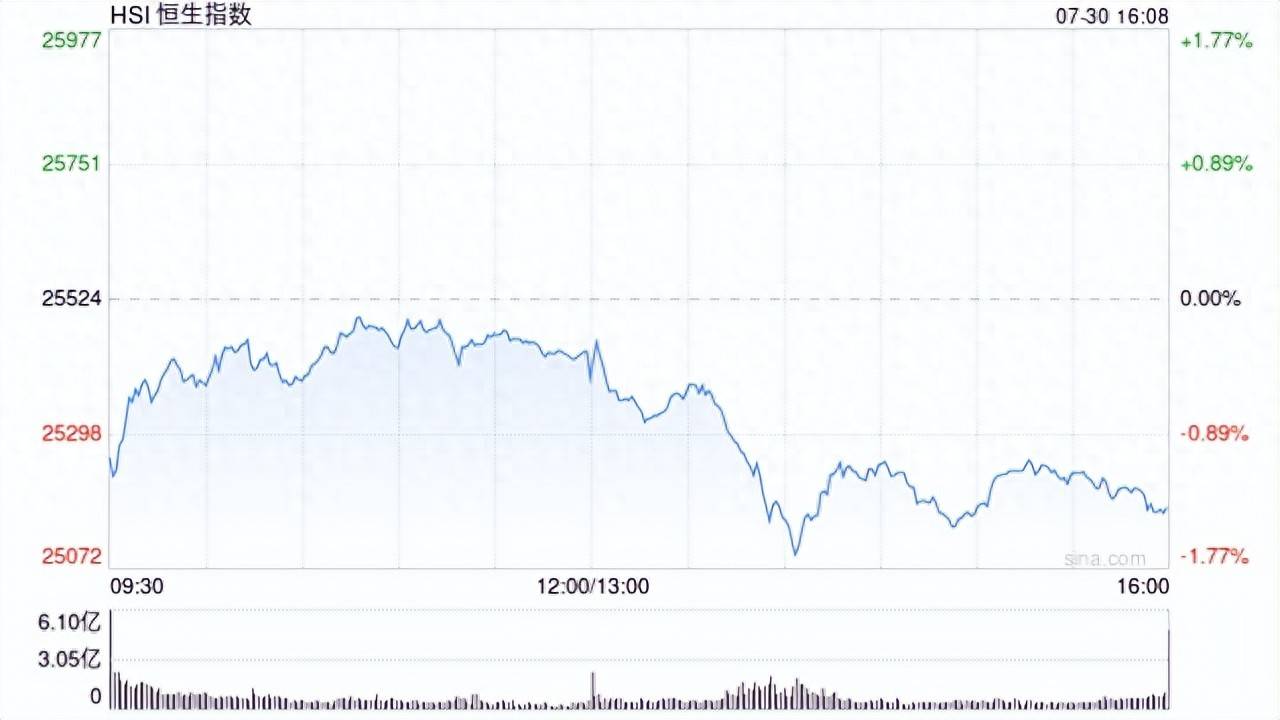
Market Overview - The Hong Kong stock market experienced a decline, with the Hang Seng Index falling by 1.36% to 25,176.93 points, the Hang Seng Tech Index dropping by 2.72%, and the National Enterprises Index decreasing by 1.18% [2] - Technology stocks, particularly in the internet sector, saw significant losses, with JD.com, Alibaba, and Baidu each dropping over 2%, while Tencent fell more than 1% [2] - In contrast, AI healthcare concept stocks and medical equipment stocks surged, with Ping An Good Doctor rising over 11% and China Health Group increasing by 48% [2][4] AI Healthcare Sector - The AI healthcare and medical equipment sectors are experiencing rapid growth, driven by supportive government policies and increasing market demand [4] - The National Medical Products Administration announced measures to support the innovation of high-end medical devices, focusing on AI imaging diagnostics and surgical robots [4] - Beijing's "AI + Healthcare" action plan aims to establish an innovative ecosystem by 2027, promoting over 30 core technologies and innovative products [4] Oil and Gas Sector - Oil and gas equipment and services stocks performed well, with Shandong Graphite rising over 16% [4] - International oil prices rebounded, with Brent and WTI crude futures both increasing by over 3%, returning to around $70 per barrel [4] Automotive Sector - The automotive sector faced significant declines, with Li Auto dropping over 12% and other major players like BYD and Xpeng also experiencing losses [7] Semiconductor Sector - Semiconductor stocks weakened, with SMIC falling over 5% amid news that Nvidia placed a new order for 300,000 H20 chips with TSMC, impacting market sentiment negatively for local semiconductor suppliers [7][8]



港股收评:恒指跌1.36%科指跌2.72%!科网股普跌理想汽车跌12%,平安好医生涨11%,中国卫生集团涨48%,中芯国际跌5%
Sou Hu Cai Jing· 2025-07-30 08:27
7月30日消息,三大指数低开低走。截至收盘,恒生指数跌1.36%,报25176.93点,恒生指数跌2.72%, 国企指数跌1.18%。盘面上,科网股普跌,京东、阿里巴巴、百度跌超2%,腾讯跌超1%;AI医疗概念 股、医疗设备及用品股大涨,平安好医生涨超11%,中国卫生集团涨超48%;油气设备与服务股涨幅居 前,山东石墨涨超16%;汽车股大跌,理想汽车跌超12%;芯片股走弱,中芯国际跌超5%。 | 代码 | 名称 | | 最新价 | 涨跌幅 √ | | --- | --- | --- | --- | --- | | 01833 | 平安好医生 | 0 | 12.060 | 11.67% | | 02252 | 微创机器人-B | | 23.000 | 9.26% | | 02192 | 医航通 | | 16.300 | 7.66% | | 02273 | 固牛堂 | | 36.700 | 3.67% | | 00241 | 阿里健康 | | 4.960 | 2.27% | | 02158 | 医渡科技 | | 6.580 | 1.08% | AI医疗概念股 油气设备与服务股涨幅居前,山东石墨涨超16%。国际油价 ...
AI医疗有哪些支付逻辑?产业界详议模式与路径
Di Yi Cai Jing· 2025-07-29 15:00
从AI驱动医疗企业发展的情况看,约30%企业在进行技术研发时会借助AI工具,约30%企业会在销售与 运营环节中引入AI,另有约10%的企业会在生产制造阶段运用AI。 AI(人工智能)医疗产品、服务的买单方与支付逻辑何在?AI医疗产业实现可持续发展有无经验可 循? 在7月28日举办的2025世界人工智能大会"AI+医健产业可持续创新论坛"上,多位医疗大健康产业界资 深人士围绕上述问题展开讨论。 新模式、新路径 根据BCG(波士顿咨询)董事总经理、全球合伙人郝婧给出的一组数据,从AI驱动医疗企业发展的情 况看,约30%企业在进行技术研发时会借助AI工具,包括靶点选择、效率提升、创意来源等;约30%企 业会在销售与运营环节中引入AI,包括市场资料搜集、宣传等;另有约10%的企业会在生产制造阶段运 用AI以进行质量管控、分析等。 瑞宁康生物创始人兼CEO、原FDA(美国药监局)临床药理审评室定量药理学审评部部长王亚宁表示, 以美国经验为例,基于AI算法的AI医疗器械在美国已形成了一套较为成熟的审评流程,上市产品也有 1000余个,但AI驱动的药物还没有成功的。 王国鑫建议说,一方面,AI医疗可以探索在急危重症方面的快 ...
AI医疗应遵循哪些变现逻辑?产业界人士详议模式与路径
Di Yi Cai Jing· 2025-07-29 10:55
AUF ITP IT: Veeva AI(人工智能)医疗产品、服务的买单方与支付逻辑何在?AI医疗产业实现可持续发展有无经验可循?医疗产业如何理解AI向善? 在今日举办的2025世界人工智能大会"AI+医健产业可持续创新论坛"上,多位医疗大健康产业界资深人士围绕上述痛点难点展开讨论。 新模式、新路径 根据BCG董事总经理、全球合伙人郝婧给出的一组数据,从AI驱动医疗企业发展的情况看,约30%企业在进行技术研发时会借助AI工具,包括靶点选择、效 率提升、创意来源等;约30%企业会在销售与运营环节中引入AI,包括市场资料搜集、宣传等;另有约10%的企业会在生产制造阶段运用AI以进行质量管 控、分析等。 俞熔表示,早些时期,大家在谈论健康管理时都觉得似乎有些不太靠谱,因为工具、方法以及可反馈、可量化的东西都不具备。现在不一样了,数据、智能 终端、可穿戴监测设备都打通了,商业逻辑就显现出来了,付费主体也就出现了,"后续,AI医疗服务将率先在院外市场(慢病)领域取得突破,真正实现 医疗服务质量、可及性、成本三个要素的协同。" 京东健康探索研究院首席科学家王国鑫也表示,正是因为AI能够实现更强、更快的链接,因此AI能够在 ...

浙商证券浙商早知道-20250729
ZHESHANG SECURITIES· 2025-07-28 23:30
Market Overview - On July 28, the Shanghai Composite Index rose by 0.12%, the CSI 300 increased by 0.21%, the STAR Market 50 gained 0.09%, the CSI 1000 was up by 0.35%, the ChiNext Index climbed by 0.96%, and the Hang Seng Index increased by 0.68% [3][4] - The best-performing sectors on July 28 were defense and military (+1.86%), non-bank financials (+1.51%), pharmaceutical and biological (+1.47%), comprehensive (+1.29%), and communication (+1.24%). The worst-performing sectors were coal (-2.6%), steel (-1.41%), transportation (-1.38%), oil and petrochemicals (-1.02%), and textiles and apparel (-0.93%) [3][4] - The total trading volume for the A-share market on July 28 was 1.7662 trillion yuan, with a net inflow of 9.253 billion Hong Kong dollars from southbound funds [3][4] Key Insights - The report emphasizes a focus on consumption and growth styles, with industry attention on electric equipment, non-ferrous metals, pharmaceuticals, electronics, and brokerage firms [5] - The report suggests that under the current monetary environment, the "dumbbell strategy" remains effective, but the large-cap growth style may attract market attention in the short term [5] - Factors driving this outlook include strong support from hydropower projects and policy catalysts such as "anti-involution" and Hainan's customs closure, which have impacted the previously strong dumbbell strategy [5] - The report recommends increasing focus on mid-to-large-cap growth styles in August, particularly in sectors related to consumption and growth, as well as electric equipment and non-ferrous metals influenced by industry trends in pharmaceuticals (innovative drugs, AI healthcare) and electronics [5]
2025世界人工智能大会点燃行业热潮 鹰瞳科技(02251)AI眼底筛查加速渗透社区场景
智通财经网· 2025-07-28 08:22
Core Insights - The 2025 World Artificial Intelligence Conference has highlighted the advancements and future developments in AI technology, particularly in the healthcare sector [1] - Eagle Vision Technology-B (02251), a leading AI medical company in the Hong Kong stock market, has gained attention with its three AI product lines, including an integrated AI diagnostic solution for retinal imaging [1] - The company's stock price rose by 7.03% to 14 HKD following the conference, reaching a peak of 14.36 HKD during trading [1] Company Developments - Eagle Vision Technology has implemented community outreach programs, providing AI-based eye screening and health risk assessments in various community service stations [1][2] - The AI retinal imaging system, Airdoc, can automatically capture retinal images in 1-3 minutes and accurately identify 55 types of eye diseases and associated health risks [3] - In 2024, the company served 7.1 million cases through its AI-assisted retinal detection products, identifying 35,600 significant positive cases, with a 39% increase in active service points to 7,883 [3] Market Trends - The integration of AI in healthcare is moving from conceptual phases to practical applications, driven by policy support and clinical needs [2] - The release of the "Expert Consensus on Eye Health Screening and Management for the Population (2024)" emphasizes the potential of AI in assisting diagnosis and addressing eye health management challenges [2] - The significant growth in the usage of AI for myopia prevention, with a 352.1% increase in usage and a 61.8% rise in user base, indicates a strong market demand for AI healthcare solutions [3]
医疗器械行业框架+AI医疗行业分析
2025-07-28 01:42
Summary of Medical Device Industry and AI Medical Analysis Industry Overview - The medical device industry is experiencing growth driven by an aging population, increasing diagnostic and treatment demands, and improvements in patient payment capabilities due to the development of health insurance and commercial insurance [1][3] - The domestic medical device market in China has significant potential, supported by advancements in underlying technologies and a mature supply chain in regions like the Pearl River Delta and Yangtze River Delta [2] Key Insights - **Aging Population Impact**: The demand for medical devices is steadily increasing due to the aging population, with China's medical device-to-drug ratio currently at 2.9 compared to the global average of 1:4, indicating room for growth [3] - **Domestic Substitution**: The shift towards domestic medical devices is crucial, especially in high-level hospitals where the cost of medical materials is significant. The penetration of medical devices varies with economic development levels [4] - **Centralized Procurement Policy**: This policy is expected to suppress the valuation of the medical device sector by reducing long-term market space and increasing short-term performance uncertainty. Price reductions can lead to significant pressure on distributors, with discounts reaching 60% to 80% [5][7] - **Market Trends**: The future of the medical device industry includes a focus on product quality and the importance of grassroots penetration. The development of domestic companies will further drive industry growth [6] Financial and Market Dynamics - **Investment Growth**: The investment scale for medical devices is projected to grow at an annual rate of approximately 7% from 2024 to 2027, with some tender data showing positive year-on-year growth [1][9] - **Market Share and Valuation**: Companies that can innovate or offer superior clinical outcomes are likely to benefit from centralized procurement policies, with expectations of improved valuations for previously suppressed companies [7][8] AI Integration in Medical Sector - **AI's Role**: AI is expected to lower medical costs by replicating physician intelligence, enhancing efficiency, and breaking cognitive limitations in areas like drug development and medical imaging [1][26] - **Commercial Models**: AI can be integrated into traditional products to enhance performance and create service-based revenue models, particularly in grassroots hospitals where software can be used on a pay-per-use basis [28][29] - **Regulatory Framework**: AI medical software is categorized based on its function, with different regulatory requirements for decision-support and data processing software [30][31] Future Opportunities - **Emerging Technologies**: Key areas with potential include electrophysiology, valve intervention treatments, gene sequencing technologies, and surgical robotics, which are expected to see significant growth [22][24] - **Market Focus**: The market is increasingly focused on efficiency improvements, with companies possessing strong AI capabilities likely to stand out in the competitive landscape [35] Conclusion The medical device industry is poised for growth driven by demographic trends, technological advancements, and regulatory changes. The integration of AI presents new opportunities for efficiency and cost reduction, positioning companies that adapt to these changes favorably in the market.
医疗与消费周报:AI医疗:技术赋能驱动诊疗从“经验”到“数据”转型破局三重壁垒向普惠化进阶-20250726
Huafu Securities· 2025-07-26 13:03
Group 1 - The report highlights that five out of six sub-sectors in the pharmaceutical index recorded positive returns, indicating a strong market performance [2][14]. - AI in healthcare is transforming from "experience-driven" to "data-driven" approaches, leveraging internet and data technologies to enhance diagnostic efficiency and address structural issues in healthcare resources [3][8]. - The core capabilities of AI in healthcare are categorized into three layers: perception intelligence, computational intelligence, and cognitive intelligence, which collectively support the transition to data-driven decision-making in clinical settings [9][11]. Group 2 - The report identifies three major barriers facing AI in healthcare: data barriers, privacy concerns, and data bias, with future breakthroughs expected through "AI + edge computing" and regulatory sandboxes [11]. - The pharmaceutical sector's performance for the week of July 21-25 shows significant gains in medical services (+6.73%) and medical devices (+4.43%), while traditional Chinese medicine and chemical pharmaceuticals experienced lower returns [14][15]. - The report notes that the central government has allocated 700 million yuan to support healthcare reform projects in Henan, highlighting ongoing investments in healthcare infrastructure [20]. Group 3 - The National Medical Insurance Administration is advancing drug procurement reforms to ensure quality and affordability, having conducted ten rounds of drug procurement since 2018, covering 435 types of drugs [23]. - During the "14th Five-Year Plan" period, the National Medical Insurance Bureau has funded 350 million people from disadvantaged backgrounds to ensure they have access to medical insurance, with a total expenditure of 72.29 billion yuan [24][25].