化学原料

Search documents
华塑股份分析师会议-20250826
Dong Jian Yan Bao· 2025-08-26 15:17
Group 1: Report Overview - The report is about the analyst meeting of Huasu Co., Ltd., a company in the chemical raw materials industry, with a research date of August 26, 2025 [1][2] Group 2: Core Viewpoints - The company's revenue decreased by 151 million yuan year-on-year, a decline of 6.46%, mainly due to market demand and price fluctuations of core products like PVC and caustic soda [24] - The company will implement a cost - reduction and efficiency - enhancement plan with 23 measures in 5 aspects, promote differentiated products, and focus on the western market to offset the decline in the eastern market [24] - The company uses idle raised funds to supplement working capital, with 321.3151 million yuan used as of June 30, 2025 [25] - The company has advantages in resources and energy, relying on self - owned mines and a self - built cogeneration system [25][26] - The company's financial expenses increased by 454.24% in the first half of the year, which will gradually decrease as loans are repaid [26] - The company's net profit attributable to shareholders in the first half of 2025 was - 129 million yuan, and it aims to enhance core business competitiveness and achieve profitability in the main business [26] - The company has a complete industrial chain from resources to energy, chemicals, new materials, and environmental protection, and will explore new products to increase future growth points [27] Group 3: Specific Content by Section 1. Basic Research Information - The research object is Huasu Co., Ltd. in the chemical raw materials industry, and the reception time was on August 26, 2025. The reception staff included the chairman, CFO, board secretary, and independent director [17] 2. Detailed Research Institutions - The reception objects included investors and others [20] 3. Proportion of Research Institutions - No specific content provided 4. Main Content Data - **Business and Market Strategy**: The company will continue to implement cost - reduction and efficiency - enhancement measures, promote differentiated products in the eastern market, and focus on the western market's potential from industrial transfer [24] - **Raised Funds**: The company approved using up to 370 million yuan of idle raised funds to supplement working capital in 2024, and 321.3151 million yuan was used as of June 30, 2025 [25] - **Resources and Energy Advantages**: The company relies on self - owned mines and a self - built cogeneration system to ensure raw material supply and reduce costs [25][26] - **Financial Cost**: The company's financial expenses increased by 454.24% in the first half of the year, which will decrease as loans are repaid [26] - **Profitability and Strategy**: The company aims to enhance core business competitiveness,摆脱 over - dependence on non - recurring gains and losses, and achieve profitability in the main business [26][27]

新瀚新材分析师会议-20250826
Dong Jian Yan Bao· 2025-08-26 15:17
1. Report Industry Investment Rating - No information provided in the given content. 2. Report's Core View - In the first half of 2025, the company achieved an operating income of 229 million yuan, a year - on - year increase of 9.66%, and a net profit of 35.29 million yuan, a year - on - year increase of 20.40%. The company is optimistic about the development of the PEEK industry chain, and the market prospects of HAP and HDO in cosmetics raw materials are good. The company's product sales volume and gross profit margin have increased, mainly due to capacity improvement [24]. 3. Summary According to Relevant Catalogs 3.1 Research Basic Situation - Research object: New Han New Materials; Industry: Chemical raw materials; Reception time: August 26, 2025; Listed company reception personnel: Board Secretary Li Xiangfei, Securities Affairs Representative Ge Mingmin, and Financial Controller Wang Zhongyan [16]. 3.2 Detailed Research Institutions - Fund management companies: Harvest Fund (represented by Xu Heyang), Donghai Fund (represented by Zhang Yuantao), CITIC Prudential Fund (represented by Yao Sizhou), Jianxin Fund (represented by Wu Angda), Chunhou Fund (represented by Tian Wentian) [17]. - Investment companies: Shanghai Xishirun Investment (represented by Liu Chongli), Bissell (Shanghai) Investment (represented by Luo Hongyong), Shanghai Jisheng Investment (represented by Liu Qinglin) [17]. - Securities companies: Nanjing Securities (represented by Gu Shiyuan), Shenwan Hongyuan (represented by Li Shaocheng) [17]. - Others: Zhengyuan Private Fund (represented by Liu Jiasuo) [17]. 3.3 Main Content Data - **2025 Semi - annual Brief Analysis**: The company's operating income in the first half of 2025 was 229 million yuan, a year - on - year increase of 9.66%, and the net profit was 35.29 million yuan, a year - on - year increase of 20.40%. The comprehensive gross profit margin and sales net profit margin improved for two consecutive quarters, reaching 27% and 15.41% respectively. The sales volume of the company's main products increased by about 30%, among which the sales volume of DFBP, HAP, and photoinitiators increased by about 25%, and the sales volume of medical and agricultural intermediates increased by more than 50% [24]. - **Question and Answer Session**: - **DFBP sales growth reason**: Due to the continuous exploration of new application fields of PEEK, the number of new customers of PEEK has increased in the past two years. The company has maintained stable cooperation with old customers, and the orders of individual new customers have also increased [24]. - **PEEK industry prospects**: PEEK has excellent comprehensive performance, and its new attempts in fields such as aerospace, human implants, high - end manufacturing, low - altitude aircraft, and robots have added new growth momentum to the market. The company is optimistic about the development of the PEEK industry chain [24][25]. - **Market prospects of HAP and HDO in 2025**: The company's HAP product is mainly used in high - end creams and masks of well - known brands, and the use cases of some new cosmetic categories and new domestic and foreign brands are increasing. The HDO product can be directly used as a cosmetic raw material, with good moisturizing and bactericidal effects, and is used as a new type of preservative additive similar to HAP, targeting the same customer group as HAP [25]. - **Reason for the increase in the sales volume of pharmaceutical intermediates in the first half of 2025**: After the new workshop of the 8,000 - ton project was put into production, the company's production capacity was sufficient to support the development of new customers and markets for this type of product [26]. - **Factors for the recovery of the company's product gross profit margin in the first half of the year**: The main reason is the stable increase in the company's capacity utilization rate, and the fixed cost per unit product has decreased [26].
化学原料板块8月26日涨2.47%,中核钛白领涨,主力资金净流入1.81亿元
Zheng Xing Xing Ye Ri Bao· 2025-08-26 08:30
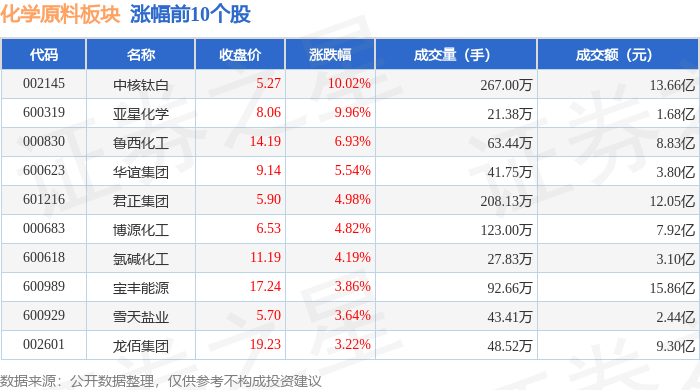
Market Overview - The chemical raw materials sector increased by 2.47% on August 26, with Zhongke Titanium White leading the gains [1] - The Shanghai Composite Index closed at 3868.38, down 0.39%, while the Shenzhen Component Index closed at 12473.17, up 0.26% [1] Top Gainers in Chemical Sector - Zhongke Titanium White (002145) closed at 5.27, up 10.02%, with a trading volume of 2.67 million shares and a turnover of 1.366 billion yuan [1] - Yaxing Chemical (600319) closed at 8.06, up 9.96%, with a trading volume of 213,800 shares and a turnover of 168 million yuan [1] - LUXI Chemical (000830) closed at 14.19, up 6.93%, with a trading volume of 634,400 shares and a turnover of 883 million yuan [1] Top Losers in Chemical Sector - Xinghua Co. (002109) closed at 3.89, down 3.47%, with a trading volume of 615,000 shares and a turnover of 240 million yuan [2] - Jiangtian Chemical (300927) closed at 30.06, down 3.47%, with a trading volume of 79,700 shares and a turnover of 242 million yuan [2] - Kaisheng New Materials (301069) closed at 22.63, down 3.33%, with a trading volume of 205,600 shares and a turnover of 470 million yuan [2] Capital Flow Analysis - The chemical raw materials sector saw a net inflow of 181 million yuan from institutional investors, while retail investors experienced a net outflow of 69.7859 million yuan [2] - Major stocks like Zhongke Titanium White had a net inflow of 312 million yuan from institutional investors, while retail investors had a net outflow of 182 million yuan [3] - Other notable stocks with significant capital movements include Junzheng Group and LUXI Chemical, which also experienced varying levels of net inflow and outflow [3]


鲁西化工涨2.03%,成交额1.18亿元,主力资金净流入494.26万元
Xin Lang Cai Jing· 2025-08-26 02:52
Core Viewpoint - Lu Xi Chemical has shown significant stock performance with a year-to-date increase of 19.40% and a recent 5-day increase of 13.21% [1] Financial Performance - As of June 30, Lu Xi Chemical reported a revenue of 14.739 billion yuan, representing a year-on-year growth of 4.98%, while the net profit attributable to shareholders decreased by 34.81% to 763 million yuan [2] - Cumulative cash dividends since the A-share listing amount to 9.885 billion yuan, with 2.167 billion yuan distributed over the past three years [3] Shareholder Information - The number of shareholders increased to 101,000, up by 9.83%, while the average circulating shares per person decreased by 8.95% to 18,860 shares [2] - Major shareholders include Southern CSI 500 ETF, holding 16.9804 million shares, and Hong Kong Central Clearing Limited, holding 16.6184 million shares, with notable changes in their holdings [3] Stock Market Activity - On August 26, Lu Xi Chemical's stock price reached 13.54 yuan per share, with a trading volume of 118 million yuan and a turnover rate of 0.46% [1] - The stock experienced a net inflow of 4.9426 million yuan from main funds, with significant buying and selling activities recorded [1] Business Overview - Lu Xi Chemical, established on June 11, 1998, operates in the chemical new materials and basic chemicals sectors, with a revenue composition of 66.07% from new materials, 20.11% from basic chemicals, and 12.06% from fertilizers [1] - The company is categorized under the basic chemicals industry, specifically in coal chemicals, and is involved in various concept sectors including fertilizers and methanol [1]
中银晨会聚焦-20250826
Bank of China Securities· 2025-08-26 01:58
Key Insights - The report highlights a selection of stocks for August, including companies like SF Holding, Satellite Chemical, and Anji Technology, indicating potential investment opportunities in these firms [1] - The report emphasizes the steady growth of Tongcheng Travel, with Q2 2025 revenue reaching 4.669 billion yuan, a year-on-year increase of 10.0%, and an adjusted net profit of 775 million yuan, up 18.0% [3][8] - Nanya Technology's performance in Q2 2025 shows significant growth, with revenue of 2.305 billion yuan, a year-on-year increase of 43.06%, and a net profit of 87 million yuan, up 57.69% [13][14] - East China Pharmaceutical's revenue for the first half of 2025 was 21.675 billion yuan, a 3.39% increase year-on-year, with a net profit of 1.815 billion yuan, up 7.01% [18][19] Industry Performance - The report provides an overview of industry performance, with the telecommunications sector leading with a 4.85% increase, followed by non-ferrous metals at 4.63% and real estate at 3.32% [4] - The Shanghai Composite Index closed at 3883.56, reflecting a 1.51% increase, while the Shenzhen Component Index rose by 2.26% to 12441.07 [4] Company-Specific Highlights - Tongcheng Travel's core OTA business showed robust growth, with Q2 2025 OTA revenue reaching 4.01 billion yuan, a 13.7% increase year-on-year [9] - Nanya Technology's high-end product demand is driven by AI applications, with significant growth in high-end copper-clad laminate sales [15][16] - East China Pharmaceutical's innovative products are entering a harvest phase, with a notable increase in revenue from innovative products, reaching 1.084 billion yuan, a 59% year-on-year growth [20][21]


英力特:2025年上半年营收8.67亿元,募资6.8亿元提升主营业务生产能力
Zheng Quan Shi Bao Wang· 2025-08-26 01:33
Core Viewpoint - The company reported a significant loss in the first half of 2025, with a net profit loss of approximately 1.56 billion yuan, despite maintaining stable production operations and enhancing its integrated industrial chain [1][2] Group 1: Financial Performance - The company's operating revenue for the first half of 2025 was approximately 867 million yuan, with a net profit loss of about 156 million yuan [1] - The company successfully completed a targeted placement of 9.105 million shares, raising a net amount of approximately 679 million yuan, which strengthens its financial position [2] Group 2: Production and Operations - The company maintains stable production operations, with continuous and stable operation of major product lines such as calcium carbide, PVC, and caustic soda, laying a solid foundation for capturing market opportunities in the second half of the year [2] - The company has established an integrated industrial chain from self-supplied electricity to calcium carbide and PVC, enhancing its operational efficiency [1] Group 3: Industry Position and Efficiency - The company's total asset turnover rate averaged 0.64 times per year, ranking 11th among 61 companies in the chemical raw materials industry, indicating strong asset operational efficiency and management [2] - The company is focusing on high-value-added products like E-PVC, preparing for future product structure upgrades [2] Group 4: Environmental Initiatives - The company is advancing green low-carbon projects, including a 10MW self-generated wind power project that is set to commence construction, and a zero wastewater discharge project that has entered trial operation [1]

博源化工股价上涨2.64% 成交额达5.62亿元
Jin Rong Jie· 2025-08-25 17:13
8月25日主力资金净流入178.37万元,占流通市值的0.01%。近五个交易日主力资金累计净流出1.7亿 元,占流通市值的0.82%。 风险提示:股市有风险,投资需谨慎。 博源化工最新股价为6.23元,较前一交易日上涨0.16元。当日开盘价为6.12元,最高触及6.34元,最低下 探至6.07元,振幅为4.45%。成交量达90.37万手,成交金额5.62亿元。 博源化工属于化学原料行业,公司注册地位于内蒙古。该公司同时被纳入多个国际指数成分股,包括标 准普尔、富时罗素和MSCI中国指数。公司当前总市值为231.68亿元,流通市值206.76亿元。 ...

亚星化学股价上涨1.66% 7211万股限售股迎解禁
Jin Rong Jie· 2025-08-25 17:12
Group 1 - The latest stock price of Yaxing Chemical is 7.33 yuan, an increase of 0.12 yuan from the previous trading day, with a trading volume of 76,317 hands and a transaction amount of 0.55 billion yuan [1] - The company operates in the chemical raw materials industry, focusing on the production and sales of products such as chlorinated polyethylene and caustic soda, and is a significant chemical enterprise in Shandong province [1] - Yaxing Chemical experienced a lock-up share release on August 25, with a total of 72.1154 million shares becoming available for trading [1] Group 2 - On the day of the lock-up release, the net outflow of main funds was 248.58 million yuan, with a cumulative net outflow of 506.29 million yuan over the past five trading days [1]
重大利好!国防军工ETF(512810)放量续刷阶段新高!卫星互联网牌照即将发放,概念股集体涨超10%
Xin Lang Ji Jin· 2025-08-25 14:42
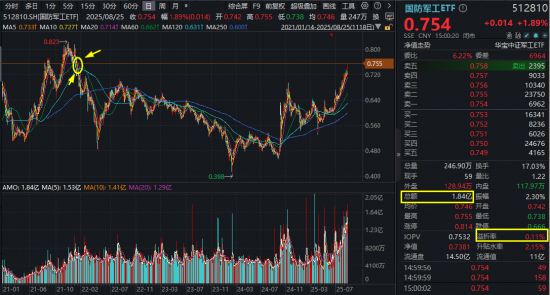
Market Overview - On August 25, A-shares experienced a significant upward trend, with all three major indices reaching new highs, and the Shanghai Composite Index approaching 3900 points. The market turnover exceeded 3 trillion yuan, marking a historical peak [1][4]. Defense and Military Industry - The defense and military sector showed heightened activity ahead of the upcoming September 3 military parade, with the "August 1" defense and military ETF (512810) surging by 2% and reaching its highest price since January 10, 2022 [1][4]. - The ETF recorded a total trading volume of 184 million yuan, indicating strong buying interest and potential large capital inflows [1]. Satellite Internet Sector - The satellite internet concept stocks saw a significant surge, with companies like Zhongke Xingtu and Huafeng Technology rising approximately 12%, while Shanghai Hantong and China Satellite hit the daily limit [3]. - A senior technical expert indicated that the issuance of satellite internet licenses marks a significant step towards commercial operations in China, although it may take 2-3 years to achieve services comparable to Starlink [3]. Event Catalysts - The upcoming military parade is expected to create short-term opportunities in the defense and military sector, with historical data showing that major parades often lead to significant price increases in related stocks [4]. - The "August 1" military ETF (512810) encompasses various themes, including commercial aerospace, low-altitude economy, large aircraft, deep-sea technology, military AI, and controllable nuclear fusion, making it an efficient tool for investing in core defense and military assets [4].
川恒股份股价报26.73元 磷化工企业获养老金持仓
Sou Hu Cai Jing· 2025-08-25 11:48
Group 1 - The stock price of Chuanheng Co., Ltd. closed at 26.73 yuan on August 25, 2025, reflecting a 1.29% increase from the previous trading day [1] - The trading volume on that day was 105,538 lots, with a total transaction amount of 281 million yuan [1] - Chuanheng Co., Ltd. specializes in the research, production, and sales of phosphate chemical products, including monoammonium phosphate and diammonium phosphate [1] Group 2 - The company is headquartered in Guizhou Province and operates within the chemical raw materials industry [1] - Chuanheng Co., Ltd. has been included in the 2025 mid-term report pre-increase concept sector and appears on the pension fund holding list [1] - The current price-to-earnings ratio of the company is 20.10 times, and the price-to-book ratio is 2.47 times [1] Group 3 - On August 25, the net outflow of main funds was 4.66 million yuan, with a cumulative net outflow of 923,900 yuan over the past five trading days [1]