纺织业

Search documents
加快生产赶订单 全力冲刺“收官季”
Xin Lang Cai Jing· 2025-12-22 20:23
Core Viewpoint - The article highlights the economic stability and growth in Changxing County, Huzhou City, Zhejiang Province, driven by policies that encourage technological innovation, tax reductions, and support for enterprises, which in turn enhance the competitiveness of local brands and promote smart manufacturing upgrades [1] Group 1: Economic Policies and Impact - The local government has implemented policies to encourage technological innovation, reduce taxes and fees, and provide support to enterprises [1] - These measures have contributed to the enhancement of the competitiveness of local brands [1] - The economic growth has remained stable, indicating a positive response to these policies [1] Group 2: Employment and Rural Revitalization - The development of industries has facilitated local employment opportunities, allowing workers to find jobs close to home [1] - This local employment growth supports the broader initiative of rural revitalization [1]
【财经分析】土耳其纺织业产能就业双收缩 结构调整进入关键期
Xin Hua Cai Jing· 2025-12-22 16:17
新华财经伊斯坦布尔12月22日电(记者许万虎)土耳其纺织业当前正面临明显调整压力,业内人士表 示,在外部需求走弱、生产成本上升等因素叠加影响下,该行业正在经历至少20年来最明显的一轮下行 周期。 业内人士透露,行业还面临劳动力供给结构变化带来的挑战。长期从事缝纫、染整和裁剪等劳动密集环 节的部分叙利亚难民正在陆续返回本国,而本国年轻劳动力进入纺织行业意愿不足,用工短缺问题突 出。 纺织业是土耳其制造业和出口体系的重要支柱。数据显示,今年以来,该国已有300多家纺织和成衣企 业申请破产保护,过去两年间相关行业就业岗位减少超过30万个。业内普遍认为,本轮调整已超出短期 周期波动范畴,呈现出较为明显的结构性特征。 多重压力迫使企业退出行业呼吁紧急"转型" 产出放缓买家减少传统市场持续承压 据土耳其媒体报道,在伊斯坦布尔、代尼兹利、布尔萨、加济安泰普和卡赫拉曼马拉什等主要纺织产业 集中地区,不少工厂目前已停产或将开工率降至正常水平的30%至40%。作为行业重要支撑的出口表现 持续承压,欧洲市场需求疲软叠加原材料和能源成本上升,对企业经营形成制约。 官方数据显示,截至今年11月,土耳其纺织品出口额约为86亿美元,成衣出 ...
定制服务促制造业逐“绿”而行
Xin Lang Cai Jing· 2025-12-21 23:49
Group 1 - The core viewpoint of the articles highlights the efforts of companies in the textile and bamboo industries to enhance green development and compliance through tax incentives and support from local tax authorities [1][2] - Huzhou Jingcheng Textile Co., Ltd. has utilized over 800 tons of recycled fibers annually, reducing oil extraction by 24,000 tons and lowering carbon emissions by over 30% [1] - The company has implemented a three-tier approval mechanism for financial and legal reviews, promoting a shift towards high value-added sectors, resulting in a direct economic benefit of over 5 million yuan from green technology conversion last year [1] Group 2 - The "Tax Small Beauty" credit management team provides one-stop services, including policy interpretation and tax declaration, to help companies strengthen compliance management and accelerate their transition to new business models [2] - Zhejiang Fenghui Bamboo and Wood Products Co., Ltd. has achieved dual A certification in tax credit and ecological environment credit, enhancing the appeal of its green bamboo products in international markets [2] - The local tax bureau plans to deepen the application of tax big data to accurately track the green transformation of manufacturing industries and improve the support system for green manufacturing through collaboration with multiple departments [2]
“山东首富”造车,千亿铝业帝国的赌局
汽车商业评论· 2025-12-21 23:04
Core Viewpoint - The Chinese automotive market in 2025 is characterized by a stark contrast between industry consolidation and the influx of new entrants, with companies like Weiqiao Group making significant moves into the electric vehicle sector amid challenges in their traditional businesses [4][5]. Group 1: Industry Challenges and New Entrants - Several established automotive companies, including Hozon Auto and GAC Fiat, have declared bankruptcy, indicating a harsh industry shakeout [5]. - New players, such as Chasing Technology and Weiqiao Group, are entering the market, driven by government support and the need for diversification from struggling core businesses [5][9]. Group 2: Weiqiao Group's Background and Strategy - Weiqiao Group, originally established in 1951, has diversified into various sectors, including textiles and aluminum, and has been listed among the Fortune Global 500 for 13 consecutive years [7]. - The company faced significant challenges in its textile and aluminum businesses, with textile profits dropping by 24.8% in 2022 and a major environmental crackdown affecting aluminum production [9][10]. - Following these setbacks, Weiqiao Group shifted its focus to the electric vehicle sector, motivated by favorable government policies and the need for new growth avenues [12][19]. Group 3: Leadership and Vision - Zhang Bo, the son of the founder, took over leadership in 2018 and has been pivotal in steering the company towards the automotive industry, emphasizing the importance of aligning new ventures with the company's core competencies [16][22]. - Under Zhang Bo's leadership, Weiqiao Group has made strategic partnerships and investments in the electric vehicle space, including collaborations with research institutions and other automotive companies [17][22]. Group 4: Automotive Brand Development - Weiqiao Group has established four automotive brands: 212, Jishi, Ruisheng, and Leichi, covering a wide range of market segments from commercial to passenger vehicles [32]. - The company has adopted a strategy of acquiring existing automotive assets and brands rather than starting from scratch, which allows for quicker market entry and leveraging existing capabilities [33]. - The 212 brand has been particularly notable, with a range of models priced between 139,900 to 188,800 yuan, although it has faced challenges such as product quality issues and trademark disputes [23][32]. Group 5: Future Outlook - Weiqiao Group's automotive ventures are seen as a new hope for the company, with significant revenue growth reported in 2024, but they also introduce new uncertainties and risks [22][32].

中天精装参投企业拟间接收购中国高科控制权;观想科技筹划购买辽晶电子不低于60%股权 | 公告精选
Mei Ri Jing Ji Xin Wen· 2025-12-21 13:45
Group 1 - Zhongtian Jingzhuang announced that its partner Changjiang Semiconductor intends to acquire 100% equity of Zhengzhong International Education, thereby indirectly gaining control of China High-Tech [1] - Changjiang Semiconductor plans to introduce semiconductor packaging business to China High-Tech, focusing on HBM packaging and customized packaging products, with specifics to be determined by future developments [1] Group 2 - Jinshi Resources announced a plan to purchase 15.7147% equity of Nuoya Fluorochemical for 257 million yuan, making it the second-largest shareholder of Nuoya Fluorochemical [2] - This transaction is a strategic investment leveraging upstream resource advantages to target quality entities in the downstream fine chemical sector [2] Group 3 - Guanshang Technology plans to acquire at least 60% equity of Liao Jing Electronics through a share issuance, while also raising matching funds; the transaction remains uncertain [3] - The company's stock will be suspended from trading starting December 22 [3] Group 4 - Delin Hai's vice chairman Ma Jianhua intends to reduce his shareholding by up to 196,000 shares, representing no more than 0.1735% of the total share capital [4] - This reduction will not exceed 25% of his total shareholding prior to the sale [4] Group 5 - Mercury Home Textiles announced that shareholders Li Lijun and Li Yujian plan to collectively reduce their holdings by no more than 1.72% of the total shares [5] - Li Lijun plans to reduce up to 1.52 million shares (0.5791% of total shares), while Li Yujian plans to reduce up to 3 million shares (1.1429% of total shares) [5] Group 6 - Kairuide announced that its major shareholder Hubei Nonggu Group plans to reduce its holdings by up to 3% of the total shares, totaling 11.03 million shares [6] - The reduction will occur through both centralized bidding and block trading methods [6] Group 7 - Victory Energy reported significant stock price volatility, with a cumulative increase of 77.22% over six consecutive trading days, indicating a high risk of rapid decline [7] - The stock price has significantly deviated from the company's fundamentals, suggesting potential for a sharp downturn [7] Group 8 - Wantong Development announced that its controlling shareholder Jia Hua Holdings has had 364 million shares frozen, representing 100% of its holdings and 19.28% of the company's total shares [8] - The controlling shareholder has faced overdue debts totaling 1.301 billion yuan, with ongoing negotiations to resolve contractual disputes [8]






下周审核9家IPO,创业板开板以来首单未盈利IPO项目将上会迎审!
Sou Hu Cai Jing· 2025-12-21 13:26
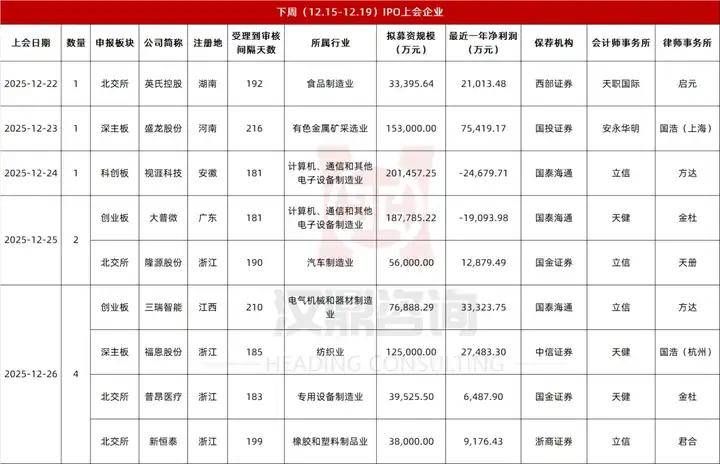
Group 1 - A total of 9 companies are scheduled for IPO review next week, aiming to raise a combined capital of 9.111 billion yuan [1] - The companies include Ying's Holdings, Shenglong Co., Shiya Technology, and others, with various industries represented such as food manufacturing, non-ferrous metal mining, and electronic equipment manufacturing [2][6] - Ying's Holdings is a leading enterprise in the infant food industry in China, focusing on nutritional care for infants and young children [6][7] Group 2 - Shenglong Co. is a major molybdenum company in China, engaged in the comprehensive development and utilization of non-ferrous metal resources [15][16] - Shiya Technology specializes in micro-display solutions, being the first to achieve mass production of silicon-based OLED micro-displays [10][11] - Dapu Microelectronics focuses on enterprise-level SSD products, with a strong capability in self-research and development [20][21] Group 3 - Longyuan Co. specializes in the research, production, and sales of aluminum alloy precision die-casting parts, primarily for the automotive industry [25][26] - Fuen Co. is a global supplier of eco-friendly fabrics, emphasizing sustainable development in its operations [33] - Sanrui Intelligent Technology is a leading manufacturer of drone and robot power systems, actively developing products for electric vertical takeoff and landing aircraft [29][30]

棉花:震荡偏强关注需求20251221
Guo Tai Jun An Qi Huo· 2025-12-21 12:50
Report Industry Investment Rating - Not provided in the report Core Viewpoints of the Report - ICE cotton is expected to remain in a low - level oscillation. Although the poor US cotton export data restricts its upward drive, the lack of new negative fundamentals limits its downward momentum. Attention should be paid to external market factors, and there may be a risk of decline if market risk appetite deteriorates [6][17] - The domestic cotton futures and spot prices continue to strengthen slightly, and the basis remains relatively firm. The high and stable basis supports cotton futures, but the increasing cotton warehouse receipts and the incomplete release of domestic cotton supply pressure limit the upward momentum of Zhengzhou cotton futures. The downstream demand is in the off - season, and it is too early to focus on next year's planting. It is better to discuss it after the Spring Festival in combination with demand. In the short term, Zhengzhou cotton futures are expected to maintain a slightly stronger oscillating trend, but the upward space may be limited, and attention should be paid to the change of the spot basis [2][17] Summary by Relevant Catalogs 1. Market Data | Variety | Opening Price | Highest Price | Lowest Price | Closing Price | Change | Change Rate (%) | Trading Volume (Lots) | Trading Volume Change (Lots) | Open Interest (Lots) | Open Interest Change (Lots) | | --- | --- | --- | --- | --- | --- | --- | --- | --- | --- | --- | | ICE Cotton Main - connected | 63.83 | 64.39 | 62.97 | 63.65 | - 0.18 | - 0.28 | 96897 | 10398 | 183446 | 1813 | | Zhengzhou Cotton Main - connected | 13800 | 14070 | 13790 | 14015 | 180 | 1.30 | 1209539 | - 20174 | 761543 | 364044 | | Cotton Yarn Main - connected | 19980 | 20225 | 19950 | 20050 | 70 | 0.35 | 38934 | 5139 | 22821 | 1986 | [5] 2. Fundamental Analysis International Cotton Situation - ICE cotton fluctuated at a low level this week. The March contract once fell below 63 cents/pound on Tuesday due to the decline in crude oil prices and poor US cotton export data. However, driven by the US inflation data boosting interest - rate cut expectations and short - covering, it rebounded slightly in the second half of the week, recovering most of the losses on Tuesday. Currently, the poor US cotton export data makes ICE cotton lack upward drive, but in the context of an overall optimistic external market risk appetite, it temporarily holds the 63 - cent/pound line [6] - As of the week ending November 27, the weekly signing volume of 2025/26 US upland cotton was 30,800 tons, a 8% decrease from the previous week and a 23% decrease from the four - week average. The weekly shipment volume was 27,700 tons, a 1% increase from the previous week and a 5% decrease from the four - week average. The total signed sales volume of US upland cotton and Pima cotton in the 2025/26 season accounted for 51% of the annual forecasted total export volume, and the cumulative export shipment volume accounted for 41% of the annual total signed volume [7] - In India, both cotton import and export were strong in October. Textile exports were still affected by US tariffs. The raw cotton import volume in October was 127,000 tons, a record high in recent months. The export volume was 24,000 tons, a 33% increase from September and a 36% increase year - on - year. The textile export value in October was 1.55 billion US dollars. The Cotton Corporation of India has purchased about 4 million bales of new cotton, with a total inventory of 4.6 million bales [8] - ABRAPA's forecast of Brazil's cotton production in the 2025/26 season is lower than CONAB's. The cotton planting area in Mato Grosso state is expected to decline by 7.8% this season. The Brazilian Cotton Growers Association predicts that the cotton production in 2026 will reach 3.83 million tons [9] - In Pakistan, the demand for imported cotton has slightly improved, and the cotton production forecast remains in the range of 7 - 7.25 million bales. The local yarn demand is continuously weak, and some spinning enterprises are selling inventory at low prices. Yarn exports are mainly to the Chinese market [10] - In Bangladesh, it is expected that the import volume of US cotton will increase slightly in the next few months. Cotton import procurement is still sporadic. Although clothing and textile export orders are relatively stable, yarn prices are flat, and producers are facing increasing operating pressure [10] - As of the week ending December 19, the operating rates of textile enterprises in India, Vietnam, and Pakistan were 67%, 62%, and 65.5% respectively, showing little change [11] Domestic Cotton Situation - From December 12 - 19, domestic cotton futures and spot prices continued to be stable and slightly stronger. The procurement of cotton raw materials by spinning enterprises and cotton merchants was good in the first half of the week, mainly for low - basis spot lock - basis transactions. The spot basis changed little, and the price of 2025/26 machine - picked cotton in North and South Xinjiang was mostly between 14,900 - 15,100 yuan per ton [12] - As of December 19, the registered cotton warehouse receipts were 3,870, and the forecast warehouse receipts were 3,852, totaling 7,722, equivalent to 324,324 tons [12] - The sales of pure - cotton yarn in the market were generally poor, except for the relatively stable demand for combed high - count yarn. The prices of pure - cotton yarn fluctuated. Xinjiang spinning enterprises maintained a high operating rate with no inventory pressure, while the operating rate of inland spinning enterprises continued to decline. The pure - cotton grey cloth market remained weak, with local traders stocking up slightly, and the overall order volume did not recover much [13] 3. Basic Data Charts - The report provides charts on cotton sales progress, commercial inventory (weekly), spinning enterprises' cotton inventory (weekly), weaving enterprises' yarn inventory (weekly), spinning enterprises' cotton yarn inventory (weekly), cotton cloth enterprises' cotton cloth inventory (weekly), yarn enterprises' operating rate (weekly), cotton cloth enterprises' operating rate (weekly), pure - cotton yarn profit, pure - cotton cloth CGC32 profit, cotton 1 - 5 spread, cotton import profit, cotton basis, and Zhengzhou cotton warehouse receipts [14][15][16] 4. Operation Suggestions - ICE cotton is expected to maintain a low - level oscillation. Attention should be paid to external market factors. If market risk appetite deteriorates, there may be a risk of decline [17] - In the short term, Zhengzhou cotton futures are expected to maintain a slightly stronger oscillating trend, but the upward space may be limited. Attention should be paid to the change of the spot basis. It is too early to focus on next year's planting, and it is better to discuss it after the Spring Festival in combination with demand [2][17]
上会日期定了!福恩股份12月26日IPO迎考,拟募资12.5亿元
Bei Jing Shang Bao· 2025-12-21 02:09
本次冲击上市,福恩股份拟募集资金约12.5亿元,扣除发行费用后,将用于萧政工出(2023)82号再生环 保毛型色纺面料一体化项目、高档环保再生材料研究院及绿色智造项目。 北京商报讯(记者马换换李佳雪)近期,深交所官网显示,杭州福恩股份有限公司(以下简称"福恩股份") 主板IPO将于12月26日上会迎考。 据悉,福恩股份是一家以可持续发展为核心的全球生态环保面料供应商,以生态环保面料的研发、生产 和销售作为主营业务。公司IPO于2025年6月24日获得受理,并于7月9日进入问询阶段。 ...
东南亚深陷中美夹缝,既难舍中国供应链,又害怕美国的制裁大棒!
Sou Hu Cai Jing· 2025-12-20 05:51
Group 1 - Southeast Asian countries are caught in a complex situation due to US-China trade tensions, relying on Chinese supply chains while facing US tariffs [1][11] - The "China plus one" strategy has led multinational companies to shift assembly operations to Southeast Asia to avoid US tariffs, but this still ties them to Chinese supply chains [5][6] - Southeast Asia's dependence on Chinese supply chains is critical for its assembly industries, which are essential for exports to the US market [8][10] Group 2 - The tightening of US policies under the Trump administration has exacerbated the challenges faced by Southeast Asian countries, pushing them towards a more extreme position of choosing sides [3][15] - New US policies classify products as "Made in China" if they rely on Chinese components, imposing additional tariffs and creating uncertainty for Southeast Asian exporters [17][20] - The economic growth in Southeast Asia is showing signs of fragility, with industries like textiles and electronics facing significant risks due to reliance on US markets and Chinese supply chains [22][23] Group 3 - The US has pressured Southeast Asian countries to choose between trade agreements with the US or China, complicating their ability to maintain a balanced approach [29][31] - Countries like Indonesia have rejected US demands, while smaller nations like Cambodia face difficult choices between losing access to the US market or compromising their strategic autonomy with China [32][35] - The path to industrial upgrading for Southeast Asia is fraught with challenges, as they struggle to break free from dependence on Chinese supply chains while needing to enhance their technological capabilities [34]
大生纱厂漆颖斌:传承的力量,在此具象化
Xin Lang Cai Jing· 2025-12-19 12:44
Core Insights - The article highlights the legacy of Zhang Jian, a late Qing dynasty entrepreneur, who founded the Dazhong Spinning Factory in Nantong, Jiangsu Province, emphasizing his contributions to industry and education as a means of national salvation [1][10][12]. Group 1: Historical Significance - Zhang Jian established the Dazhong Spinning Factory in 1895, marking a pivotal step in his mission of industrial salvation for the nation [3][12]. - The Dazhong Spinning Factory has become a symbol of Nantong's textile industry and a living testament to over a century of Chinese spinning history [5][12]. Group 2: Innovation and Transformation - The textile industry is evolving into a high-tech sector, with Dazhong Spinning Factory leading the way in upgrading to high-end production equipment and digital technologies [6][15]. - In 2015, Dazhong built the first fully digital spinning workshop in China, reducing labor from thousands to just 15 workers for a capacity of 10,000 spindles [6][15]. - The factory is set to launch the country's first carbon-neutral smart spinning factory in 2025, integrating a zero-carbon energy supply system and achieving near-zero carbon emissions in production [8][17]. Group 3: Economic Impact - The textile industry in Nantong has grown into a modern industrial cluster with an output value exceeding 240 billion yuan, recognized as a national advanced manufacturing cluster [9][18]. - The collaboration between Nantong, Suzhou, and Wuxi has established a high-end textile cluster, making it one of the most comprehensive textile regions in China [9][18].