量子科技

Search documents
特斯拉准备扩建得州超级工厂,拟年产1000万台Optimus人形机器人;国内脑机接口产品首次进入审批“绿色通道”——《投资早参》
Mei Ri Jing Ji Xin Wen· 2025-11-12 00:41
Market News - The three major US stock indices closed mixed, with the Dow Jones up 1.18%, S&P 500 up 0.21%, and Nasdaq down 0.25% [1] - International gold prices continued to rise, with spot gold up 0.34% at $4129.75 per ounce, and COMEX gold futures up 0.36% at $4136.7 per ounce [1] - International oil prices increased, with WTI crude oil up 1.33% at $60.93 per barrel, and Brent crude oil up 1.56% at $65.06 per barrel [1] - European stock indices all closed higher, with Germany's DAX up 0.53%, France's CAC40 up 1.25%, and the UK's FTSE 100 up 1.15% [1] Industry Insights - Tesla is preparing to expand its Texas Gigafactory to build a dedicated facility for mass production of its humanoid robot, Optimus, aiming for an annual production capacity of 10 million units by 2027 [2] - The humanoid robot industry is expected to see significant growth starting in 2025, driven by advancements in component performance and cost reduction [2] - Key beneficiaries in the humanoid robot sector include core supply chains and application scenarios, with concept stocks such as Hanyu Group, Haoshi Electromechanical, and Hanwei Technology [2] - Anhui Province is advancing in quantum technology, with plans to implement nearly 300 application scenarios by the end of this year and 1,000 by 2027 [3] - Recent breakthroughs in quantum computing have been achieved, particularly in atomic quantum computing, which could enhance the stability and speed of operations [3] - The MEMS optical switch market is projected to grow at a compound annual growth rate of 25% from 2024 to 2025, with concept stocks including Keda Technology, Saiwei Electronics, and Puyuan Precision [4] - Shanghai Ladder Medical Technology's implantable wireless brain-machine interface system has entered the special review process for innovative medical devices, marking a significant step in the commercialization of this technology [3][6] - The global brain-machine interface medical application market is expected to reach $40 billion by 2030 and $145 billion by 2040, indicating substantial growth potential [5][6] - Key concept stocks in the brain-machine interface sector include Zhongke Information, Guanhao Biological, and Aipeng Medical [6]


量子科技成经济新增长点 35只概念股前三季度研发费用均超1亿元
Zheng Quan Shi Bao· 2025-11-11 17:52
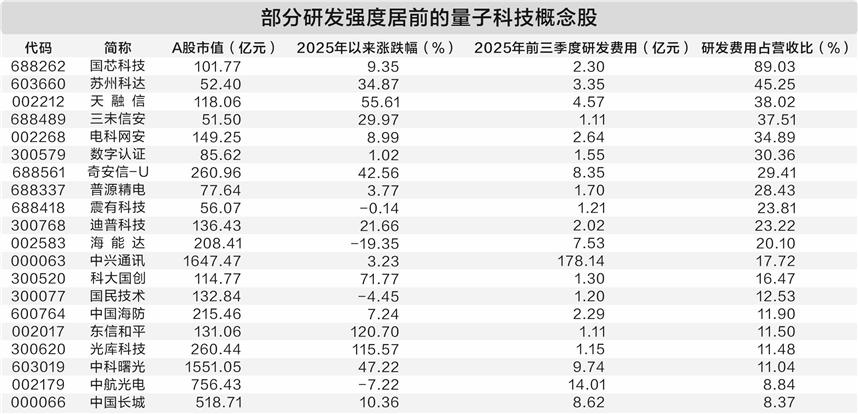
Core Insights - The quantum technology sector is experiencing significant advancements, with both policy support and technological breakthroughs driving growth [2][3][4] - The global quantum computing industry is projected to grow from $4.7 billion in 2023 to over $800 billion by 2035, indicating substantial market potential [4] - A total of over 60 A-share companies are involved in quantum technology, with significant R&D investments, particularly in quantum security chips and modules [4][5] Policy Developments - Anhui Province is focusing on scaling quantum technology applications, aiming to implement nearly 300 application scenarios by the end of this year and 1,000 by 2027 [2] Technological Breakthroughs - Domestic advancements include a new architecture for atomic quantum computing that addresses challenges in high parallelism, speed, and stability [3] - Internationally, a team from the University of Chicago has theoretically extended the connection distance between quantum computers to 2,000 kilometers [3] Industry Growth and Investment - In the first three quarters of this year, A-share companies involved in quantum technology reported a total R&D expenditure of 69.47 billion yuan, accounting for 3.86% of total revenue [4] - Notable companies with high R&D expenditure include China Mobile, ZTE, and China Telecom, with 国芯科技 leading at 89.03% of revenue spent on R&D [4][5] Market Opportunities - Quantum communication, particularly quantum key distribution (QKD), is identified as the most mature and commercially viable area within quantum technology [3] - Quantum measurement is also highlighted as an early revenue-generating sector, akin to "hidden champions" in niche markets [3]





利好!工信部发布
中国基金报· 2025-11-11 08:53
Core Viewpoint - The Ministry of Industry and Information Technology (MIIT) of China has issued a notification to accelerate the systematic layout and high-level construction of manufacturing pilot platforms, aiming to establish a modern pilot platform system by the end of 2027 [2][3]. Summary by Sections Overall Requirements - The notification emphasizes the importance of promoting new industrialization and aims to strengthen the role of pilot platforms as key nodes connecting the innovation chain, technology chain, and industrial chain [7]. Main Tasks - The notification outlines three main tasks for the development of pilot platforms: 1. **Strengthening a Batch of Pilot Platforms**: Focus on strategic positioning, basic capabilities, technological advantages, operational mechanisms, service effectiveness, and future potential to elevate pilot platforms to higher levels [8]. 2. **Activating a Batch of Pilot Platforms**: Implement targeted support and enhance the internal development dynamics and competitiveness of pilot platforms [9]. 3. **Supplementing a Batch of Pilot Platforms**: Focus on key industries such as artificial intelligence, humanoid robots, quantum technology, clean low-carbon hydrogen, biomedicine, and new materials to address supply shortages in critical areas [9]. Construction Goals - The construction goal of the pilot platforms is to create a comprehensive public service system that enhances pilot capabilities and service effectiveness, accelerates the engineering breakthroughs of innovative achievements, and promotes the deep integration of technological and industrial innovation [5]. Work Arrangements - Local industrial and information departments are required to mobilize eligible pilot platforms to apply for inclusion in the reserve list by specific deadlines, ensuring a systematic approach to the development of pilot platforms [10]. Work Requirements - Emphasis is placed on establishing a stable investment mechanism, a scientific operational mechanism, and an efficient support mechanism to enhance the overall development effectiveness of pilot platforms [12].

量子科技重大突破,高研发+高增长潜力概念股仅9只(名单)
Zheng Quan Shi Bao Wang· 2025-11-11 05:10
Core Insights - Quantum technology is viewed as the "key" to the next generation of information technology revolution, with significant breakthroughs in both policy and technology [1][3]. Policy Developments - The Anhui Provincial Development and Reform Commission announced that quantum technology is transitioning from technological breakthroughs to large-scale industrial applications, aiming to implement nearly 300 application scenarios by the end of this year and 1,000 by 2027 [1]. - The United Nations Educational, Scientific and Cultural Organization (UNESCO) has declared 2025 as the "International Year of Quantum Science and Technology" to commemorate the 100th anniversary of quantum mechanics [3]. Technological Advancements - A team from the Chinese Academy of Sciences has made significant progress in neutral atom quantum computing, proposing a new architecture based on fiber arrays that addresses challenges in achieving high parallelism, speed, and stability [1]. - Researchers at the University of Chicago have theoretically extended the connection distance between quantum computers to 2,000 kilometers, making the construction of a global quantum internet more feasible [2]. Industry Growth Potential - Quantum technology, encompassing quantum computing, quantum communication, and quantum precision measurement, is identified as a future industry with substantial growth potential, as highlighted in the 14th Five-Year Plan [3]. - The global quantum computing industry is projected to grow from $4.7 billion in 2023 to over $800 billion by 2035 [3]. R&D Investment - Over 60 companies in the A-share market are involved in quantum technology, with a total R&D expenditure of 69.47 billion yuan, accounting for 3.86% of total revenue [4]. - Among these, 35 companies reported R&D expenses exceeding 100 million yuan in the first three quarters, with seven companies surpassing 1 billion yuan [5]. Key Players and Financial Metrics - Notable companies include Guoxin Technology, which has the highest R&D expense-to-revenue ratio at 89.03%, and has successfully commercialized quantum security chips [5][6]. - Other companies with significant R&D investments include Suzhou Keda, Tianrongxin, and Digital Certification, with varying R&D expense ratios [5][6]. Institutional Interest - Institutional interest is high for companies like ZTE Corporation and China Mobile, with ZTE receiving ratings from 23 institutions [7]. - Forecasts indicate that nine companies are expected to achieve net profit growth rates exceeding 15% from 2025 to 2027 [7]. Market Predictions - Several stocks, including China Haifang and Keda Technology, are projected to have significant upside potential based on institutional target prices [8].




量子计算机理论互联距离达两千公里
Ke Ji Ri Bao· 2025-11-10 22:55
Core Insights - The team from the University of Chicago's Pritzker School of Molecular Engineering has significantly advanced quantum communication by theoretically extending the connection distance between quantum computers to 2000 kilometers, enabling communication between devices that were previously unable to "talk" to each other [1][2] - This breakthrough is attributed to an innovative manufacturing process rather than new materials, utilizing a technique called molecular beam epitaxy to construct crystal structures with high precision, akin to 3D printing [2][3] Group 1: Quantum Communication Breakthrough - The previous maximum distance for quantum computers to communicate via fiber optics was only a few kilometers, limiting connectivity between devices located in different areas of the same city [1] - The key to overcoming this limitation lies in enhancing the coherence time of individual erbium atoms, which was improved from 0.1 milliseconds to over 10 milliseconds, and in some experimental conditions, even reached 24 milliseconds, theoretically supporting quantum connections up to 4000 kilometers [1] Group 2: Manufacturing Process Innovation - The traditional method of creating quantum devices involved high-temperature melting and slow cooling, followed by chemical etching, which has been replaced by a more innovative approach that allows for precise layer-by-layer construction of crystal structures [2] - This new technique opens a feasible path for the scalable production of interconnected quantum bits, as noted by experts in the field [2]
影响市场重大事件:国家发改委支持建设一批综合性重大场景、高价值的小切口场景;两部门研究推动新能源、用户等主体参与跨省跨区电力市场直接交易
Mei Ri Jing Ji Xin Wen· 2025-11-10 22:47
Group 1: Policy Initiatives on Renewable Energy - The National Development and Reform Commission and the National Energy Administration released guidelines to promote the consumption and regulation of renewable energy, emphasizing the need to upgrade intelligent control technologies and accelerate the application of advanced technologies like AI, big data, and cloud computing in the coordination of main and distributed microgrids [1] - The guidelines call for breakthroughs in large-capacity long-duration energy storage technologies, including innovations in flow batteries, compressed air storage, and gravity storage, as well as enhancing the flexible regulation capabilities of newly built pumped storage power stations [2] - The policy aims to establish a market rule system that accommodates renewable energy participation in electricity markets, supporting direct trading models for distributed renewable energy and storage [3] Group 2: Future Goals for Energy Systems - By 2030, a multi-level renewable energy consumption regulation system is expected to be established, ensuring the integration and efficient operation of renewable energy sources, with an annual demand for 200 million kilowatts of new energy consumption to be met [4] - By 2035, a new power system compatible with a high proportion of renewable energy is projected to be fundamentally established, further improving the renewable energy consumption regulation system [4] Group 3: Development of Application Scenarios - The Guangdong Provincial Development and Reform Commission plans to expand major application scenarios in areas such as unmanned systems and intelligent manufacturing, focusing on promoting and implementing significant application scenarios [5] - The Ministry of Science and Technology aims to strengthen the development of key core technologies and their transformation into practical applications, emphasizing a coordinated approach to technology development, standard formulation, and industry cultivation [6] - Anhui Province is set to implement a quantum information application scenario initiative, targeting the establishment of 300 application scenarios by the end of 2025 and 1,000 by 2027 [7][8] Group 4: Enhancing Scene Supply and Application - The State-owned Assets Supervision and Administration Commission will collaborate with relevant departments to enhance the supply of high-value application scenarios and promote the integration of technological and industrial innovation [9] - The National Development and Reform Commission supports the construction of comprehensive major scenarios and high-value small-scale scenarios, aiming to create a positive cycle of scenario release, application, feedback, and optimization [10] - Emphasizing the importance of collaboration, the National Development and Reform Commission highlights the need for standardized logistics to reduce costs and improve efficiency in multi-scenario integration [11]
到2027年安徽将落地1000个量子科技应用场景
Bei Jing Shang Bao· 2025-11-10 09:33
Core Viewpoint - The Chinese government is accelerating the cultivation and large-scale application of quantum technology, with a focus on developing various application scenarios in Anhui province [1] Group 1: Industry Development - Anhui province is at a critical stage of transitioning quantum technology from technical breakthroughs to large-scale industrial applications [1] - The province is implementing a "thousand scenarios" initiative for quantum information, aiming to establish nearly 300 application scenarios by the end of this year [1] - By 2027, Anhui plans to have a total of 1,000 application scenarios in place [1]
中国经济信心说丨加快场景培育和开放 尽快把“试验田”变成“高产田”
Yang Shi Xin Wen Ke Hu Duan· 2025-11-10 03:06
Core Viewpoint - The Chinese government emphasizes the importance of creating application scenarios to accelerate the commercialization of "black technology" and enhance new productive forces, ultimately supporting high-quality economic and social development [1][2]. Group 1: Importance of Scenarios - Scenarios are likened to "experimental fields" for testing new technologies, which are essential for transforming "black technology" into new productive forces [1]. - The government aims to build various types of scenarios, including comprehensive major scenarios and high-value niche scenarios, to facilitate the rapid application of new technologies and products [1][2]. Group 2: Challenges and Solutions - Despite the potential of "black technology," large-scale commercial applications face challenges, such as the need for policy adjustments and technological upgrades [2]. - The approach of "testing in small areas" is suggested to address development issues, allowing for gradual exploration and problem-solving [2][3]. Group 3: Role of Government and Market - The government is tasked with expanding the supply of production, work, and living scenarios to encourage social capital investment and facilitate the transformation of technological achievements into productive forces [3]. - Opening up scenario resources is expected to stimulate market competition, enabling companies to benefit from technological advancements and efficiency improvements [3]. Group 4: Future Growth Areas - The "14th Five-Year Plan" suggests promoting emerging industries such as quantum technology, biomanufacturing, hydrogen energy, and brain-computer interfaces as new economic growth points [3]. - Establishing typical application scenarios for these future industries, along with innovative regulatory approaches, is crucial for fostering the development of small and medium-sized enterprises and nurturing unicorn companies [3].
量子科技诠释中国“下好先手棋” 三重共振推升板块指数创历史新高
Zheng Quan Shi Bao· 2025-11-09 22:17
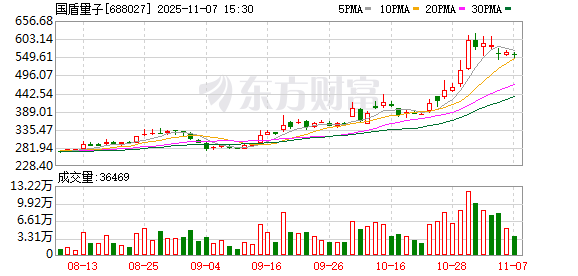
Core Insights - Quantum technology is becoming a focal point for global innovation and is recognized as a key area for measuring national technological strength [2][3] - The successful development of the "Zu Chongzhi No. 3" quantum computing prototype marks a significant shift for China from a follower to a leader in quantum computing [2][3] - The quantum technology index reached a historical high with a year-to-date increase of 40.92%, indicating growing market expectations [1][2] Industry Development - The quantum technology market in China is projected to reach $9.758 billion by 2029, with a compound annual growth rate of 37.45% from 2024 to 2029 [4] - The industry is currently in a transitional phase, moving from "0 to 1" to "1 to N," with quantum communication being the most mature sector [4][5] - Key challenges for the commercialization of quantum technology include the maturity of technology and the completeness of the industrial chain [5][6] Investment Opportunities - Quantum communication, particularly quantum key distribution (QKD), is seen as the most mature and likely to achieve large-scale revenue first [6][7] - Companies like Guodun Quantum are gaining attention, with significant holdings in various funds, reflecting investor interest in the sector [8][9] - The recent surge in quantum technology stocks is attributed to both technological advancements and policy support, indicating a potential long-term investment opportunity [9][10]

量子科技诠释中国“下好先手棋”三重共振推升板块指数创历史新高
Zheng Quan Shi Bao· 2025-11-09 20:41
Core Insights - The Chinese quantum technology industry is transitioning from "strategic layout" to "commercial dawn" driven by technological breakthroughs, policy support, and capital influx [1][4][12] - The Wind Quantum Technology Index reached a historical high with an annual increase of 40.92% as of October 31, indicating rising market expectations [1] Group 1: Technological Advancements - The "Zuchongzhi No. 3" quantum computing prototype has outperformed classical supercomputers by 15 orders of magnitude in "quantum random circuit sampling" [2][4] - China is shifting from a "follower" to a "leader" in quantum computing, marking a significant milestone in key technology fields [4] - Quantum technology is recognized as a crucial area for national technological strength, with the government prioritizing it in future industry cultivation plans [4] Group 2: Industry Development and Challenges - The quantum technology industry is still in the "0 to 1" incubation stage, with varying development progress across quantum computing, communication, and measurement [3][6] - Key bottlenecks for industrialization include technology maturity and supply chain integration, particularly in quantum bit stability and error correction [7][8] - The market size for quantum technology in China is projected to reach $9.758 billion by 2029, with a compound annual growth rate of 37.45% from 2024 to 2029 [6] Group 3: Investment Landscape - The quantum communication sector shows clearer commercial prospects, while quantum computing is viewed as a long-term strategic investment due to its potential to solve complex problems [8][10] - Companies like Guodun Quantum are gaining attention, with significant investments from public funds, indicating a growing interest in the sector [11][12] - The recent surge in quantum technology stocks is attributed to technological advancements and policy catalysts, although there are concerns about the sustainability of this growth [10][12][13]