
农文旅

Search documents
创新模式提升开放质量
Jing Ji Ri Bao· 2025-10-12 22:05
Core Insights - The article emphasizes the importance of breaking trade barriers and enhancing the quality of agricultural openness to drive agricultural modernization in China [1] Group 1: Development Model - Anqiu, Shandong, has established a "three-in-one" development model consisting of "ecological foundation - open empowerment - industrial integration" to address international market trends in ecological certification [1] - The local agricultural production system is being reshaped through digital supervision for standardized control across the entire supply chain, promoting resource efficiency and green transformation via circular agriculture [1] - Innovative ecological practices, such as integrated farming and three-dimensional production, have turned environmental constraints into quality advantages, enabling various agricultural products to gain international certification and access high-end markets [1] Group 2: Economic Impact - The expansion of ecological agriculture has made industrial integration a core engine for driving common prosperity in the county [1] - Anqiu has developed a "three-chain collaborative" model that significantly enhances the added value of primary agricultural products through deep processing, such as curcumin extraction and wheat peptide powder development [1] - The integration of ecological agriculture, facility agriculture, and cultural tourism projects has led to an annual increase in farmers' income by 2.6 billion yuan [1] - The "farm + cooperative + farmer" mechanism promotes deep participation of smallholders, successfully bridging the gap between "green mountains and clear waters" and "golden mountains and silver mountains" [1] Group 3: Challenges and Solutions - Anqiu faces common challenges, such as addressing standard differences in breaking international green barriers and connecting smallholders with large markets during industrial upgrades [2] - The region aims to enhance innovation and research capabilities in the health food industry [2] - Anqiu is actively responding to these challenges by strengthening alignment with international standards, improving mechanisms to support farmers, and increasing research investment, providing valuable references for similar regions [2]
白沙新高峰村:依托绿水青山推进农旅融合
Hai Nan Ri Bao· 2025-10-12 00:00
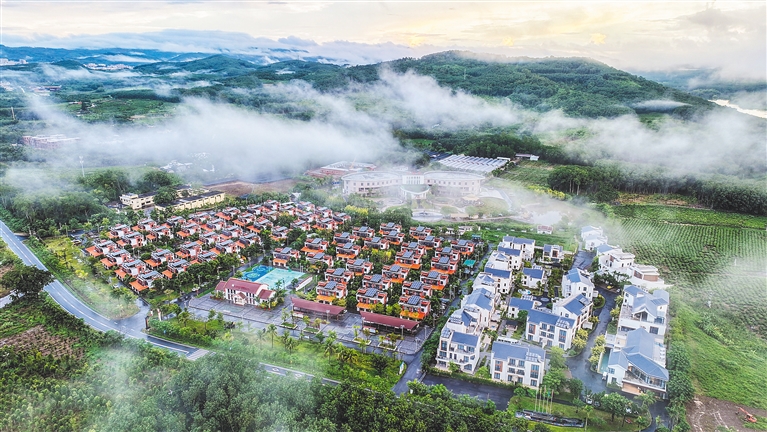
Core Points - The article highlights the development of the "Baisha Courtyard" agricultural and cultural tourism integration demonstration project in Xinfeng Village, Yacha Town, Baisha Li Autonomous County [2] - The project aims to create a tourism station that combines rainforest vacation, Li ethnic culture, and tea tourism experiences, leveraging the surrounding tourism highway [2] - The initiative is designed to increase income for local villagers through a cooperation mechanism involving enterprises, village collectives, and farmers [2]

经理人如何盘活农村集体经济
Ren Min Ri Bao· 2025-09-26 10:02
Core Insights - The article discusses the role of rural collective economic managers in revitalizing rural economies in China, highlighting successful case studies from different regions [8][9][18]. Group 1: Role of Rural Collective Economic Managers - Rural collective economic managers are professionals tasked with developing and managing rural collective economies, focusing on resource allocation and operational management [8][9]. - The introduction of this role aims to stimulate local economies by leveraging local resources and talents, as seen in the case of Zhao Yingwu in Guizhou and Liu Song in Zhejiang [11][14]. Group 2: Success Stories - Zhao Yingwu transformed the economy of Shimen Village by focusing on chili pepper cultivation, achieving a collective income of 146,000 yuan in the previous year [8][11]. - Liu Song, hired in 2020, increased the collective income of Yong'an Village to 6.09 million yuan by implementing agricultural tourism and community events [15][16]. Group 3: Recruitment and Training - Various recruitment strategies are employed, including social recruitment, local selection, and state-owned enterprise assignments, to attract talent to rural areas [17][21]. - Training programs, such as the "Rural CEO Cultivation Plan," aim to equip managers with necessary skills and knowledge, with over 1,000 managers expected to be trained in Guangdong [24][25]. Group 4: Challenges and Solutions - Despite progress, challenges remain in attracting and retaining talent, particularly in less developed regions where resources are limited [19][20]. - Local governments are implementing supportive policies and mentorship programs to help managers overcome operational challenges and enhance their effectiveness [26][28].
记者在浙江、广东、贵州等地探访—— 经理人如何盘活农村集体经济(人民眼·乡村全面振兴)
Ren Min Ri Bao· 2025-09-25 22:14
Core Insights - The article discusses the role of rural collective economic managers in revitalizing rural economies in China, highlighting their impact on agricultural production and community development [1][2][3] Group 1: Role of Rural Collective Economic Managers - Rural collective economic managers are tasked with developing and managing economic activities in rural areas, focusing on resource allocation and operational management [1][2] - The introduction of this role has led to significant improvements in rural economies, as seen in the case of Shimen Village, where the collective income reached 1.46 million yuan last year [1][2][3] Group 2: Case Studies of Successful Implementation - Zhao Yingwu, a rural collective economic manager, successfully revitalized Shimen Village's economy by focusing on pepper cultivation, resulting in a profit of 80,000 yuan despite initial challenges [3][4] - In contrast, Liu Song in Yuhang District, Zhejiang, enhanced the village's economic performance by integrating cultural and tourism activities, leading to a collective income increase to 6.09 million yuan by 2024 [5][6][7] Group 3: Recruitment and Training of Managers - Various recruitment strategies are employed across regions, including social recruitment, local selection, and state-owned enterprise assignments, to attract talent to rural areas [12][14] - Training programs are being established to cultivate managerial skills among rural economic managers, with initiatives like the "Rural CEO" training plan in Zhejiang and Guangdong [16][17] Group 4: Challenges and Solutions - Despite progress, challenges remain in attracting and retaining talent in rural areas, particularly in western regions where resources are limited [12][13] - Innovative solutions, such as policy support and mentorship programs, are being implemented to assist rural managers in overcoming operational challenges [18][19][20]
遵循市场化原则 多路径促进联农带农机制走向“共赢”
Jin Rong Shi Bao· 2025-09-25 02:37
Core Viewpoint - The theme of the eighth China Farmers' Harvest Festival emphasizes not only the increase in agricultural production but also the enhancement of farmers' income and the quality of industrial development, aiming towards building a strong agricultural nation [1] Policy and Mechanism - The 2024 Central Rural Work Conference highlights the need to improve the mechanism of connecting farmers with agricultural enterprises and to implement actions that promote farmers' income [1] - The 2025 Central Document No. 1 requires the establishment of support policies for new agricultural business entities linked to farmers' income, making the connection between farmers and enterprises a key focus of policy [1] Agricultural Business Models - Various models for connecting farmers and enterprises have emerged, including direct purchasing, contract farming, social services, land transfer, and shareholding cooperation in planting and breeding sectors [2] - In the agricultural tourism sector, leading enterprises develop projects that enhance local agricultural product sales and individual hospitality businesses [2] Market Price Volatility - Market price fluctuations pose significant challenges to the effectiveness of the farmer-enterprise connection mechanism, impacting both direct purchasing and contract farming models [3] - The practice in Heilongjiang's grain trade aims to mitigate price risks through futures contracts, benefiting both farmers and processing enterprises [3] Industry Collaboration - The improvement of the farmer-enterprise connection mechanism requires market-driven approaches, with industry associations playing a crucial role in risk mitigation and enhancing agricultural production capabilities [4] - Successful examples include the pig farming industry in Jiangxi, where associations facilitate cooperation in disease prevention and procurement, leading to better financial support for farmers [4] Capacity Building - The Ministry of Finance and the Ministry of Agriculture and Rural Affairs have introduced funding management measures to enhance the capabilities of new agricultural business entities [5] - In 2024, there are 1.094 million operational entities providing social services, covering over 2.14 billion acres, with a significant portion serving small farmers [6] Sustainable Development - A more efficient and sustainable farmer-enterprise connection mechanism requires a balance between enhancing benefits and improving capabilities, ensuring stable relationships and shared risks [6]
从“车间”到“田间”,探寻乡村发展“致富经”
Zhen Jiang Ri Bao· 2025-09-14 23:30
Core Insights - The article discusses the implementation of rural revitalization strategies in the Runzhou District, focusing on exploring new paths for increasing collective village assets and enhancing local employment opportunities [1][2] Group 1: Village Collective Income Generation - The representatives visited Yangzhong City's Yufang Town to learn about practical experiences in increasing village collective income and fostering employment through local industry projects [1] - The visit included an inspection of the Shandong Health Development Co., which operates a catering service that effectively utilizes local resources and promotes nearby employment through a model of "enterprise investment + localized operation" [1] Group 2: Integration of Culture and Industry - The representatives observed the integration of red culture, traditional crafts, and ecological leisure resources in Mingfeng Village, which has transformed the area into a comprehensive educational base that combines cultural heritage, hands-on experiences, and outdoor activities [1] - This model of ecological, cultural, and industrial integration is seen as a replicable and referenceable example for increasing village collective income [1] Group 3: Discussions and Future Actions - Following the site visit, representatives engaged in discussions on broadening income paths for village collectives, promoting sustainable development of characteristic industries, and enhancing community involvement in shared development outcomes [2] - The representatives expressed a commitment to combining the advanced experiences from Yufang Town with the specific challenges faced in the Qididian Street area to propose constructive suggestions for high-quality economic and social development [2]
赵一德在咸阳市调研时强调坚持改革创新做强特色产业 加快培塑高质量发展新动能
Shan Xi Ri Bao· 2025-08-14 23:27
Group 1 - The provincial secretary emphasized the importance of implementing Xi Jinping's important speeches and instructions during his visits to Shaanxi, focusing on reform and innovation to strengthen characteristic industries and accelerate high-quality development [1][4] - The Longwu County Dingjia Town is highlighted as a key area for rural revitalization, with a focus on developing new business models that integrate agriculture, culture, and tourism [1] - The Shaanxi (Binzou) High-end Energy Chemical Park is identified as a provincial economic and technological development zone, prioritizing clean and low-carbon energy [2] Group 2 - The meeting with township party committee secretaries underscored the role of grassroots governance in rural revitalization, emphasizing the need for effective management of rural collective assets and the development of characteristic economies [3] - The provincial secretary acknowledged the positive trends in the development of the private economy in Shaanxi, advocating for stronger support measures to promote high-quality growth [4][5] - The government aims to enhance the collection and response mechanisms for enterprise demands, addressing financing challenges faced by private enterprises and ensuring the protection of their legal rights [5]
用“两山”理念绘就京华大地新画卷
Bei Jing Qing Nian Bao· 2025-08-14 18:48
Core Ideas - The article emphasizes Beijing's commitment to ecological civilization and the "Two Mountains" concept, aiming for a harmonious coexistence between humans and nature while promoting high-quality development [1][5] Group 1: "Two Mountains" Concept - The "Two Mountains" concept, proposed by Xi Jinping, highlights the relationship between economic development and environmental protection, advocating for a path of high-quality development that integrates ecological protection [2][3] - This concept has transformed the traditional dichotomy of economic growth versus ecological preservation, promoting a model where ecological factors are integrated into industrial upgrades [2] Group 2: Beijing's Ecological Achievements - Beijing has established nine districts as ecological civilization demonstration zones or "Two Mountains" innovation bases, with five ecological conservation areas receiving dual recognition [3] - The city recorded 290 days of good air quality in the past year, an increase of 114 days compared to 2013, marking the highest number of good air quality days in history [3] Group 3: Economic and Environmental Synergy - Since the 13th Five-Year Plan, Beijing has achieved an average economic growth of 5.2% while maintaining a low energy consumption growth rate of 1.5%, with carbon emission intensity being the best among provincial-level regions [4] - The proportion of green enterprises in Beijing stands at 24%, with high-tech and strategic emerging industries accounting for 30% and 25.1% of the economy, respectively [4]
抗日根据地·今昔巨变丨革命老区产业兴旺焕新生 民生不断改善
Yang Shi Wang· 2025-08-12 07:21
Group 1 - The article highlights the transformation of Taohua Mountain from a historical site of resistance during the Anti-Japanese War to a modern integrated tourism, leisure, and vacation forest park, leveraging red culture and ecological resources [6][10] - The local economy has diversified with the development of specialty agriculture and cultural tourism projects, leading to significant improvements in living standards and the eradication of poverty in 28 villages by 2017 [10][18] - The region has seen a substantial increase in agricultural productivity, with over 5,000 acres of wrinkled tangerines bearing fruit, indicating a successful agricultural initiative [8][10] Group 2 - Huarong County has actively aligned with the Yangtze River Economic Belt development strategy, enhancing its industrial layout, including the recent launch of a coal-water transport and storage base [12][14] - The county's industrial structure has evolved to focus on modern agriculture, green food processing, textile manufacturing, general equipment manufacturing, and biomanufacturing, with 60 national high-tech enterprises and 27 specialized enterprises [16] - The GDP of Huarong County has increased from 20.41 billion yuan in 2012 to 41.67 billion yuan in 2024, while rural residents' per capita disposable income has risen from 8,860 yuan to 30,296 yuan, marking a 241.9% increase [18]
守好“人民家产” 筑牢管理防线 监督赋能,激活村组资产“一池春水”
Zhen Jiang Ri Bao· 2025-08-08 00:02
Core Viewpoint - The collective economy in rural areas is identified as a "driving engine" for rural revitalization, with Dan Yang taking the lead in implementing collective asset management supervision to safeguard community assets [1] Group 1: Asset Management Supervision - Long-standing issues in rural collective asset management include unclear asset status, inadequate management, insufficient investment, and waste, with some assets being illegally occupied [2] - The leadership of the Party Committee is crucial, with government involvement as key and legislative oversight as a guarantee; suggestions from representatives during the Dan Yang "Two Sessions" emphasized the need for enhanced supervision of rural collective asset management [2] - Dan Yang has established a reporting system for village collective asset management, with all 12 towns achieving full coverage of asset reporting by July this year [2] Group 2: Supervision Framework - Dan Yang has innovatively constructed a "1234" supervision system focusing on 11 aspects of collective asset management, utilizing various legal supervision methods to ensure regular and institutionalized oversight [3] - The system includes a digital management framework with a smart regulatory platform and a property trading platform to ensure transparency in rural property transactions [3] - The establishment of this supervision system marks a transition from post-event supervision to comprehensive supervision, enhancing the effectiveness and legality of asset management [3] Group 3: Economic Revitalization - Under legislative supervision, diverse paths have activated rural revitalization, creating a positive cycle of "asset activation - industrial prosperity - farmer income increase" [4] - Specific examples include the Dan Yang Tea Culture Park, which turned around from losses to generating an annual income of approximately 340,000 yuan through village-enterprise cooperation [4] - The industrial park in Jiezhong Community has seen a revenue increase of over 3 million yuan due to new standardized factory constructions and the introduction of high-tax enterprises [4] Group 4: Innovative Asset Utilization - Dan Yang Development Zone has explored new paths for activating rural collective assets, such as the Huanglian Mountain Forest Trail, which added over 200,000 yuan to collective income [5] - Zhengdian Village has innovated the market entry of collective construction land, generating an additional 100,000 yuan annually for collective economy [5] - Dashing Village is developing a comprehensive cultural tourism project, with projected collective economic income exceeding 3.27 million yuan in 2024 [5]