Workflow
有色矿业
icon
Search documents
“成长未必长期跑赢价值,股市风格轮动或更频繁”,中金公司最新研判!
Zhong Guo Ji Jin Bao· 2025-11-17 14:48
Group 1: Market Outlook - The current bull market is shaped by the "fragile balance" in US-China economic relations, which has evolved from a phase of symbiosis (2005-2016) to increased trade friction (2017-2024) and now to a new phase since 2025 [2][3] - The "fragile" aspect indicates potential tail risks, while the "balance" suggests both countries have sufficient leverage for negotiations, potentially leading to a reassessment of China's competitiveness and a new valuation recovery space [2][3] Group 2: Gold Market - The ongoing bull market for gold is expected to continue, with gold seen as a key hedging tool against tail risks in the current economic environment [2][4] - The influx of funds into gold ETFs in the US and Europe reflects a trend of "de-dollarization," indicating a detachment from US real interest rates [4] Group 3: Equity Market Dynamics - Historical trends show that during technological revolutions, growth often outpaces value; however, the current AI revolution may lead to more frequent style rotations between growth and value stocks [3] - Different markets exhibit varying performance; for instance, since the launch of ChatGPT in November 2022, US stocks have shown growth outperforming value, while non-US markets have seen value outperforming growth [3] Group 4: Non-Ferrous Metals Industry - The non-ferrous metals sector is poised for significant growth opportunities due to rising demand from AI, electricity, new energy, and high-end manufacturing, coupled with insufficient capital expenditure on the supply side [4] - Strategic metals like cobalt, natural uranium, tungsten, rare earths, and antimony are expected to maintain a bull market due to increasing control and stockpiling by resource countries, leading to a systemic price uplift [4]
中金 | 深度布局“十五五”:有色金属篇
中金点睛· 2025-11-15 00:07
Core Viewpoint - The article emphasizes the increasing risks to China's strategic mineral resource security and the need for domestic exploration and production to enhance the growth potential of Chinese mining companies, particularly in the non-ferrous metals sector, amid a favorable market outlook driven by monetary, demand, and supply factors [2][12]. Group 1: Strategic Mineral Resource Security - China's reliance on foreign sources for most strategic mineral resources is high, with projections indicating that by 2024, most resources will have an external dependency rate exceeding 50% [3][5]. - The domestic supply of strategic mineral resources in China has a weak cost competitiveness globally, with most resources positioned above the 50th percentile on the global marginal cost curve [3][5]. Group 2: Policy Initiatives and Reforms - A new round of domestic exploration for strategic minerals was launched in early 2023, with significant reforms in mineral resource management being implemented [7][9]. - Key policy measures include the "10th Document" issued in March 2023, which aims to activate the development dynamics of the mining sector, and the ongoing revision of the Mineral Resources Law to enhance national resource security [7][9]. Group 3: Investment Trends in Non-Ferrous Metals - Since August 2023, fixed investment in China's non-ferrous metal mining sector has shown a significant increase, with a cumulative year-on-year growth exceeding 30%, reaching a record high of 208.9 billion yuan in 2024 [10][12]. - The investment momentum in the non-ferrous metal mining sector is expected to continue, with a cumulative year-on-year increase of 49% reported by September 2025 [10][12]. Group 4: Market Outlook - The non-ferrous metals industry is anticipated to enter a bullish market phase driven by a confluence of monetary easing, rising demand from emerging industries, and supply constraints due to insufficient capital expenditures over the past decade [12][13]. - Precious metals are expected to benefit from declining real interest rates and a shift away from the US dollar, with silver likely to gain from rising gold prices and improving demand [13].
2026年有色金属展望:货币与需求共振期望牛市
Xin Lang Cai Jing· 2025-11-08 03:49
Group 1: Outlook for Non-Ferrous Metals Industry - The non-ferrous metals industry is expected to experience a bullish market by 2026, driven by monetary policy, demand growth, and supply changes [1] - The Federal Reserve may restart interest rate cuts, and the trend of de-dollarization will increase global liquidity demand for non-ferrous metals, particularly physical assets [1] - Demand for non-ferrous metals will accelerate due to adjustments in U.S. tariff policies and the reshaping of global supply chains, especially in emerging industries like AI, electricity, new energy, and high-end equipment manufacturing [1] Group 2: Supply Challenges - The industry faces significant supply challenges due to insufficient capital expenditure over the past decade, leading to low supply elasticity [1] - Resource-rich countries are tightening control over key minerals, increasing supply uncertainty and presenting multiple challenges for the non-ferrous metals industry [1] Group 3: Precious Metals Market - The resonance of interest rate cuts and de-dollarization is expected to drive gold prices higher, with silver benefiting from rising gold prices and the restoration of the gold-silver ratio [2] - Basic metals like copper, aluminum, and tin are anticipated to perform well in 2026 due to the rise of emerging demands in AI, electricity, new energy, and high-end equipment manufacturing [2] Group 4: Strategic Metals and Market Dynamics - The supply-demand dynamics for strategic metals such as cobalt, natural uranium, tungsten, rare earths, and antimony are changing, with prices expected to rise overall, forming a bullish market [2] - The overall price increase in non-ferrous metals will enhance the allocation value of non-ferrous mining companies, prompting investors to focus on leading companies with strong resource expansion capabilities and potential for mergers and acquisitions [2] Group 5: Gold Market Trends - Gold prices are expected to remain in an upward trend through 2026, supported by a slowing U.S. economy and potential stagflation risks [2] - Central banks and financial institutions are likely to increase their allocation to physical gold, further boosting the gold market [3] - The net inflow of global gold ETFs reached 397 tons in the first half of 2025, the highest since 2020, indicating strong investor interest in gold assets [3] Group 6: Base Metals and New Energy Metals - Copper supply shortages are becoming clearer, with expectations for copper prices to enter a bull market by 2026 [3] - The demand for aluminum is expected to improve despite some policy impacts, with a growing supply-demand gap for electrolytic aluminum [3] - Cobalt's supply-demand tension is likely to push its price upward, while lithium market supply disruptions are gradually easing, which may affect lithium price trends [3]
中金2026年展望 | 有色金属:乘风破浪(要点版)
中金点睛· 2025-11-08 01:07
Core Viewpoint - The non-ferrous metal industry is expected to enter a bull market by 2026, driven by a combination of monetary easing, increasing demand, and supply constraints. The Federal Reserve's potential interest rate cuts and the trend of de-dollarization are likely to enhance global liquidity and demand for physical assets like non-ferrous metals [2][4]. Monetary Factors - The Federal Reserve is anticipated to have significant room for interest rate cuts as the U.S. economy cools down, which may lead to a decline in real interest rates. This environment could foster inflationary pressures, supporting the bull market for gold [4][5]. - The trend of de-dollarization is expected to increase the demand for gold as a stable asset amid global monetary system uncertainties, potentially leading to unpredictable price movements for gold [4][5]. Demand Factors - The demand for non-ferrous metals is projected to accelerate due to the restructuring of global supply chains, the rise of emerging industries such as AI, electric power, and renewable energy, and the re-industrialization efforts in the U.S. and Europe [2][3]. - Specific sectors like clean energy, electric vehicles, and high-end manufacturing are expected to drive significant demand for metals like copper, aluminum, and tin [3][8]. Supply Factors - The non-ferrous metal industry faces supply constraints due to insufficient capital expenditure over the past decade, leading to low supply elasticity. Additionally, geopolitical factors are increasing the control of resource-rich countries over strategic minerals, adding uncertainty to supply [2][3]. - The copper market is expected to experience a clear supply-demand shortage by 2026, driven by frequent supply disruptions and a decline in new production capacity [7][9]. Specific Metal Insights - **Gold**: The decline in real interest rates and de-dollarization trends are expected to drive gold prices higher, with central banks and financial institutions increasing their physical gold holdings [4][5]. - **Copper**: The copper market is projected to face a significant supply-demand gap, with demand from clean energy and electric power sectors expected to grow substantially [7][9]. - **Aluminum**: The aluminum sector is likely to enter a bull market due to tightening supply and recovering demand from various industries, including construction and electric vehicles [10]. - **Tin**: The tin market is expected to benefit from rising demand in the semiconductor industry and supply disruptions in key producing regions [11]. - **Cobalt**: Cobalt prices are anticipated to rise due to tightening supply from the Democratic Republic of Congo and increasing demand from battery technologies [13][14]. - **Lithium**: The lithium market may experience a downward trend in prices due to oversupply, despite short-term demand support from the battery sector [15][16]. - **Uranium**: Uranium prices are expected to recover due to limited supply and increased interest from investment funds [17]. - **Tungsten**: The tungsten market is likely to remain tight, supporting higher prices due to strong demand from emerging industries [18][19]. - **Rare Earths**: The demand for rare earth elements is projected to grow significantly, driven by advancements in technology and the need for high-performance materials [20][21].
供需基本面改善明确——从三季报看有色矿业如何布局?
Sou Hu Cai Jing· 2025-11-06 09:43
Overview of Nonferrous Metals Industry - The nonferrous metals sector achieved revenue of 24,380.50 billion yuan in Q3 2025, representing a year-on-year growth of 9.33% [1] - The net profit attributable to shareholders reached 1,337.48 billion yuan, with a year-on-year increase of 41.88% [1] Market Performance - The CSI 300 Index rose by 17.9% in Q3 2025, while the CSI Nonferrous Metals Mining Theme Index surged by 50.20% [2] - The nonferrous metals index increased by 43.95% during the same period [2] - The Federal Reserve resumed interest rate cuts, leading to a rise in gold prices, which broke through previous resistance levels [2] - Industrial metals benefited from ongoing supply disruptions, with copper and aluminum prices trending upward [2] - Lithium prices increased due to expectations of supply-side reforms, while rare earth prices were supported by tightened supply and increased exports [2] Segment Performance and Outlook Precious Metals - The precious metals sector generated revenue of 1,342.10 billion yuan in Q3 2025, with a quarter-on-quarter increase of 6.03% [3] - Net profit was 67.39 billion yuan, showing a quarter-on-quarter decrease of 1.70% [3] - The gross margin was 25.92%, down by 0.61 percentage points, while the net margin increased by 5.50 percentage points to 19.82% [3] - Gold prices reached new highs due to global central bank purchases and geopolitical tensions [3] Industrial Metals - Copper mining and smelting companies reported revenue of 4,281.00 billion yuan, with a quarter-on-quarter increase of 0.14% [4] - Net profit for copper mining was 247.91 billion yuan, up by 7.92% [4] - The aluminum sector saw revenue of 1,139.26 billion yuan, with a quarter-on-quarter increase of 0.19% and net profit of 104.01 billion yuan, up by 8.33% [4] Minor Metals - The rare earth sector experienced a revenue increase of 21.18% quarter-on-quarter, with net profit rising by 34.32% [5] - The average price of praseodymium and neodymium oxide was 540,300 yuan/ton, up by 25.07% [5] - The small metals sector saw a revenue increase of 9.16% and net profit growth of 24.62% [5] Energy Metals - Lithium prices rebounded, with an average price increase of 11.91% quarter-on-quarter [6] - The lithium sector generated revenue of 28.6 billion yuan, a year-on-year increase of 23.2%, with net profit soaring by 208% to 4.78 billion yuan [6] - Cobalt prices rose by 10.88% due to ongoing export restrictions from the Democratic Republic of Congo [6] Future Focus Areas - Industrial metals (copper, aluminum) are expected to benefit from improving macroeconomic conditions and supply adjustments [7] - Gold prices are likely to remain supported in the early stages of the interest rate cut cycle [8] - The lithium sector is anticipated to see a clearer trend of improving supply-demand fundamentals [9] Investment Participation in Nonferrous Sector - Mining ETF (561330) has outperformed the nonferrous sector by over 10% this year [10] - Nonferrous 60 ETF (159881) provides comprehensive coverage of the sector [11] - As of October 31, 2025, the CSI Nonferrous Metals Mining Theme Index PB ratio is at 3.45, in the 92.16 percentile over the past decade [11]
家里有“矿”,涨超有色|2025招商证券“招财杯”ETF实盘大赛
Sou Hu Cai Jing· 2025-10-24 07:44
Core Insights - The article discusses the ongoing trends in the ETF market, particularly focusing on the performance of various metals, including gold, rare earths, copper, aluminum, lithium, and cobalt, influenced by factors such as Federal Reserve interest rate policies and geopolitical tensions [1][3][4]. ETF Market and Investment Opportunities - The "Zhaocai Cup" ETF live competition aims to educate investors on asset allocation and risk management, promoting the healthy development of the ETF market [1]. - The China Securities Rare Earth Mining Index is highlighted as a potential investment target due to its focus on leading companies in the non-ferrous sector, benefiting from metal price performance [2]. Federal Reserve Policies and Market Impact - The Federal Reserve's expected interest rate cuts are seen as a significant driver for the non-ferrous mining sector, with a high likelihood of a 25 basis point cut in the upcoming meetings [3][4]. - The Fed's shift from a tightening to a loosening monetary policy is expected to support the performance of the non-ferrous mining industry [4]. Gold Market Dynamics - Gold prices have shown a significant upward trend, driven by expectations of Fed rate cuts and increased central bank purchases, with global central bank gold purchases exceeding 1,000 tons since 2022 [6][7]. - The geopolitical landscape, including conflicts and trade disputes, has heightened global demand for gold as a safe-haven asset [6][8]. Rare Earth Market Insights - Rare earth prices have surged due to supply constraints from China's export controls and high demand from the renewable energy sector [9][10]. - China dominates the global rare earth market, holding approximately 44 billion tons of the total 90 billion tons of rare earth oxides [9]. Copper and Aluminum Market Trends - Copper prices are expected to remain strong due to a supply gap exacerbated by production cuts from major mines and increasing demand from AI and renewable energy sectors [12][13]. - Aluminum prices are anticipated to show strong performance due to low valuations and potential demand increases, with current PE ratios for aluminum companies being lower than those for copper [14][15]. Lithium and Cobalt Market Outlook - The lithium market is currently influenced by supply-side reforms, with expectations of a significant supply increase post-2027 [16]. - Cobalt prices are expected to remain strong due to reduced export quotas from the Democratic Republic of Congo, which is a major supplier [16]. Overall Market Perspective - The non-ferrous metals sector, including industrial metals, gold, rare earths, and energy metals, is projected to experience tight supply conditions, supported by recovering domestic macroeconomic demand and ongoing trends in renewable energy [17]. - Investors are encouraged to focus on the China Securities Rare Earth Mining Index for potential opportunities, as it includes leading companies that are more likely to benefit from rising metal prices [17].
市场进入盘整期
Minsheng Securities· 2025-10-19 13:02
- The report introduces a "Three-dimensional Timing Framework" model, which is based on liquidity, divergence, and prosperity indicators. The model suggests that the market is in a consolidation phase, with liquidity trending downward, divergence trending upward, and prosperity remaining stable. The framework indicates a continued oscillating downward trend[7][12][14] - The "ETF Hotspot Trend Strategy" is constructed by selecting ETFs with both the highest and lowest price trends in an upward direction. The strategy further incorporates a support-resistance factor based on the steepness of the regression coefficients of the highest and lowest prices over the past 20 days. The top 10 ETFs with the highest turnover rate in the last 5 days relative to the last 20 days are selected to form a risk parity portfolio[28][31] - The "Capital Flow Resonance Strategy" is built using two factors: the financing margin factor and the active large-order capital factor. The financing margin factor is defined as the two-week rate of change of the 50-day average of the market-neutralized financing net buy minus the margin net buy (aggregated by individual stocks). The active large-order capital factor is defined as the net inflow ranking of the time-neutralized industry transaction volume over the past year, taking the 10-day average. The strategy excludes extreme head industries from the active large-order factor and applies a negative exclusion for the top industries in the financing margin factor. This adjustment improves the strategy's stability. Since 2018, the strategy has achieved an annualized excess return of 13.5% after fees, with an IR of 1.7. Last week, the strategy recorded a positive excess return of 4.96% relative to industry equal weight, with an absolute return of 2.37%[37][40] Model Backtesting Results - Three-dimensional Timing Framework: Historical performance indicates oscillating downward trends during periods of low liquidity and high divergence[14] - ETF Hotspot Trend Strategy: The strategy has achieved cumulative excess returns over the CSI 300 index this year[29][30] - Capital Flow Resonance Strategy: Since 2018, the strategy has achieved an annualized excess return of 13.5% after fees, with an IR of 1.7. Last week, it recorded a positive excess return of 4.96% relative to industry equal weight, with an absolute return of 2.37%[37][40] Factor Construction and Evaluation - **Beta Factor**: Constructed to measure the sensitivity of a stock's returns to market returns. It recorded a positive return of 2.63% last week, indicating that high-beta portfolios outperformed low-beta portfolios[41][42] - **Growth Factor**: Reflects high-growth stocks favored by the market. It achieved a return of 1.51% last week[41][42] - **Size Factor**: Measures the performance of large-cap versus small-cap stocks. It recorded a positive return of 1.39% last week, with large-cap stocks outperforming small-cap stocks[41][42] - **Alpha Factors**: Includes institutional holdings and momentum factors. Notable factors include "Fund Holdings to Float Share Ratio" (1.33% weekly excess return), "Top Ten Mean Stock Value to NAV" (1.00% weekly excess return), and "1-Year-1-Month Momentum" (0.94% weekly excess return)[44][46] - **Growth and R&D Factors**: Factors such as "R&D Total Assets Ratio" (22.36% weekly excess return in CSI 300), "R&D Sales Revenue Ratio" (19.32% weekly excess return in CSI 300), and "Quarterly ROE YoY Difference" (19.43% weekly excess return in CSI 300) performed well across different indices, with stronger results in small-cap indices like CSI 1000[47][48] Factor Backtesting Results - **Beta Factor**: Annual return of 27.16%, monthly return of 2.83%, weekly return of 2.63%[42] - **Growth Factor**: Annual return of -0.45%, monthly return of 4.73%, weekly return of 1.51%[42] - **Size Factor**: Annual return of -23.40%, monthly return of 4.72%, weekly return of 1.39%[42] - **Alpha Factors**: Weekly excess returns range from 0.56% to 1.33%, with monthly excess returns ranging from 1.79% to 3.68%[44][46] - **Growth and R&D Factors**: Weekly excess returns in CSI 300 range from 13.71% to 22.36%, with higher returns observed in smaller-cap indices like CSI 1000[47][48]
美联储重启降息,有色矿业景气向上
Sou Hu Cai Jing· 2025-10-17 01:41
Industry Overview - The non-ferrous metal industry is experiencing a positive trend, with the CSI 300 index rising by 17.9% and the CSI Non-Ferrous Metals Mining Theme Index increasing by 50.20% in Q3 2025 [1] - The Federal Reserve's decision to restart interest rate cuts has led to a surge in gold prices, while industrial metals like copper and aluminum are benefiting from ongoing supply disruptions [1][2] - Lithium prices have stabilized and begun to rise due to supply-side reforms, while rare earth prices are supported by tightened supply and increased exports [1] Precious Metals Outlook - Gold prices are expected to continue rising due to the Fed's anticipated rate cuts and increased demand driven by macroeconomic uncertainties and trade tensions [2] - Central bank gold purchases are seen as a long-term trend, further supporting gold prices [2] Industrial Metals Outlook - Copper prices are likely to rise due to ongoing supply disruptions and increasing demand from sectors such as electric vehicles and AI [3] - Aluminum supply is expected to tighten as domestic production peaks and international construction progresses slowly, leading to potential price increases [3] Minor Metals Outlook - Rare earth exports are subject to increasing controls, enhancing China's strategic position in the global market [4] - The fourth quarter is typically a peak season for procurement in the renewable energy sector, which is expected to support rare earth prices [4] Energy Metals Outlook - Cobalt supply is projected to face a significant shortfall due to lower-than-expected export quotas from the Democratic Republic of Congo, likely raising long-term prices [5] - Lithium demand remains strong, with expectations for continued production increases in downstream sectors [6] Investment Opportunities - The mining ETF (561330) has seen over 600 million yuan inflow recently, indicating strong investor interest amid favorable economic conditions [7] - Investors are encouraged to monitor the mining ETF and the Non-Ferrous 60 ETF (159881), which have significant allocations in gold, copper, and rare earths [7] - The current price-to-book ratios for the non-ferrous metal indices are at high percentiles historically, suggesting potential investment opportunities during market corrections [7]
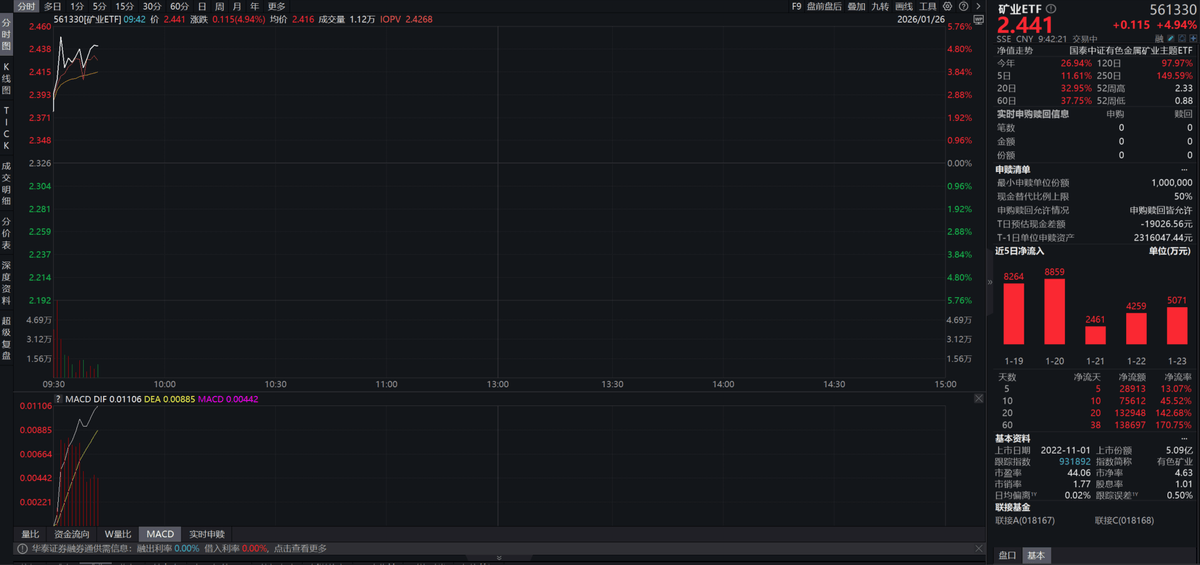
涨超稀土和有色,矿业ETF(561330)是怎么练成的?
Sou Hu Cai Jing· 2025-10-15 02:49
Core Viewpoint - Recent US-China trade tensions and China's export controls on rare earths have reignited market interest in the non-ferrous metals sector, particularly in mining ETFs, which have significantly outperformed traditional non-ferrous metal ETFs this year [1][3]. Performance Summary - The year-to-date performance of various indices shows that the CSI Non-ferrous Metal Mining Theme Index has increased by 84.54%, surpassing other indices including the CSI Rare Earth Industry Index at 84.24% and the CSI Industrial Non-ferrous Metal Theme Index at 76.07% [2]. Market Dynamics - The non-ferrous sector's fundamentals present long-term investment value, with mining ETFs focusing on companies with substantial non-ferrous metal resource reserves, demonstrating stronger price elasticity in the current macroeconomic environment [3]. - Recent developments, including detailed export controls on rare earths and renewed US tariffs, alongside the Federal Reserve's interest rate cuts, have collectively strengthened the mining sector [5]. Sector Composition - The mining ETF (561330) has a significant focus on gold, copper, and rare earths, with these three categories accounting for 56% of its total composition [4]. - The top ten holdings in the mining ETF are all leading resource companies, collectively representing over 57% of the ETF, indicating a high concentration of resource-rich firms [4]. Supply Chain Influences - Recent accidents at major copper mines, such as Escondida and Grasberg, have disrupted supply, with expectations of a 35% decrease in copper production by 2026 compared to previous forecasts [6]. - The overall outlook for the non-ferrous metal industry remains positive, driven by supply disruptions and favorable macroeconomic conditions, including the potential for rising gold prices due to geopolitical tensions and monetary policy changes [6].
中金公司 假期动态与节后交易主线
中金· 2025-10-13 14:56
Investment Rating - The report indicates a cautious investment stance due to ongoing geopolitical risks and economic uncertainties, particularly in the context of U.S.-China trade relations and domestic consumption trends [1][3]. Core Insights - The report highlights that the recent surge in gold and base metal prices is driven by increased geopolitical risks and the potential for U.S. government shutdowns, suggesting that these factors will continue to support commodity prices in the near future [4][17]. - It emphasizes the importance of monitoring Japan's political changes, which could lead to both short-term asset price volatility and long-term structural economic reforms [5][23]. - The report notes that consumer spending data during the holiday period was weaker than expected, reflecting broader economic challenges, and suggests that high-valuation sectors are experiencing significant corrections [6][29]. Summary by Sections U.S.-China Trade Relations - The report discusses the impact of renewed U.S.-China tariffs, which have led to significant market volatility, particularly affecting U.S. stocks and Chinese concept stocks [3][10]. - It suggests that market sentiment has adjusted to these developments, potentially limiting asset declines [3]. Commodity Market Outlook - The report identifies a new bull market cycle for colored resources, driven by global supply chain adjustments and rising demand from emerging industries [2][15]. - It specifically highlights the bullish outlook for precious metals, basic metals, and strategic minor metals, with gold expected to benefit from declining real interest rates and de-dollarization trends [17][18]. Japanese Political Landscape - The report outlines the implications of recent political changes in Japan, which are expected to influence stock market performance and monetary policy [5][23]. - It notes that the new leadership may not pursue aggressive fiscal expansion, which could stabilize the yen and impact market expectations [24][27]. Consumer Trends - The report indicates that consumer spending during the recent holiday period was below expectations, with a notable shift in consumer preferences towards experience-based spending [6][29]. - It highlights that structural changes in consumer behavior, particularly among younger demographics, are shaping the retail landscape [29]. Market Valuation and Performance - The report assesses current market valuations as high, with both U.S. and Chinese markets showing signs of inflated valuations compared to historical levels [7][8]. - It notes that U.S. stock performance has been primarily driven by earnings revisions, while Hong Kong stocks have relied more on valuation increases [9]. Future Market Dynamics - The report expresses uncertainty regarding future market trends due to escalating unexpected events and the complexities of trade negotiations [10][11]. - It suggests that the credit cycles in both the U.S. and China are approaching a phase of recovery, with potential implications for asset prices [12][14]. Specific Metal Outlook - The report provides a positive outlook for silver, driven by industrial demand recovery and its correlation with gold price movements [20]. - It also highlights the potential for basic metals to enter a bull market due to supply disruptions and increasing demand from new industries [21][22]. Strategic Resource Management - The report emphasizes the growing importance of strategic resource management, particularly for critical minerals like cobalt, lithium, and rare earths, which are expected to maintain bullish trends [22].