IoT

Search documents
小米集团-W涨超3% 双十一全渠道累计支付金额破290亿元
Zhi Tong Cai Jing· 2025-11-12 02:23
Core Viewpoint - Xiaomi Group's stock price increased by 3.68% to HKD 44.56, with a trading volume of HKD 3.855 billion, following the announcement of its 2025 Double 11 sales report, which showed total payments exceeding RMB 29 billion [1] Group 1: Sales Performance - As of November 11, 23:59:59, Xiaomi reported a cumulative payment amount exceeding RMB 29 billion for the Double 11 shopping event [1] - The company claimed to have provided discounts totaling RMB 2 billion, with individual products offering savings of up to RMB 4,000 across various categories including smartphones, digital products, and home appliances [1] Group 2: Financial Outlook - Guosheng Securities noted that the continuous optimization of Xiaomi's smartphone product structure may positively impact the smartphone gross margin [1] - Despite the anticipated increase in global storage chip prices leading to cost pressures, the firm expects Xiaomi's smartphone gross margin to remain around 11% for Q3 and Q4 [1] - The potential reduction in national subsidies may affect growth in the home appliance sector, but Xiaomi's competitive edge in the IoT space is expected to remain robust due to product quality and supply chain management capabilities [1]

Identiv(INVE) - 2025 Q3 - Earnings Call Transcript
2025-11-10 23:02
Financial Data and Key Metrics Changes - In Q3 2025, the company reported revenue of $5.0 million, down from $6.5 million in Q3 2024, attributed to exiting lower margin business [5][10] - GAAP gross margin improved to 10.7% from 3.6% year-over-year, while non-GAAP gross margin increased to 19.1% from 9.3% [5][8] - GAAP net loss from continuing operations decreased to $3.5 million, or $0.15 per share, compared to a loss of $9.3 million, or $0.40 per share in Q3 2024 [8][10] - Non-GAAP adjusted EBITDA loss was $3.6 million, an improvement from $4.5 million in Q3 2024 [8][9] Business Line Data and Key Metrics Changes - The transition to the new manufacturing facility in Thailand has been completed, leading to lower costs and improved efficiency [4][12] - The company has achieved 100% production of RFID tags, inlays, and labels in Thailand, marking a significant operational milestone [12][21] Market Data and Key Metrics Changes - The company is seeing growth from existing channel customers and increased traction in BLE projects, contributing to expected sales growth in Q4 2025 [26][30] - The new opportunity pipeline has expanded, with 118 new opportunities identified, and 18% of these have been converted to sales [19][20] Company Strategy and Development Direction - The company continues to execute its Perform, Accelerate, and Transform (PAT) strategy, focusing on operational excellence, high-value segments, and strategic M&A [3][19] - The strategic focus has shifted to being a pure play in IoT and RFID technologies following the separation from the physical security business [15][22] Management Comments on Operating Environment and Future Outlook - Management expressed optimism about the progress made in Q3 and the potential for continued growth in high-value segments [11][22] - The company anticipates completing the Singapore site shutdown by year-end and expects further margin expansion as the Thailand facility reaches full productivity [4][10] Other Important Information - The company has launched CRM and MRP automation initiatives to enhance operational efficiency [12] - New product development initiatives are underway, particularly in BLE technology, which is expected to drive future growth [16][18] Q&A Session Summary Question: What is driving the expected sales growth in Q4? - Management noted growth from existing channel customers and increased traction in BLE projects as key drivers [26] Question: Is IFCO on track for volume shipments next year? - Management confirmed progress with IFCO and ongoing product development, with prototypes being tested in the field [28][29] Question: What can be expected for gross margins in Q4? - Management indicated that while benefits from the Singapore shutdown will continue, full impact on gross margins may not be realized until Q1 of the following year [32] Question: What percentage of new opportunities converted are above the 28% gross margin goal? - Approximately two-thirds of the converted opportunities are expected to exceed the 30% gross margin threshold [36] Question: What is the status of healthcare opportunities? - Management remains positive about healthcare opportunities, noting that these projects typically take longer to commercialize compared to logistics and consumer products [39]

财报即将公布,对冲基金已对小米股票转为看空
Zheng Quan Shi Bao· 2025-11-06 10:54
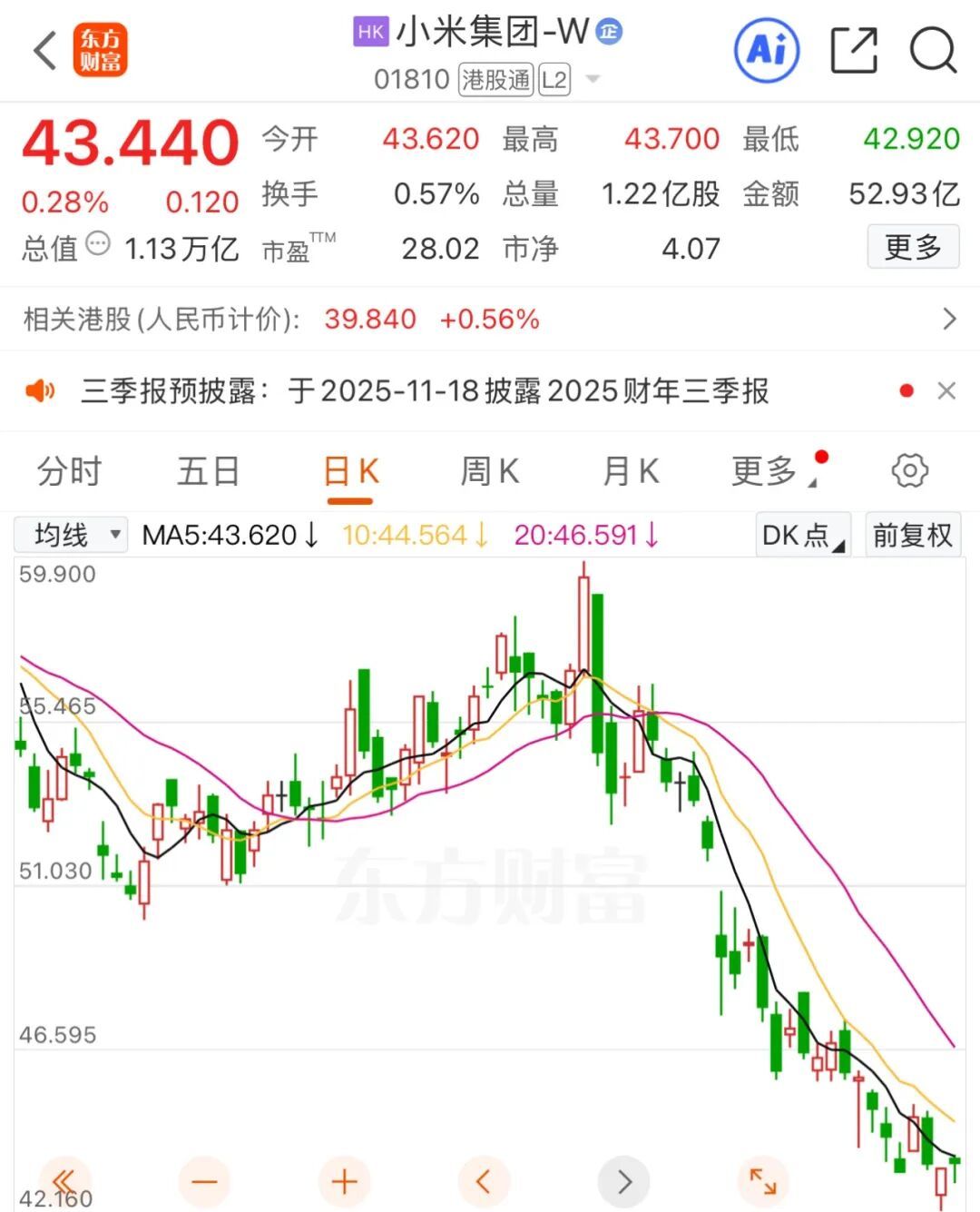
Core Viewpoint - Hedge funds have turned bearish on Xiaomi stock, with significant short positions expected to persist until the earnings report season due to a lack of catalysts and safety concerns [1][5] Group 1: Stock Performance and Market Sentiment - Xiaomi's stock has declined nearly 30% since reaching a historical high in June [1][3] - Short positions from institutional clients have increased by 53% in the past week, primarily driven by pension funds and hedge funds [2][5] - The consensus among hedge funds is that Xiaomi is a common short/sell target in the short term [5] Group 2: Financial Projections and Analyst Opinions - CITIC Securities projects that Xiaomi will achieve total revenue of 113.2 billion yuan in Q3 2025, a year-on-year increase of 22.3%, and a Non-IFRS net profit of 10.2 billion yuan, up 63% [1] - Despite the bearish sentiment, CITIC Securities maintains a positive outlook on Xiaomi's long-term potential as a leading hard-tech ecosystem company [1][5] - Ping An International also reaffirms a "buy" rating for Xiaomi, anticipating that the automotive business may achieve its first quarterly profit [5] Group 3: Market Position and Product Performance - According to Canalys, Xiaomi's smartphone shipments reached 43.4 million units in Q3 2025, a 1% year-on-year increase, maintaining a 14% global market share [7] - In the Chinese market, Xiaomi's smartphone shipments declined by approximately 2%, with a market share of 15%, ranking fourth [7] - Xiaomi's high-end smartphone series, the Xiaomi 17, achieved record sales shortly after launch, indicating a positive trend in product structure optimization [7] Group 4: Automotive and IoT Business Developments - Xiaomi has delivered 400,000 cars since the launch of its automotive division, with monthly deliveries exceeding 40,000 units in September and October 2025 [8] - The company has introduced a tax subsidy scheme to enhance consumer benefits, aiming for a break-even point in its automotive business [8] - Despite challenges in the IoT sector due to reduced government subsidies, Xiaomi's competitive edge in product quality and supply chain management is expected to remain strong [8]

小米,突发!
券商中国· 2025-11-06 10:37
Core Viewpoint - Hedge funds have turned bearish on Xiaomi stock, with significant short positions expected to persist until the earnings report, citing a lack of catalysts and safety concerns as primary reasons for the negative sentiment [1][4]. Group 1: Stock Performance and Market Sentiment - Xiaomi's stock has declined nearly 30% since reaching a historical high in June [1][2]. - Goldman Sachs reported a 53% increase in short positions on Xiaomi stock over the past week, indicating a strong bearish sentiment among institutional investors [4]. - The consensus among hedge funds is that Xiaomi is a common target for short selling in the short term due to various concerns, including delayed factory construction and challenges in the electric vehicle sector [4]. Group 2: Financial Projections and Analyst Ratings - CITIC Securities projects that Xiaomi will achieve total revenue of 113.2 billion yuan in Q3 2025, a year-on-year increase of 22.3%, with a Non-IFRS net profit of 10.2 billion yuan, up 63% [1]. - Despite current pressures, CITIC Securities maintains a positive long-term outlook for Xiaomi, expecting it to remain a leading technology ecosystem company globally [4]. - Ping An International also reiterated a "buy" rating for Xiaomi, anticipating that the automotive business may achieve profitability for the first time in a single quarter [4]. Group 3: Product Performance and Market Position - According to Canalys, Xiaomi's smartphone shipments reached 43.4 million units in Q3 2025, a 1% year-on-year increase, maintaining a 14% market share globally [5]. - In the Chinese market, Xiaomi's smartphone shipments were 10 million units, a decline of approximately 2%, resulting in a 15% market share, ranking fourth [5]. - Xiaomi's high-end smartphone series, launched in September 2025, achieved record sales shortly after release, indicating a positive trend in product structure optimization [5]. Group 4: Automotive and IoT Business Developments - Xiaomi has delivered 400,000 vehicles since launching its automotive division, with monthly deliveries exceeding 40,000 units in September and October 2025 [6]. - The company introduced a tax subsidy scheme to enhance consumer benefits, aiming for a break-even point in its automotive business [6]. - Despite a slowdown in national subsidies, Xiaomi's IoT business remains competitive, supported by product quality and supply chain management [7].

Gorilla Technology Group (NasdaqCM:GRRR) 2025 Conference Transcript
2025-10-30 17:00
Summary of Gorilla Technology Group Conference Call Company Overview - **Company Name**: Gorilla Technology Group Inc. (NasdaqCM: GRRR) - **Founded**: 24 years ago in Taiwan, with 20 years in AI - **Public Listing**: Went public in 2022 via a de-SPAC - **Global Presence**: Operations in eight countries, with a focus on emerging markets in the Middle East, Asia, and Latin America [1][2][5] Core Strengths and Offerings - **Key Areas**: - Video Analytics: Analyzing video feeds for real-time learning and post-event investigations [2][3] - IoT and Big Data Analytics: Connecting numerous devices for seamless operation and improved data management [3][4] - Cybersecurity: Protecting devices and networks from intrusions and malware [4][6] - **Solution Approach**: Offers a combination of service and architecture software, providing comprehensive solutions tailored to customer needs [4][10] Market Position and Customer Base - **Target Customers**: Primarily governments and large corporations in emerging markets, where price sensitivity is significant [5][6] - **Competitive Advantage**: Ability to provide lower price points through deep hardware relationships and flexible payment models (CapEx or OpEx) [6][10] Management Team - **Leadership**: Experienced team with backgrounds in major tech companies and government [7][9] - **Board of Directors**: Includes influential figures with extensive networks, enhancing credibility and opening doors for business [9][10] Key Contracts and Projects - **Taiwan Airport**: Deployed a video analytics solution for ground operations, with ongoing discussions for expansion [12] - **Middle East Government**: Delivered a $270 million air-gapped network contract over three years, connecting over 30,000 sites [13][14] - **Data Center Contracts**: Announced a $1.4 billion contract with Frere for data center services, expected to start generating revenue in 2026 [19][20] Financial Performance and Projections - **Revenue Growth**: Transition year revenue of $22 million, with guidance for 2024 at $100 to $110 million [19] - **Backlog**: $85 million in booked contracts, with additional upside expected from ongoing projects [19][21] - **Cost Efficiency**: Expected 6-7% overall cost reduction for clients due to expertise in IoT and vendor relationships [16] Future Outlook - **Growth Areas**: Focus on data center solutions, offering full-stack services tailored to specific customer needs [14][15] - **Pipeline**: Several billion in qualified leads, indicating strong future revenue opportunities [21][23] Competitive Landscape - **Market Positioning**: Competes primarily with smaller players and occasionally larger firms like Cisco and Huawei, but often targets customers overlooked by major players [23][24] - **Consultative Selling Approach**: Emphasizes providing comprehensive solutions rather than just hardware, leading to a unique value proposition [24][25] Conclusion Gorilla Technology Group is positioned as a strong player in the AI, cybersecurity, and IoT sectors, with a focus on delivering tailored solutions to government and corporate clients in emerging markets. The company is on track for significant revenue growth and has a robust pipeline of future contracts.

雷军,太委屈
3 6 Ke· 2025-10-30 00:30
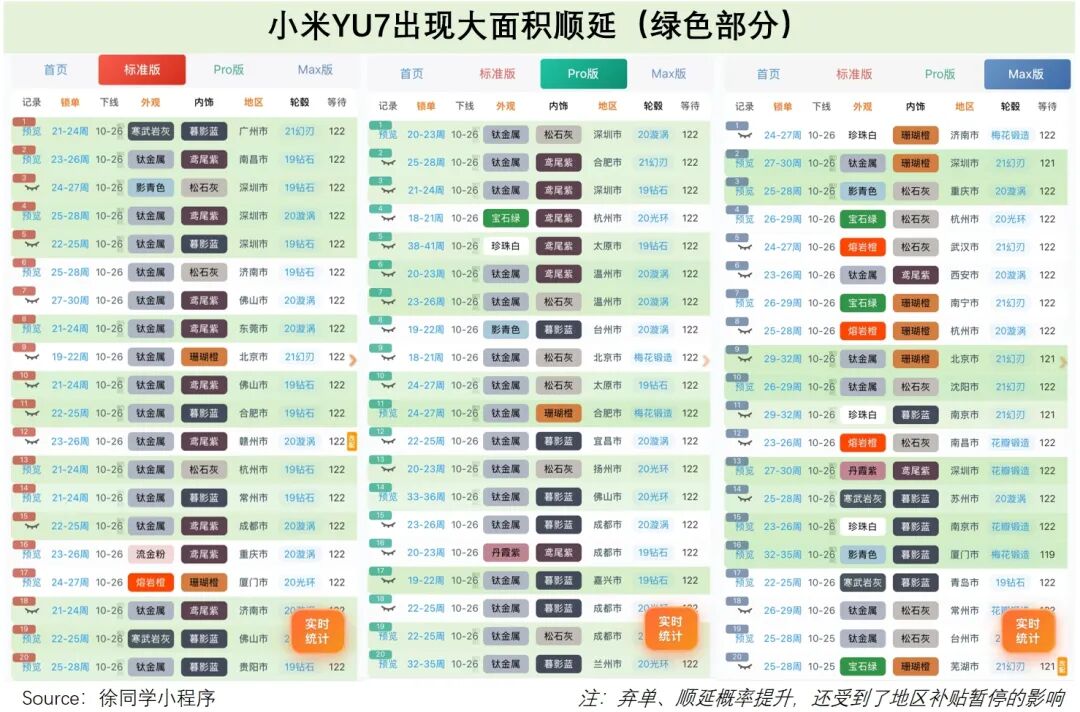
Core Viewpoint - The article discusses the significant decline in public perception and trust towards Xiaomi's automotive products, particularly the YU7 model, leading to increased customer dissatisfaction and a drop in stock prices. Group 1: Brand Reputation and Customer Sentiment - Xiaomi's brand reputation has deteriorated, resulting in a negative impact on its car owners, who now face relentless criticism and skepticism regarding product reliability [3][12][30] - Recent data indicates a high order cancellation rate for the Xiaomi YU7, with some models experiencing a postponement rate of up to 30% [3][12] - Xiaomi's stock price has dropped nearly 30% from its peak earlier in the year, reflecting investor concerns over the brand's reputation [3][12] Group 2: Customer Experiences and Reactions - Some customers, like Lin Lei, have expressed disappointment after initially being excited about their YU7 orders, leading to a decision to cancel due to ongoing issues and lack of communication from the company [6][7] - Other customers have reported feeling misled by marketing claims, such as exaggerated range and features, which has contributed to a sense of betrayal among early adopters [12][18] - Despite the negative sentiment, a subset of customers continues to defend the brand, sharing positive experiences to counteract the prevailing criticism [6][14][18] Group 3: Market Position and Competitive Landscape - Xiaomi's entry into the automotive market has been met with skepticism, and the company is now facing increased scrutiny as it attempts to establish itself among established competitors [30][31] - The article highlights the challenges Xiaomi faces in maintaining its market position, as customer expectations rise alongside its growing brand presence [30][31] - The automotive sector's competitive nature means that Xiaomi must address quality and reliability issues to regain consumer trust and stabilize its market share [30][31]
小米集团-W(01810.HK):3Q25手机高端化持续 料汽车首次单季度盈利
Ge Long Hui· 2025-10-27 03:32
Core Viewpoint - The company is expected to see significant growth in adjusted net profit and revenue in Q3 2025, driven by strong performance in its smartphone and automotive segments, despite some challenges in the Chinese market [1][2]. Group 1: Financial Performance - Q3 2025 revenue is projected to increase by 21.46% year-on-year to 112.36 billion yuan, with adjusted net profit expected to rise by 68.88% to 10.56 billion yuan, largely due to profitability in automotive and innovative businesses [1]. - Smartphone revenue is anticipated to decline by 3.49% year-on-year to 45.80 billion yuan, with a slight decrease in average selling price (ASP) to 1,065 yuan [1]. - IoT revenue is expected to grow by 5% year-on-year to 27.41 billion yuan, with an improved gross margin of 23.5% [2]. - Internet services revenue is projected to increase by 9% year-on-year to 9.23 billion yuan, maintaining a healthy gross margin of 75% [2]. - Automotive deliveries are forecasted to reach 109,000 units, generating revenue of 29.43 billion yuan, with the automotive business likely achieving its first quarterly profit of 707 million yuan [2]. Group 2: Market Dynamics - The global smartphone shipment is expected to maintain a top-three position, with a 1.8% year-on-year increase to 43.50 million units, although the Chinese market is projected to see a slight decline of 1.7% [1]. - The company is focusing on high-end models like the Xiaomi 17 series, which has shown strong initial sales performance [1]. - The automotive segment is anticipated to benefit from increased deliveries and the release of new models, contributing to sustained growth in both delivery volume and profitability [2]. Group 3: Profit Forecast and Valuation - Adjusted net profit forecasts for 2025 and 2026 have been revised down by 5.2% and 3.6% to 43.76 billion yuan and 64.02 billion yuan, respectively, due to rising storage costs [2]. - The current stock price corresponds to a price-to-earnings ratio of 25.0x for 2025 and 16.9x for 2026 based on adjusted net profit [2]. - The target price has been lowered by 15% to 59.5 HKD, reflecting a potential upside of 29.6% based on the sum-of-the-parts valuation method [2].
中金:维持小米集团-W(01810)跑赢行业评级 下调目标价至59.5港元
Zhi Tong Cai Jing· 2025-10-27 02:04
Core Viewpoint - CICC has lowered Xiaomi Group's adjusted net profit forecasts for 2025 and 2026 by 5.2% and 3.6% to CNY 43.757 billion and CNY 64.016 billion respectively, due to cost pressures from rising storage prices [1] Group 1: Financial Projections - CICC predicts a 68.88% year-on-year increase in adjusted net profit for Q3 2025, reaching CNY 10.557 billion, with revenue expected to grow by 21.46% to CNY 112.357 billion [2] - The target price for Xiaomi has been reduced by 15% to HKD 59.5, reflecting a valuation of 35.3 times and 24.1 times adjusted net profit for 2025 and 2026 respectively, indicating a potential upside of 29.6% [1] Group 2: Smartphone Performance - Xiaomi's global smartphone shipments are expected to increase by 1.8% year-on-year to 43.5 million units in Q3 2025, with a slight decline in the Chinese market by 1.7% to 10 million units [2] - The average selling price (ASP) is anticipated to slightly decrease to CNY 1,065 due to an increase in overseas market share, while smartphone revenue is projected to decline by 3.49% to CNY 45.795 billion [2] Group 3: IoT and Internet Services - IoT revenue is expected to grow by 5% year-on-year to CNY 27.407 billion in Q3 2025, with an improvement in gross margin to 23.5% [3] - Internet services revenue is projected to increase by 9.0% year-on-year to CNY 9.225 billion, maintaining a healthy gross margin of 75.0% [3] Group 4: Automotive Business - The automotive business is expected to deliver 109,000 units in Q3 2025, generating revenue of CNY 29.430 billion, with the first quarterly profit anticipated at CNY 0.707 billion [3] - The company is optimistic about the long-term value of its "car-home" ecosystem, expecting continued growth in automotive deliveries and profit acceleration [3]
中金:维持小米集团-W跑赢行业评级 下调目标价至59.5港元
Zhi Tong Cai Jing· 2025-10-27 02:02
Core Viewpoint - CICC has lowered Xiaomi Group-W's (01810) adjusted net profit forecasts for 2025 and 2026 by 5.2% and 3.6% to CNY 43.757 billion and CNY 64.016 billion respectively, due to cost pressures from rising storage prices [1] Group 1: Financial Projections - CICC predicts a 68.88% year-on-year growth in adjusted net profit for Q3 2025 [2] - Expected revenue for Q3 2025 is projected to increase by 21.46% to CNY 112.357 billion, with adjusted net profit anticipated to reach CNY 10.557 billion [2] - The target price has been reduced by 15.0% to HKD 59.5, reflecting a valuation of 35.3 times and 24.1 times adjusted net profit for 2025 and 2026 respectively, indicating a potential upside of 29.6% [1] Group 2: Smartphone Business - Xiaomi's global smartphone shipments are expected to grow by 1.8% year-on-year to 43.5 million units in Q3 2025, with a slight decline in the Chinese market [2] - The average selling price (ASP) is projected to decrease slightly to CNY 1,065 due to an increase in overseas market share [2] - Smartphone revenue is expected to decline by 3.49% year-on-year to CNY 45.795 billion, with a forecasted gross margin decrease of 0.4 percentage points to 11.1% [2] Group 3: IoT and Internet Services - IoT revenue is expected to grow by 5% year-on-year to CNY 27.407 billion, with an improved gross margin of 23.5% [3] - Internet services revenue is projected to increase by 9.0% year-on-year to CNY 9.225 billion, maintaining a healthy gross margin of 75.0% [3] Group 4: Automotive Business - Q3 2025 automotive deliveries are expected to reach 109,000 units, generating revenue of CNY 29.430 billion [4] - The automotive business is anticipated to achieve its first quarterly profit of CNY 0.707 billion, driven by increased deliveries and ASP [4] - The long-term value of Xiaomi's "car-home" ecosystem is viewed positively, with expectations for continued growth in automotive deliveries and profit acceleration [4]
blackberry limited (TSX:BB) – profile & key information – CanadianValueStocks.com
Canadianvaluestocks· 2025-09-18 06:33
Company Overview - BlackBerry Limited has transitioned from a mobile handset manufacturer to a specialized provider of secure enterprise software, cybersecurity services, and IoT platforms [1][2] - The company's modern focus includes cybersecurity, endpoint management, and embedded vehicle systems, targeting regulated industries and large-scale OEM relationships [2][3] Business Model and Product Offerings - BlackBerry's value proposition is built on three main capabilities: secure endpoint management, AI-driven threat prevention, and automotive-grade platforms based on QNX [3] - Key product lines include BlackBerry Enterprise solutions, BlackBerry Workspaces, BBM Enterprise, AtHoc for emergency communications, and QNX for embedded systems [18][19] Financial Metrics - As of recent market snapshots, BlackBerry's market capitalization is approximately CA$2.55 billion, with annual revenue ranging from CA$700 million to CA$1 billion [9][12] - Revenue drivers include subscription and licensing for UEM and Dynamics suites, IoT platform contracts, and professional security services [10][15] Historical Context and Strategic Evolution - Founded in 1984 as Research In Motion, BlackBerry gained prominence with its wireless data solutions and push-email-enabled devices [23] - The company faced significant challenges in the smartphone market post-2007, leading to a strategic pivot towards enterprise software and cybersecurity under new leadership in 2013 [24][27] Leadership and Governance - Leadership transitions have been pivotal during strategic redirections, with a focus on turnaround management and software emphasis [28][29] - Active board engagement has been noted during periods of restructuring and M&A activities [29] Market Position and Industry Dynamics - BlackBerry operates in enterprise cybersecurity, embedded automotive software, and emergency communications, selling to CIOs, automotive teams, and national security agencies [17] - The company's transition from hardware to software has positioned it among specialist software and cybersecurity firms in Canadian markets [30][32]