
家具制造

Search documents
特朗普关税“大刀”砍向木材及木制品 盟友加拿大将“首当其冲”
智通财经网· 2025-09-30 07:08
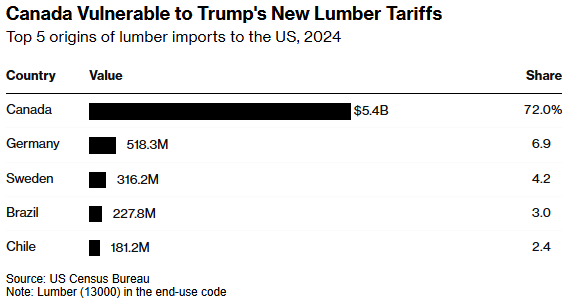
Core Viewpoint - The U.S. government, under President Trump, has imposed new tariffs on imported softwood lumber and wood products to support domestic manufacturing, with a 10% tariff on lumber and a 25% tariff on cabinets and upholstered wood products, effective from October 14 [1][2]. Group 1: Tariff Details - The tariffs will increase the cost of imported wood products, with specific rates set at 10% for lumber and 25% for cabinets and bathroom vanities, with further increases planned for January 1, 2024 [1][3]. - Canada, as the largest supplier of lumber to the U.S., will be significantly impacted, already facing a 35.2% tariff due to previous trade disputes [2][4]. - The legal basis for these tariffs is the Trade Expansion Act of 1962, which allows for tariffs under the guise of national security [2][3]. Group 2: Industry Impact - U.S. home builders have expressed concerns that these tariffs could suppress new home construction and renovation investments, contradicting the administration's goal of stimulating the housing market [1][4]. - The National Association of Home Builders has warned that the housing crisis poses a greater threat to national security than imported lumber, emphasizing the renewable nature of wood and the long-standing trade relationships with countries like Canada and Germany [4][5]. - Retailers in the furniture industry, such as Wayfair and Williams-Sonoma, have raised alarms about the significant cost pressures these tariffs will impose on their businesses, potentially leading to job losses [5]. Group 3: Political and Economic Context - Some Republican lawmakers are pushing for even higher tariffs on furniture and wood products to protect local industries, particularly in North Carolina, a state known for its furniture manufacturing [4][5]. - The tariffs are part of a broader trend of increasing industry-specific tariffs by the Trump administration, which has already targeted steel, aluminum, and various other products [3].

加税!加税!特朗普关税核弹引爆全球:中欧印三国沦陷,美国经济却先血流成河!
Sou Hu Cai Jing· 2025-09-30 04:16
Group 1 - The core point of the article is that Trump's recent tariff increases, effective from October 1, 2025, are expected to have widespread negative impacts on both the U.S. economy and global trade dynamics, with no clear winners in a trade war [1][3][14] - The tariffs cover a wide range of products, including a 50% increase on kitchen cabinets and bathroom sinks, 30% on furniture, 100% on patented drugs, and 25% on heavy trucks, indicating a comprehensive approach to trade protectionism [7][9] - The tariffs are framed under the guise of "national security," but the underlying motive appears to be to protect U.S. manufacturers and appeal to domestic voters, despite the potential for significant economic backlash [7][9][12] Group 2 - The tariffs are projected to lead to a decline in U.S. GDP by 0.5% annually in 2025 and 2026, with a long-term decrease of 0.4%, as the costs are likely to be passed on to consumers [7][9] - The average tariff rate in the U.S. is expected to rise to 17.3%, the highest since 1935, which will result in increased consumer prices and exacerbate inflation [9][11] - The tariffs could lead to a loss of approximately 497,000 jobs by the end of 2025, with specific sectors like construction and agriculture facing declines [9][12] Group 3 - The global trade system is at risk of collapse due to the U.S. violating WTO principles with these tariffs, which could further alienate allies like the EU and Canada [11][12] - Historical parallels are drawn to the Smoot-Hawley Tariff Act of the 1930s, which contributed to the Great Depression, suggesting that Trump's actions may lead to similar economic consequences [12][14] - The article emphasizes that trade wars do not produce winners, and the ultimate victims will be consumers and the broader economy, highlighting the need for dialogue and cooperation among nations [14]
阿尔及利亚Relaxi公司获准发行股权证券
Shang Wu Bu Wang Zhan· 2025-09-30 03:38
Group 1 - The Algerian Securities Exchange Commission (COSOB) has approved Relaxi's issuance of equity securities totaling 400 million dinars (approximately 3 million USD) aimed at professional investors [1] - Relaxi is issuing 400,000 equity securities, each with a nominal value of 1,000 dinars (approximately 7.7 USD), with a maturity of 7 years, to be listed on the emerging segment of the Algerian Securities Exchange's debt securities market [1] - Established in 2022 and headquartered in Oran, Relaxi specializes in the design, production, and sale of mattresses, bedding, and wooden furniture, with a registered capital of 260 million dinars (approximately 2 million USD) [1] Group 2 - The projected revenue for Relaxi in 2024 is expected to exceed 1.9 billion dinars (approximately 14.6 million USD) [1]
关税突发,特朗普宣布:10月14日起生效
Zheng Quan Shi Bao· 2025-09-30 01:56
Group 1 - The U.S. government announced new tariffs on imported softwood lumber and wood products, with a 10% tariff on softwood and a 25% tariff on cabinets and related products, effective October 14 [1] - Additional tariffs include a 50% tariff on kitchen cabinets and bathroom sinks, a 30% tariff on imported furniture, and a 100% tariff on patented and branded drugs starting October 1 [1] - The announcement led to a significant drop in pharmaceutical stocks, with the White House clarifying that the new drug tariffs do not apply to countries with existing trade agreements with the U.S. [1] Group 2 - The U.S. Bureau of Labor Statistics reported a 4.7% year-over-year increase in furniture prices as a result of the tariff policies [2] - The U.S. Chamber of Commerce expressed concerns over new tariffs on heavy trucks, highlighting that the top five sources of heavy truck imports are allied countries [2] - President Trump announced plans to impose a 100% tariff on films produced outside the U.S., citing the loss of the American film industry to foreign competition [2] Group 3 - The U.S. Federal Circuit Court ruled that the legal basis for the tariffs imposed by President Trump did not grant him the authority to levy such taxes [3] - The Trump administration has appealed this ruling to the U.S. Supreme Court, which is set to hear arguments regarding the legality of the tariffs in early November [3]
关税突发!特朗普宣布:10月14日起生效!
Zheng Quan Shi Bao Wang· 2025-09-30 01:45
Group 1: Tariff Announcements - On September 29, President Trump announced a 10% tariff on imported softwood logs and lumber, and a 25% tariff on imported cabinets, bathroom vanities, and upholstered wood products, effective October 14 [1] - Additional tariffs include a 50% tariff on kitchen cabinets and bathroom sinks, a 30% tariff on imported furniture, and a 100% tariff on patented and branded drugs starting October 1 [1] - Heavy trucks will also face a 25% tariff starting October 1, with a future increase planned [1] Group 2: Market Impact - The U.S. Bureau of Labor Statistics reported a 4.7% year-over-year increase in furniture prices as of August 2025, attributed to the tariff policies [2] - The U.S. Chamber of Commerce has urged the government to reconsider new tariffs on heavy trucks, highlighting that the top five sources of heavy truck imports are allied nations [2] Group 3: Legal Challenges - The U.S. Federal Circuit Court ruled on August 29 that the law cited by Trump to impose tariffs did not grant him the authority to do so [3] - The Trump administration has appealed this ruling to the U.S. Supreme Court, which is set to hear oral arguments in the first week of November [3]
美总统特朗普下令 10月14日起对进口木材与橱柜加征关税
Zhong Jin Zai Xian· 2025-09-30 01:25
Core Viewpoint - The U.S. government is imposing new tariffs on imported softwood lumber and wood products, indicating a continued focus on trade protectionism in the timber industry [1] Tariff Details - A 10% tariff will be applied to imported softwood lumber and timber products, effective from October 14 [1] - A 25% tariff will be imposed on imported cabinets, bathroom vanities, and upholstered wood products, also starting on October 14 [1] - Some tariff rates are set to increase further on January 1 of the following year [1] Background Context - The U.S. Department of Commerce has been investigating lumber and its derivatives, including cabinets and furniture, since March of this year [1]
特朗普下令,加征关税
第一财经· 2025-09-30 01:14
Core Viewpoint - The U.S. government has announced new tariffs on imported softwood lumber and wood products, indicating a shift in trade policy that may impact the construction and furniture industries significantly [1][2]. Group 1: Tariff Details - A 10% tariff will be imposed on imported softwood lumber and timber, while a 25% tariff will be applied to imported cabinets, bathroom vanities, and upholstered wood products [1]. - The new tariffs will take effect on October 14, with some rates set to increase further on January 1 of the following year [2]. Group 2: Background Information - The U.S. Department of Commerce has been investigating wood products and their derivatives, including cabinets and furniture, since March of this year [3].
特朗普:将对所有在美境外制作的电影征收100%关税
Zhong Guo Xin Wen Wang· 2025-09-29 18:34
Core Points - The U.S. government, under President Trump, plans to impose a 100% tariff on all films produced outside the United States, citing the need to protect the domestic film industry [1] - Trump also announced high tariffs on various imported goods, including a 100% tariff on all brand-name or patented drugs, a 50% tariff on kitchen and bathroom cabinets, a 30% tariff on upholstered furniture, and a 25% tariff on heavy trucks produced outside the U.S. [1] - The recent tariff announcements have led to significant dissatisfaction among U.S. businesses, which are facing increased costs beyond their planned budgets [1] Industry Impact - The film industry may face increased production costs and potential shifts in production locations due to the new tariffs on foreign films [1] - The furniture and cabinetry industries could experience price increases, affecting consumer purchasing behavior and overall market dynamics [1] - Pharmaceutical companies are likely to be impacted by the 100% tariff on imported drugs, which could lead to higher prices for consumers and potential supply chain disruptions [1]
贸易战打到文化战:特朗普威胁对海外制片征100%关税,好莱坞懵了
Hua Er Jie Jian Wen· 2025-09-29 16:48
Core Viewpoint - President Trump's renewed threat to impose a 100% tariff on films produced outside the U.S. could challenge Hollywood's global business model, raising concerns about the feasibility and execution of such a policy [1][2][3]. Group 1: Tariff Threat and Market Reaction - Trump claims that the U.S. film industry is being undermined by foreign competition and suggests imposing a 100% tariff on films made abroad [1][2]. - The market reacted variably, with AMC Entertainment rising over 6.2%, Disney increasing nearly 1.2%, and Netflix initially dropping 1.9% before recovering [1]. - Concerns exist regarding Trump's legal authority and the practical execution of the proposed tariffs, as the White House has not provided clarity on the matter [1][2]. Group 2: Industry Concerns and Execution Challenges - Industry executives express skepticism about the feasibility of enforcing such tariffs, given the collaborative nature of modern film production across multiple countries [3]. - The United Talent Agency's Jay Sures noted that production costs are often lower overseas, making it economically unfeasible for U.S. studios to shift production back domestically [3]. - Analysts highlight that the uncertainties surrounding the tariff proposal raise more questions than answers, potentially leading to increased costs for consumers [3]. Group 3: Current Challenges in the U.S. Film Industry - The U.S. film industry is facing significant challenges, including a decline in box office revenue and a shift in consumer viewing habits towards streaming platforms [4]. - Box office revenue peaked at nearly $12 billion in 2018 but plummeted to just $2 billion in 2020 due to the pandemic, with recovery remaining sluggish [4]. - Warner Bros. has reported global box office earnings of $4 billion this year, becoming the first studio to reach this milestone since the pandemic [4]. Group 4: Broader Tariff Measures - In addition to the film tariff, Trump announced a series of other tariffs on various imported goods, including a 50% tariff on kitchen cabinets and a 30% tariff on imported furniture [5]. - The implementation of these tariffs may face challenges, as they target products rather than countries, complicating enforcement [5].
美国关税大棒挥向家具!但中国“家具王国”早已弃美转身
Jin Tou Wang· 2025-09-29 04:20
Core Viewpoint - The recent announcement by the U.S. government to impose significant tariffs on kitchen cabinets, bathroom sinks, and related materials, as well as upholstered furniture, is expected to impact China's home building materials industry, particularly in furniture production and exports [1][2]. Group 1: Impact on Chinese Furniture Industry - The U.S. will impose a 50% tariff on kitchen cabinets and related materials, and a 30% tariff on upholstered furniture starting October 1 [1]. - China is the world's largest furniture producer, accounting for over 25% of global output and is also the leading exporter of furniture [1]. - In Guangdong's Lecong Town, known as the "furniture capital," local manufacturers have already shifted focus away from the U.S. market due to previous tariff announcements [1]. Group 2: Shift in Export Strategies - Many exporters are redirecting their products to domestic markets and exploring opportunities in India, Southeast Asia, and Africa [2]. - In Zhejiang's Anji region, which is a major office chair production base, the share of exports to the U.S. has decreased from over 60% to 30% due to tariff pressures [2]. - Local manufacturers have implemented smart reforms that reduced production costs by 18%, partially offsetting the impact of tariffs [2]. Group 3: U.S. Market Dynamics - The tariffs are part of a broader strategy to revitalize the furniture industry in North Carolina, South Carolina, and Michigan [2]. - The U.S. furniture and wood products manufacturing jobs have halved, with only about 340,000 jobs remaining [2]. - Despite the tariffs, a California furniture buyer noted that Chinese suppliers' design optimization keeps overall procurement costs stable, indicating that Chinese products remain irreplaceable in the U.S. market [2].