
Consumer Electronics

Search documents
苹果新版Siri将于2026年推出,或无缘iOS 26.4
Huan Qiu Wang Zi Xun· 2026-02-13 03:52
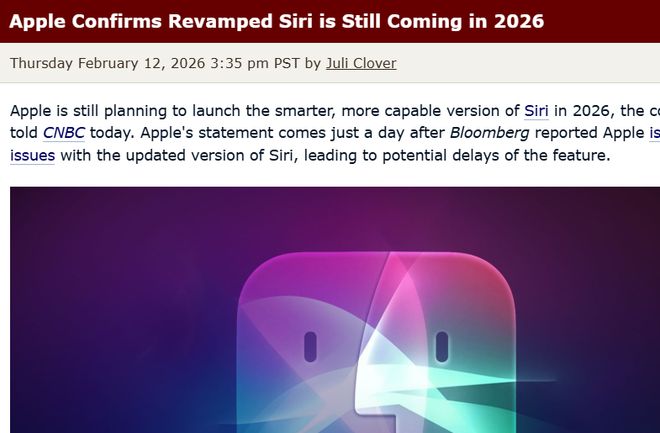
Core Viewpoint - Apple has confirmed that the new version of Siri, equipped with advanced smart technology, is still scheduled for release in 2026 despite previous reports of development delays [1][4] Group 1: Release Timeline - Initially, Apple planned to launch the new Siri in spring 2025, but this was postponed due to readiness issues, with the new target set for 2026 [4] - Bloomberg reported that the internal goal is to include the new Siri in the upcoming iOS 26.4 update, expected to release a developer preview on February 23, with a formal version in March or April [4] - Recent leaks suggest that the new Siri may not be ready in time for iOS 26.4 and could be delayed until iOS 26.5 or even iOS 27 [4] Group 2: Company Statements - Apple stated that it has never publicly committed to a specific release date in 2026, indicating that there is no actual delay, and the company has ample time to fulfill its commitments made in summer 2025 [4] - The company plans to release multiple updates for iOS 26 throughout 2026, with iOS 27 set to launch in September [4] - A testing version of iOS 26.4 is expected to be released later this month, which may provide further clarity on the progress of the new Siri [4]


苹果新一代Mac Studio细节曝光:搭载M5系列芯片,2026上半年发布
Huan Qiu Wang Zi Xun· 2026-02-13 03:52
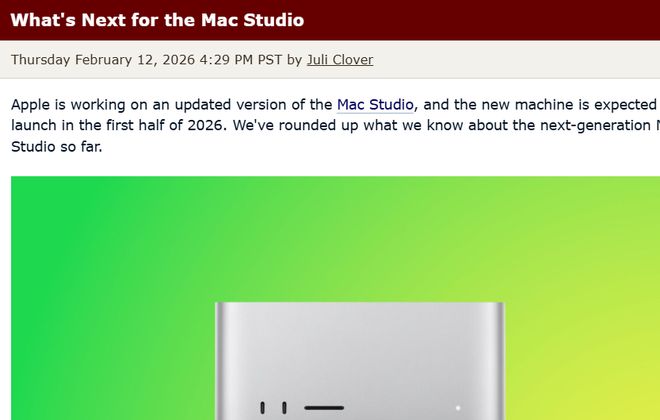
来源:环球网 设计方面,新一代Mac Studio预计不会进行大幅调整,将延续现款类似Apple TV或Mac mini的圆角方形 设计,保持紧凑机身优势。其机身高度仅3.7英寸、宽度7.7英寸,相比Mac Pro更为小巧。据悉,苹果目 前已将Mac Pro研发搁置,Mac Studio被视为未来苹果桌面计算的核心发展方向。 核心性能是此次升级的重点,新一代Mac Studio将搭载M5 Max和M5 Ultra两款芯片。其中,M5 Max芯 片的CPU和GPU性能将远超去年10月推出的M5芯片,M5 Ultra芯片则可实现M5 Max性能的翻倍,目前 这两款芯片的相关迹象已在最新的iOS 26.3候选版本中被发现。此外,得益于M5 MacBook Pro已升级更 快的SSD,新一代Mac Studio也有望同步配备这款高速固态硬盘,进一步提升存储读写速度。 发布时机方面,彭博社记者马克·古尔曼透露,新一代Mac Studio将在春季Mac产品更新后不久推出,而 新款MacBook Pro最早可能在3月2日那周发布,这意味着Mac Studio的发布时间或将在该日期之后。 (旺旺) 【环球网科技综合报道】2月 ...
Why Apple Stock Fell Today
Yahoo Finance· 2026-02-13 03:20
Core Viewpoint - Apple's stock price fell by 5% following negative news regarding its Siri virtual assistant upgrades and potential regulatory scrutiny [1][4]. Group 1: Siri Upgrades - Apple is reportedly considering delaying upgrades to its Siri virtual assistant due to issues with in-app voice commands not functioning as intended [2]. - Previous delays in Siri updates occurred in March 2025, with many advanced capabilities still not launched [2]. - The company's privacy policies may complicate the integration of artificial intelligence, as Apple aims to protect user data while enhancing Siri's capabilities [3]. Group 2: Regulatory Pressure - Apple CEO Tim Cook received a warning from FTC Chairman Andrew Ferguson regarding potential violations of law related to Apple News misrepresenting its terms of service based on political views [4]. - Investors are concerned about increased regulatory scrutiny on Apple and other tech giants, which may impact the company's operations and stock performance [4]. Group 3: Investment Considerations - Analysts from The Motley Fool Stock Advisor have identified 10 stocks they believe are better investment opportunities than Apple at this time [5]. - Historical performance of stocks recommended by The Motley Fool shows significant returns, with examples like Netflix and Nvidia yielding substantial profits for early investors [6].
政策焕新让百姓“年货篮子”添新品 消费涌热潮促“乡村市场+家电服务”升级
Yang Shi Wang· 2026-02-13 03:10
Core Viewpoint - The article highlights the impact of China's "old-for-new" policy on consumer behavior during the Spring Festival, particularly focusing on the surge in demand for digital and smart products, including smart glasses, due to government subsidies. Group 1: Policy Impact on Consumer Electronics - The "old-for-new" policy supports the purchase of digital and smart products, offering a subsidy of 15% on items priced under 6000 yuan, with a maximum subsidy of 500 yuan per item [1] - Smart glasses have emerged as a popular new year product, benefiting from the policy and showing significant sales growth [3][5] - The production of smart glasses has accelerated, with factories in Guangdong producing nearly 1,000 units daily [6] Group 2: Broader Consumer Trends - The "old-for-new" policy has been implemented nationwide, reaching both urban and rural areas, with a reported 30% increase in orders for old-for-new products on islands [13] - In rural regions, orders for subsidized television products have increased by over 80%, while air conditioners and refrigerators saw increases of over 70% and 40%, respectively [15] - The policy has improved living standards for residents, as seen in the case of families purchasing complete sets of appliances with the subsidies [16] Group 3: Service and Installation Demand - The implementation of the "old-for-new" policy has led to a significant increase in demand for home appliance installation services, with some service teams reporting a doubling of installation orders [19] - Training programs for service engineers have adapted to include new smart products, reflecting the changing market demands [21] - Since October of the previous year, an average of 500 service engineers have completed training each month, indicating a growing workforce to meet the rising demand [23]

未知机构:中信科技小米集团跟踪点评1月销量2026年1月小米汽车交-20260213
未知机构· 2026-02-13 03:00
Summary of Xiaomi Group Conference Call Company Overview - **Company**: Xiaomi Group - **Industry**: Automotive and Consumer Electronics Key Points Sales Performance - In January 2026, Xiaomi delivered over 39,000 vehicles, a decrease from over 50,000 in December 2025 [1] - The decline in deliveries is attributed to: 1. The discontinuation of the first-generation SU7, with production lines being reconfigured for the new generation SU7 set to launch in April 2026 [1] 2. January had 21 working days, two fewer than December [1] - Future outlook suggests further decline in deliveries due to the impact of the Chinese New Year in February [1] Vehicle Pipeline - At least two key models are expected to launch in 2026: 1. The new generation SU7, which will officially launch in April 2026 [2] 2. The YU9 model, part of the range-extended platform, is undergoing road tests and is expected to launch in the second half of 2026 [2] - The YU7GT model has completed the necessary regulatory filings and is anticipated to be released within the year [2] - Xiaomi's target for 2026 is to deliver 550,000 vehicles, which is considered conservative compared to the previous year's performance of over 410,000 vehicles [2] - With the introduction of new models and potential capacity releases, the forecast for 2026 deliveries is adjusted to 660,000 electric vehicles [2] Cost Pressures - **Storage Costs**: The proportion of storage costs in the Bill of Materials (BOM) for Xiaomi smartphones is expected to rise from 10-15% to 20-30% by Q4 2025, impacting the gross margin to approximately 9% [3] - **Battery Costs**: The cost of lithium batteries is increasing, with a projected rise in battery costs by approximately 5,640 RMB per vehicle due to significant price increases in lithium carbonate and lithium hexafluorophosphate [4] - Overall, the smartphone industry is facing challenges from declining shipments and increased competition in the white goods market, leading to a downward revision of revenue forecasts for 2025-2027 [4] Financial Projections - Revenue expectations for 2025-2027 have been adjusted to 461.2 billion, 541.8 billion, and 600.5 billion RMB respectively, down from previous estimates [4] - Non-IFRS net profit projections have also been revised to 40 billion, 36.2 billion, and 50.2 billion RMB for the same period [4] Valuation and Target Price - The company is valued using a 30x PE ratio, resulting in a total market capitalization of approximately 1.31 trillion HKD [5] - A target price of 47 HKD is set, maintaining a "Buy" rating for the stock [5]
智能设备春节热卖 你的年货清单含“科”量有多高?
Xin Hua Wang· 2026-02-13 01:53
Group 1 - The core viewpoint of the article highlights the rising popularity of technology products in the Chinese New Year shopping market, with consumers increasingly favoring smart and innovative items [1][9] - Smart home appliances and interactive technology products are becoming significant highlights in the New Year market, reflecting a shift in consumer demand towards "intelligent" options [1][3] - The integration of technology into daily life is stimulating new consumption dynamics, driven by mature technology, policy guidance, and upgraded consumer expectations [9][10] Group 2 - Sales of smart terminals and AI wearable products have seen significant growth, with specific examples such as the sale of over 30 drones in a single day at a Shenzhen store [5][6] - The introduction of national subsidies for AI products, including smart glasses, has further boosted sales, with over 15 million units sold across various categories in January, generating nearly 59 billion yuan in revenue [8][9] - The launch of the 2026 National Online New Year Goods Festival has sparked a consumption boom, with online retail sales reaching 989.73 billion yuan by February 8 [9][10]
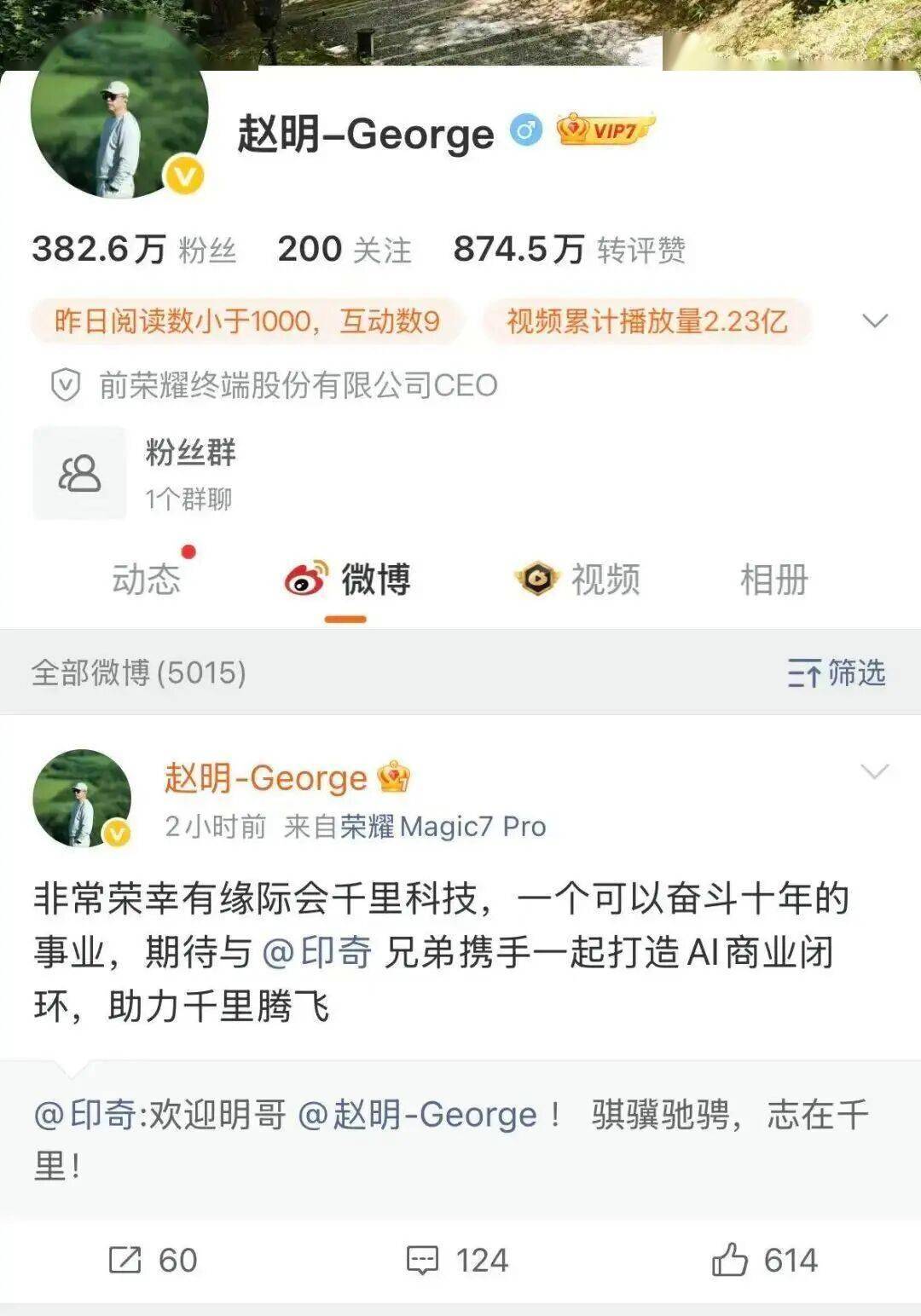
苹果被曝新 Siri 再次延期,股价大跌4%;原荣耀 CEO 赵明官宣加入千里科技;Spotify 宣称其程序员不再写代码 | 极客早知道
Sou Hu Cai Jing· 2026-02-13 01:43
Group 1 - Apple confirmed that the AI version of Siri is still on track for release within 2026, despite reports suggesting delays, which led to a 5% drop in its stock price [1][1] - The stock price decline erased Apple's gains for the year, with a nearly 4% drop attributed to the news [1] - The company aims to stabilize investor confidence by affirming its commitment to the planned release schedule [1] Group 2 - Zhao Ming, former CEO of Honor, announced his joining of Qianli Technology, expressing excitement about building an AI business ecosystem [2] - Zhao's decision to join Qianli Technology is influenced by his belief that AI is a field worth investing in for the next 20 years [2] Group 3 - Google announced a significant upgrade to its Gemini 3 Deep Think model, designed for scientific and engineering applications, achieving high performance in complex reasoning tasks [3][3] - The upgraded model demonstrated a 48.4% score on the Humanity's Last Exam and 84.6% on ARC-AGI-2, verified by ARC Prize Foundation [3] - In addition to mathematics, the model also showed strong capabilities in chemistry and physics, achieving gold medal-level results in international competitions [3][3] Group 4 - OpenAI and Cerebras launched the GPT-5.3-Codex-Spark model, aimed at real-time programming, marking their first public collaboration [4][4] - Codex-Spark is designed for high-speed interactive software development, achieving over 1000 tokens/s inference speed [5] - OpenAI emphasized the importance of developer control in the coding process, positioning Codex-Spark as a collaborative tool [5] Group 5 - Spotify revealed that its top developers have not written any code since December 2022, attributing this to the use of an internal AI system called "Honk" [6][6] - The "Honk" system utilizes generative AI technology to enhance coding speed and efficiency, allowing for real-time code deployment [6] Group 6 - Xiaomi announced that it will provide at least 10 years of spare parts support for its first-generation SU7 model, even after its discontinuation [8] - The new generation SU7 will be showcased in various cities starting February 13, with plans for a launch event in April [8] Group 7 - BMW confirmed a global recall of several hundred thousand vehicles due to a potential fire risk associated with the starter motor, affecting 16 models produced between July 2020 and July 2022 [9][9] - The company will notify affected vehicle owners to replace the potentially defective motors [9] Group 8 - Mercedes-Benz announced a recall of 11,895 EQB electric vehicles in the U.S. due to a risk of fire from the high-voltage battery [10] - The company will replace the batteries free of charge and has advised owners to park their vehicles outdoors [10] Group 9 - Sony launched the WF-1000XM6 wireless earbuds, claiming a 25% improvement in noise-canceling performance compared to the previous model [12][12] - The new earbuds feature an upgraded processor for enhanced audio processing and improved connectivity [12] Group 10 - NeuroXess announced a significant advancement in brain-computer interface technology, enabling a paralyzed patient to perform daily activities through thought control [15][15] - The patient achieved a brain control decoding rate of 5.2 BPS, comparable to international standards [15]





荣耀前CEO赵明加入这家公司任联席董事长
Sou Hu Cai Jing· 2026-02-13 00:53
Core Viewpoint - Zhao Ming, former CEO of Honor, has been nominated as a non-independent director candidate for Qianli Technology's board, marking a new chapter in his career after leaving Honor over a year ago [1]. Group 1: Zhao Ming's Background and Career - Zhao Ming was born in March 1973 and holds a master's degree in mobile communication and electronic systems from Shanghai Jiao Tong University [3]. - He served as a core engineer at Huawei and became the president of Huawei's Honor business in 2015, later becoming CEO of Honor after its sale by Huawei in November 2020 [3]. - During his tenure, he focused on AI technology, laying the groundwork for Honor's early positioning in the AI smartphone sector [3]. - Zhao Ming resigned from his roles in January 2025, citing personal reasons, and expressed a desire to find a new venture that excites him for the next decade [3]. Group 2: Qianli Technology's Developments - Qianli Technology, formerly known as Lifan Technology, underwent significant leadership changes, with Yin Qi becoming chairman after acquiring a 19.91% stake for approximately 2.43 billion RMB in July 2024 [5]. - The company rebranded to Qianli Technology in February 2025 and has adopted an "AI + vehicle" strategy, focusing on enhancing R&D capabilities in smart driving and smart cockpit technologies [5]. - Qianli Technology's main business includes the R&D, production, and sales of passenger cars (including new energy vehicles), motorcycles, and general machinery [6]. Group 3: Company Performance - In early 2025, Qianli Technology reported a sales volume of 106,300 vehicles, representing a year-on-year increase of 83.93%, with 33,600 of those being new energy vehicles [6]. - For the first three quarters of 2025, the company achieved a revenue of 6.946 billion RMB, a year-on-year growth of 44.27%, while the net profit attributable to shareholders was 53.28 million RMB, up 33.37% [6]. - However, the company's net profit excluding non-recurring items was -176 million RMB, reflecting a significant year-on-year decline of 826.19% [6].
中国最低调手机老板被围剿,消失的30亿都去哪了?
创业邦· 2026-02-13 00:08
Core Viewpoint - Transsion Holdings, known as the "King of Africa," has experienced a significant decline in net profit, dropping from 55.49 billion to 25.46 billion, a decrease of 54.11%, despite a slight revenue drop of 4.58% to 655.68 billion in 2025 [6][12]. Group 1: Company Background and Success - Transsion's success is attributed to its strategic focus on the African market, which was largely overlooked by global giants, and its ability to meet local consumer needs with affordable, durable, and feature-rich mobile phones [7][8]. - The company gained a strong market position by offering innovative features such as four-SIM support and tailored camera algorithms for darker skin tones, which resonated well with African consumers [8][10]. - Transsion's revenue grew from 253.46 billion to over 600 billion in four years, with a compound annual growth rate exceeding 30% [10]. Group 2: Profit Decline and Challenges - The decline in profit is attributed to rising global storage chip prices, which increased by over 40%, forcing Transsion to consider a price hike of 17% on its low-cost phones, a move that could jeopardize its market share in price-sensitive regions [12][13]. - Increased competition from domestic brands like Xiaomi and Honor has led to higher sales and marketing costs for Transsion, further eroding its profit margins [13][15]. - The company's high-margin feature phone business is rapidly shrinking, with its revenue share dropping to 5.86%, while lower-margin smartphones now account for 83.87% of its revenue [13][15]. Group 3: Strategic Shifts and Future Outlook - Transsion is attempting to diversify its business by investing approximately 20 billion in energy storage and electric vehicles, although this new venture only contributed 8.8% to its revenue in the first half of 2025 [15][18]. - The company faces a significant challenge in transitioning to an AI-driven market, as competitors have already established strong technological foundations [18]. - The loss of 30 billion in profit signifies the end of an era for Transsion, which must now focus on innovation, brand value, and operational efficiency to maintain its market position and profitability [18][20].

苹果遭遇“黑色星期四” 回应Siri更新跳票:仍计划在2026年推出
Feng Huang Wang· 2026-02-12 23:49
Core Viewpoint - Apple experienced its worst trading day since April of the previous year due to delays in the AI update for its voice assistant Siri and scrutiny of its news application by regulatory authorities [1][2]. Group 1: Stock Performance - As of Thursday's market close, Apple's stock price fell by 5%, erasing all gains made in 2026, with a cumulative decline of nearly 4% year-to-date [2]. - The stock's recent performance has been influenced by concerns from Wall Street regarding excessive spending by large tech companies in the AI sector [3]. Group 2: Product Updates - Reports indicated that the highly anticipated Siri AI update has been postponed internally to May or even later, with features now expected to be rolled out in phases over several months [2]. - Despite the delays, Apple stated that it still plans to launch the Siri update as scheduled in 2026 [3]. Group 3: Regulatory Scrutiny - The U.S. Federal Trade Commission (FTC) has warned Apple against suppressing conservative content on its Apple News platform, indicating that such practices could violate laws aimed at preventing corporate deception of consumers [3].
