
支付

Search documents
PayPal第三季度:仍未出现拐点,价值陷阱依然存在
美股研究社· 2025-11-04 12:04
Core Viewpoint - PayPal's stock price initially surged 15% due to news of collaboration with OpenAI, but the momentum faded quickly after the third-quarter earnings report, which, despite beating expectations, did not elicit a strong market reaction [1][3]. Group 1: Financial Performance - The total payment volume (TPV) grew by 7.4% year-over-year, rebounding from 5.4% in the previous quarter but still below last year's 9% [3]. - Transaction revenue increased by 6.4%, remaining stable compared to the same quarter in the previous fiscal year [3]. - The profit margin slightly contracted quarter-over-quarter, indicating that profitability is not currently a priority for the company as it invests heavily in high-growth areas like wallets, BNPL, and AI agents [4]. Group 2: Key Metrics and Guidance - The "transaction marginal dollar" metric, which is net revenue minus transaction fees and transaction and loan losses, grew by 5.9% year-over-year but was lower than the 6.5% growth in the previous quarter [4]. - PayPal's management indicated that the transaction marginal dollar metric reached the upper limit of previous guidance, with a long-term goal of achieving high single-digit growth, which does not suggest an imminent growth inflection point [4]. - The company announced a dividend payout plan targeting a 10% payout ratio of net profits [5]. Group 3: Market Position and Challenges - In the third quarter of fiscal year 2025, 44% of PayPal's total revenue came from international markets, with a nearly 45% share of the global online payment market [6]. - A service disruption in Germany led to a spike in fraudulent transactions, impacting transaction marginal dollar growth by 1.5% [6]. - Despite raising the fiscal year 2025 guidance, the details suggest a bleak outlook for the fourth quarter, with a potential $5 billion shortfall in transaction marginal dollars and expected low single-digit year-over-year growth [6]. Group 4: Future Prospects - The collaboration with OpenAI could serve as a long-term growth catalyst, as integrating PayPal's checkout feature into ChatGPT may increase payment volumes [7]. - The launch of "smart agent commerce services" allows merchants to sell through AI platforms, but monetization of this service is expected to take time [7]. - PayPal's valuation remains low, but it has been trapped in a "value trap" for years, with core growth indicators showing no short-term growth inflection [7][8]. Group 5: Investor Sentiment - Although PayPal's valuation appears low compared to the S&P 500's dynamic P/E ratio of 23, a stock being undervalued for an extended period often reflects deteriorating fundamentals and an unclear recovery timeline [8]. - The upward revision of fiscal year 2025 guidance, driven by better-than-expected third-quarter performance, suggests a lackluster fourth-quarter outlook [9]. - PayPal requires a "blockbuster quarter" to convince investors, or else the "value trap" situation is likely to persist [9].



Thunes获美国支付业务牌照
Jing Ji Guan Cha Wang· 2025-11-04 09:40
经济观察网 11月4日,Thunes易付达微信公众号发布,获得在美国全境开展支付业务所需的50项牌照, 能够直接向美国各地的企业、商户和数字平台提供全面的支付和收款服务。凭借新的监管批准,Thunes 能够通过其直连的全球网络(Thunes' Direct Global Network)直接与美国企业签约,进行实时跨境支付。 该网络连接超过70亿个移动钱包和银行账户,覆盖130多个国家及地区、80种货币的150亿张银行卡。 这一进展标志着Thunes在完成D轮融资后,进一步兑现其战略发展承诺,加快全球支付网络建设。 ...
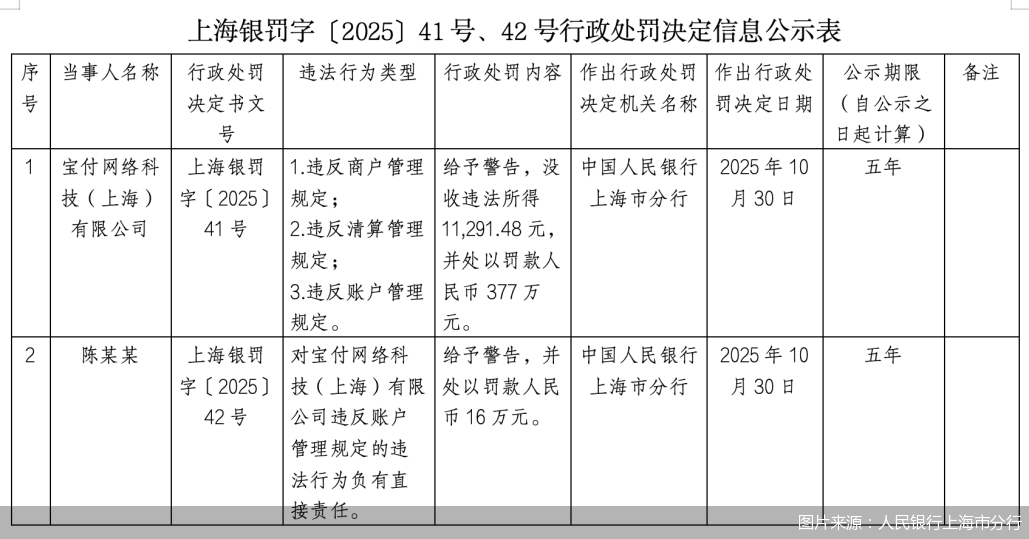
宝付支付涉三项违规被罚377万元 回应称已成立专项小组
Zhong Guo Jing Ying Bao· 2025-11-04 08:47
Core Viewpoint - The People's Bank of China (PBOC) Shanghai Branch has imposed penalties on Baofu Network Technology (Shanghai) Co., Ltd. for violations related to merchant management, clearing management, and account management, resulting in a total fine of RMB 3.77 million and confiscation of illegal gains amounting to RMB 11,291.48 [1] Group 1: Regulatory Actions - Baofu Payment received a warning and was fined RMB 3.77 million for multiple regulatory violations [1] - An individual, Chen, was also penalized with a warning and a fine of RMB 160,000 for direct responsibility in the account management violations [1] Group 2: Company Response - Baofu Payment stated that it has established a special team to follow up on the PBOC's guidance and has completed self-inspection and rectification work [1] - The company expressed its commitment to comply with regulatory requirements and aims to optimize its business management processes as a result of the regulatory guidance [1] - Baofu Payment emphasized its dedication to adhering to compliance and risk management standards to promote high-quality development in the payment industry [1]
宝付支付又领罚377万元!回应称已成立专项小组完成自查整改
Bei Jing Shang Bao· 2025-11-03 11:37
Core Points - The payment industry has seen significant penalties, with Baofu Network Technology (Shanghai) Co., Ltd. receiving a fine of 3.77 million RMB for multiple violations [1][2] - The penalties reflect a broader trend in the industry, with at least 37 fines exceeding one million RMB issued since 2025, indicating a systemic issue with compliance [3][4] Company Summary - Baofu Payment was penalized for violating merchant management, clearing management, and account management regulations, resulting in a total fine of 3.77 million RMB and the confiscation of illegal gains amounting to 11,291.48 RMB [1][2] - The company has acknowledged the penalties and stated that it has established a special team to address regulatory guidance and has completed self-inspection and rectification work [3] - Baofu Payment emphasizes that compliance is fundamental to its business development and aims to optimize its management processes following regulatory guidance [3] Industry Summary - The payment industry is facing increased regulatory scrutiny, with a focus on compliance and risk management, as evidenced by the high frequency of penalties [4][5] - Regulatory bodies are enforcing stricter compliance measures, particularly in merchant management, clearing management, and account management, which are critical for licensed payment institutions [4] - Analysts suggest that the industry needs to improve its compliance frameworks, incorporating advanced technologies for real-time monitoring and prevention of violations [5]
看不见的武器:黄金、石油与美元之网
虎嗅APP· 2025-11-01 14:11
Core Viewpoint - The article discusses the evolution of the U.S. dollar's dominance in the global financial system, highlighting how financial instruments and geopolitical strategies have been used to maintain this supremacy, particularly through mechanisms like the SWIFT system and the Petrodollar agreement [5][13][27]. Group 1: Historical Context - The Bretton Woods Conference in 1944 established a dollar-gold standard, positioning the U.S. dollar as the world's primary reserve currency, which was later challenged by the "Triffin Dilemma" [9][10]. - The U.S. dollar's link to gold ended in 1971 when President Nixon suspended the dollar's convertibility into gold, marking the transition to a fiat currency system [12][13]. Group 2: The Petrodollar System - The 1973 oil crisis led to the establishment of the Petrodollar system, where oil transactions were conducted exclusively in U.S. dollars, creating a structural demand for the dollar globally [15][27]. - This system allowed the U.S. to finance its deficits by printing dollars, which were then recycled back into the U.S. economy through the purchase of U.S. Treasury bonds by oil-exporting countries [15][27]. Group 3: Financial Control Mechanisms - The SWIFT system, established in 1973, became a crucial tool for tracking and controlling international financial transactions, effectively allowing the U.S. to monitor global financial flows [18][20]. - The U.S. Treasury's Office of Foreign Assets Control (OFAC) maintains a blacklist that can freeze assets and restrict transactions, serving as a powerful tool for enforcing economic sanctions [25][31]. Group 4: Case Studies of Financial Power - The case of BNP Paribas illustrates the consequences of violating U.S. sanctions, resulting in a $8.97 billion fine, which exemplifies the reach of U.S. financial regulations [30][31]. - The article highlights the impact of sanctions on countries like Iran and Russia, demonstrating how financial tools can be used to exert geopolitical pressure and isolate nations from the global financial system [36][38]. Group 5: Emerging Alternatives - In response to U.S. financial dominance, countries are exploring alternatives such as the Chinese Cross-Border Interbank Payment System (CIPS) and digital currencies, which aim to reduce reliance on the U.S. dollar [44][48]. - The resurgence of gold as a reserve asset reflects a growing concern over the security of dollar-denominated assets, prompting central banks to increase their gold holdings [42][43].

新国都
2025-11-01 12:41
Summary of the Conference Call Company Overview - **Company Name**: 新国都 (Newland) - **Industry**: Payment Technology - **Founded**: 2001 - **Public Listing**: 2010 on Shenzhen Stock Exchange's Growth Enterprise Market - **Core Business Areas**: - Card acquiring - Payment hardware - Cross-border payments - Artificial intelligence applications [2][3] Key Financial Highlights - **Q3 2023 Total Revenue**: 2.343 billion RMB, a year-on-year decrease of 4.15% primarily due to a decline in average transaction fees in card acquiring [3] - **Net Profit**: 408 million RMB, a year-on-year increase of 37.1% with a net profit margin of 17.439%, up by 5.2 percentage points [3] - **Transaction Volume in Card Acquiring**: Approximately 1.08 trillion RMB for the first three quarters, stable compared to the previous year [3] - **Revenue from Payment Hardware**: Grew by 11.9% year-on-year, driven by overseas market expansion [4] Business Segment Performance - **Card Acquiring**: - Q3 transaction volume was around 360 billion RMB, a slight year-on-year decline of 2.5% but an increase of 1.6% compared to Q2 [7] - Fee rates have seen a gradual recovery since June 2023 [8][9] - **Cross-Border Payments**: - Significant growth with transaction volumes increasing over 200% quarter-on-quarter [4] - Services include B2C e-commerce collection, B2B foreign trade collection, independent site collection, and local collection in foreign markets [18] - Expected revenue contribution from cross-border payments for 2023 is between 2 to 3 billion RMB [25] Market Trends and Future Outlook - **Market Dynamics**: - The payment industry is experiencing consolidation with fewer licenses available, leading to increased concentration among leading players [13] - Future growth is contingent on macroeconomic improvements and consumer spending recovery [14] - **Cross-Border Payment Strategy**: - The company has obtained licenses in the EU, the US, and Hong Kong, enhancing its ability to serve international clients [21][24] - The total import and export volume in China exceeds 40 trillion RMB, indicating a large market potential for cross-border services [19] AI and Technological Integration - **AI Applications**: - The company has developed AI digital employee products that have been commercialized in various sectors [3] - Revenue from AI-related ventures is expected to grow, with a target of achieving around 10 million RMB in revenue for the year [31] - **Integration with Payment Solutions**: - AI is being utilized for customer service, transaction verification, and marketing tools [40] Strategic Initiatives - **H-Share Listing**: - The company is preparing for an H-share listing to support its international expansion strategy and enhance brand recognition [62][63] - **Focus on Overseas Markets**: - The company is actively expanding its presence in overseas markets, particularly in Europe and Japan, where it has seen significant growth [53][54] Additional Insights - **Stablecoin and Cryptocurrency**: - The company maintains a cautious stance on stablecoins and cryptocurrencies, aligning with regulatory perspectives [15][16] - **Future Revenue Projections**: - The company aims to achieve breakeven in its cross-border payment segment within three years, targeting transaction volumes in the hundreds of billions RMB [27][50] This summary encapsulates the key points discussed during the conference call, highlighting the company's performance, market dynamics, and strategic direction.

微信、支付宝不香了?很多年轻人开始使用现金消费,原因有以下4点
Sou Hu Cai Jing· 2025-11-01 07:44
Core Insights - The article discusses a surprising trend among young people in China who are increasingly using cash instead of mobile payments, suggesting a potential shift in consumer behavior [1][3][4] Group 1: Reasons for Increased Cash Usage - Young consumers cite better control over spending as a primary reason for using cash, with studies indicating that cash users save an average of 18.7% on non-essential expenses compared to mobile payment users [3][4] - Concerns over privacy and data security are driving young people to prefer cash, with 73% of respondents worried about excessive data collection by mobile payment platforms, particularly among the 18-35 age group [3][4] - The desire for unique social and emotional experiences is also a factor, as cash payments are perceived to enhance the enjoyment of certain social settings, with discussions around "cash life" and "slow consumption" increasing by 78% in the first half of 2025 [4][6] Group 2: Context of Cash Usage - Technical issues with mobile payments, such as network instability and device failures, have led some consumers to keep cash on hand for emergencies, with 12% of retail terminals still not fully supporting mobile payments, especially in rural areas [6][7] - The trend of returning to cash does not indicate a decline in mobile payments but rather reflects a diversification of payment methods, with mobile payments still accounting for 76.3% of total social consumption [6][7] Group 3: Future Implications - The article suggests that the trend of cash usage may continue as consumers seek a balance between digital convenience and personal control over finances, indicating a rational adjustment in payment preferences [7][9] - For businesses, offering multiple payment options is essential to meet diverse consumer needs, particularly among younger demographics who are reassessing their payment choices [7][9] - Privacy protection and data security will be critical competitive factors for mobile payment platforms moving forward, as users prioritize safety alongside convenience [9]

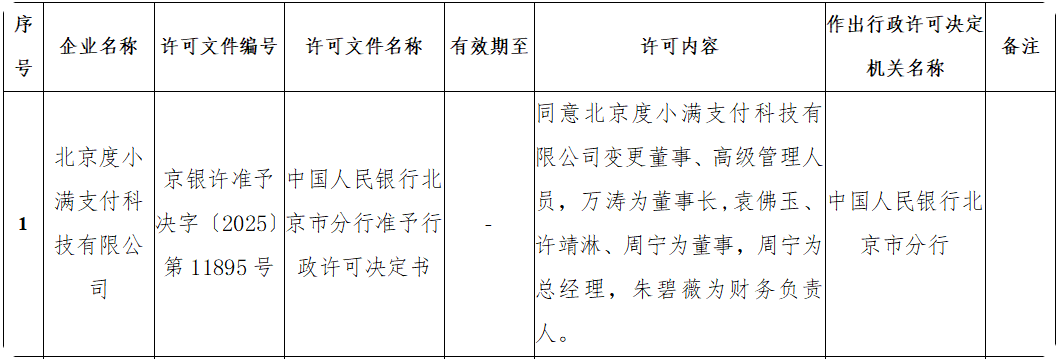
北京四家支付机构获批变更重大事项
Xin Lang Cai Jing· 2025-11-01 06:37
(来源:POS圈支付网) 近日,中国人民银行北京市分行更新了非银行支付机构重大事项变更许可信息,北京度小满支付科技有限公司、天翼支付科技有限公司、贝宝支付 (北京)有限公司及裕福支付有限公司共四家持牌支付机构的重大事项变更获批公示。 总体来看,本次四家支付机构的重大事项变更,涉及董事会结构、高管任命及核心职能调整。 度小满支付 | 序 | 企业名称 | 许可文件编号 | 许可文件名称 | 有效期至 | 许可内容 | 作出行政许可决定 | 备注 | | --- | --- | --- | --- | --- | --- | --- | --- | | 등 | | | | | 同意北京度小满支付科技有 | 机关名称 | | | 1 | 北京度小 满支付科 | | 京银许准予 中国人民银行北 | | 限公司变更董事、高级管理人 员,万涛为董事长,袁佛玉、 | | | | | | | | | | 中国人民银行北 | | | | | 决字(2025) 京市分行准予行 | | | | | | | | 技有限公 | | | | 许靖淋、周宁为董事,周宁为 | 京市分行 | | | | | 第 11895 号 | 政许可决定 ...
2025金融街论坛共话金融新生态
Zhong Guo Jing Ji Wang· 2025-10-31 23:58
Group 1 - The 2025 Financial Street Forum sub-forum focused on "Green Technology Empowerment for Building a New Financial Ecosystem in Urban Sub-centers" was held on October 30, gathering experts, financial institutions, and corporate representatives to discuss high-quality financial development paths for urban sub-centers [1] - The People's Bank of China Beijing Branch is actively promoting green financial development in the capital, aiming to support the high-standard construction of a national green development demonstration zone in Beijing's urban sub-center [1] - The Beijing Municipal Financial Work Committee emphasized the sub-center's role as an important area for financial innovation, highlighting achievements such as the first real estate trust property registration and the first batch of equity trust property registrations in the country [1] Group 2 - The founder and CEO of Yibao Payment, Tang Bin, stated that payment serves as the foundational infrastructure of modern finance, connecting financial policies with real demands and facilitating the integration of consumption scenarios with financial services [2] - Tang Bin identified three key transformations in the payment industry: assisting enterprises in transitioning to "digitalization + globalization," empowering transaction service ecosystems, and promoting win-win industrial ecosystems under the new global trade pattern [2] - Yibao Payment aims to leverage payment technology to actively participate in the construction of a new financial ecosystem, supporting the transformation of the real economy, activating consumption potential, and underpinning green development [2]

AI不是万能药!对话唐彬:支付玩AI 先过数字化这关
Bei Jing Shang Bao· 2025-10-31 16:22
Core Insights - The payment industry is undergoing a structural transformation from "payment tools" to "transaction services" as domestic competition intensifies and overseas opportunities emerge [1][6] - The future of payment methods is expected to evolve significantly, potentially leading to the disappearance of the "payment" phase, while the value of transaction services will be amplified [1][6] Domestic Market Dynamics - The domestic payment market has transitioned from "land grabbing" to a phase of "fine cultivation," with mobile payment penetration nearing saturation [2] - Companies are increasingly focusing on "intelligent solutions" as a key strategy to navigate the competitive landscape, with risk control being particularly crucial [2] - AI-driven risk control systems are seen as essential for cost reduction and efficiency improvement in payment processing [2] AI and Digital Transformation - AI is not a panacea; its successful application in the payment sector requires a solid digital foundation within companies [2][3] - The impact of AI varies across different roles, with traditional entry-level programming jobs at risk of replacement, while experienced and creative talents will be empowered [3] International Expansion Strategies - The overseas strategy of payment companies like Yibao Payment is to follow Chinese enterprises expanding abroad, providing comprehensive services including payment settlement and value-added services [4][5] - Local market adaptation is critical for successful international operations, with a dual strategy of obtaining licenses and forming partnerships to comply with local regulations [4][5] Future Outlook - The payment industry is expected to shift from being payment companies to transaction service providers, driven by technological advancements such as AI and blockchain [6] - The focus will be on integrating deeply into the global industrial ecosystem and enhancing transaction services, rather than merely competing on technology or channels [6]