
私募基金

Search documents
全球股市“财富效应”凸显,私募基金“出海”寻金
2 1 Shi Ji Jing Ji Bao Dao· 2025-10-28 13:51
Group 1 - The global stock market has been boosted by the easing of trade tensions, with Japan's stock market surpassing 50,000 points and European and American markets reaching new highs for the year [1] - Domestic private equity funds are increasingly investing in overseas markets, particularly in AI and blockchain stocks, aiming to enhance their overall returns by 3-5 percentage points by year-end [1][2] - The demand for global asset allocation among high-net-worth investors in China is driving domestic private equity funds to invest through channels like QDII and Hong Kong Stock Connect [1][2] Group 2 - A significant portion of the investments by domestic private equity funds is directed towards the AI sector, with over 50% of holdings in AI stocks, while blockchain and new consumption sectors account for 10% and 20% respectively [2] - The influx of capital into Hong Kong stocks has been notable, with net inflows through the Hong Kong Stock Connect exceeding 1.2 trillion HKD this year [2][3] - The valuation of Hong Kong stocks remains relatively low, presenting opportunities for investment, especially in the technology sector following the emergence of DeepSeek [3] Group 3 - Domestic private equity funds are expanding their investment scope beyond Hong Kong to include U.S. and Asia-Pacific markets, driven by the global interest in AI and blockchain [4] - The investment strategy focuses on identifying high-quality companies with strong growth potential, despite the challenges posed by the experience gap compared to Western investment firms [5][6] - The investment sentiment in the AI sector remains strong, with many funds believing it represents one of the largest investment opportunities in history [5][6] Group 4 - The investment approach emphasizes safety, with 90% of holdings based on investing in high-quality companies at reasonable prices, while the remaining 10% allows for more flexible investment strategies [7] - The need for domestic private equity funds to adapt to the rules and dynamics of overseas markets is highlighted, as they face challenges in competing with established Western investment firms [6][7]
金融司法与自律监管协同联动 北京金融法院联合中基协发布重磅成果
Zheng Quan Ri Bao Wang· 2025-10-28 11:06
Core Insights - The Beijing Financial Court and the Asset Management Association of China (AMAC) jointly released revised guidelines for private investment fund manager changes and typical cases, addressing issues related to manager disconnection and incapacity in the private fund industry [1][2] - The initiative aims to enhance investor protection and maintain market order amid the rapid evolution of the private fund sector, which has seen a rise in the elimination of underperforming managers and associated governance challenges [1] Group 1 - The release of the revised guidelines is a collaborative effort to tackle the challenges posed by disconnected and incapacitated fund managers, which have hindered the high-quality development of the industry [1] - The guidelines were developed in response to the requirements of the Central Financial Work Conference and the new "National Nine Articles," focusing on judicial support and self-regulatory oversight [1][2] - The AMAC has established a standardized path for changing fund managers and improved investor relief mechanisms under the guidance of the China Securities Regulatory Commission and support from the Beijing Financial Court [1] Group 2 - The Beijing Financial Court has published two typical cases that provide judicial support for orderly exits of related institutions and the resolution of risks in existing funds [2] - One case allows investors to authorize representative litigation through a fund holder meeting resolution, addressing the legitimacy and feasibility of this approach in situations where managers are unresponsive [2] - Another case permits creditors to secure their claims by providing guarantees, balancing the interests of both the executing party and potential creditors, thus exploring new pathways to resolve liquidation deadlocks [2]
私募股票策略收益哪家强?幻方量化、黑翼、云起量化等居前!
Sou Hu Cai Jing· 2025-10-28 10:57
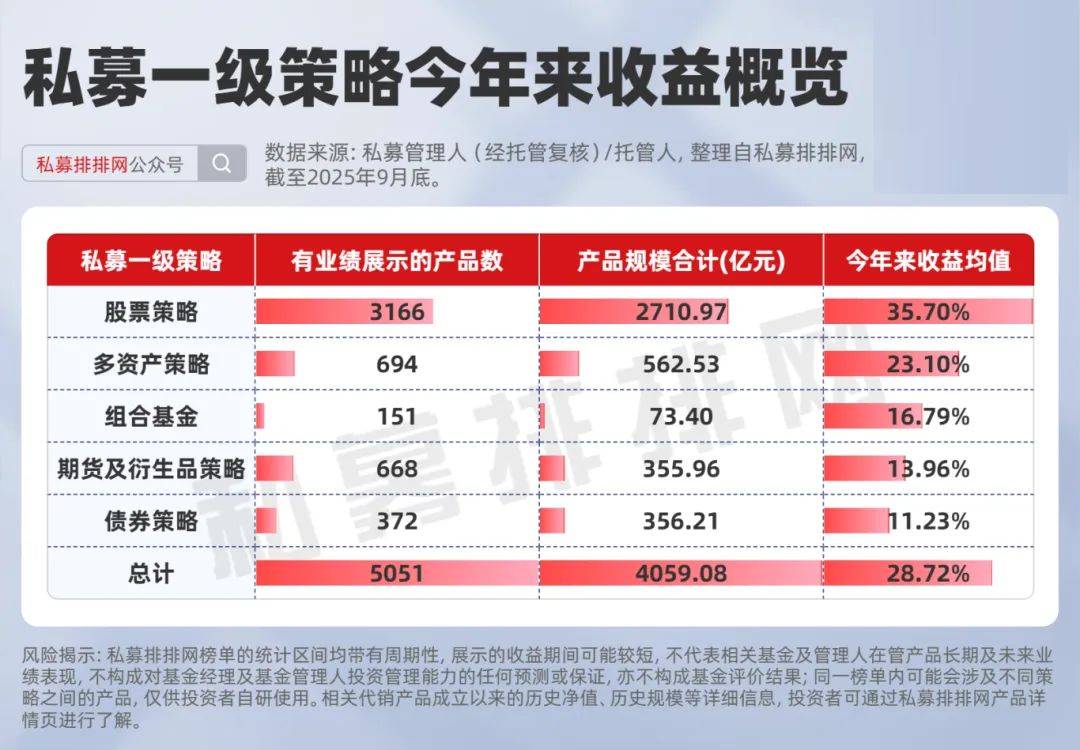
Market Performance - The A-share market has shown strong performance this year, driven by supportive policies, breakthroughs in technology, and a recovery in risk appetite among investors, with the Shanghai Composite Index rising approximately 15.84% by the end of September [1] - The Shenzhen Component Index increased nearly 30%, while the ChiNext Index surged by 51.20%, indicating a "slow bull" market trend [1] - Key sectors driving market enthusiasm include innovative pharmaceuticals, humanoid robots, computing power, and themes related to "anti-involution" [1] Private Equity Performance - Private equity products related to stock strategies have performed well, with 3,166 products showing an average return of 35.70% year-to-date, outperforming the overall market average return of 28.72% [1] - The total scale of these products reached approximately 271.1 billion yuan, significantly exceeding the average returns of other private equity strategies [1] Top Performing Private Equity Firms - Among firms managing over 100 billion yuan, the top three in stock strategy performance are: 1. Fusheng Asset 2. Wangzheng Asset 3. Lingjun Investment [3][4] - Fusheng Asset leads with an average return of ***%, focusing on research-driven value investment [5] - Wangzheng Asset, established in 2014, emphasizes industry trends and core competitiveness in its investment strategy [5][6] Performance by Scale - In the 50-100 billion yuan category, the top three firms are: 1. Tongben Investment 2. Ruiyang Investment 3. Shengqi Asset [8][10] - The 20-50 billion yuan category features Beijing Xiyue Private Equity, Rongshu Investment, and Shenzhen Zeyuan as the top three [12][15] - For the 10-20 billion yuan category, the leading firms are Liangli Private Equity, Beiheng Fund, and Nengjing Investment Holdings [16][18] - In the 5-10 billion yuan category, the top three are Fuyuan Capital, Shanghai Hengsui Asset, and Zhinan Fund [19][21] - The 0-5 billion yuan category is led by Longhuixiang Investment, Moku Asset, and Qinxin Fund [23][25] Investment Strategies - Fusheng Asset focuses on the profitability trends of leading companies in various industries, particularly those showing signs of marginal improvement [5] - Wangzheng Asset adopts a "core + satellite" investment strategy, targeting undervalued quality companies and high-growth innovative sectors [6][7] - The investment strategies of other firms include a mix of subjective and quantitative approaches, with an emphasis on risk control and diversification [10][11]

第十九届HED中国峰会·深圳即将启幕
Xin Lang Ji Jin· 2025-10-28 10:03
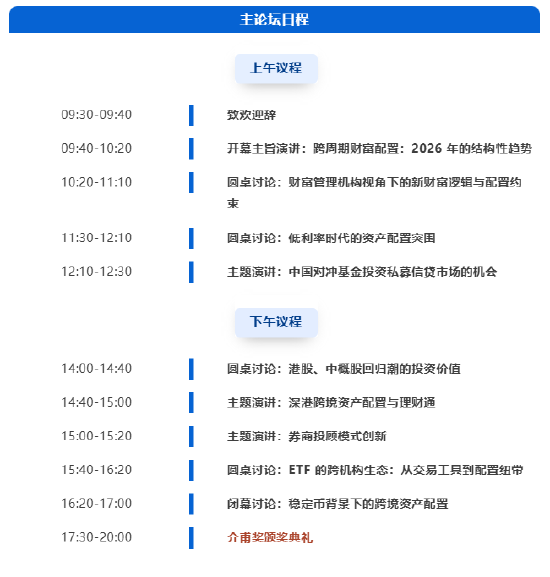
Core Insights - The 19th HED China Summit will be held in Shenzhen on January 15, 2026, focusing on the integration of private equity and wealth management [1] - The event will gather over 400 decision-makers from private equity funds, brokerages, banks, trusts, family offices, and wealth platforms to facilitate high-quality development in the asset management industry [1] Agenda Highlights - The morning session includes a welcome speech, keynote addresses on wealth allocation trends for 2026, and discussions on new wealth logic and asset allocation strategies in a low-interest-rate environment [2] - Afternoon sessions will cover topics such as investment value in Hong Kong and mainland stocks, cross-border asset allocation, and innovations in brokerage advisory services [2] - The event will conclude with discussions on the ecosystem of ETFs and cross-border asset allocation in the context of stablecoins [2] Additional Sessions - The agenda features discussions on innovative stock strategies, the application of AI in quantitative stock strategies, and the evolution of investment strategies in a low-interest-rate environment [4][5] - Keynote speeches will address the investment opportunities arising from the global interest rate decline and the challenges and opportunities for investment funds [5]
私募基金迈入普惠时代:高门槛模式正被时代淘汰
Sou Hu Cai Jing· 2025-10-28 07:29
Core Insights - The private equity fund industry is undergoing a significant transformation driven by global innovation, moving away from high entry barriers and closed operations to more accessible and decentralized models [1][5] - New fund models such as DeFi index funds and DAO venture capital funds are emerging, allowing ordinary investors to participate in global asset allocation and early-stage project investments [1][4] - The evolution of investor demands is leading to a shift from traditional profit models to impact investing, where financial returns are coupled with social value creation [4] Group 1: New Fund Models - DeFi index funds utilize smart contracts to manage a basket of crypto assets, enabling users to invest with small amounts and trade freely 24/7 [1] - DAO venture capital funds allow community members to make collective investment decisions through governance tokens, democratizing access to venture capital [1] - NFT fragmentation technology enables ordinary investors to share in the appreciation of high-value digital art by dividing it into thousands of shares [1] Group 2: Technological Impact - Big data and AI are reshaping investment decision-making, using alternative data sources like satellite imagery and social media sentiment to enhance predictive capabilities [2] - Music copyright funds are transforming intangible intellectual property into stable cash-generating financial assets, while permanent capital tools alleviate exit pressure [2] - These innovations collectively lower barriers to entry, improve efficiency, and enhance transparency in investment practices [2] Group 3: Changing Investor Demands - The new generation of investors seeks models that align their financial interests with social values, moving beyond traditional risk-reward frameworks [4] - The rise of impact funds reflects a desire for investments that contribute to environmental and social causes, indicating a shift in investment philosophy [4] - Traditional private equity models are increasingly viewed as outdated, as they fail to meet the current expectations for fairness, stability, and sustainability [4] Group 4: Market Adaptation - Thoma Bravo, a prominent private equity firm, is introducing a new investment mechanism in China that eliminates traditional high entry barriers and focuses on risk management and guaranteed returns [4][5] - This approach combines global innovative practices with local market characteristics, signaling a potential maturation and diversification of the private equity landscape in China [5] - The transition towards more inclusive investment opportunities is expected to reveal the true value of private equity funds, marking the end of an era characterized by exclusivity [5]

神火股份等成立高质量产业投资发展合伙企业,出资额15.12亿
Xin Lang Cai Jing· 2025-10-28 01:47
Core Insights - A new investment partnership named Henan Shenhuo High-Quality Industry Investment Development Partnership (Limited Partnership) has been established, with a total investment of 1.512 billion RMB [1] Group 1: Company Formation - The executing partner is Anhui Jiangkong Chuangfu Private Fund Management Co., Ltd. [1] - The partnership's business scope includes private equity investment, investment management, asset management, and venture capital activities [1] Group 2: Investment Structure - The partnership is jointly funded by Shenhuo Co., Ltd., Henan Asset Management Co., Ltd., Anhui Jiangkong Chuangfu Private Fund Management Co., Ltd., and Henan Asset Fund Management Co., Ltd. [1]

高频日内策略迭代升级,业绩跻身Top10! | 打卡100家小而美私募
私募排排网· 2025-10-28 00:00
Core Viewpoint - The article highlights the significance of small to medium-sized private equity firms in the industry, particularly focusing on Xuanxin Asset Management, which utilizes machine learning and quantitative models to achieve stable absolute returns [3][4]. Company Overview - Xuanxin Asset Management was established in June 2015 with a registered capital of 30 million. It employs self-developed big data quantitative investment models to construct investment portfolios aimed at achieving long-term and stable absolute returns [4]. - As of September 2025, Xuanxin's products have an average return of ***% this year, ranking in the top 10 of quantitative private equity performance among firms with assets under management between 2 billion and 5 billion [4]. Core Team - The company was founded by experienced hedge fund traders from Wall Street and renowned computer scientists, with a core team of over 50 members, all of whom have extensive asset management experience and impressive investment performance [8]. Core Strategies and Representative Products Research and Investment System - Xuanxin has established a centralized research and investment system consisting of four main stages: factor mining, modeling, portfolio management, and trading. This system is characterized by high specialization, closed-loop iteration, and comprehensive risk control [10]. - The system incorporates feedback from real trading performance to update the factor library and optimize strategies based on execution issues [10][11]. Strategy Evolution - Since the launch of its asset management strategy in 2021, Xuanxin has undergone two major iterations: the first in early 2022, which integrated intraday prediction frameworks, and the second in early 2023, which added intraday machine learning factors to enhance predictive capabilities [11]. Representative Strategies and Products - **Index Enhancement Strategy**: Focuses on strict stock selection within components, utilizing intraday timing strategies for high-frequency trading, aiming for returns that exceed market benchmarks [12]. - **Market Neutral Strategy**: Aims to maintain a market-neutral investment portfolio to reduce sensitivity to overall market volatility, thus lowering market risk [15]. Core Advantages - The company boasts a high-quality talent team from prestigious universities, advanced high-frequency trading model frameworks, efficient trading channels, and competitive performance in the market [16]. - Xuanxin aims for steady development and plans to enhance strategy competitiveness through faster iterations and collaborations with leading financial institutions in various directions [17][18].

量化基金经理最新十强揭晓!马志宇、徐进、陆政哲领衔!黄铂、施恩、颜学阶等夺冠!
私募排排网· 2025-10-27 03:39
Core Viewpoint - The article highlights the performance of quantitative private equity funds in the first three quarters of the year, showing significant returns that outperform the market, particularly among larger fund managers [2][4]. Summary by Categories Overall Performance - As of September 30, there are 1,694 quantitative products with a total scale of approximately 137.76 billion yuan, achieving an average return of 25.73% in the first three quarters, significantly outperforming the market [2][3]. Performance by Fund Size - **100 Billion and Above**: - 370 quantitative products managed by 86 fund managers achieved an average return of 31.34%, with 99.46% of products showing positive returns [4][5]. - Top fund managers include Ma Zhiyu from Lingjun Investment, Xu Jin, and Lu Zhengzhe from Ningbo Huansheng Quantitative [4][6]. - **50-100 Billion**: - 207 products managed by fund managers in this category achieved an average return of 22.98%, with 95.65% showing positive returns [8][9]. - Leading managers are Huang Bo from Dayan Capital and Zhang Xiangfang from Mingxi Capital [8][10]. - **20-50 Billion**: - 215 products in this range achieved an average return of 23.63%, with 98.14% showing positive returns [11][12]. - Top managers include Shi En from Yunqi Quantitative and Li Jing from Anzi Fund [11][13]. - **10-20 Billion**: - 265 products achieved an average return of 22.43%, with 97.74% showing positive returns [14][15]. - Leading managers are Nie Shouhua and He Jie from Hanrong Investment [14][15]. - **5-10 Billion**: - 260 products achieved an average return of 26.35%, with 94.23% showing positive returns [16]. - Top manager is Cheng Zhitian from Juliang Balanced Fund [16]. - **0-5 Billion**: - 617 products achieved an average return of 22.13%, with 99.19% showing positive returns [17][18]. - Leading managers include Yan Xuejie from Huacheng Private Equity and Wu Zhengpeng from Zhixin Rongke [17][18].
一场私募业的“供给侧改革”
Shang Hai Zheng Quan Bao· 2025-10-26 17:46
Core Viewpoint - The private equity industry in China is undergoing a significant transformation characterized by a "supply-side reform," leading to the exit of non-compliant firms and the emergence of high-quality private equity managers [1][5]. Group 1: Industry Changes - Over 1,000 private equity fund managers have been deregistered as of October 23 this year, with 493 opting for voluntary deregistration [2][3]. - The number of newly registered private equity fund managers reached a record high in September, with over 100 firms now managing assets exceeding 10 billion yuan [1][9]. - The industry is witnessing a positive cycle of survival of the fittest, allowing compliant and professional firms to thrive [1][5]. Group 2: Regulatory Actions - Regulatory bodies have intensified scrutiny, with nearly 300 disciplinary actions taken against non-compliant private equity firms this year [4][6]. - Specific cases of regulatory actions include the suspension of product registration for firms like Lupu Wealth due to significant compliance failures [4]. - The introduction of new regulations has raised compliance costs, prompting some firms to exit the market [3][7]. Group 3: Professionalization and Growth - The professional qualifications of new private equity managers have significantly improved compared to previous years, indicating a trend towards higher industry standards [8][10]. - The total number of private equity fund managers has decreased from 20,289 at the beginning of the year to 19,614, while the total assets under management have increased from 19.91 trillion yuan to 20.73 trillion yuan [9][10]. - The number of private equity firms managing over 10 billion yuan has surpassed 100, reflecting a growing trend towards consolidation and specialization within the industry [10].
私募基金:全会为投资提供重要指导,关注科技创新、扩大内需等主线
Zhong Guo Ji Jin Bao· 2025-10-26 12:15
【导读】私募基金解读党的二十届四中全会精神:为投资提供重要指导,关注科技创新、扩大内需等主 线 10月20日至23日,党的二十届四中全会在北京举行,全会审议通过了《中共中央关于制定国民经济和社 会发展第十五个五年规划的建议》。10月23日,党的二十届四中全会公报(以下简称公报)发布。 紫阁投资表示,今年前三季度GDP增速为5.2%,超过了年初设定值。不过,相对于上半年5.3%的增 速,三季度经济增速下滑,四季度经济增长依然面临压力。因此,市场期待后续在稳增长、稳就业等方 面出台政策,加大促进经济企稳的力度。 星石投资副总经理、高级合伙人方磊表示,全会提出要"构建以先进制造业为骨干的现代化产业体系", 后续制造业增加值占GDP比重可能是重要指标;公报提出"加快建设制造强国、质量强国、航天强国、 交通强国、网络强国",为"十五五"产业政策指明方向;全会提出要"抓住新一轮科技革命和产业变革历 史机遇",显示科技创新可能逐渐成为新的经济增长逻辑和主要动力,科技领域蕴含中长期机会;此 外,对内需的重视程度明显提升,加大在需求端的发力力度并着力培育新的消费增长点,中期视角下消 费的投资机会有望增加。 世诚投资表示,"十五 ...